Comparing Electoral and Party Systems (AQA A-Level Politics): Revision Notes
📚Revision Notes
Internal Party Unity
Introduction to internal party unity
Both the UK and USA operate two-party systems where large parties dominate the political landscape. Because these parties must appeal to broad constituencies, they inevitably contain a wide range of views and opinions. Political scientists describe all four major parties as internal coalitions - groups that bring together diverse factions under one party banner.
These coalitions create natural fault lines within parties. Divisions typically centre on two interconnected areas: policy disagreements and personality clashes. The relationship between internal unity in US and UK parties reveals complex patterns that challenge simple generalisations.
Note
Understanding Internal Coalitions
The concept of internal coalitions is crucial for understanding party dynamics in both countries. Unlike smaller parties that can maintain ideological purity, major parties must accommodate diverse viewpoints to remain competitive. This creates inherent tensions that manifest differently across the Atlantic.
Two competing narratives appear to contrast party unity across the Atlantic:
- US parties are becoming more unified and displaying stronger internal cohesion
- UK parties are becoming increasingly divided and internally rebellious
Whilst both statements contain important truths, they require significant qualification and nuance.
Arguments for greater party unity in USA and growing division in UK
Hyperpartisanship in the USA
The United States has experienced a notable growth in hyperpartisanship since the 1980s. This term describes extreme partisan behaviour where parties become increasingly polarised and unwilling to cooperate across party lines.
Both Republican and Democratic parties have become more ideologically homogeneous - meaning their members share increasingly similar political beliefs. Parties have also become more geographically segregated. Very few Democrats win elections in the Deep South today, except in majority-minority districts like Mississippi's 2nd district represented by Bennie Thompson. Similarly, Republicans struggle to win seats on the West Coast and in the northeast.
Important
Key Predictors of Party Loyalty
Modern party loyalty in the USA is now strongly predicted by:
- Race and ethnicity
- Religious affiliation
- Geographic region
- Media consumption habits
These factors have become more reliable indicators of party affiliation than traditional class-based divisions, marking a significant shift in American political alignment.
Congressional voting patterns
Voting records in Congress demonstrate strong party-line voting on major legislation. The table below shows party loyalty across key congressional votes:
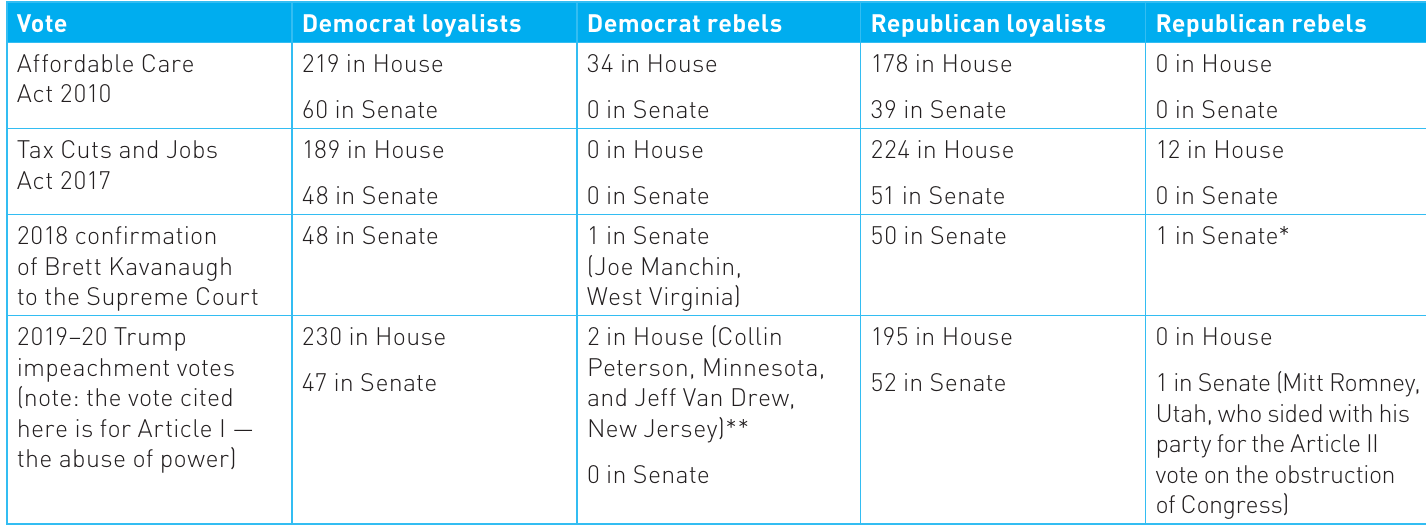
When Congress voted on the Affordable Care Act (Obamacare) in 2010, 219 House Democrats and all 60 Senate Democrats supported the legislation. Only 34 House Democrats rebelled, whilst zero Democrats in the Senate voted against it. No Republicans in either chamber supported the bill.
The Tax Cuts and Jobs Act 2017 saw perfect Democratic unity in opposition - zero Democrats in either chamber supported Trump's signature tax legislation. Only 12 House Republicans voted against, with perfect Republican unity in the Senate.
Trump's impeachment votes in 2019-20 revealed extraordinary party loyalty. Just two House Democrats voted against Article I (abuse of power): Collin Peterson (Minnesota) and Jeff Van Drew (New Jersey). In the Senate, only Mitt Romney (Utah) broke Republican ranks, becoming the first senator ever to vote to convict a president from his own party.
Note
Exam Tip: Using Legislative Examples
When discussing party unity, use specific legislative examples like these to demonstrate your knowledge. The impeachment vote is particularly significant because it shows how party loyalty held even during a constitutional crisis. Remember to cite specific votes, numbers, and names of key individuals who broke ranks.
Parliamentary rebellions in the UK
UK parliamentary votes reveal a contrasting pattern of increasing backbench rebellion. The table below compares loyalty and rebellion across major votes:
| Vote | Conservative loyalists | Conservative rebels | Labour loyalists | Labour rebels |
|---|---|---|---|---|
| 2003 Iraq War vote (rebel motion opposing Blair government) | 139 MPs | 15 MPs | 245 MPs | 139 MPs |
| 2013 same-sex marriage vote | 126 MPs | 137 MPs | 217 MPs | 22 MPs |
| September 2019 Brexit delay motion | 287 MPs | 21 MPs | 240 MPs | 2 MPs |
Example
Case Study: Same-sex Marriage 2013
The 2013 vote on same-sex marriage provides a striking example of party division. Although introduced by Conservative Prime Minister David Cameron, the majority of his own party voted against it - 137 rebels compared to just 126 loyalists.
The legislation only passed because 217 Labour MPs supported it. This demonstrates how a government can pass legislation despite losing the support of most of its own backbenchers - a situation virtually impossible in the US system where the president cannot rely on opposition party support for signature legislation.
Example
Case Study: Brexit September 2019
Boris Johnson regarded the September 2019 vote as a crucial loyalty test for Conservative MPs. When 21 MPs rebelled to support taking control of Commons business to delay Brexit, Johnson immediately withdrew the party whip from all rebels.
This harsh punishment demonstrated the seriousness with which party leaders view rebellion on key issues. Many of these rebels were senior MPs with decades of service, including former chancellors and cabinet ministers, showing that even experienced politicians face consequences for defying party leadership.
Leadership challenges in the UK
UK parties have experienced unprecedented leadership challenges in recent years. These challenges expose deep divisions over both policy and leadership quality.
Example
Jeremy Corbyn (Labour, 2016)
Following the Brexit referendum, Corbyn lost a no confidence vote among his own MPs by a crushing margin of 172-40. An unprecedented 21 shadow ministers resigned from his shadow cabinet.
Corbyn only survived by winning a leadership ballot of the entire party membership, defeating Owen Smith with 62% of the vote. This revealed a stark divide between the parliamentary party and grassroots members - a tension that persists in Labour to this day.
Theresa May (Conservative, 2019): Conservative MPs effectively removed May as Prime Minister in 2019. Deep divisions existed over Brexit and the terms of any withdrawal agreement. Many blamed May for the lacklustre performance in the 2017 general election, where the Conservatives lost their parliamentary majority.
Margaret Thatcher (Conservative, 1990): Despite winning three successive elections, Thatcher was removed by her own MPs in 1990. Colleagues blamed her rigid leadership style, particularly over the deeply unpopular poll tax. Many believed she had stopped listening to colleagues' concerns and would not win a fourth election.
Note
Common Features of UK Leadership Challenges
These leadership challenges share common features:
- Policy divisions within the parliamentary party
- Concerns about leadership style and communication
- Fears about electoral prospects
- Public and damaging internal feuding
Notice how all three leaders faced challenges despite having achieved significant electoral or policy success, suggesting that UK party leaders operate with less security than their US counterparts.
US presidential security
US parties have not witnessed similar levels of internal opposition to their leaders. Even controversial President Trump maintained Republican Party support throughout his term. Significantly, neither Trump, Obama, nor any recent president seeking re-election has faced a serious primary challenge.
The last such challenge occurred in 1980, when Senator Ted Kennedy challenged President Jimmy Carter for the Democratic nomination. This 40-year gap demonstrates how US parties rally behind sitting presidents, even when internal disagreements exist.
Arguments against greater unity in USA and for division being longstanding in UK
Some interpretations challenge the narrative of growing US unity and UK division. These arguments suggest that deep divisions persist in US parties, whilst UK party divisions are not a new phenomenon.
Deep divisions in US parties
Recent presidential primaries reveal continuing factionalism and policy disagreements within both major parties.
Democrats
The 2019 Democratic primaries exposed fundamental divides over how progressive the party should become.
Progressive wing: Candidates like Bernie Sanders and Elizabeth Warren advocated radical policies including:
- Writing off all student loan debts (costing $1.6 trillion)
- Introducing single state-run healthcare ('Medicare for All')
- Aggressive climate change legislation (Green New Deal)
Centrist wing: Joe Biden and other moderate candidates favoured more cautious, incremental policy approaches. They argued that moving too far left would alienate swing voters in crucial battleground states.
Example
Case Study: Alexandria Ocasio-Cortez (AOC)
In one of the 2018 midterm election's greatest upsets, AOC defeated longstanding establishment incumbent Joe Crowley in New York's 14th district. AOC represented the party's most progressive wing and received endorsement from the Democratic Socialists of America organisation.
Her victory demonstrated how the progressive movement challenges centrist Democratic control. AOC's success inspired other progressive candidates to challenge moderate incumbents, showing how primary elections can amplify internal party divisions rather than promoting unity.
Note
Democratic Factions
The Democratic Party contains several organized factions representing different ideological positions:
- Congressional Progressive Caucus: Led by figures like AOC and Bernie Sanders, advocates for democratic socialist policies
- New Democrat Coalition: Moderate progressives who favour market-friendly policies with social justice goals
- Blue Dog Caucus: Conservative Democrats, strongest in rural and Southern districts
These factions often disagree on fundamental policy questions, from healthcare to climate change to foreign policy.
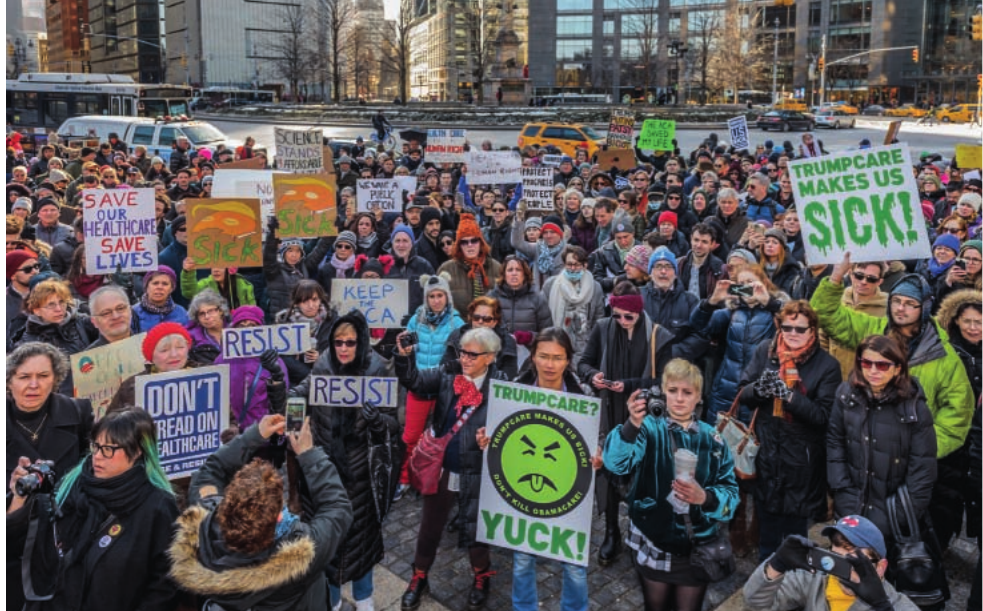
The image above shows protesters rallying against Republican healthcare proposals, illustrating how healthcare policy creates deep divisions within and between both parties.
Republicans
The Republican Party contains equally diverse and often conflicting viewpoints.
Libertarian faction: Represented by Senator Rand Paul (Kentucky), libertarians prioritise individual liberty, limited government, and non-interventionist foreign policy. They often oppose government spending even for traditional Republican priorities.
Moderate faction: Senators like Lisa Murkowski (Alaska) and Susan Collins (Maine) represent Republicans willing to break party lines on issues like healthcare and Supreme Court nominations. They often provide crucial swing votes in a closely divided Senate.
Example
Case Study: Republican Healthcare Divisions
Republicans' inability to agree on an alternative to Obamacare (Trumpcare) revealed longstanding divisions over healthcare policy. Disagreements centred on:
- How far public healthcare should reach
- Whether to maintain protections for pre-existing conditions
- The role of government in healthcare markets
- Medicaid expansion
These policy divisions prevented Republicans from fulfilling their campaign promise to "repeal and replace" Obamacare despite controlling both Congress and the presidency. The failure demonstrated that even unified party control doesn't guarantee policy unity, especially on complex issues where different factions have fundamentally opposed views.
Primary system effects
The primary system actively encourages intra-party competition and personality-focused campaigning. When watching primary adverts and televised debates, candidates often attack each other more fiercely than they attack the opposing party. This system:
- Amplifies policy differences within parties
- Rewards candidates who distinguish themselves from rivals
- Makes internal divisions highly visible to voters
- Encourages extreme positions to appeal to party activists
Important
Structural Features Promoting Division
The primary system is a structural feature that promotes division. Compare this to the UK, where internal selection processes are less public and confrontational. US primaries force party members to publicly debate their differences, while UK selection processes typically occur behind closed doors within constituency parties.
This structural difference means US party divisions are more visible even when they're not necessarily deeper than UK divisions.
Longstanding divisions in UK parties
UK parties have contained rival factions throughout their history, suggesting current rebellions continue longstanding patterns rather than representing new phenomena.
Labour's historical divisions
Nuclear disarmament (1960): Labour experienced bitter divisions over unilateral nuclear disarmament. Leader Hugh Gaitskell famously implored party conference delegates to reject the unilateralist, pacifist wing, declaring his determination to "fight, and fight, and fight again, to save the party we love". This rhetoric revealed the intensity of internal party battles.
Militant infiltration (1980s): In the early 1980s, Labour was plagued by Trotskyite infiltration through the Militant tendency. This far-left group within Labour pursued revolutionary socialist policies. Deputy Leader Neil Kinnock's famous 1985 conference speech attacking Militant demonstrated how the party struggled to maintain cohesion whilst excluding extremist elements.
Note
Deselection and Trigger Ballots
The Labour Party saw nine sitting MPs deselected between 1983 and 1992. However, in 1990 the party abolished mandatory deselection and replaced it with trigger ballots.
Under this system, sitting MPs face reselection contests only if sufficient local party members vote for one. Significantly, no Labour MP has been formally deselected since 2010, suggesting the party has mechanisms to protect incumbents despite disagreements.
Conservative historical divisions
Despite historically boasting of loyalty as its "secret weapon", the Conservative Party has experienced deep factional splits.
Europe: European integration has divided Conservatives for decades. The issue destroyed John Major's premiership in the 1990s and eventually led to Theresa May's downfall in 2019. Both Eurosceptic and pro-European wings have battled for control of party policy.
Example
Wets vs Dries (Thatcher Era)
During Margaret Thatcher's leadership, the party split between two distinct factions:
-
"Wets": Moderate Conservatives who favoured consensus politics and were sceptical of radical free-market reforms. They worried about the social costs of rapid economic change.
-
"Dries": Thatcher's strongest supporters who backed monetarism, privatisation, and reduced government intervention. They believed radical reform was necessary to revive Britain's economy.
This division showed how even during Thatcher's electoral dominance, the party contained fundamental disagreements about the proper role of government and the pace of economic reform.
Example
John Major's Leadership Challenge (1995)
Faced with constant internal unrest from MPs over Europe, Prime Minister John Major called a snap party leadership election with a "Back me or sack me" ultimatum.
Although he won, the challenge demonstrated how internal divisions could paralyse party unity even when holding government. Major's frustrated response showed the limits of prime ministerial authority when facing a rebellious parliamentary party.
Formal factions and caucuses
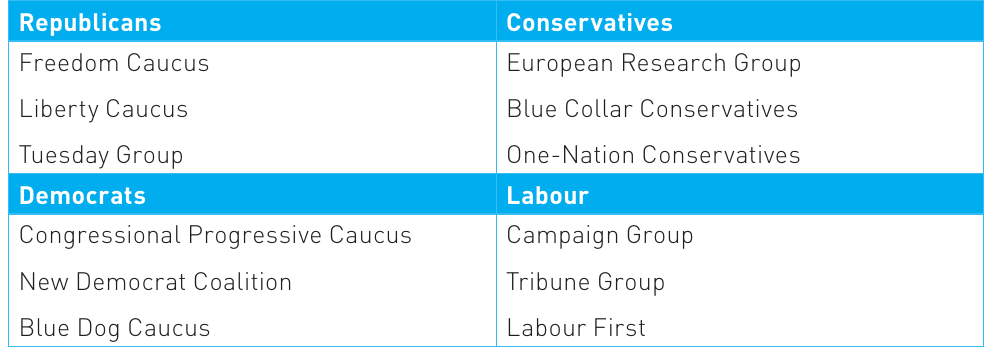
Both countries' parties contain organised internal groups representing different ideological positions. The table below lists major factions:
Note
Understanding Factional Organization
Republican factions:
- Freedom Caucus: Hard-right conservatives opposing government spending and favouring strict constitutional interpretation
- Liberty Caucus: Libertarians emphasising individual freedom and limited government
- Tuesday Group: Moderate Republicans supporting pragmatic, centrist policies
Conservative factions:
- European Research Group (ERG): Eurosceptics who campaigned for Brexit and hard-line withdrawal terms
- Blue Collar Conservatives: Focus on working-class Conservative voters' concerns
- One-Nation Conservatives: Moderate faction supporting social cohesion and pragmatic conservatism
Democratic factions:
- Congressional Progressive Caucus: Largest progressive organisation advocating democratic socialist policies
- New Democrat Coalition: Centrist, business-friendly Democrats
- Blue Dog Caucus: Conservative Democrats, mainly from rural and Southern districts
Labour factions:
- Campaign Group: Left-wing socialists supporting increased nationalisation and wealth redistribution
- Tribune Group: Soft-left faction historically associated with democratic socialism
- Labour First: Moderate faction opposing far-left influence in the party
Important
Study Tip: Understanding Factional Continuity
When referencing internal groups and factions, remember these groups change names but continue representing fundamental ideological differences within each party. For example, Labour's various left-wing factions have reorganised multiple times but consistently represent socialist viewpoints.
Focus on understanding the ideological positions these factions represent rather than memorizing every faction name and its history.
Comparative analysis: Incumbent security vs leader vulnerability
An important structural difference affects party unity in both countries.
USA - incumbent legislators vulnerable: Sitting members of Congress face regular primary challenges from within their own party. The primary system makes incumbents relatively precarious, as they must continually prove themselves to party activists and voters. This vulnerability can discourage breaking party lines.
UK - party leaders vulnerable: Whilst sitting MPs are difficult to deselect (particularly since Labour abolished mandatory deselection in 1990), party leaders face greater threats. Leadership challenges can emerge quickly when MPs lose confidence, as seen with Thatcher, Major, May, and Corbyn. This vulnerability can weaken leaders' authority over their parliamentary parties.
Important
The Unity Paradox
This creates a paradox: US party leaders (especially presidents) maintain stronger authority despite structural features that should promote division (primaries, separated powers). UK party leaders face weaker authority despite structural features that should promote unity (parliamentary system, party discipline).
This counter-intuitive pattern suggests that formal institutional structures don't always produce expected outcomes. Personal leadership qualities, political circumstances, and cultural factors also significantly influence party unity patterns.
Summary
Summary
Key Takeaways: Internal Party Unity
-
All four parties function as internal coalitions containing diverse views, with fault lines over policies and personalities that create ongoing tensions despite party labels
-
US parties show increased ideological homogeneity since the 1980s with voting records in Congress demonstrating strong party loyalty on major legislation like Obamacare, tax cuts, and Trump's impeachment
-
UK parties experience high-profile rebellions on crucial votes including Iraq 2003, same-sex marriage 2013, and Brexit 2019, plus unprecedented leadership challenges against Corbyn (2016), May (2019), and Thatcher (1990)
-
Deep divisions persist in both countries' parties despite surface appearances - US primaries reveal progressive vs centrist Democratic splits and libertarian vs moderate Republican divides, whilst UK parties contain historical factions like Labour's Campaign Group vs Labour First and Conservatives' ERG vs One-Nation Conservatives
-
Structural differences affect unity patterns - the US primary system encourages intra-party competition and makes incumbents vulnerable, whilst UK leaders face greater threats from parliamentary parties despite sitting MPs being harder to deselect since trigger ballots replaced mandatory reselection in 1990