Parliamentary Debate and the Legislative Process (AQA A-Level Politics): Revision Notes
📚Revision Notes
Parliamentary Debate and the Legislative Process
Introduction to legislation
Parliament's legislative function is one of its most important roles. Legislation refers to measures put before parliament that, once passed, become law. The vast majority of laws passed are public bills (bills that apply to everyone once they become law) and especially government-backed bills.
Note
Success Rates of Different Bill Types:
The success rate of different types of bills varies significantly:
- Government bills: In the 2015-17 parliament, 55 government bills were debated and 48 were passed (87% success rate)
- Private members' bills: In the same period, 324 private members' bills were introduced but only 14 were passed (4% success rate)
This dramatic difference illustrates the power of government backing in the legislative process.
How bills become law
All bills must pass through several key stages to become law. Understanding this process is essential to grasping how parliament functions as a legislature.
Important
Core Requirements for Bills to Become Law:
- Bills must pass through both the House of Commons and House of Lords
- Bills go through set stages in a specific order
- Every public bill can be debated and amended
- Most government-backed bills become law, whilst most backbench bills do not
- Every bill must receive Royal Assent to become law (though this is now only a formality)
Annual output of legislation
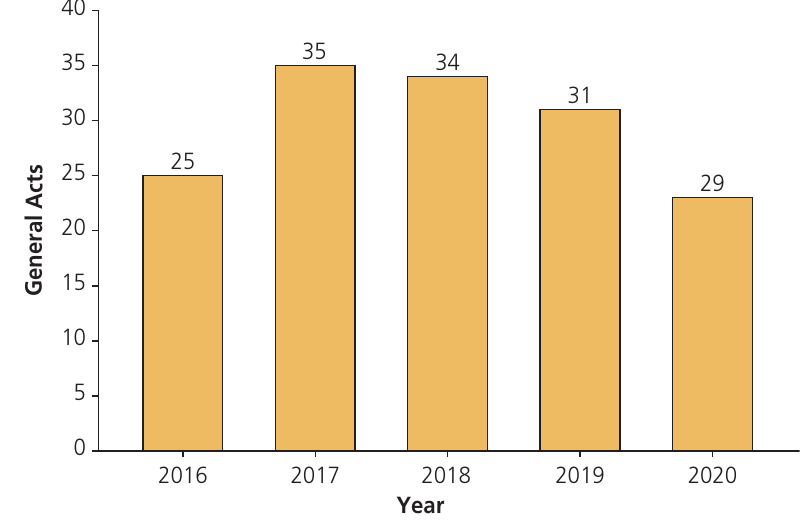
On average, around 30-40 public bills are passed by parliament each year. For example, 31 bills were passed in 2019.
Note
The chart shows that legislative output has varied between 25-35 General Acts per year from 2016-2020, with a peak of 35 Acts in 2017. This relatively stable output demonstrates the consistent legislative workload of parliament.
Pre-legislative stages
Before a bill is formally introduced to parliament, the government may undertake several preparatory steps that help shape and refine the proposed legislation.
Green Papers are government discussion documents that set out issues and options for legislation. They invite consultation and feedback.
White Papers are more formal government documents that set out detailed plans and proposals for legislation. They represent the government's firm policy intentions.
Note
Green Papers vs White Papers:
Think of Green Papers as the consultation phase—they present options and invite feedback. White Papers represent the commitment phase—they set out detailed, firm proposals that the government intends to pursue.
Pre-legislative scrutiny has increased in recent years. Draft bills are sometimes published and scrutinised by a select committee or joint committee before formal introduction to parliament.
Example
Pre-legislative Scrutiny in Action:
In November 2017, the draft Tenant Fees Bill was examined by the Communities and Local Government select committee before being formally introduced. This process allowed MPs to identify potential issues and suggest improvements before the bill entered the full legislative process.
During the 2017-19 parliamentary session, ten draft bills underwent this pre-legislative scrutiny process.
The government's overall legislative programme is announced in the Queen's Speech at the start of each parliamentary session.
The stages of a bill
First reading
The first reading is the formal introduction of the bill. The relevant government minister reads out the bill's title in the Commons chamber. There is no debate or vote at this stage—it is purely procedural.
Second reading
The second reading is where the main debate on the principles of the bill takes place in the Commons chamber. Debate refers to discussions in the main chamber during the passage of a bill.
Important
Government Defeats at Second Reading:
Government defeats at second reading are extremely rare. The last government defeat at this stage was in 1986, when a Sunday Trading Bill was defeated by 296 votes to 282.
This rarity demonstrates the significant advantage the government has in the legislative process, particularly when it holds a strong majority.
Committee stage
Bills are sent to public bill committees (previously called standing committees before 2006). Committee members consider the bill line by line, often suggesting amendments. Expert witnesses may be called to inform debate.
Key points about the committee stage:
- The government always has a majority on the committee
- Major changes to bills are unlikely at this stage
- Each committee exists only for the lifetime of the bill it is considering
- Party whips appoint committee members
Note
Committee Stage Effectiveness:
A 2015 Democratic Audit report found that:
- Nearly two-thirds (63%) of MPs appointed to bill committees between 2000-2010 brought relevant experience or expertise
- 87% of amendments accepted by the government came from these specialised MPs
- However, only 0.5% of non-government amendments in committee succeeded during 2000-10
This demonstrates that while expertise matters, the government's majority makes it very difficult for opposition amendments to succeed.
Report stage
During the report stage, any amendments agreed in the committee stage are considered by the full Commons. MPs can accept, reject or change these amendments. There is also opportunity for further amendments to be put to the vote.
Third reading
The third reading is a final debate on the amended version of the bill. No further changes are permitted at this stage. It represents the Commons' final consideration of the bill.
House of Lords stages
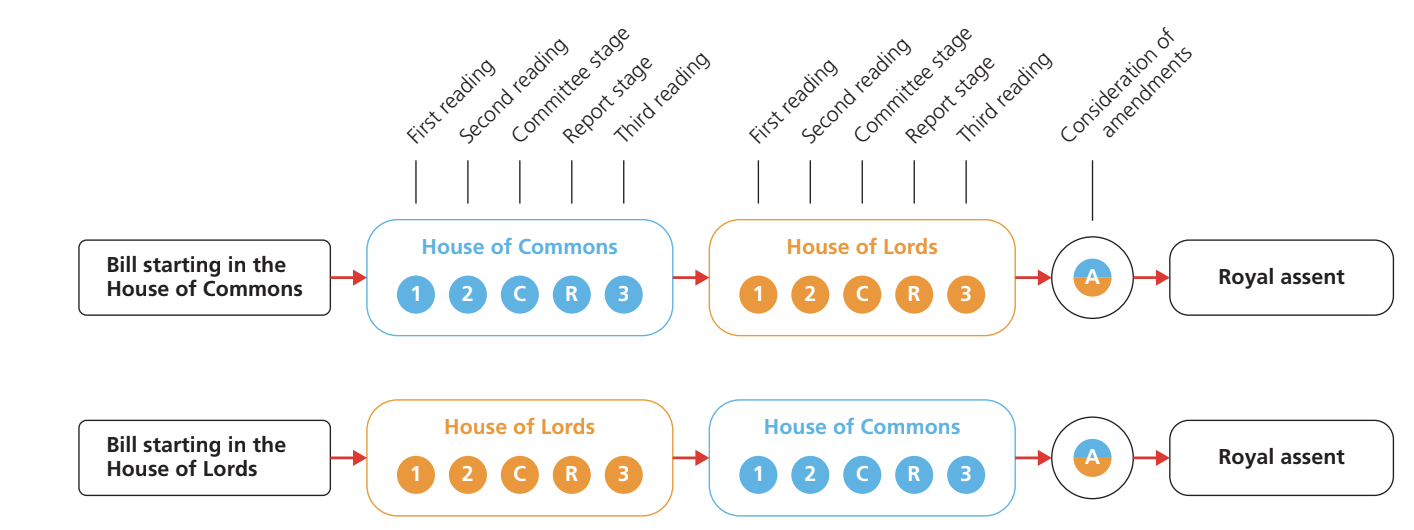
After passing through all Commons stages, the process is repeated in the House of Lords. Any amendments made by the upper house only become part of the bill if they are accepted by the Commons.
Bills may go back and forth between the two houses in a process often called 'parliamentary ping-pong'.
Example
Parliamentary Ping-Pong in Action:
The Prevention of Terrorism Act 2005 was considered five times by the Lords and four times by the Commons over a 30-hour period until compromise was reached.
This back-and-forth process demonstrates how disagreements between the two houses can significantly extend the legislative process.
If agreement cannot be reached, the Commons can invoke the Parliament Act, which allows their version of the bill to become law within a year, bypassing the Lords.
Note
The Parliament Act was last used to pass the Hunting Act 2004, which banned hunting wild mammals with dogs. This demonstrates that while the procedure exists, it is used sparingly—only as a last resort when the two houses cannot reach agreement.
Royal Assent
Once both houses agree on the final version, the bill receives Royal Assent from the monarch and becomes an Act of Parliament. This is now purely a formality.
Summary
The Legislative Journey:
Every bill follows the same five stages in both Houses:
- First reading - Formal introduction (no debate)
- Second reading - Main debate on principles
- Committee stage - Line-by-line scrutiny and amendments
- Report stage - Full house considers committee amendments
- Third reading - Final debate (no further changes)
After passing both Houses, the bill receives Royal Assent and becomes law.
English Votes for English Laws (EVEL)
English Votes for English Laws (EVEL) was introduced in 2015 to address consequences of devolution. It ensures that English MPs can veto bills or parts of bills that only apply to England.
How EVEL works
The EVEL procedure creates a complex system that balances the interests of English MPs with the authority of the whole House.
- The Speaker decides whether a bill or clauses within it are valid for the EVEL procedure, issuing a Speaker's certificate if appropriate
- After the report stage, the Speaker can refer the bill to the Legislative Grand Committee
- In the Legislative Grand Committee, all MPs can debate but only MPs representing English (or Welsh) constituencies can vote or move amendments
- The bill must then be reconsidered by the whole House
- If the Legislative Grand Committee withholds consent twice, either the whole bill falls or disputed clauses are removed
Note
The 'Double Veto' System:
EVEL creates a 'double veto' system—bills affecting only England must pass by a majority of both all MPs and English MPs specifically. This means legislation can fail even if it has overall majority support, if English MPs specifically reject it.
EVEL in practice
In the first year of operation, nine bills required the EVEL procedure (either wholly or partly). In none of the 14 votes held under EVEL was the government defeated.
Critics, particularly SNP MPs, have protested against being barred from voting on EVEL-certified bills.
Example
EVEL Controversy:
In February 2020, SNP MPs claimed that an EVEL-certified NHS funding bill also affected Scotland. This highlights the ongoing debate about which bills truly affect only England, given the interconnected nature of UK governance and the Barnett formula for funding devolved administrations.
Secondary legislation
Although all primary legislation passes through the full parliamentary process, many laws derive from secondary legislation or statutory instruments (SIs).
Statutory instruments refer to provisions within primary legislation that allow the relevant minister to introduce new clauses or changes. This is minister-made law, not parliament-passed law, used mainly for efficiency.
Example
Secondary Legislation in Action:
The Misuse of Drugs Act 1971 allows the government to add new drugs to the list of banned substances as information about their harm becomes apparent, without requiring a completely new Act of Parliament.
This flexibility enables the law to respond quickly to emerging threats, such as new synthetic drugs, without the time-consuming process of primary legislation.
Scale and scrutiny of secondary legislation
Important
The Scale and Scrutiny Gap:
- Around 3,500 SIs are passed annually—far more than the 30-40 parliamentary Acts
- SIs are scrutinised by the Joint Committee on Statutory Instruments (a joint committee of MPs and peers)
- Unusually, the government does not have a majority on this committee (the 2020 committee had only 6 Conservatives out of 14 members)
- The committee's role is purely to ensure SIs are legal and don't exceed powers specified in the parent Act
- Parliament must approve all SIs but cannot amend them
- Overall, scrutiny of secondary legislation is considerably less than for primary legislation
This represents a significant democratic concern—the vast majority of law-making happens through SIs with minimal parliamentary oversight.
Private members' bills
Private members' bills (PMBs) allow backbench MPs and peers to draft and present their own bills. This system began in its current form in the late 1940s and gives backbenchers freedom to respond to public concern or reflect their own policy priorities.
PMBs are especially useful for:
- Issues that are not primarily party political
- Issues where an MP's own party is divided
- Matters of conscience
Note
Historic Significance of PMBs:
Some important laws started as PMBs, including:
- The Abortion Act 1967
- The abolition of capital punishment in 1965
These succeeded partly because they were matters of conscience that the government backed but was reluctant to propose as official bills. This demonstrates how PMBs can facilitate legislative change on sensitive issues where the government prefers not to lead.
Types of private members' bills
There are three forms of PMB, distinguished by when and how they are introduced. Each has different chances of success and serves different purposes.
Ballot bills
Ballot bills have the best chance of becoming law or receiving proper debate in the chamber.
- Thirteen Friday sittings (approximately 65 hours) are set aside each year for PMBs
- Priority for the first seven sitting Fridays goes to ballot bills
- MPs enter a ballot and 20 names are drawn
- MPs who win the ballot are often approached by pressure groups with suggestions
- Some MPs adopt government 'handout' bills—technical changes the government couldn't find time for or didn't wish to steer through itself
Important
Why Most Ballot Bills Fail:
Ballot bills only pass if they are:
- Uncontroversial
- Not opposed by the government
- Otherwise, they can easily be blocked by MPs speaking until time runs out
This tactic is called 'filibustering' and demonstrates how determined opposition can kill even high-priority PMBs.
Example
The 'Turing Bill' Filibuster (2016):
The so-called 'Turing Bill' in 2016 would have pardoned men with UK convictions for same-sex offences before the 1967 law change. The government withdrew support and a minister spoke for 25 minutes, reaching the time limit and causing the bill to fail.
This example illustrates how government opposition can kill even popular and morally significant bills.
Example
Recent Success: Assaults on Emergency Workers Act 2018:
Introduced by Chris Bryant, this Act increased penalties for attacking emergency workers. Just four ballot bills passed in the 2017-19 session, compared to eight in 2016-17, demonstrating how difficult it is for PMBs to succeed even with ballot priority.
Ten minute rule bills
Ten minute rule bills are primarily about raising awareness rather than passing legislation.
- They secure a 10-minute speaking slot during 'primetime' in the Commons chamber after Question Time on Tuesdays and Wednesdays
- Party whips decide the slots, which limits MPs' independence
- Most are policy aspirations rather than realistic legislative proposals
Example
Rare Ten Minute Rule Success:
The Guardianship (Missing Persons) Act 2017 created a new legal status allowing someone to act in a missing person's best interests after 90 days. It was originally a ten minute rule bill by Conservative MP Kevin Hollinrake.
This rare success demonstrates that while ten minute rule bills almost never become law, they can occasionally succeed with government support.
Presentation bills
Any MP can introduce a presentation bill of their choice after giving notice to the Public Bill Office.
- Formally 'presented' during Friday sittings only
- Presented after all ballot bills on the order paper (the list indicating the order of business)
- No speech or debate attached
- Less useful to MPs than ballot or ten minute rule bills
Note
Brexit Exception to Normal Rules:
The Brexit saga broke normal rules—both the Cooper-Letwin Act and Benn Act were passed using this device when MPs took control of parliament's agenda from the government to prevent no-deal Brexit.
This demonstrates that in exceptional circumstances, even the least powerful form of PMB can succeed when backbenchers seize control of the parliamentary agenda.
Factors affecting PMB success
Summary
When PMBs Are Most Likely to Succeed:
PMBs are more likely to succeed if they are:
- Uncontroversial
- Introduced by one of the 20 MPs successful in the ballot bills draw
- Backed by the government
- Introduced during exceptional circumstances (like the 2018-19 Brexit debates when the government lost control of the agenda)
Without government backing or in the face of controversy, even the best-positioned ballot bills will almost certainly fail.
Indirect backbench influence
Backbenchers, especially from the governing party, can influence government legislation by applying pressure before a bill reaches the Commons floor.
Governments often 'buy off' potential rebels by making changes to bills in advance. Sometimes major crossbench opposition (combined with public outcry) forces governments to abandon plans entirely.
Example
Forest Privatisation Plans Abandoned (2011):
Plans to privatise some English forests were abandoned due to backbench opposition and public outcry. This demonstrates how the threat of rebellion can kill government plans before they even reach the formal legislative process.
Example
Corporate Manslaughter Bill (2006):
Labour backbenchers successfully persuaded Tony Blair's government to introduce the Corporate Manslaughter Bill. This shows how sustained backbench pressure can not only prevent unwanted legislation but also generate new laws that the government might not have otherwise prioritised.
Case study: Brexit legislation
The Brexit legislative process from 2018-2020 demonstrated parliament's scrutiny and legislative functions in exceptional circumstances. Without overall government majorities under Theresa May and initially Boris Johnson, and with deep divisions over Brexit (especially within the Conservative Party), the legislative process was far from straightforward.
Key Brexit Acts
European Union (Withdrawal) Act 2018 (dubbed 'The Great Repeal Bill' by May):
- Introduced July 2017, passed June 2018
- Repealed the European Communities Act 1972
- During passage, an amendment gave parliament a legal guarantee of a vote on the final Brexit deal (the 'meaningful vote' clause)
Example
The Meaningful Votes (January-March 2019):
Parliament held three votes on Theresa May's Brexit deal:
- First vote (January 2019): Government defeated 432-202 (unprecedented margin—the largest government defeat in modern parliamentary history)
- Second vote (March 2019): Defeated 391-242
- Third vote (29 March 2019): Defeated 344-286
These historic defeats demonstrated parliament's power to reject government legislation, even on the government's central policy priority.
Cooper-Letwin Act (April 2019):
- Passed within days through backbench control of business
- Passed third reading by just 1 vote
- Required the PM to request an extension from the EU
Benn Act (September 2019):
- Required PM to seek extension beyond 31 October 2019 if no deal agreed by 19 October
- Johnson declared he would rather be 'dead in a ditch' than comply
- Eventually, he was forced to request an extension
Note
Both the Cooper-Letwin and Benn Acts were exceptional because they were backbench-initiated legislation that passed despite government opposition. This only became possible because the government had lost control of the parliamentary timetable.
European Union (Withdrawal Agreement) Act 2020:
- After Johnson's December 2019 election victory with a majority
- Easily passed on 23 January 2020 by a majority of 99
- No Conservative MPs voted against
- No amendments passed in the Commons
- Five Lords defeats were swiftly overturned by MPs
- Just 11 days' scrutiny
- Johnson removed provisions for parliamentary scrutiny of future negotiations
Important
The Lesson of Brexit Legislation:
This episode demonstrated that parliament can be an effective check on the executive, particularly when:
- The government lacks a majority
- The issue is highly contentious
- MPs are willing to defy party whips
- Backbenchers can seize control of the parliamentary agenda
However, once the government regained its majority in December 2019, parliamentary scrutiny was dramatically reduced, showing how dependent parliament's power is on the government's majority.
Remember!
Summary
Key Legislative Facts:
- Most government bills pass successfully (87% in 2015-17), whilst most private members' bills fail (only 4% success rate)
- Around 30-40 public bills pass each year, but approximately 3,500 statutory instruments are passed annually
- Bills must pass through both Houses using the same five stages: first reading, second reading, committee stage, report stage, and third reading
Important Processes:
- Green Papers are for discussion; White Papers are detailed proposals
- The second reading is the main debate stage
- The committee stage allows line-by-line scrutiny, though government majorities make amendments difficult
- Parliamentary ping-pong occurs when bills go back and forth between the Houses
- The Parliament Act allows the Commons to bypass Lords opposition within a year
Special Procedures and Exceptions:
- EVEL requires a 'double majority' (all MPs and English MPs) for England-only bills
- Ballot bills have the best chance of success among private members' bills, but still require government support or lack of controversy
- Secondary legislation receives far less scrutiny than primary legislation but is much more common
- In exceptional circumstances (like Brexit 2018-19), backbenchers can seize control of the parliamentary agenda and pass legislation against government wishes