Scrutiny of the Executive (AQA A-Level Politics): Revision Notes
📚Revision Notes
Scrutiny of the Executive
What is scrutiny of the executive?
Scrutiny of the executive is the process through which MPs hold the government accountable by questioning its actions, examining its policies, and challenging its decisions. This is a vital function of Parliament, ensuring that laws are properly designed, government policies are fully explained and debated, and ministers are held to account for their actions.
Opposition parties play the leading role in scrutiny, though backbenchers from the governing party can also be significant, particularly when the government pursues controversial policies or when the party is divided. Parliament performs this scrutiny function through three main methods: debates in the chamber, parliamentary questions, and parliamentary committees.
Note
The balance of power in Parliament significantly affects the effectiveness of executive scrutiny. When the government has a large majority, opposition scrutiny becomes more challenging, while hung parliaments or small majorities can give backbenchers greater influence over government policy.
Parliamentary debates
The role of debates
Parliamentary debates provide MPs with opportunities to raise concerns, express opinions, and occasionally force the government to reconsider its position. During moments of high political drama, Parliament takes centre stage, with debates attracting significant public and media attention.
Brexit debates have dominated recent parliamentary sessions, but other significant debates have also occurred. The debate over Syrian air strikes provides an important example of Parliament checking executive power.
Case study: Syrian air strikes debate (2013)
Example
Case Study: Parliament Defeating Government on Syrian Air Strikes (2013)
In August 2013, Prime Minister David Cameron proposed air strikes against President Assad's forces in Syria following evidence of chemical weapons use against civilians. Despite the coalition government's usual Commons majority, Cameron was defeated 285-272 votes, with 30 Conservative and nine Liberal Democrat MPs voting against their own government.
The debate context: The debate was highly charged, with memories of the Iraq War still fresh. Labour leader Ed Miliband argued that the public wanted Parliament to "learn the lessons" of Iraq. Conservative MP David Davis warned that intelligence "might just be wrong because it was before", whilst Cheryl Gillian stated, "I cannot sit in this House and be duped again."
Cameron himself used emotional language, describing videos showing "bodies with symptoms consistent with nerve agent exposure, including muscle spasms and foaming at the nose and mouth."
The outcome: After the defeat, Cameron acknowledged that "the British Parliament, reflecting the views of the British people, does not want to see British military action." This demonstrates Parliament effectively determining foreign policy, usually the sole preserve of government.
Later developments: Notably, Parliament later voted differently on similar issues - supporting air strikes on Islamic State targets in Syria in December 2015, showing how parliamentary opinion can shift with context and circumstances.
Parliamentary privilege
Parliamentary privilege protects MPs and peers when speaking in the Palace of Westminster, exempting them from the usual laws of slander and contempt of court. This protection, dating from the Bill of Rights 1689, upholds free speech within Parliament and allows news outlets to freely report parliamentary debates without threat of prosecution.
Important
Parliamentary privilege does not apply beyond Westminster, nor does it grant MPs or peers immunity from prosecution for criminal offences. It is specifically limited to speech and proceedings within the Palace of Westminster.
Recent uses of parliamentary privilege include Lord Peter Hain naming Sir Philip Green in 2018 as the person behind a court injunction preventing newspapers from publishing allegations of sexual and racial harassment.
Emergency debates
MPs can request emergency debates at the Speaker's discretion. These must concern "a specific and important matter that should have urgent consideration." If granted permission, an MP has 3 minutes to present their request to the House.
Twenty-two emergency debates occurred in the 2017-19 parliamentary session, covering topics from Brexit to Universal Credit rollout. The contaminated blood scandal debate in July 2017, moved by Labour MP Diana Johnson, led to the announcement of a full government inquiry. Johnson commented that "emergency debates may become an even more popular route to get the government to listen and act."
Recent developments in debates
Since 2010, backbenchers have gained more opportunities to scrutinise government through several mechanisms:
The Backbench Business Committee, proposed by the Wright Committee in 2009, allows MPs to shape Commons business for approximately one day per week. It decides topics for debate on the Commons floor and in Westminster Hall.
Westminster Hall debates occur four days weekly in a separate chamber with a less adversarial atmosphere than the main Commons. MPs apply for debates through a ballot system arranged by the Speaker's Office. Any MP may attend, though no votes occur. These debates allow MPs to raise local and constituency concerns. For example, in February 2020, Tim Farron led a debate on support for hill farmers, whilst Ben Bradley discussed education attainment of white working-class boys.
E-petitions are discussed on Mondays. Any petition receiving over 100,000 signatures must be considered for debate by the Petitions Committee, though debate is not guaranteed. During the COVID-19 pandemic, a petition for statutory sick pay for the self-employed garnered nearly 700,000 signatures, whilst another calling for scrapping NHS parking charges received over 415,000 signatures. The latter led to additional government funding for NHS trusts, demonstrating that these mechanisms can occasionally influence policy, even without formal parliamentary debate.
Note
While Westminster Hall debates provide valuable opportunities for MPs to raise constituency concerns and local issues, their effectiveness is limited by their inability to compel government action. They serve more as a platform for raising awareness than as a mechanism for forcing policy change.
However, Westminster Hall debates' significance is questionable. Like select committees, they cannot compel government action, only require a reply. Debates are often poorly attended. The 2017 petition to ban President Trump's state visit collected over 1 million signatures and sparked heated parliamentary debate. Whilst the visit proceeded, Trump did not visit or address Parliament, possibly reflecting the petition's influence.
Evaluating parliamentary debates
Several factors suggest parliamentary debates often have limited impact on government:
Important
Key Limitations of Parliamentary Debates:
Limited influence on voting: Few MPs change their minds during debates, as most have already decided their position or been instructed how to vote by party whips.
Government majority: The government usually wins Commons votes through its overall majority and the party whip system.
The payroll vote: The payroll vote describes MPs holding government posts (ministers, junior ministers, parliamentary private secretaries) who are guaranteed to support the government. This group has grown significantly from 101 in 1960 to 141 in 2018 (though it fell to 134 by 2020), arguably reducing the ability of governing party MPs to challenge the government.
Westminster Hall limitations: These debates are poorly attended and lack direct power over government.
Weak financial scrutiny: Finance and money bills receive particularly weak scrutiny. A 2018 Democratic Audit report noted that "Finance debates on the floor of the House are simply general political talk-fests for the government and opposition." Budget votes are effectively confidence votes, meaning rebel MPs would lose the whip. Usually only four days are allocated to budget debates, which become exercises in party political posturing rather than rigorous scrutiny.
Lords amendments: Whilst Lords debates can produce high-quality contributions, their power to influence government is severely restricted. The Lords made five amendments to Johnson's 2020 Brexit Bill, but the Commons rejected all of them, including the Dubs amendment allowing child refugees to reunite with UK families post-Brexit.
Parliamentary questions
Written and oral questions
Parliamentary questions are a high-profile method of holding government to account. Questions can be written or asked during chamber question time sessions. In 2017-18, over 55,000 questions were asked, with over 50,000 written. This represented a 42% increase from the previous year, suggesting growing parliamentary scrutiny of government.
Most questions went to departments running major public services like health and education. Ministerial questions occur on a rota basis, with relevant ministers answering questions only about their department. The first questioner is normally the relevant shadow spokesperson.
Prime Minister's Questions (PMQs)
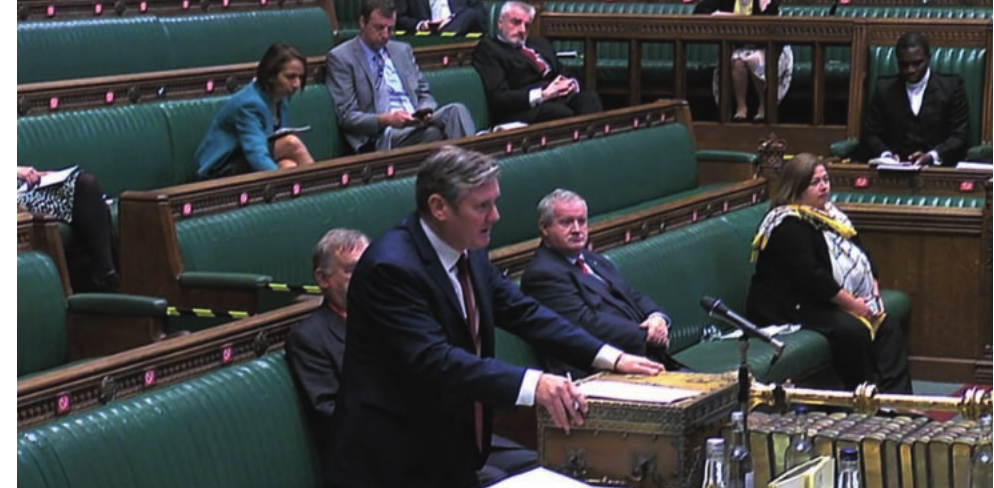
The most important occasion for oral questions is Prime Minister's Questions (PMQs), held every Wednesday at noon for 30 minutes. Its effectiveness is highly debated.
Backbench MPs from the governing party often ask "patsy questions" deliberately designed to show the government positively whilst attacking the opposition. For example, in March 2020, Conservative MP Shaun Bailey asked about police investment in his constituency, using the opportunity to criticise the Labour police and crime commissioner whilst praising government policy.
| Evidence for PMQs as an effective way of checking the government | Evidence against PMQs as an effective way of checking the government |
|---|---|
| It is high profile and widely publicised, with clips often featuring in the television news or on social media. | It gives a highly misleading and distorted image of parliament’s work and how government is scrutinised. Most debates and ministerial questions are nothing like as adversarial or theatrical. |
| It forces the prime minister to directly address key issues of the day. It is the most direct method of scrutiny, and most heads of the executive in other countries do not face it. | It is mostly an environment for ‘Punch and Judy’ politics and petty point-scoring. Former speaker John Bercow stated in 2014, ‘There are people who think culturally the atmosphere is very male, very testosterone-fuelled and, in the worst cases, of yobbery and public school twittishness.’ |
| It offers particular opportunities for the leader of the opposition to stake a claim to the premiership by delivering a ‘better’ debating performance. A good example is of David Cameron who, as newly elected Conservative leader in 2005, famously quipped that Tony Blair ‘was the future once’. |
Note
The PMQs Debate: Effective Scrutiny or Political Theatre?
The effectiveness of PMQs remains controversial. Whilst it forces the Prime Minister to directly address key issues and provides high-profile scrutiny, critics argue it presents a misleading image of Parliament's work, dominated by "Punch and Judy" politics.
Former Speaker John Bercow stated in 2014 that the atmosphere is "very male, very testosterone-fuelled and, in the worst cases, of yobbery and public school twittishness."
A Hansard Society poll found that PMQs made just 12% of the public feel proud of Parliament, whilst 67% felt there was too much party political point-scoring rather than answering questions. However, most Prime Ministers, including David Cameron and Tony Blair, have expressed fear and trepidation about facing PMQs, suggesting it does provide meaningful accountability.
Urgent questions
Since 2017, Speakers have increasingly allowed MPs to ask urgent questions (UQs) of ministers immediately after question time. MPs must apply to the Speaker that morning, with permission granted entirely at the Speaker's discretion. In the year following the 2017 Queen's Speech, the Speaker granted 114 UQs, covering topics from the Nazanin Zaghari-Ratcliffe case to the government's immigration White Paper and the cost of policing President Trump's visit.
Parliamentary committees
Three main types of parliamentary committee scrutinise government: public bill committees, select committees, and Lords committees.
Public bill committees
Public bill committees (previously called standing committees) examine legislation line by line during the bill's passage through Parliament. These committees are temporary, lasting only for the bill's lifetime. Members typically number 16-20, and committees are named after the bill they consider (e.g. the Equality Bill Committee).
The government always ensures it has a majority of loyal MPs on each committee, making major changes to bills extremely unlikely. The committees can take oral and written evidence from the public and interested pressure groups. They normally have two joint chairs, one from the government and one from the Official Opposition.
A 2013 UCL Constitution Unit report claimed that "parliamentary scrutiny of bills is arguably where the House of Commons is at its weakest — and the committee stage is central to that weakness." The report's concerns reflect several significant limitations:
Important
Limitations of Public Bill Committees:
-
Government control: Committee membership is decided proportionally to party strength, guaranteeing the government a majority. Just 0.5% of opposition amendments are accepted.
-
Temporary membership: MPs do not build expertise in particular policy areas. Only 8% of MPs on bill committees also sit on the relevant departmental select committee.
-
Whip control: Party whips decide membership through the selection committee, making party loyalists more likely to be chosen than independently minded MPs. The relevant government minister is usually included among the committee's number.
However, public bill committees do provide opportunities for backbench scrutiny beyond general debates. They can make effective changes - for example, the Investigatory Powers Act 2016 committee added additional safeguards to protect journalists during scrutiny of electronic surveillance powers. Expert witnesses like George Monbiot have given evidence to committees such as the 2019-21 Environment Bill Committee, bringing specialist knowledge to the legislative process.
Select committees
Select committees are probably the most significant parliamentary committees. Parliament defined their role in 2013 as "to hold Ministers and Departments to account for their policy and decision-making and to support the House in its control of the supply of public money and scrutiny of legislation."
Select committees check that government and public bodies perform their duties properly and spend taxpayers' money efficiently. They launch investigations, call witnesses, and publish reports with findings and recommendations. They also scrutinise some draft bills before formal parliamentary debate.
The Public Accounts Committee (PAC), dating from 1857, is the oldest and arguably most important committee. It oversees how efficiently government spends money, launching inquiries into major projects like HS2 rail and university technical colleges. It is chaired by a senior opposition backbencher - Labour MP Meg Hillier following the 2019 election.
In 1979, a comprehensive system of departmental select committees was established, ensuring every government department is "shadowed" by a select committee. These are often chaired by MPs with strong backgrounds in relevant fields. For example, the Health Select Committee was chaired by former GP Sarah Wollaston until 2019, then by former Health Secretary Jeremy Hunt from 2020. The Environment, Food and Rural Affairs Committee has been chaired since 2017 by Robert Parish, a Conservative MP with a farming background.
Twenty-eight select committees existed in 2020, most corresponding directly to government departments. They usually comprise 11 members, with total membership reflecting party balance in the Commons, ensuring the government has a majority on each committee.
Note
Key Reforms Since 2010:
Select committee chairs are now elected by secret ballot of all MPs at the start of each parliamentary session, with membership normally lasting for the rest of that parliament. This provides more permanence and stability, considerably reducing whips' power and leading to election of more independently minded MPs.
Elections vary in intensity - whilst 13 chairs were elected unopposed in January 2020, some contests were close, such as Julian Knight's nine-vote victory for the Digital, Culture, Media and Sport chair.
Several committees are chaired by opposition MPs. Following the 2019 election, Labour MP Stephen Timms chaired the Department for Work and Pensions select committee.
Working methods: Select committees aim for consensus and unanimity among members, ensuring reports have maximum impact. Members sit in a horseshoe arrangement rather than adversarial Commons seating. Despite government majorities on committees, they sometimes support opposition policies. In September 2020, the Treasury Select Committee urged the government to extend the COVID-19 furlough scheme, a Labour policy.
Many MPs serve on select committees for lengthy periods, developing specialist knowledge often exceeding that of ministers who hold office briefly. Since 2003, chairs receive additional salary and enjoy high media profile. This suggests the select committee route is increasingly attractive for MPs seeking career advancement outside the frontbench.
Powers and procedures: Committees decide independently what issues to investigate. They have considerable powers to summon witnesses and examine restricted documents. Hearings resemble court-like interrogations, especially when members suspect witnesses of misleading Parliament or concealing truth.
Recent high-profile witnesses include Sports Direct owner Mike Ashley, questioned about working practices, and Sir Philip Green, questioned over the BHS pensions scandal. Ministers face tough questioning and do not always perform well. Former immigration minister Caroline Nokes appeared visibly irritated when questioned about problems faced by highly skilled migrants, later being accused of misleading Parliament. However, her later election as Women and Equalities Committee chair suggests one poor performance does not necessarily bar promotion elsewhere.
Since 2007, select committees can review major ministerial appointments heading quasi-government agencies. Out of 59 hearings up to 2017, appointments were rejected or divided committees 13 times. For example, MPs on the Education Committee initially rejected Amanda Spielman as Ofsted head after a lacklustre performance, though she was subsequently appointed. Charlotte Hogg resigned as Deputy Governor of the Bank of England in 2017, two weeks into her job, after the Treasury Select Committee criticised her incomplete answers.
Select committees are active bodies, producing 267 reports in 2017-19, with 56 (21%) dealing with Brexit-related topics. Issues considered range widely, from departmental failings to national concerns and lower-profile but significant matters. The government must respond formally to reports within 60 days. Research suggests the government accepts around 40% of committee recommendations.
The Liaison Committee: The Prime Minister is not exempt from select committee scrutiny. The Commons Liaison Committee, consisting of all select committee chairs, questions the Prime Minister on policy matters approximately three times yearly.
Case study: Transport Select Committee and pavement parking
Example
Case Study: Select Committee Impact on Pavement Parking Policy
In September 2019, the Transport Select Committee issued a report criticising the Department for Transport for failing to act on pavement parking, promised in 2015 but with little achieved despite several reviews and consultations.
The issue identified: The report highlighted pavement parking's impact, especially on those with children or visual and mobility impairments, noting such parking discourages vulnerable people from venturing out, adding to social isolation.
Recommendations made:
- A complete national ban on pavement parking
- A national awareness campaign highlighting negative consequences
Government response: In response, the Department for Transport announced in March 2020 it would consult on giving local authorities more power to tackle the issue, demonstrating how select committee recommendations can influence policy.
Select committees and civil servants
Senior civil servants' position before select committees is particularly delicate. They must be honest and not knowingly mislead committees, whilst remaining politically neutral and loyal to ministerial masters. They cannot simply blame or criticise ministers for errors.
The Osmotherly Rules provide guidance for these scenarios:
- The Civil Service Code makes clear that civil servants are accountable to ministers, who are accountable to Parliament. Civil servants give evidence as ministerial representatives, not in a personal capacity.
- They cannot give personal views or judgements about particular policies.
- They are personally accountable for delivering or implementing government policy and cannot shift blame upwards to ministers.
- The rules set criteria for civil servants to refrain from giving evidence, such as on national security grounds.
The effectiveness of select committees in scrutinising government remains debated. Whilst they provide a less party-political forum than the Commons chamber and operate with increasing media profile, they face significant limitations. The governing party always holds a majority on committees, and the government rejects most policy recommendations. Party loyalties continue to play a significant role - between 2010 and 2019, there were votes on 125 out of 1,325 departmental select committee reports, many along party lines.
Note
Comparing UK and US Systems:
Unlike the US Senate, UK select committees cannot directly veto appointments. Party whips still control public bill committee membership, which scrutinises legislation. If select committees had real power, they would have a central role in the legislative procedure.
However, select committees do provide an alternative scrutiny forum, operate less politically than the Commons chamber, can call and question witnesses including ministers, and increasingly attract media attention. Many chairs are from opposition parties, and the secret ballot election system has reduced whip power, encouraging more independently minded chairs. Around 40% of recommendations are accepted, suggesting genuine policy influence.
Lords committees
Lords select committees are probably the least significant of the three main types, partly because the Lords has much less power than the Commons. Lords committees do not shadow government departments. Instead, they examine specialist subjects, taking advantage of the Lords' expertise across diverse areas.
Six main permanent Lords committees exist:
- European Union Committee
- Science and Technology Committee
- Communications Committee
- Constitution Committee
- Economic Affairs Committee
- International Relations Committee
Additionally, short-term ad hoc committees address specific concerns. Peers propose special inquiry committees to the Lords Liaison Committee, which recommends which should be established. The Lords typically appoints four special inquiry committees yearly. For example, in May 2020, the Lords established a COVID-19 Committee to consider the pandemic's long-term implications on UK economic and social wellbeing.
Lords committees work similarly to select committees, though usually comprising 12 not 11 members, and the government does not have a majority - reflecting party representation in the Lords. They conduct inquiries, take witness evidence, and produce reports with recommendations.
As an example, the 2014 Communications Committee report on televised election debates recommended broadcasters produce a single online portal with details about all debates and recordings access. This report targeted programme makers directly, not government. Given subsequent election debate controversies, it is difficult to argue this report had profound effect on debate conduct.
Other parliamentary committees
Several other committees perform scrutiny roles. One of the most important is the Intelligence and Security Committee of Parliament, established by the Intelligence Services Act 1994. It oversees Britain's intelligence community including MI5, MI6 and GCHQ. Comprising members of both Lords and Commons, the committee's membership is selected via party whips, but it elects its own chair.
Remember!
Summary
Key Points to Remember About Scrutiny of the Executive:
What is scrutiny?
- Scrutiny of the executive is Parliament's vital function of holding government accountable through debates, questions, and committees. Opposition parties lead this role, though governing party backbenchers can be significant, especially on controversial issues.
Parliamentary debates:
- Parliamentary debates can occasionally force government to change position (e.g. Syrian air strikes 2013), but are often limited by government majorities, the payroll vote, and party whip systems.
- Parliamentary privilege protects free speech in Westminster, whilst emergency debates and Westminster Hall debates provide additional scrutiny opportunities, though with limited direct power.
Parliamentary questions:
- Parliamentary questions, especially PMQs, provide high-profile scrutiny of government, forcing the Prime Minister to address key issues directly.
- However, effectiveness is debated due to "Punch and Judy politics", patsy questions, and limited actual policy influence.
- Written questions and urgent questions provide additional scrutiny mechanisms.
Public bill committees:
- Public bill committees scrutinise legislation line by line but are limited by government majorities, temporary membership, and whip control.
- Only 0.5% of opposition amendments are accepted, though they do provide opportunities for expert evidence and backbench input.
Select committees:
- Select committees are probably the most effective scrutiny mechanism, investigating government departments independently, calling witnesses, and producing reports with recommendations.
- Since 2010 reforms introduced secret ballot elections for chairs, reducing whip power and increasing independence.
- The government accepts around 40% of recommendations, suggesting genuine influence, though committees cannot compel government action and government maintains committee majorities.
- Key bodies include the Public Accounts Committee (overseeing government spending) and departmental select committees (shadowing each government department).