The Judiciary (AQA A-Level Politics): Revision Notes
📚Revision Notes
The Supreme Court
Introduction
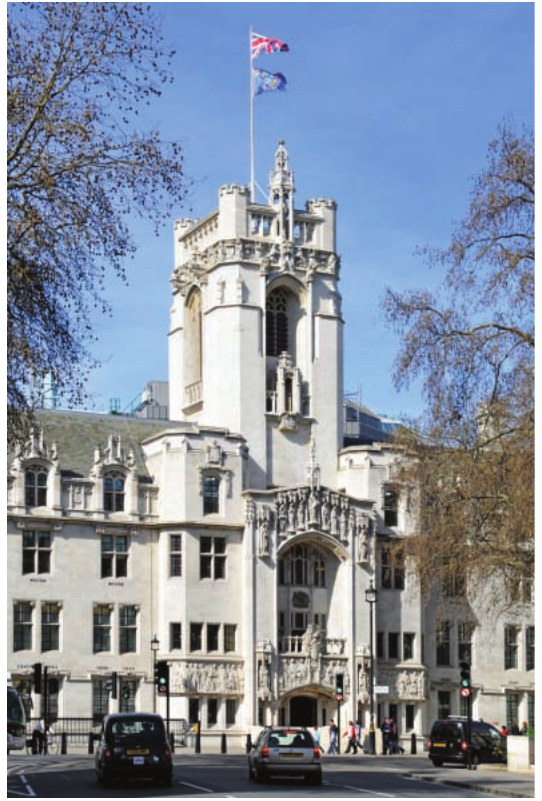
The UK Supreme Court was established in 2009 under the Constitutional Reform Act to serve as the highest court of appeal in the UK legal system. This marked a significant change in the British constitution, separating the most senior judges from Parliament and creating a dedicated institution for the final resolution of legal disputes.
Note
The creation of the Supreme Court represented a fundamental shift in the UK's constitutional arrangements, moving away from centuries of tradition where the UK's most senior judges sat as Law Lords in the House of Lords.
Why the Supreme Court was established
The Constitutional Reform Act created the Supreme Court to address three longstanding constitutional concerns:
1. Separation of powers
The UK system had an incomplete separation of powers. Law Lords previously sat in the House of Lords, blurring the boundaries between the legislature and judiciary. This arrangement contradicted the principle that legislative, executive and judicial powers should be held by separate branches of government to prevent tyranny.
Note
The traditional arrangement where Law Lords sat in Parliament meant that the same individuals could potentially participate in both making laws and judging on their application—a clear violation of the separation of powers principle that is fundamental to preventing the concentration of power.
2. Judicial appointments criticism
There was widespread criticism of how Law Lords were appointed. The old system lacked transparency and raised concerns about political interference in judicial appointments.
3. Public confusion
The general public struggled to understand the status, role and work of the Law Lords. Their position within Parliament made it difficult for citizens to comprehend their function as the highest judicial authority.
Functions of the Supreme Court
The Supreme Court performs three key functions:
- Final court of appeal: Acts as the final court of appeal in England, Wales, and Northern Ireland
- Scottish civil cases: Hears appeals from civil cases in Scotland
- Clarifying the law: Hears appeals in cases where there is uncertainty and thereby clarifies the meaning of the law
Demographics and diversity
The composition of the Supreme Court has been subject to scrutiny regarding diversity and representation. The table below shows how the demographic profile of Supreme Court justices has changed since the Court's creation:
| Category | 2009 (Oct) | 2021 (20 Apr) | UK population (2021) |
|---|---|---|---|
| Attended an independent secondary school | 10 (91%) | 9 (75%) | 7% |
| Attended Oxford or Cambridge | 10 (91%) | 11 (92%) | 1% |
| Number of women | 1 (9%) | 2 (17%) | 51% |
| Number from minority ethnic groups | 0 | 0 | 14% |
| Average age (years) | 67.8 | 65.1 | 40.5 |
| Number of justices in post | 11 | 12 | — |
Important
The data reveals that Supreme Court justices remain overwhelmingly privately educated and Oxbridge-trained, with limited representation of women and no representation from minority ethnic groups. This composition does not reflect the wider UK population, raising significant questions about whether the judiciary can truly represent and understand the experiences of all citizens who appear before it.
The rule of law
The rule of law is one of the fundamental principles underpinning the UK constitution. Constitutional theorist A.V. Dicey identified it as one of the 'twin pillars' of the English Constitution, alongside parliamentary sovereignty. The rule of law embodies the principle that 'equal justice' should be available to all citizens.
Dicey's three strands of the rule of law
Dicey outlined three key elements to demonstrate what 'equal justice' means in practice:
1. No one can be punished without trial
In theory, this principle prevents arbitrary punishment. However, in practice, exceptions exist. For example, terrorist suspects have been subject to indefinite detention, control orders and asset freezing without trial under measures passed since 2001.
Note
While the principle of 'no punishment without trial' is fundamental to the rule of law, the reality is more complex. The tension between protecting civil liberties and ensuring national security has led to significant exceptions, particularly in anti-terrorism legislation.
2. No one is above the law
All individuals should be subject to the same justice. However, exceptions have always existed in the UK. The monarch, international ambassadors and MPs (under parliamentary privilege) are effectively above the law in certain circumstances.
3. Constitutional principles result from judges' decisions
While case law (common law) plays a role in defining the UK's constitutional arrangements, Parliament remains sovereign. Statute law reigns supreme, and any legal precedent can be overturned by a simple Act of Parliament.
Judicial independence
Judicial independence refers to the principle that those in the judiciary should be free from political control. Such independence allows judges to 'do the right thing' and apply justice properly, without fear of consequences.
Six pillars of judicial independence
The UK system supports judicial independence through six main mechanisms:
1. Security of tenure
Judges are appointed for an open-ended term (until retirement). This makes it harder for politicians to bring influence to bear by threatening to dismiss or suspend them. Removing a judge by impeachment would require a vote in both Houses of Parliament.
Note
The security of tenure principle means that once appointed, judges cannot easily be removed from office. This protects them from political pressure, as they do not need to worry about losing their position if they make rulings that are unpopular with the government.
2. Guaranteed salaries
Judges' salaries are paid automatically from the Consolidated Fund. Politicians cannot manipulate judges' salaries as a way of controlling them.
3. Contempt of court
Under the sub judice rule, the media, ministers and the public are prevented from speaking out publicly during legal proceedings. This protects the integrity of the judicial process.
4. Growing separation of powers
The downgrading of the post of Lord Chancellor and the creation of the new UK Supreme Court enhanced the separation between the senior judiciary and the other branches of government.
5. Independent appointments system
The creation of the Judicial Appointments Commission (JAC) under the Constitutional Reform Act brought greater transparency to judicial appointments and addressed accusations of political bias.
6. Training and experience
Most senior judges have served a long apprenticeship in law. They have high status and take considerable pride in their legal standing. They are unlikely to compromise their professional integrity simply to defer to politicians or public opinion.
Judicial impartiality
Judicial impartiality means judges operate without personal bias in their administration of justice. It is an essential requirement of the rule of law. However, it is important to distinguish between judicial independence and judicial impartiality. Independence does not guarantee impartiality because judges may still allow their personal views to influence their decisions.
Note
Key distinction: Judicial independence relates to freedom from external control, while judicial impartiality relates to freedom from internal bias. A judge can be independent from political pressure but still fail to be impartial if they allow personal views to influence their decisions.
Four ways judicial impartiality is guaranteed
1. Anonymity
Judges generally operate away from the public eye and rarely speak out publicly on issues of law or public policy. Senior judges are expected to avoid defending their rulings openly or criticising those in government.
2. Political activity restrictions
Judges are not supposed to campaign on behalf of a political party or pressure group. Although judges retain the right to vote, their political views should not become a matter of public record.
3. Legal justifications of judgements
Senior judges must explain how their decisions are rooted in law. This makes it less likely that decisions will be coloured by personal bias. UK Supreme Court decisions are published in full on the Court's website.
4. High-level training
Judges are part of a profession that is highly trained and regulated by the Law Society. Elevation to the bench suggests an ability to put personal bias aside. Additional guidance and training can be offered where concerns exist.
Threats to judicial impartiality
Critics have identified two key threats to judicial impartiality:
Narrow recruiting pool
Most of those appointed to the higher tiers of the judiciary have been privately schooled, Oxbridge-educated, white, middle-class men beyond middle age. This narrow background could make it harder for judges to make impartial decisions when their life experiences differ significantly from most people who appear before them.
Important
Common concern: A homogeneous judiciary drawn from a narrow social background may struggle to understand and fairly judge cases involving people from very different backgrounds. Crucially, the creation of the JAC appears to have done little to address this problem.
The table below shows judicial diversity statistics for the senior judiciary below Supreme Court level:
| Level | % Women | % Minority ethnic group | ||||
|---|---|---|---|---|---|---|
| 2018 | 2019 | 2020 | 2018 | 2019 | 2020 | |
| Heads of division (5) | 0 | 0 | 20 | 0 | 0 | 20 |
| Court of Appeal judges (39) | 24 | 23 | 21 | 7 | 6 | 3 |
| High Court judges (99) | 24 | 27 | 28 | 3 | 3 | 4 |
| Deputy High Court judges (111) | 26 | 25 | 23 | 14 | 13 | 8 |
| For comparison: Magistrates (13,177) | 55 | 56 | 56 | 12 | 12 | 13 |
The data shows that while magistrates have significantly better gender and ethnic diversity, the senior judiciary remains predominantly male and white.
Politicisation of the judiciary
Politicisation refers to the process by which individuals traditionally seen as being beyond party politics are drawn into it. Senior judges have been drawn into more openly political conflicts in recent years, particularly following the passage of the Human Rights Act 1998.
Some view this growing public profile and increased conflict between senior judges and politicians as posing a threat to judicial impartiality. However, it could equally be seen as evidence of growing judicial independence—senior judges appear increasingly willing to challenge the political establishment in defence of civil liberties.
Has the UK judiciary become more politicised?
| Arguments for politicisation | Arguments against politicisation |
|---|---|
| The Human Rights Act 1998 drew senior judges into the political arena by requiring them to rule on the 'merit' of statute law rather than just its 'application' | The creation of the JAC and the Supreme Court appointments process has enhanced transparency and addressed concerns over political interference |
| The Factortame case (1990) established that UK courts could 'suspend' Acts of Parliament where they conflicted with EU law | The UK senior judiciary has become more independent following the Constitutional Reform Act, particularly through the downgrading of the Lord Chancellor role |
| The creation of the Supreme Court and its relocation to Middlesex Guildhall brought senior judges into the public arena and subjected them to greater media scrutiny | Increased conflict between judges and politicians is positive because it shows courts are challenging government when it appears to encroach upon civil liberties |
| Politicians have broken with convention by publicly criticising rulings handed down by senior judges | Security of tenure and guaranteed salaries help insulate judges from political pressure |
Note
The debate over politicisation highlights a fundamental tension: as judges become more active in protecting rights and challenging government actions, they inevitably become more visible in the political arena. Whether this represents a problem or a healthy development depends on one's perspective on the proper role of the judiciary.
Judicial review
Judicial review is the process by which judges review the actions of public officials or public bodies to determine whether they have acted lawfully. Although the UK Supreme Court cannot 'strike down' Acts of Parliament like the US Supreme Court, it still wields considerable influence through judicial review.
Unlike lower ('inferior') courts that simply apply the law, the Supreme Court and Courts of Appeal can establish legal precedent or common law (sometimes called 'judge-made law') through their judgements. These higher courts clarify the meaning of the law rather than simply applying its letter.
Ultra vires
Ultra vires is a Latin term meaning 'beyond the authority' or 'beyond one's powers'. Judicial review can be used to determine whether a minister or other government officer has acted ultra vires—that is, beyond the authority granted to them in law.
Example
Case Study: Reilly v Secretary of State for Work and Pensions (2016)
In this case, Reilly argued that the Department for Work and Pensions (DWP) had infringed the protection against slavery provided in Article 4 of the European Convention on Human Rights (ECHR) by requiring her to work for a private company to receive her benefit payments.
Initial ruling (2013): The Supreme Court concluded that although the DWP had not 'established slavery' in violation of the European Court of Human Rights when introducing its 'welfare to work' scheme, it was still unlawful because the department had operated ultra vires—beyond the authority given to it by Parliament.
Government response: The government then passed the Jobseekers (Back to Work Schemes) Act 2013, which changed the law retrospectively so that no offence had been committed.
Final ruling (2016): The Court of Appeal ruled that this retrospective legislation was incompatible with Article 6 of the ECHR (right to a fair trial). However, the Court confirmed that it was entirely up to the government and Parliament to decide how to proceed with that declaration of incompatibility.
Key lesson: This case demonstrates the limitations of judicial power—courts can declare incompatibility but cannot force Parliament to change the law.
European Union law and the Supreme Court
Under the European Communities Act 1972, the UK incorporated the Treaty of Rome into UK law. This gave European laws precedence over conflicting UK statutes, whether past or present.
Example
Case Study: Factortame (1990)
The Factortame case refers to a series of connected cases in which the European Court of Justice (ECJ) established that UK courts could suspend any UK statute law where it appeared to violate EU law, at least until the ECJ could make a final determination.
Background: The case involved a majority Spanish-owned fishing company, Factortame Limited, which challenged the legality of the Merchant Shipping Act 1988 under European law. Prior to the Act, the company had re-registered more than 50 Spanish boats as British while also purchasing other UK fishing vessels. Because these boats were registered in the UK, their catches counted against the UK's EU fishing quotas, even though most boats landed their fish in Spain. The Merchant Shipping Act 1988 was the government's attempt to close this loophole.
Significance: The Factortame case represented a significant enhancement of judicial power, as it allowed UK courts to suspend Acts of Parliament—something previously considered impossible under the doctrine of parliamentary sovereignty.
The Human Rights Act 1998 and the Supreme Court
The Human Rights Act was passed in 1998 and came into force in October 2000. It incorporated most articles of the European Convention on Human Rights (ECHR) into UK law, allowing UK citizens to pursue cases under the ECHR directly through UK courts. Prior to 2000, cases brought under the ECHR were heard at the European Court of Human Rights (ECtHR) in Strasbourg.
Example
Case Study: Tigere v Secretary of State for Business, Innovation and Skills (2015)
This case demonstrates how senior judges have used ECHR provisions to protect individuals against discrimination.
Background: Beaurish Tigere arrived in the UK from Zambia aged six as a dependent of her father, who had travelled on a student visa. When her father left the UK in 2003, Tigere remained with her mother. Although it took years for the Border Agency to become aware that Tigere had 'over-stayed', they ultimately awarded her 'temporary permission' and then 'discretionary leave to remain' in the UK.
The issue: With her UK residency secure, Tigere completed her A-levels and secured a place to read Business Management at Northumbria University. However, she was not eligible for a student loan because she would not have been able to apply for 'indefinite leave to remain' until 2018.
The ruling: In 2015, the UK Supreme Court accepted Tigere's appeal on the grounds that the negative impact on her rights under Article 2 of the ECHR (right to education) and Article 14 (prohibiting discrimination) could not be justified.
Limitations of the Supreme Court's power under the HRA
The HRA does not have the same legal force as similar documents such as the US Bill of Rights. This is because the HRA is neither entrenched nor superior to regular statute.
Important
Critical limitations of the HRA:
The HRA can be:
- Amended by a simple Act of Parliament
- Derogated (suspended), in its entirety or in part, under Article 15 of the ECHR in times of national crisis
- Repealed like any other Act
Crucially, while courts can make a declaration of incompatibility and invite Parliament to reconsider the offending statute, they cannot strike down parliamentary statute under the HRA.
Derogation is the process by which a country is exempted, perhaps temporarily, from observing a law or regulation it has previously agreed to abide by.
However, the HRA's influence extends beyond direct challenges to statute law:
- Where statute is silent or unclear, courts can use HRA provisions to establish legal precedent in common law
- The HRA has a 'hidden influence' through Parliament's Joint Committee on Human Rights, which examines draft legislation to ensure it is HRA-compatible
Judicial influence on government
The changing character of judicial action
Judicial review often requires senior judges to clarify the legal meaning of specific laws or regulations. It may also involve reviewing appeal cases heard previously at lower courts. The doctrine of parliamentary sovereignty and supremacy of statute law means that judicial review in the UK is generally seen as less significant than in the USA.
Note
However, some commentators argue that the judiciary has become more active in recent years, particularly following the passage of the Human Rights Act 1998 and the UK's membership of the European Union. This increased activity has sparked debate about whether judges are overstepping their traditional role or simply adapting to modern constitutional challenges.
Remember!
Summary
Key Points to Remember:
-
The UK Supreme Court was established in 2009 to address concerns about separation of powers, improve the appointments system, and clarify the role of senior judges
-
The Court's three key functions are: acting as the final court of appeal, hearing Scottish civil cases, and clarifying the meaning of law
-
Judicial independence (freedom from political control) is supported by six pillars: security of tenure, guaranteed salaries, contempt of court, growing separation of powers, independent appointments, and training
-
Judicial impartiality (absence of personal bias) is maintained through anonymity, restrictions on political activity, legal justifications of judgements, and high-level training
-
The Supreme Court cannot strike down Acts of Parliament but wields influence through judicial review and establishing legal precedent
-
Ultra vires cases involve determining whether public officials have acted beyond their lawful authority
-
The Human Rights Act 1998 incorporated the ECHR into UK law but courts can only make declarations of incompatibility—they cannot strike down statute
-
Concerns about judicial diversity remain significant, with Supreme Court judges predominantly privately educated, Oxbridge-trained, white, middle-class men
-
The debate over whether the judiciary has become more politicised centres on whether increased conflict with government represents a threat to impartiality or evidence of growing independence