Judicial Influence on Government (AQA A-Level Politics): Revision Notes
📚Revision Notes
Judicial Influence on Government
Introduction to judicial influence on government
Judicial review is the process by which senior judges clarify the legal meaning of specific laws or regulations, and review appeal cases from lower courts. In the UK, judicial review has traditionally been seen as less significant than in countries like the USA, because of the doctrine of parliamentary sovereignty and the supremacy of statute law. However, in recent years, commentators have argued that the judiciary has become increasingly active and willing to challenge both parliament and the executive.
Important
The UK Supreme Court's power is fundamentally limited by the fact that it cannot strike down Acts of Parliament or force the executive to comply with its rulings. This distinguishes it from supreme courts in countries with codified constitutions, such as the United States.
Courts can make a declaration of incompatibility and invite parliament to reconsider legislation, but they cannot overturn parliamentary statute under the Human Rights Act (HRA). Despite these limitations, the judiciary's influence has grown through several mechanisms, including establishing legal precedent in common law where statute is silent or unclear.
The changing character of judicial action in the UK
Growing judicial activism
Several factors have contributed to increased judicial activism in recent years. The Constitutional Reform Act 2005 enhanced judicial independence by reducing the role of the Lord Chancellor and removing senior judges from the House of Lords. The physical relocation of the Supreme Court to Middlesex Guildhall created a clearer separation between the judiciary and government, allowing senior judges to develop a more public profile.
Note
The physical separation of the Supreme Court from Parliament represents more than just a change of address. By moving from the Palace of Westminster to Middlesex Guildhall, the Court established a distinct institutional identity separate from the legislative branch, symbolizing the independence of the judiciary.
The Human Rights Act 1998 empowered UK judges to directly question Acts of Parliament and executive actions by allowing cases under the European Convention on Human Rights (ECHR) to be heard in UK courts. Additionally, the precedent established in the Factortame case (1990) allowed senior judges to suspend parliamentary and executive actions where either appeared to have breached EU law.
Hidden influence of the HRA
The HRA also exerts influence through less visible channels. Parliament's Joint Committee on Human Rights now examines draft legislation to ensure HRA compatibility, meaning potential conflicts are often resolved before bills become law. This represents a form of indirect judicial influence on the legislative process.
Note
This "hidden influence" may be the HRA's most significant impact on the legislative process. By encouraging parliament to consider human rights implications during the drafting stage, the Act shapes legislation before it even reaches the courts.
Has the UK judiciary had a greater impact on the executive and parliament?
The debate about judicial influence centres on whether recent developments have genuinely increased the judiciary's power or simply changed its form.
Arguments supporting increased judicial impact
Those who believe judicial influence has grown point to several key developments. The Constitutional Reform Act enhanced judicial independence and created physical separation between judiciary and government. The HRA gave judges tools to question parliamentary legislation directly. The expansion of EU law after the Maastricht Treaty (1992) brought judges into conflict with the executive and parliament across broader policy areas than before.
Crucially, this growth in judicial action had an indirect impact. Government and parliament increasingly sought to avoid court conflicts by ensuring legislation was HRA and EU compliant before enacting it.
Arguments against increased judicial impact
Critics argue that the changes are more symbolic than substantive. The physical relocation to Middlesex Guildhall, whilst highly symbolic, did little to change the legal-constitutional relationships between branches of government. The HRA's declaration of incompatibility carries no legal obligation for parliament to comply with court rulings.
Important
When judges rule that ministers have acted ultra vires (beyond their statutory authority), those same ministers can use executive control of parliament to pass retrospective legislation legitimising their earlier actions. This demonstrates a significant limitation on judicial power in the UK system.
Furthermore, Brexit has also reduced the scope for judicial action by removing the UK from EU law jurisdiction.
Brexit and the power of the UK Supreme Court
Understanding European courts
A common source of confusion concerns the distinction between different European judicial institutions. The European Court of Human Rights (ECtHR) and the European Court of Justice (ECJ) are separate entities with different roles and jurisdictions.
Important
Critical Distinction: Two Separate Courts
These are fundamentally different institutions that students and commentators often confuse:
- European Court of Human Rights (ECtHR): Established by the Council of Europe, hears cases under the ECHR (drafted in 1950). Not an EU institution.
- European Court of Justice (ECJ): The supreme court of the European Union, hears cases arising under EU law.
Understanding this distinction is essential for grasping how Brexit affects judicial power in the UK.
The ECtHR was established by the Council of Europe, an intergovernmental organisation separate from the European Union. It hears cases arising under the ECHR, which was drafted in 1950. The ECJ, by contrast, is the supreme court of the European Union and hears cases arising under EU law.

Brexit's impact on the HRA and ECHR
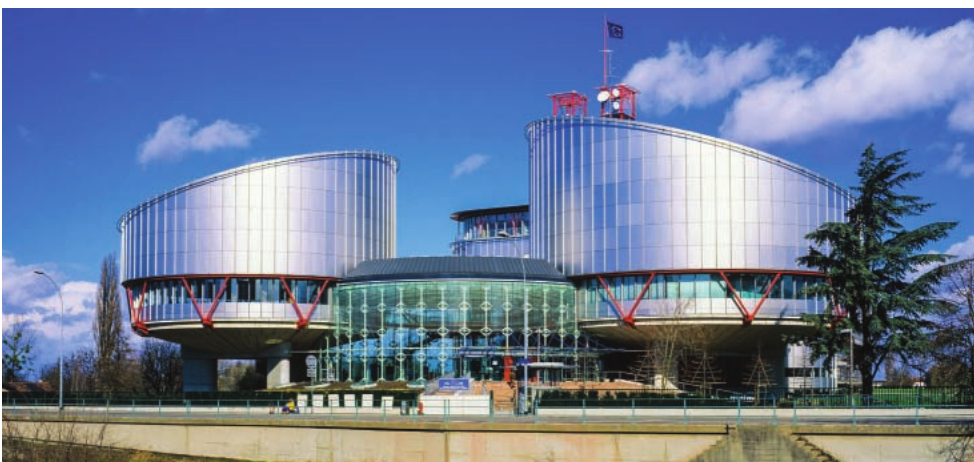
Much criticism of "European judges" is actually directed at the ECtHR rather than the ECJ. Although confusingly based in Strasbourg (a key EU centre), the ECtHR is not an EU institution. The ECHR was fully incorporated into UK law under the HRA 1998, and most controversial cases have involved this Convention rather than EU law.
Note
Crucially, leaving the EU does not remove the UK's obligations under the ECHR. The only way to escape ECtHR jurisdiction would be withdrawing from the Convention itself, an almost unthinkable act given that all European states except Belarus, Kazakhstan and Vatican City are signatories.
Therefore, Brexit has little direct impact on the Court's powers under the HRA.
Brexit's impact on EU law
Brexit did involve withdrawing from the Treaty of Rome (1957), meaning EU law no longer takes precedence over UK law and the ECJ no longer has jurisdiction over the UK. This impacts the Supreme Court in three significant ways:
- A proportion of recent case load has related to EU law
- The Court no longer enforces EU law over UK law
- Removing a court superior to the Supreme Court (in some legal areas) enhances the Supreme Court's status and authority
Constitutional expert Professor Vernon Bogdanor commented that Brexit would leave "a gap in our constitution in terms of the protection of human rights. This gap could well be filled by the judges. If that happens, Brexit will increase the danger of a clash between the judges and parliament."
The evolution of the UK Supreme Court
Key cases demonstrating judicial development
Lord Neuberger identified five key cases from the Supreme Court's first five years that demonstrated its evolving role, though he noted these did not represent significant departure from what the Law Lords might have done previously.
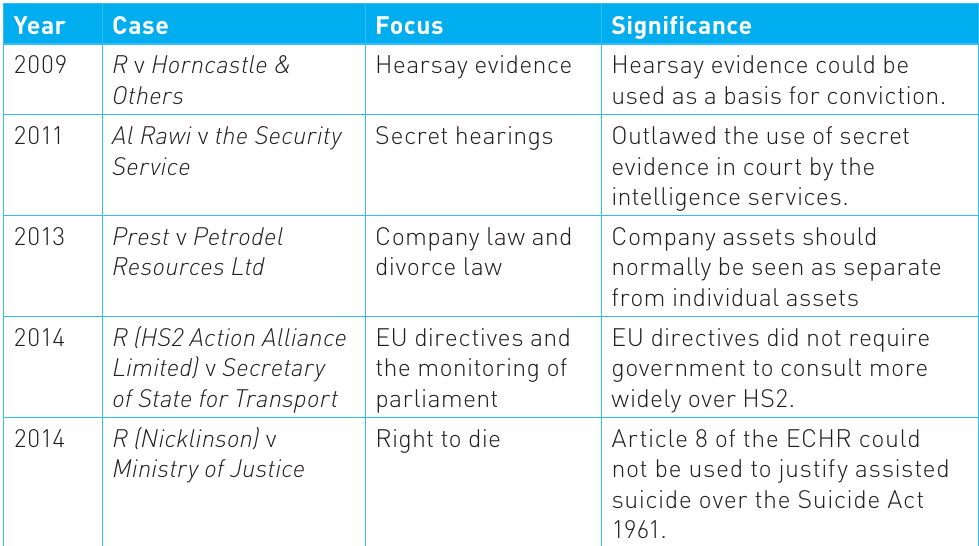
These cases covered diverse areas including hearsay evidence, secret hearings by intelligence services, company law in divorce proceedings, EU directives and parliamentary monitoring, and the right to die under Article 8 ECHR. Subsequent significant cases have followed similar patterns.
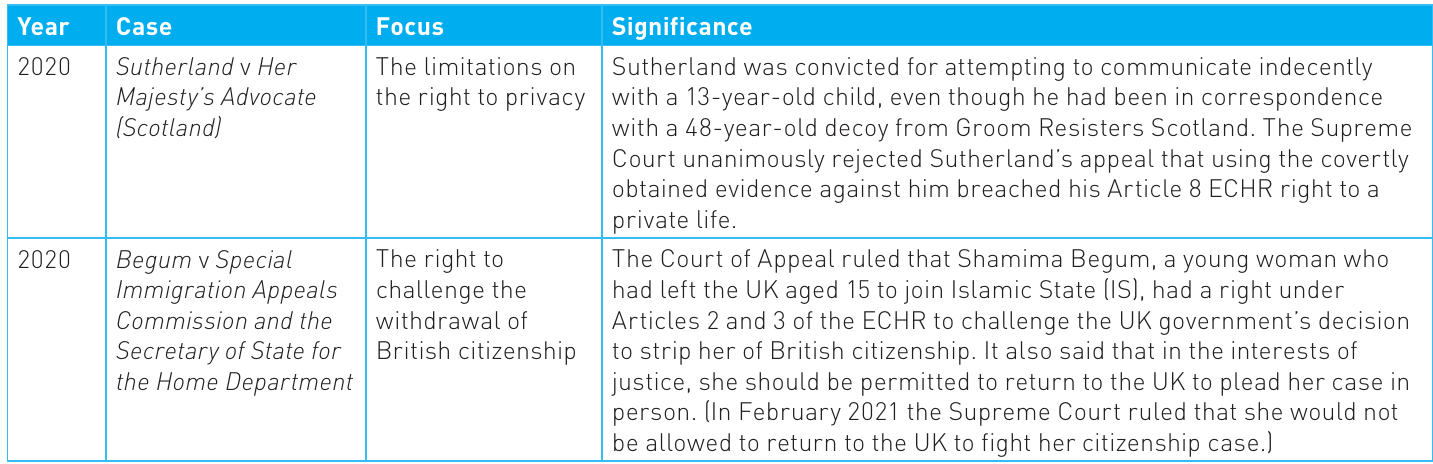
The 2020 cases show the Court continuing to address contentious issues. In Sutherland v Her Majesty's Advocate, the Court rejected an appeal that using covertly obtained evidence breached Article 8 ECHR privacy rights. In Begum v Special Immigration Appeals Commission, the Court of Appeal initially ruled that Shamima Begum had rights under Articles 2 and 3 ECHR to challenge citizenship withdrawal and return to the UK, though the Supreme Court later reversed this decision.
The prorogation case: breaking new ground
Important
Watershed Moment: The September 2019 Prorogation Ruling
The Supreme Court's ruling on Boris Johnson's decision to prorogue parliament marked a significant watershed in the Court's evolution. This case demonstrated the Court's willingness to intervene in high-profile constitutional disputes, even when involving the Prime Minister and fundamental questions of parliamentary sovereignty.
The Court argued that using the royal prerogative to prorogue parliament must respect parliamentary sovereignty and democratic accountability conventions. Any prorogation that frustrated parliament's constitutional functions without reasonable justification would be unlawful.
Example
The Prorogation Decision: Key Reasoning
The Court found that this particular prorogation had an "extreme" effect on the "fundamentals of democracy", coming at a crucial point in the Brexit process.
The Court's Actions:
- Declared the prorogation unlawful
- Quashed the relevant Order in Council
- Ruled that parliament had never legally been prorogued
Significance: This represented the Court taking a firm stance on protecting parliamentary democracy, even when challenging executive authority at the highest level.
Professor Bogdanor noted that whilst the decision was "politically and constitutionally significant", it was "not a huge jump" and would not transform the UK into countries like the United States or Germany with constitutional courts that can strike down legislation.
The overall impact of the UK Supreme Court
Three main areas of Court power
Following Brexit, the Court's power is limited to three main areas:
Summary
Key Powers of the UK Supreme Court
- Revisiting legal precedent: Reviewing and updating earlier precedent established under common law and case law (judge-made law)
- Ultra vires rulings: Judging that public bodies have acted beyond their statutory authority
- Declarations of incompatibility: Issued under the Human Rights Act 1998 when legislation conflicts with ECHR rights
The UK lacks an entrenched, codified constitutional document or "fundamental law". Consequently, whilst the US Supreme Court can strike down Acts of Congress and force presidential compliance, the UK Supreme Court cannot strike down Acts of Parliament or compel executive compliance.
Limited but developing role
Lord Philips predicted that the Supreme Court's creation would essentially be one of "form rather than of substance", and this has largely proven accurate. The Court has developed a more public profile since 2009, but the types of rulings it hands down are similar to those the Law Lords might have issued previously.
The apparent threat posed by the Supreme Court's growing authority
Are judges becoming "politicians in robes"?
Recent coverage has questioned whether the Supreme Court has become "too powerful", suggesting a blurring between those who "make" the law (politicians) and those who "apply" it (judges). Critics argue that senior judges have become "politicians in robes" or "politicians sitting on a bench".
However, this distinction was always somewhat flawed. Senior judges have historically played a role in interpreting and clarifying law when resolving disputes. The Supreme Court's ability to establish precedent through common law represents a quasi-legislative power, where differences in the Court's interpretations over time can appear tantamount to legislative change, even though parliament makes no changes to statute law.
Note
This quasi-legislative power is not new or unique to the Supreme Court. The common law tradition has always involved judges creating and developing law through their decisions. What has changed is the visibility and public awareness of this role.
The unelected nature of the Supreme Court
The UK Supreme Court has no more power than the equally unelected Appellate Committee of the House of Lords it replaced in 2009. Whilst the unelected nature of the House of Lords attracted criticism regarding its legislative function, this was never grounds for criticising the Law Lords in the Appellate Committee.
It is almost unheard of for the highest judges in other countries to be elected. Judicial independence requires senior judges to interpret the law and dispense justice fairly without fear of arbitrary removal via ballot box or other means. The Roman poet Juvenal posed the question "quis custodiet ipsos custodies?" (who guards the guards themselves?). From the Supreme Court's perspective, whilst accountability is generally positive, judicial independence demands a degree of unaccountability. Democracy requires placing trust in those not directly accountable to citizens.
Important
The Independence Paradox
Judicial independence creates an apparent paradox: democracy requires placing trust in unelected and relatively unaccountable judges. This is necessary because judges must be free to make unpopular decisions based on law and principle, without fear of electoral consequences or political pressure.
The growing authority of the UK Supreme Court
Whilst power is the ability to do something or make something happen, authority is the right to take a particular course of action. German sociologist Max Weber (1864-1920) identified three sources of authority:
- Traditional authority: based on established traditions and customs
- Charismatic authority: based on a leader's personal characteristics
- Legal-rational authority: granted through formal processes like elections
Although the UK Supreme Court has no more formal power than the Appellate Committee of the House of Lords, and does not clearly fit Weber's categories, it arguably possesses greater authority than its predecessor. The nature of its foundation and operation has changed how it is perceived as an institution, transforming how other institutions, media and the wider public view and accept its rulings.
Note
Factors Enhancing the Supreme Court's Authority
The Court's enhanced authority stems from several interconnected developments:
- A more independent and transparent appointments process than that for Law Lords
- Clearer separation of powers with physical separation between legislature and judiciary
- Ongoing "demystification" through public visits, an accessible website and enhanced mainstream media coverage
These changes have transformed public perception and institutional legitimacy, even without changing the Court's formal powers.
Conclusions
When comparing UK and US Supreme Courts, students often assume the latter's greater power results from Article 3 of the US Constitution. In reality, Article 3 focuses on federal judiciary organisation and structure, making no explicit mention of judicial review. Rather than being constitutionally vested, judicial review power was "discovered" by the US Court and developed over time through justices' rulings and other institutions' willingness to accept them.
Note
This historical parallel with the US Supreme Court suggests that formal constitutional powers are not the only path to judicial influence. The UK Supreme Court's authority may continue to develop through precedent, institutional acceptance, and public legitimacy, much as its American counterpart did.
Although the UK lacks a codified constitution providing "fundamental law" for interpretation, and the UK Supreme Court only possesses powers previously held by Law Lords, its status and authority appear to be developing along a similar trajectory to its US counterpart. How far the UK Supreme Court travels along this path will depend on sustaining confidence and support from other key political institutions and the wider public.
Remember!
Summary
Key Points to Remember
- Judicial review allows senior judges to clarify law meanings and review lower court cases, but UK courts cannot strike down Acts of Parliament
- Declarations of incompatibility under the HRA invite parliament to reconsider legislation but carry no legal obligation
- The European Court of Human Rights (Council of Europe) and European Court of Justice (EU) are separate institutions with different jurisdictions
- Brexit does not affect UK obligations under the ECHR but removes ECJ jurisdiction, potentially enhancing the Supreme Court's relative authority
- The 2019 prorogation ruling marked a watershed moment in the Court's evolution, demonstrating willingness to intervene in high-profile constitutional disputes
- Ultra vires rulings allow judges to declare public bodies have acted beyond statutory authority
- The Court's authority (right to act) has grown despite limited formal power (ability to act)
- Judicial independence requires judges remain unelected and somewhat unaccountable to protect impartial justice
- Weber's three sources of authority: traditional, charismatic, and legal-rational
- The Supreme Court's developing authority depends on maintaining confidence from other institutions and the public