The Power of the Prime Minister and the Cabinet (AQA A-Level Politics): Revision Notes
📚Revision Notes
The Power of the Prime Minister and the Cabinet
Introduction to policy-making and executive power
When governments make policy decisions, they are influenced by numerous factors. The strength of their parliamentary majority plays a significant role, as does the personality and leadership style of individual prime ministers. However, policy can also be forced upon governments through popular pressure or unexpected events. Harold Macmillan, probably referring to the Profumo scandal, famously remarked: "Events, dear boy, events" — a sentiment that resonates with all prime ministers who have found their agendas disrupted by unforeseen circumstances.
Note
Macmillan's famous quote "Events, dear boy, events" has become a shorthand for the way unexpected circumstances can derail even the most carefully planned political agenda. It serves as a reminder that prime ministers, despite their considerable powers, cannot control everything that happens during their time in office.
Factors affecting government policy-making
Prime ministers and their cabinets have only partial control over events and policy decisions. There are many occasions when the executive has little or no control over either events or the direction of policy. However, there are clear examples that demonstrate how a prime minister and cabinet can effectively dictate events and determine policy-making when they choose to assert their authority.
Examples of prime ministerial power to dictate policy
Three particularly striking cases demonstrate the extent of prime ministerial power to dictate policy:
- The introduction of the poll tax in 1990 by Margaret Thatcher
- The invasion of Iraq in 2003 by Tony Blair
- Theresa May's decision to call an early election in 2017
Each of these decisions was primarily driven by the personal conviction or strategic calculation of the prime minister, rather than by external pressure or collective cabinet decision-making.
The introduction of the poll tax in 1990
Background to the policy
Domestic rates was a property-based tax that helped fund local councils. The homeowner or landlord paid it, but not those who rented or were lodgers. Because it was based on property value, the amount paid did not necessarily reflect someone's income or ability to pay. Many residents who did not pay the tax felt comfortable voting for councils (often Labour-run) that promised high spending, as they would not personally face increased costs.
Conservatives had long wanted to reform this system, and included the issue in their 1987 party manifesto. The proposal was to replace the rates with a flat-rate tax payable by nearly all adults. Its formal name was the community charge, though it became universally known as the poll tax — a pejorative reference to the medieval tax levied between 1377 and 1381 that sparked the Peasants' Revolt.
Note
The name "poll tax" carried significant historical baggage. The medieval poll tax of 1377-1381 was deeply unpopular and contributed to the Peasants' Revolt. By using this term, opponents of the community charge were able to tap into centuries-old associations with unfair taxation and social unrest.
Margaret Thatcher's personal involvement and commitment to ushering in the poll tax is clear from cabinet papers released in 2016, with many annotations in her own handwriting visible on the original policy documents. Following her third successive election victory in 1987, a bill was easily passed to implement the community charge — first in Scotland for 1989, then rolled out to the rest of Great Britain the following year.
The prime minister's ability to dictate policy: the poll tax
The poll tax is widely regarded as Thatcher's biggest political misjudgement and it hastened the end of her premiership. Several factors contributed to its failure:
Important
The poll tax demonstrates a critical lesson in governance: even a prime minister with a strong parliamentary majority and significant political capital can fail spectacularly when they ignore warnings and push through unpopular policies without adequate consultation. Thatcher's personal association with the policy meant she had no 'political cover' when it began to unravel.
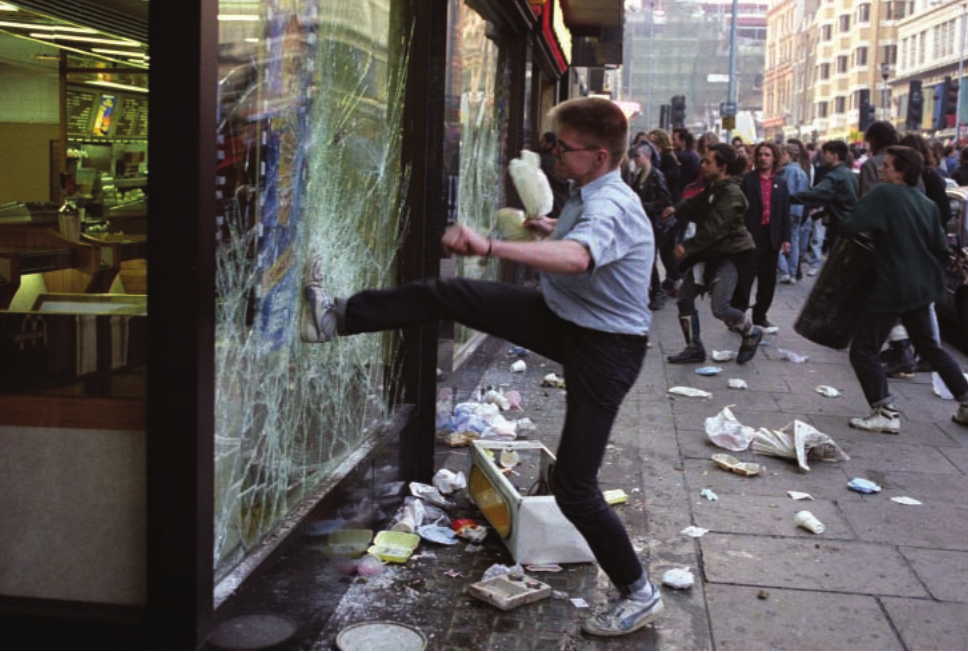
Public opposition and civil unrest: The new tax proved very unpopular in Scotland when introduced there, yet this did not deflect the 'Iron Lady' from her course. Major poll tax riots broke out in London and elsewhere in March 1990, often ending in violence. There were 100 injuries and 400 arrests following the anti-poll tax rally in central London. A major civil disobedience campaign of non-payment also emerged.
Administrative difficulties: The poll tax proved difficult to collect, essentially because people can easily move or disappear in ways that bricks and mortar cannot. High rates of evasion occurred and the tax proved costly to administer.
Media criticism: The new tax was easily parodied in parts of the media, where opponents seized on the 'duke and dustman' analogy — namely that the duke in his mansion would pay the same as the man who emptied the duke's bins.
Internal party opposition: Opposition within Thatcher's own party sparked a leadership challenge against her by former cabinet minister Michael Heseltine. Thatcher failed to win sufficient votes in the first ballot to be assured of final victory and was, somewhat reluctantly, persuaded to step down rather than face possible defeat in the second ballot.
Economic context: There was evidence that the economy was weakening and Tory opinion poll numbers were slipping.
Swift reversal: Soon after Thatcher's resignation, the new prime minister and Conservative Party leader, John Major, replaced the poll tax with the council tax, which was a property-based tax not dissimilar to the original rates system.
Lessons from the poll tax failure
The poll tax was a policy personally associated with Thatcher and demonstrates how the prime minister can personally dictate and decide policy. However, when it began to unravel, she had no 'political cover' — there was no one else to blame for its lack of popularity.
The policy, and especially Thatcher's handling of it, highlighted growing concerns within her own party about her inability or unwillingness to listen to others. This was illustrated when a normally loyal backbencher, Ralph Howell, sought to raise the issue with the prime minister on behalf of two constituents. An elderly couple living in a house called Dream of Delight in Great Snoring, North Norfolk, had written directly to the prime minister complaining about the poll tax. In their letter they commented: "You have taken advantage of your position to impose your will upon us to the point where you are now virtually a dictator riding roughshod over anyone who opposes you." When Howell sought a meeting with Thatcher to discuss the complaint, her adviser suggested this be granted but commented: "The meeting will be a waste of time, but I am afraid she will have to do it to keep his frustration at bay." This was a telling reflection on how Thatcher was perceived even by those closest to her.
Note
The story of the couple from Dream of Delight in Great Snoring illustrates how the poll tax affected ordinary constituents and how even loyal backbenchers became concerned about Thatcher's leadership style. The adviser's dismissive comment about the meeting being "a waste of time" reveals the increasingly isolated and dismissive attitude that characterized Thatcher's final period in office.
The poll tax story shows that powerful prime ministers clearly have the power to push through policy. It also highlights the real dangers that can ensue from rejecting the advice of political allies and natural supporters. For some in the Conservative Party, the policy represented a 'final straw' with regard to Thatcher's leadership, coming amid growing fears that the Conservatives would lose the next election due in 1992.
The decision to invade Iraq in 2003
The risks of military intervention
Committing the armed forces to combat zones is always a risky move for prime ministers. When it goes well, with low casualties and both military and strategic success, it can offer a major political boost. This was the case with Thatcher and the Falklands War. When it goes badly, not only is the prime minister made to look weak and to possess poor judgement, but there is also the moral dimension of lives lost for no positive purpose.
Blair's decision to join the Iraq War
For Tony Blair, the Iraq War significantly coloured his legacy. When approached by US president George W. Bush to commit troops to a US-led invasion of Iraq, Blair obliged. He justified UK involvement on the moral grounds of removing weapons of mass destruction (WMDs) and used discredited intelligence reports claiming these could be launched within 45 minutes. The UK was almost alone among EU and NATO states in joining the USA in the war. It would have been relatively easy for the UK to follow the example of France and Germany and stay on the sidelines.
Important
Blair's decision to join the Iraq War was particularly significant because it went against the position taken by most of Britain's European allies. The UK could have chosen to remain on the sidelines, as France and Germany did, but Blair's personal relationship with President Bush and his conviction about the moral case for intervention drove the decision.
As it happened, formal military victory was largely straightforward, and Iraq's dictator Saddam Hussein was soon removed. Far less easy, however, was the creation of a peaceful and stable successor state. Iraq descended into bloody civil war, the entire region was destabilised, and fertile seeds were sown for the later rise of fundamentalist militant groups such as IS. Over 180 British lives were lost — alongside, lest we forget, thousands of Iraqis — and no WMDs were found. There were also allegations of human rights abuses committed by British soldiers on Iraqi civilians and prisoners. Large-scale anti-war protests took place across the UK, and opinion polls showed a sharp slump in public trust of Blair. His standing in the Labour Party was badly (some would say irreparably) damaged.
The prime minister's ability to dictate policy: the Iraq War
There was no pressure within the cabinet or the wider party, or indeed the public, for UK troops to be mobilised. There was no sense that national security was imminently threatened by Iraq. The decision was largely the result of Blair wanting to cement his strong personal relationship with Bush and to deepen the 'coalition of the willing'.
Lack of proper scrutiny: A series of official reports after the war, such as the 2004 report by Lord Butler and the 2016 Chilcot Report, were highly critical of government actions, especially those taken by Blair personally. It transpired that although the cabinet was briefed many times on the situation in Iraq beforehand, ministers were denied access to key papers.
Important
The post-war reports, particularly the comprehensive Chilcot Report in 2016, revealed serious flaws in the decision-making process. Cabinet ministers were briefed on Iraq but denied access to key documents, preventing informed collective discussion. This lack of proper scrutiny is a fundamental failure of cabinet government.
Sofa government: Blair's preference for informal 'sofa government' meant there was little by way of informed collective discussion and decision-making. Blair also disregarded security warnings and criticism that the legal basis for going to war had not been fully evaluated. There was apparently scant discussion of other policy options, such as working more in tandem with European neighbours or through the UN. Blair was left without much, if any, political or diplomatic cover, especially when the non-existence of WMDs emerged.
Cabinet resignations: The resignation of key and high-profile cabinet minister Robin Cook, and of Clare Short soon afterwards, served to weaken Blair's position further and more publicly. The suicide of government scientist Dr David Kelly also increased scrutiny of government and criticism of the government's Iraq War policy.
Long-term legacy: The legacy of this unsuccessful military venture can be seen in the reluctance of subsequent UK governments to deploy ground forces in further Middle East conflicts, such as Syria.
Note
The term 'sofa government' refers to Blair's preference for making decisions in informal settings with a small group of advisers, rather than through proper cabinet discussions. This style of governance bypassed traditional structures of collective decision-making and meant that important decisions were made without the full scrutiny and input of elected cabinet ministers.
The decision to call an early election in 2017
The political and legal context
Sometimes in politics, it is hard to draw a clear line between policy and political strategy. The calling of a snap election for June 2017 is just such a case. Calling an election is one of the traditional prerogative powers enjoyed by the prime minister. However, for Theresa May the situation was not straightforward. Under the Fixed-term Parliaments Act (FTPA) 2011, another general election was not due until 2020.
Having become leader in July 2016 after David Cameron resigned following the success of the Leave campaign, May had said in September on the BBC's Andrew Marr Show: "I'm not going to be calling a snap election." Yet she reversed that promise on 18 April 2017, when she announced she would be calling an early election, effectively challenging Labour leader Jeremy Corbyn to 'come out and fight'. Labour's support was needed to ensure the two-thirds majority in the Commons required by the FTPA for an election to take place. Labour supported the call and the election duly took place on 8 June.
Note
The Fixed-term Parliaments Act 2011 had removed the prime minister's traditional power to call elections at will, requiring instead either a two-thirds majority in the Commons or a vote of no confidence. May's U-turn on calling an election was particularly striking given her clear public statement just months earlier that she would not do so.
Motives behind the decision
The motives behind this change of policy are best understood as a mixture of capitalising on perceived political advantage and enabling her Brexit strategy to be successfully implemented. In the event, the policy backfired and the Conservatives lost rather than gained seats, forfeiting their overall majority in parliament.
The prime minister's ability to dictate policy: the 2017 election
This was ultimately a personal decision made by May, although she had taken advice from her political advisers, especially Nick Timothy, who resigned soon afterwards.
Seeking a personal mandate: As an unelected leader, May wanted her own personal endorsement from voters. She might have been influenced by the earlier example of Labour prime minister Gordon Brown. Like May, he took over the premiership mid-term, and while there was talk of him calling an early election to secure that alluring personal mandate, he was accused of 'bottling it', delaying the election until 2010 when he subsequently lost.
Brexit strategy: May was convinced she needed her own mandate to push through Britain's exit from the EU following the 2016 referendum. She was aware, however, that many Tory Remainers would resist leaving the single market and the customs union. She therefore wanted an increased majority to neutralise such a threat.
Favourable polling: A key factor was that the opinion polls prior to calling the election looked very favourable. They indicated a 20% lead for the Conservatives, while Corbyn was regarded as too left-wing and an easy opponent to defeat.
Campaign failures and outcomes
Important
May's decision to call the 2017 election appeared rational based on the polling data available at the time. However, the campaign revealed fundamental weaknesses in both her leadership style and her campaign team's strategy. The outcome demonstrates that even seemingly safe political gambles can backfire spectacularly.
Electoral losses: The gamble did not pay off. Although gaining seats in Scotland, the Conservatives lost seats to Labour in England, and ended up eight seats short of an overall Commons majority, suffering a net loss of 13 seats.
Manifesto problems: The Conservative manifesto flopped. One of its centrepiece policies, a new way of funding care for older people, was quickly dubbed the 'dementia tax'. An attempt to backtrack on aspects of this social care policy undermined May's self-proclaimed portrayal of 'strong and stable' leadership.
Weak campaigning: The campaign revealed May to be a weak public campaigner. Her repetition of the phrase 'strong and stable' was criticised in some quarters as 'Dalek messaging'.
Strategic errors: A further campaign flaw was revealed when The Guardian newspaper found the prime minister spent more than half the campaign in Labour-held seats, and just a fifth of her stops were in Tory marginals. In other words, she was being over-confident and not defensive enough in her campaign strategy.
Command and control: There is strong evidence that May relied too much on a small group of inner advisers and not wider sections of the party — in other words, there was too much 'command and control'.
The outcome of this fatally flawed decision was that although she remained in No. 10, the rest of May's premiership was undertaken in straitened circumstances. She squandered much of her political capital with her party and had a weaker, not stronger, mandate after the election. Her original desire to follow through and deliver Brexit essentially hit the parliamentary buffers.
A comparison of the three cases
It is worthwhile comparing the three situations, while bearing in mind that they are distinct cases that reveal the different ways prime ministers have fared when seeking to dictate policy and events.
Similarities between the three cases
Note
Common patterns in prime ministerial failures
Despite occurring in different decades and involving different policy areas, the three cases share striking similarities that reveal common pitfalls in prime ministerial decision-making.
Personal prime ministerial decisions: Each case involved decisions taken directly by and personally associated with the individual prime minister. In all three instances, the prime minister put their personal authority and reputation on the line.
Appeared rational initially: Each case appeared rational and logical at the outset. The policies seemed to offer clear benefits or solutions to existing problems, which is why they were pursued despite potential risks.
Involved significant gambles: Each case represented a gamble — none 'had' to be undertaken in response to a particular crisis or to fulfil a major policy pledge (although the Conservatives had for a while promised to reform domestic rates). The prime ministers chose to take these risks.
Failed to consult widely: In all cases, the prime minister failed in the preliminary stages to consult widely and heed more closely the voices of caution within their party. This lack of proper consultation proved to be a critical weakness.
Ended in failure and resignation: Each decision ended in failure and contributed significantly to each leader's resignation. The political costs of these failed gambles were severe and ultimately terminal for each premiership.
Differences between the three cases
Note
Key distinctions between the cases
While the three cases share important similarities, understanding their differences helps reveal the various contexts in which prime ministerial power can be exercised and the different ways it can go wrong.
Nature of the policy: The poll tax was much more a 'conviction' policy driven by ideological beliefs, while the 2017 election was determined more by political and electoral considerations. The invasion of Iraq resulted from pressure from one of Britain's closest overseas allies.
Timing in premiership: The poll tax came at the tail end of a long-established premiership (Thatcher's third term), whereas the 2017 election was early on in Theresa May's time as prime minister. The Iraq War was midway through Tony Blair's premiership.
Type of consequences: The poll tax involved serious breaches of public order, with riots and violent protests, while the Iraq War claimed the lives of a significant number of British servicemen and women. The 2017 election decision was a more direct test of the prime minister's abilities as a political campaigner.
Speed of resignation: The Iraq War did not immediately end the Blair premiership. He went on to win the 2005 election, although his majority fell to 66 seats compared with the 167-seat majority gained in 2001. In contrast, the poll tax and 2017 election had more immediate impacts on the respective prime ministers.
Lessons for future prime ministers
The lesson to take away from this analysis is that when prime ministers seek to dictate events and determine policy-making, they need to be extremely careful, have effective 'political antennae', and calculate and manage risks carefully. If a political gamble looks too attractive to be true, it probably is!
Important
Critical requirements for successful prime ministerial leadership
Prime ministers who fail to meet these key requirements are likely to find their authority undermined and their premierships shortened.
Prime ministers who fail to:
- Consult widely within their party
- Listen to voices of caution
- Test their assumptions against reality
- Consider alternative options
- Build political support for risky decisions
...are likely to find their authority undermined and their premierships shortened.
Remember!
Summary
Key takeaways on prime ministerial power:
-
Partial control: Prime ministers and their cabinets have only partial control over events and policy decisions, though they can dictate policy in certain circumstances.
-
Personal authority brings risk: When prime ministers personally drive policy decisions (such as the poll tax, Iraq War, or 2017 election), they risk having no 'political cover' when things go wrong — there is no one else to blame.
-
Consultation is crucial: All three major failures (poll tax, Iraq War, 2017 election) involved prime ministers failing to consult widely and heed voices of caution within their party. Ignoring advice from political allies and natural supporters can prove fatal.
-
Political capital matters: Successful policy-making requires careful management of political capital. Prime ministers need effective 'political antennae' to calculate and manage risks carefully, especially when taking political gambles.