The Role of Prime Minister (AQA A-Level Politics): Revision Notes
📚Revision Notes
The Role of Prime Minister
How the role has evolved
The formal powers of the Prime Minister have remained relatively unchanged since the days of Robert Walpole in the eighteenth century. However, the office itself has transformed considerably over the past 250 years. Understanding these changes requires examining both the continuities and the shifts in how prime ministers exercise power.
The Prime Minister's prerogative powers remain significant. These powers allow the executive to act without direct parliamentary approval, particularly in areas such as negotiating treaties and defence agreements with other nations. However, these powers have clear limitations.
Note
The Brexit saga demonstrated how the Supreme Court can constrain executive action, forcing the Prime Minister to submit Brexit proposals to Parliament for approval. Even in foreign policy and diplomacy, the government must respond to parliamentary scrutiny, media attention, and public opinion. This shows that prerogative powers, whilst significant, operate within a framework of accountability and cannot be exercised without regard for other constitutional actors.
Reflections from former prime ministers
Understanding the role of Prime Minister is enhanced by considering how previous holders of the office have reflected on their experience. Their observations reveal important truths about the constraints and opportunities of the position.
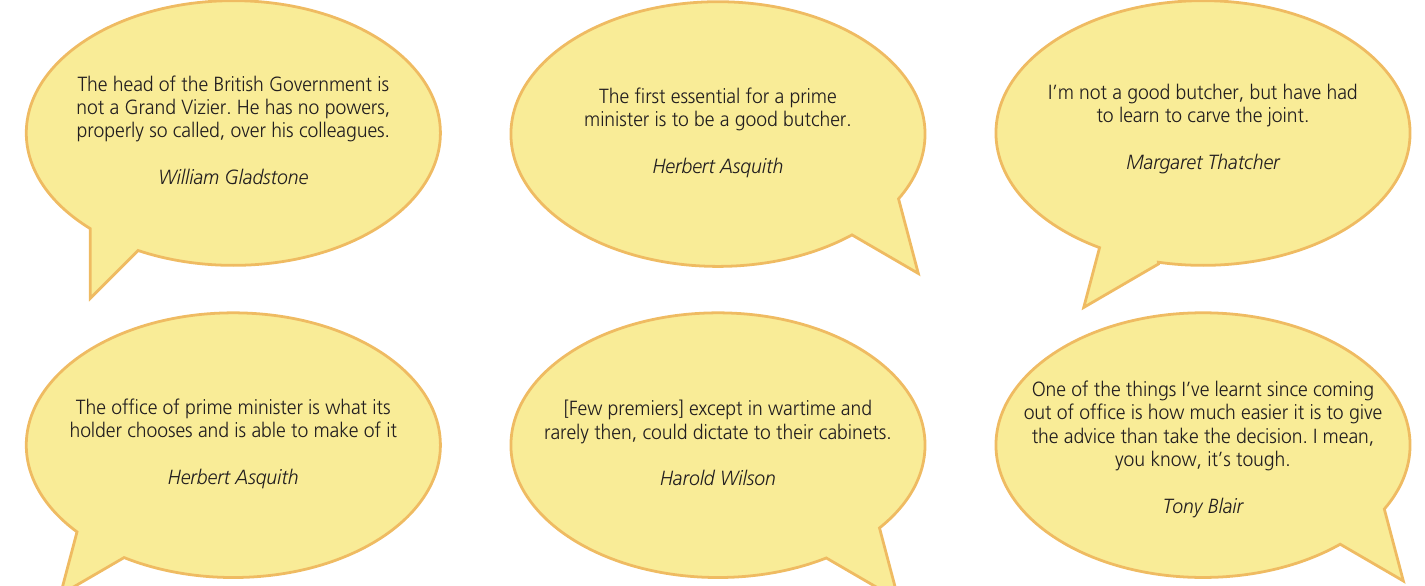
These quotations from prime ministers spanning the late nineteenth to early twenty-first century reveal several crucial aspects of the role:
- A Prime Minister cannot simply command obedience from colleagues. As William Gladstone observed, the head of the British government lacks absolute power over the cabinet.
- The position requires making difficult decisions. Herbert Asquith famously stated that "the first essential for a prime minister is to be a good butcher," whilst Margaret Thatcher admitted she had to learn to "carve the joint" - both referring to the need to remove or reshuffle ministers.
- Prime Ministers must work hard at persuasion. Harold Wilson noted that premiers rarely dictate to their cabinets, even in wartime. This emphasises the importance of building consensus and bringing colleagues around to one's viewpoint.
- Decision-making is challenging. Tony Blair reflected that giving advice is far easier than actually taking the decision, highlighting the immense responsibility of the office.
- The role is inherently flexible. Asquith recognised that "the office of prime minister is what its holder chooses and is able to make of it," suggesting scope for different leadership styles.
Note
These reflections reveal a consistent theme across different eras: the Prime Minister's power is constrained by the need to work with others. Despite being the most powerful figure in British politics, no PM can govern effectively through command alone - they must persuade, negotiate, and build consensus within their cabinet and party.
The accusation of presidentialism
What is presidentialism?
Important
Presidentialism refers to the criticism that the Prime Minister has adopted a more presidential style of leadership - becoming increasingly autocratic and dominant, particularly over the cabinet. Critics argue that cabinet government has been undermined, with the traditional model of open debate replaced by a compliant body of "yes men and women."
Thatcher and Blair: presidential prime ministers?
This accusation has been most frequently directed at Margaret Thatcher (1979-90) and Tony Blair (1997-2007).
Thatcher's style was often criticised as intolerant and overbearing. Her cabinet became divided between 'wets' (dissenters) and 'dries' (supporters), with opponents increasingly marginalised from positions of real influence.
The Blair government faced accusations of preferring 'sofa government' - informal discussions involving just two or three ministers - rather than full cabinet meetings. Mo Mowlam, Blair's former Northern Ireland Secretary, lamented in 2002 that "Cabinet itself is dead, it doesn't have a function to play."
The coalition and 'The Quad'
Even the 2010-15 coalition government, which required greater consensus due to power-sharing between two parties, saw power concentrated amongst a small group.
Example
The Quad: Power Concentration in Coalition Government
Real authority in the 2010-15 coalition rested with 'The Quad', consisting of just four key figures:
- Prime Minister David Cameron (Conservative)
- Deputy Prime Minister Nick Clegg (Liberal Democrat)
- Chancellor George Osborne (Conservative)
- Chief Secretary to the Treasury Danny Alexander (Liberal Democrat)
Despite the coalition involving two entire parties with full cabinets, major decisions were made by this small group, demonstrating that even in supposedly more collaborative arrangements, power can become concentrated in the hands of a few key individuals.
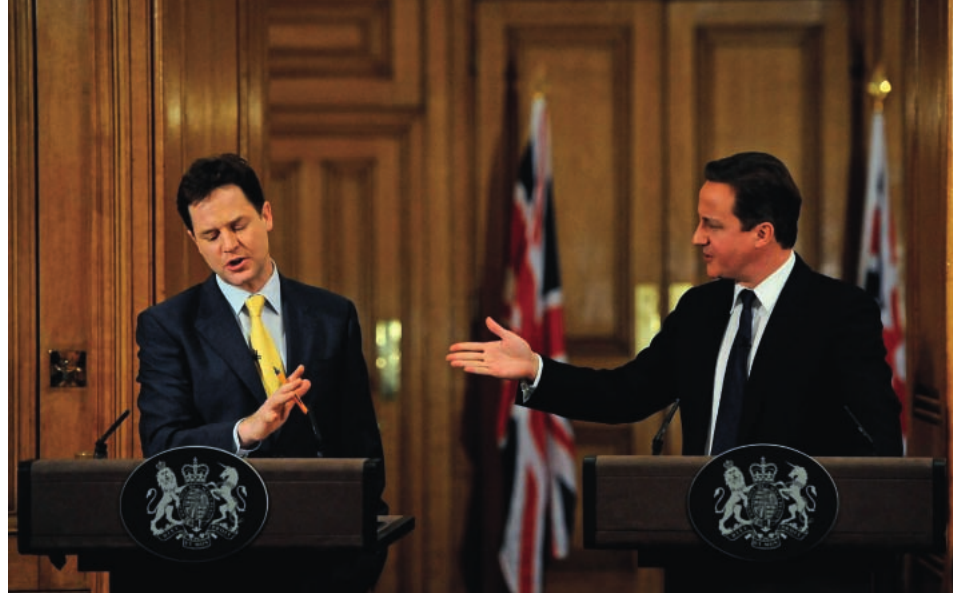
This phenomenon is termed spatial leadership - when distance is created between the Prime Minister and the rest of government and party. The PM relies heavily on a small inner circle of advisers, sometimes called a kitchen cabinet or inner cabinet.
Inner cabinet refers to a small core of ministers a Prime Minister particularly relies upon for advice or support. This reflects both the large size of the full cabinet and the tendency for prime ministers to seek ideas from ministers they particularly trust.
The rise of special advisers
Much attention has focused on prime ministers' increasing reliance on special advisers (SpAds). These are political and personal appointments made by the PM, unlike permanent civil servants. SpAds are policy advisers often believed to wield excessive power over the Prime Minister at the expense of fellow ministers and the civil service.
SpAds were first appointed by Harold Wilson in the 1960s, but their role has grown significantly. They are often colourful, controversial figures:
- Alastair Campbell (Blair's chief of staff and press secretary) famously interrupted an interview about Blair's faith with "We don't do God"
- Nick Timothy and Fiona Hill were principal advisers to Theresa May
- Dominic Cummings served Boris Johnson, controversially appealing for "weirdos and misfits with odd skills" to apply for government jobs
By December 2019, Boris Johnson's government employed 108 special advisers, compared with 99 under Theresa May. Many SpAds are long-time political associates of the Prime Minister, such as Eddie Lister (Johnson's chief strategic adviser who had worked with him as London mayor).
Note
The controversy surrounding special advisers centres on their perceived influence over policy-making and their lack of traditional civil service accountability. Clare Short, in her 2003 resignation speech, criticised "the centralisation of power into the hands of the prime minister and an increasingly small number of advisers who make decisions in private without proper discussion." The departure of Dominic Cummings in November 2020 seemed to confirm concerns about SpAds becoming too powerful and controversial.
The case against presidentialism
The importance of context
It is misleading to see a clear, sustained trend towards prime ministerial power accumulation. The Thatcher and Blair years may suggest strong, dominant premiers, but this overlooks the broader picture.
Important
Prime ministers with weak or non-existent parliamentary majorities operate in very different circumstances. Context is not just important - it can be decisive in determining how much power a PM can actually exercise.
Example
Theresa May: An Imperilled Prime Minister
Theresa May's premiership demonstrates how parliamentary arithmetic and party division can cripple even a sitting Prime Minister:
- January and March 2019: May suffered two crushing defeats over her Brexit deal in Parliament
- July 2018: Her cabinet agreed the 'Chequers deal' on Brexit, but within days two cabinet ministers resigned: Brexit Secretary David Davis and Foreign Secretary Boris Johnson (who colourfully compared the deal to "polishing a turd")
- Weak position: May lacked an overall Commons majority, depending on the DUP to pass legislation, whilst her party was deeply divided over Brexit
This demonstrates that formal powers mean little when a PM lacks the parliamentary support to implement their agenda.
Even strong prime ministers face limits
Even prime ministers with large majorities can find themselves imperilled. Both Thatcher and Blair were effectively forced from office due to criticism and divisions within their own party over controversial policies - the poll tax (Thatcher) and the Iraq War (Blair). Loyalty from backbenchers is never guaranteed and always conditional.
All prime ministers must work through key ministerial colleagues. Tony Blair had to navigate his relationship with Chancellor Gordon Brown, his sometime rival and eventual successor.
Note
Former Conservative minister Enoch Powell shrewdly observed in 1977 that "All political lives, unless they are cut off in midstream at a happy juncture, end in failure, because that is the nature of politics and of human affairs." Few recent UK prime ministers have left office entirely at a time of their own choosing. This sobering reality underscores the ultimate limitations on prime ministerial power.
Reconsidering the power of SpAds
The power of special advisers may be exaggerated. Some prime ministers appoint them because they feel the civil service is too set in its ways with its own agenda. However, as former senior minister Gerald Kaufman pointed out, ministers who antagonise the civil service "can do little," whilst those who win its cooperation "can do quite a lot."
During the COVID-19 pandemic, the most influential advice came not from SpAds but from medical experts like Chief Medical Officer Professor Chris Whitty and Chief Scientific Adviser Sir Patrick Vallance. This suggests traditional sources of policy advice remain important.
The best way for prime ministers to wield power is to work alongside others, listen, and refuse to become captive to a small clique.
Has the role really changed?
Arguments that the role has greatly changed:
Presidential leadership styles: Recent prime ministers like Thatcher and Blair have been accused of bypassing full cabinet meetings, preferring smaller gatherings of key ministers and advisers.
Growth of SpAds: There has been significant growth in special advisers at the expense of seeking policy advice from the civil service.
Celebrity culture and media focus: Social media and celebrity culture have resulted in growing focus on individual personality and style rather than the wider cabinet. Since 2010, televised leaders' debates during general election campaigns have reinforced this personal focus.
Direct communication with the public: Increased media scrutiny has led more prime ministers to take their message directly to the people, often appearing on 'soft format' TV chat shows.
Arguments that the role has barely changed:
Formal powers unchanged: There have been no formal changes in prime ministerial powers in recent times. Twenty-first-century premiers possess the same prerogative powers as their predecessors. Some powers have even been reduced, such as the ability to easily call fresh general elections.
Variable circumstances: The 'predominant premierships' of Thatcher and Blair should be assessed alongside the more imperilled ones of John Major, Theresa May, and David Cameron's coalition administration.
SpAds' influence overstated: The influence of special advisers is probably exaggerated. Traditional sources of policy advice - fellow ministers and the civil service - remain important. During COVID-19, the most powerful advice came from medical experts like Chris Whitty, not SpAds.
Collaborative presentation: Image-aware prime ministers often want to present themselves as collegiate and collaborative rather than sole star players. During the COVID-19 emergency, Boris Johnson frequently appeared at media briefings with Chief Scientific Adviser Sir Patrick Vallance.
Academic perspectives
Opinions differ significantly on whether the Prime Minister has become more presidential.
Michael Foley (2000) argued in The British Presidency:
The British prime minister has evolved, and is evolving, away from what a prime minister used to do and used to be…British politics has accommodated and adjusted to a distinctive presidential dimension.
Richard Heffernan (2005) offered a contrasting view:
To describe the prime minister as a president underplays the core degree of collegiality found within a parliamentary executive. It also underestimates the degree of leverage a prime minister, compared to a president, can have over both legislature and executive.
Note
Perhaps modern prime ministers are best described as parliamentary presidents - exhibiting some presidential characteristics whilst remaining fundamentally constrained by the parliamentary system. This concept attempts to bridge the gap between the two perspectives, recognising both the increasing prominence of individual prime ministers and the continuing importance of parliamentary and cabinet constraints.
Conclusion: context is key
The formal institutional powers of the Prime Minister have changed very little in recent times. Their prerogative powers and those derived from being leader of the majority party in Parliament have remained constant.
What is variable - and this has been true for all modern prime ministers - is the context and particular situations of their premierships. A Prime Minister with a large majority, united party, and popular policies can appear dominant and presidential. A PM with a small majority, divided party, or controversial policies will appear weak and imperilled.
The role of Prime Minister remains flexible, shaped by the individual's personality, their political circumstances, and the challenges they face. Understanding this variability is key to assessing prime ministerial power.
Remember!
Summary
Key Points to Remember:
-
Prerogative powers remain significant but are limited by Parliament, courts, media and public opinion, as the Brexit saga demonstrated.
-
Presidentialism refers to accusations that PMs like Thatcher and Blair became too autocratic, bypassing cabinet and relying on small groups of advisers and SpAds (special advisers).
-
Context matters enormously: even prime ministers with large majorities (Thatcher, Blair) can be forced out, whilst those with weak majorities (May, Major) face severe constraints.
-
The formal powers of the Prime Minister have remained largely unchanged - what varies is the political context, parliamentary majority, party unity, and individual leadership style.
-
Academic debate continues: Foley sees a "presidential dimension" emerging, whilst Heffernan emphasises the continuing importance of collegiality and parliamentary constraints.