Forms and Patterns of Participation in Politics (AQA A-Level Politics): Revision Notes
📚Revision Notes
Forms and Patterns of Participation in Politics
Introduction to political participation
While voting represents the most significant form of political participation in a democracy, citizens can engage with politics through numerous other methods. These range from traditional activities that have existed for decades to modern approaches enabled by digital technology and social media.
Note
Understanding the full spectrum of political participation is essential for evaluating the health of democratic engagement in the UK. This includes both conventional methods and emerging digital forms that have transformed how citizens interact with the political process.
Traditional forms of political participation
Traditional political participation encompasses a range of established activities that citizens have used to engage with the political process. Citizens can engage through various established channels:
- Voting in various types of elections, including general elections, local elections, regional elections and referendums
- Party membership, which includes attending meetings, participating in internal discussions and actively campaigning during elections
- Standing as a candidate in elections at any level of government
- Joining pressure groups to campaign for specific causes or interests
- Writing letters to MPs, councillors and other political representatives
- Attending marches and demonstrations to show support for particular issues
- Participating in strikes as a form of industrial and political action
These traditional forms have been the backbone of political engagement in the UK for many decades and continue to play an important role in democratic participation.
Recent developments in political participation
The digital age has introduced new forms of political participation that complement traditional methods. Citizens can now engage through modern channels that leverage digital technology:
- Signing e-petitions, particularly those on the UK Parliament website, which can trigger parliamentary debates if they reach 100,000 signatures
- Engaging with political content on social media platforms such as Twitter and Facebook through following, retweeting, liking and sharing political posts
- Organising and participating in protests through social media networks, as demonstrated by movements like Black Lives Matter
- Ethical boycotting of goods and businesses based on political or moral principles
These modern forms of participation have made political engagement more accessible and immediate, allowing citizens to respond quickly to political developments and connect with like-minded individuals across geographical boundaries.
Note
Digital participation has lowered barriers to entry, enabling citizens who might not attend traditional political meetings to engage from home. However, this accessibility raises questions about the depth and effectiveness of such engagement.
Criticisms and limitations of social media participation
While digital forms of participation offer new opportunities for engagement, they have attracted significant criticism and concern.
Important
Slacktivism represents a shallow level of political engagement. The term describes the practice of supporting political causes through minimal-effort actions, such as clicking 'like' on a social media post. Critics argue this requires little personal commitment and may create an illusion of activism without meaningful political impact.
Trolling and abusive discourse undermine constructive political debate. Much online political discussion features aggressive, abusive language that discourages participation and reduces the quality of political discourse. This toxic environment can particularly deter women, ethnic minorities and young people from engaging in online political spaces.
Twitter bots can distort the appearance of political support. These automated accounts use software to perform actions like tweeting, retweeting, liking and following other accounts. This artificial activity can misrepresent the genuine level of support for particular causes or politicians, making it difficult to assess real public opinion.
Is there a political participation crisis in the UK?
Many political scientists and commentators express concern about a potential participation crisis in British politics. The argument suggests that fewer people are becoming involved in political activity, leading to widespread political apathy. Three main types of evidence support this concern:
- Declining voter turnout in elections
- Falling membership of political parties
- Growing electoral volatility among voters
However, the 2009 MPs' expenses scandal and the protracted Brexit debates between 2017 and 2020 have been cited as events that particularly damaged public trust in politicians and political institutions.
Participation through voting
Voter turnout in general elections has declined significantly from historical levels. Between 1945 and 1992, turnout typically exceeded 75% and reached 84% in 1950. In 2019, turnout fell to 67.3% across the UK, representing a 1.5 percentage point decrease from 2017 (68.8%). Nevertheless, this remained the second-highest turnout since 1997.
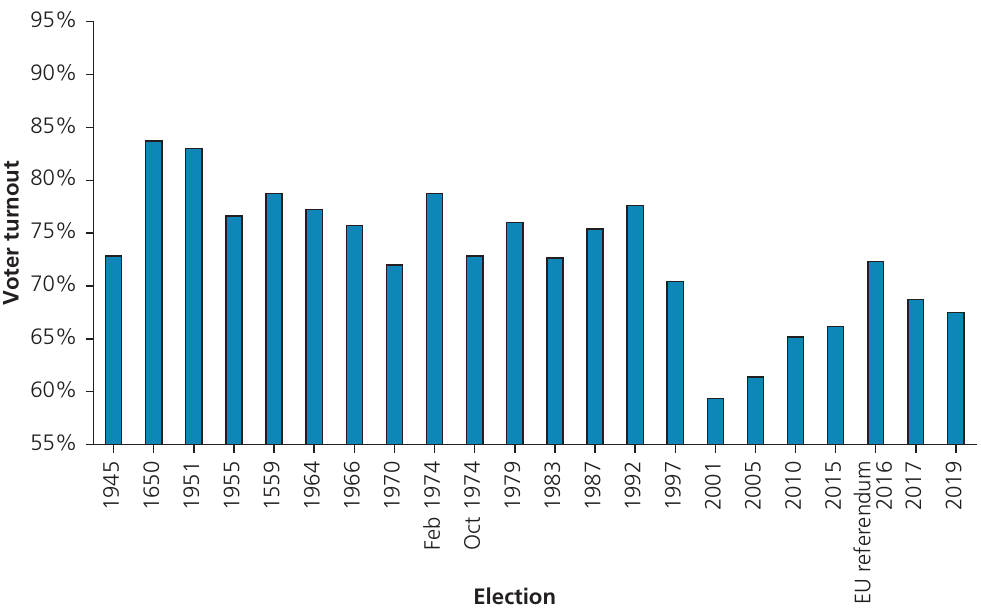
Turnout in other recent elections reveals more concerning patterns:
- European Parliament elections 2019: 37% (34% in 2014)
- Local elections for unitary councils 2018: 33% (37% in 2017)
- Police and crime commissioner elections 2016: 27% (15% in 2012)
- Scottish Parliament elections 2016: 56% (50% in 2011)
However, turnout for referendums shows that voters engage strongly when issues excite passionate responses:
- Scottish independence referendum 2014: 85%
- EU referendum 2016: 72%
- Alternative vote referendum 2011: 42%
Note
These figures suggest that turnout varies considerably depending on the perceived importance and salience of the vote. Issues like Scottish independence and Brexit generated much higher participation than routine local or police commissioner elections. This pattern challenges simplistic narratives about widespread political apathy.
Age represents a crucial factor in determining likelihood to vote. Research by Ipsos MORI for the 2019 general election found turnout ranged from just 47% among 18- to 24-year-olds to 74% among those over 65. This represented a wider gap than in 2017, when the same organisation recorded 54% and 71% respectively. However, these polling-based figures should be treated with caution as they only sample selected voters, unlike comprehensive turnout data.
Important
The generational gap in voting participation represents one of the most significant challenges to democratic representation in the UK. Young people's lower engagement means their interests may be underrepresented in policy-making, creating a self-reinforcing cycle where politics appears irrelevant to younger citizens.
Constituency variations also reveal significant differences in participation. In 2019, East Dunbartonshire (a highly marginal seat) recorded the highest turnout at 80%, while Kingston upon Hull East showed the lowest at just 49%. Low-turnout constituencies clustered in urban northern England, the West Midlands, the Thames estuary and South Wales valleys. High-turnout constituencies tended to be in southwest and southeast England, often in relatively affluent areas with above-average education levels and graduate populations.
Interestingly, turnout in 2017 and 2019 showed little correlation with constituency marginality. Of the 650 constituencies, 453 (70%) had been won by the same party in each of the last four general elections, classifying them as safe seats. However, average 2019 turnout in these constituencies (67.1%) was only slightly lower than in the 197 seats that changed hands at least once in that period (67.9%).
Participation through party membership
Political party membership has experienced dramatic decline over recent decades. A House of Commons research paper published in 2019 provided current membership figures:
- Labour Party: approximately 485,000 members
- Conservative Party: 180,000 members
- SNP: 126,000 members
- Liberal Democrats: approximately 115,000 members
- Green Party (England and Wales): 48,500 members
- UKIP: approximately 29,000 members
- Plaid Cymru: approximately 10,000 members
The combined membership of the Conservatives, Labour and Liberal Democrats represents just 1.7% of the electorate. While this compares favourably to a historic low of 0.8% in 2013, these figures remain far below earlier decades. During the 1950s, the Conservatives boasted approximately 2.8 million members, while Labour exceeded 1 million members plus several million more through affiliated trade union membership.
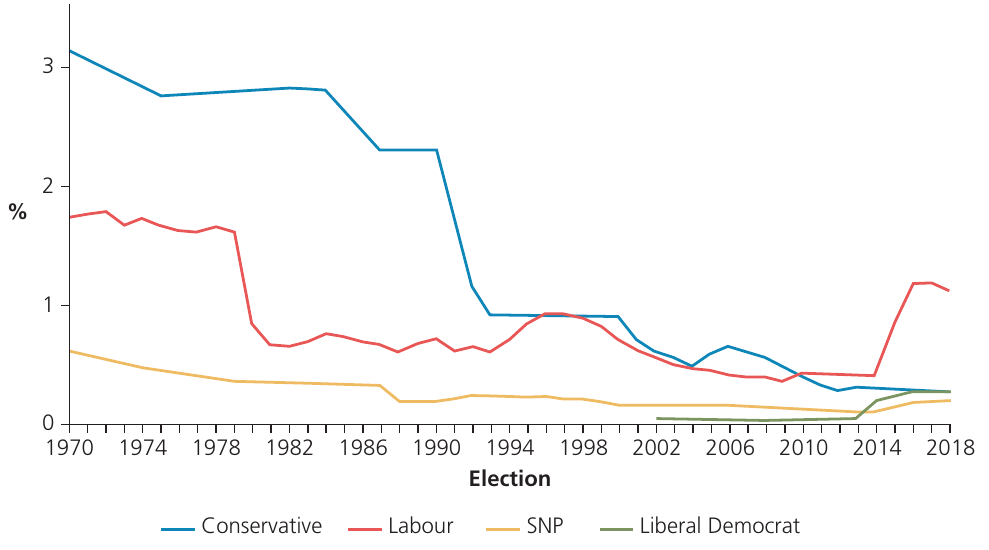
Note
Despite overall decline, the picture shows some positive developments. Labour experienced a significant membership surge during Jeremy Corbyn's leadership years. The steady decline in Conservative Party membership has levelled off. Membership of parties like the SNP and Greens has grown considerably in recent years. Political parties are not alone in experiencing membership decline—churches and trade unions have also seen sharp decreases since the 1950s.
Complications arise because not all parties publish clear, comparable membership figures regularly. The Brexit Party had no official membership but claimed 115,000 registered supporters in 2019.
Party membership demographics reveal significant skews by age and social class. A majority of party members belong to higher social classes (ABC1), ranging from 85% of Liberal Democrat members to 65% of UKIP members. Regarding age, the average party member exceeds 50 years old across all main parties. More than half (53%) of current Conservative Party members are aged 60 or over. By contrast, 18- to 24-year-olds comprise just 4% to 6% of Labour, Liberal Democrat and Conservative memberships.
Important
The demographic imbalance in party membership—skewed towards older, middle-class individuals—raises concerns about representation and policy priorities. Political parties may struggle to connect with younger voters and working-class communities when their active membership does not reflect these groups.
Participation and electoral volatility
Partisan dealignment—the process whereby individuals become less partisan and predictable in supporting a particular political party—represents a third indicator cited as evidence of participation crisis. Growing electoral volatility suggests voters are increasingly willing to switch between parties, potentially indicating wider disillusionment with parties and politicians.
As social class has become less reliable as an indicator of voting behaviour, voters have become more prepared to "shop around," making decisions based on policies and personalities rather than traditional tribal loyalties. New parties have gained popularity in recent elections. UKIP and the Brexit Party topped polls in the last two UK-contested European elections, while the Green Party gained nearly 200 seats in the 2019 local elections. Independents secured over 600 new councillors in the same election.
Note
Whether partisan dealignment represents a genuine participation crisis or merely disillusionment with established parties remains debatable. A protest vote still constitutes participation, albeit perhaps less positive in nature. The combined Conservative and Labour vote share reached 75% in 2019 and 82% in 2017, compared to just 65% in 2010.
Some growth in "political promiscuity" can be attributed to declining traditional notions of class. British politics was once dominated by class identity, but this no longer holds true. While voters may switch between parties more readily, this does not automatically reflect wider disengagement from politics. Instead, it may indicate that citizens are making more sophisticated, issue-based choices rather than following traditional allegiances.
The debate: is there a participation crisis in UK politics?
Important
The question of whether the UK faces a genuine participation crisis divides political scientists and commentators. Evidence exists on both sides of this debate, and the answer may depend on how we define meaningful political participation in the 21st century.
Arguments suggesting a participation crisis exists:
- Low turnout across many recent elections indicates reduced engagement, particularly in local and European Parliament elections
- Sharp decline in party membership over the past half-century shows weakening institutional connection between citizens and political parties
- Partisan dealignment demonstrates voters feel less affiliation to particular parties, undermining stable democratic representation
- Disillusionment following scandals, particularly the 2009 expenses scandal, has damaged trust in politicians and may have driven citizens away from formal participation
- Youth disengagement is particularly marked, with 18- to 24-year-olds significantly less likely to vote or join parties than older voters, threatening long-term democratic vitality
- Slacktivism means many modern participation methods lack depth and genuine commitment, replacing substantive engagement with token gestures
Arguments suggesting no participation crisis exists:
- Some parties growing: SNP and Green Party membership has increased recently, suggesting disillusionment may be with particular parties rather than politics itself
- High referendum turnout shows citizens engage strongly when issues matter to them—the 85% turnout for the Scottish independence referendum and 72% for the EU referendum demonstrate robust civic engagement
- Different participation modes: Citizens still participate, just through new methods like e-petitions and social media rather than traditional forms—this represents evolution, not decline
- Social movements thrive: Less structured campaign groups focused on direct action, such as Extinction Rebellion and Black Lives Matter, attract strong support and commitment, especially from younger voters who may eschew party membership
- Pressure group growth: Many pressure groups have experienced considerable membership growth, with some boasting millions of members, suggesting issue-based participation remains strong
- Effective internet campaigns: Movements like #MeToo against sexual harassment demonstrate that internet-based campaigns can be powerful and generate substantial public debate, achieving real-world change
Summary
Key Points to Remember:
- Political participation extends beyond voting to include party membership, pressure group activity, contacting representatives, attending protests and increasingly, digital engagement
- Traditional forms (voting, party membership, marches) continue alongside recent developments (e-petitions, social media engagement, online protest organisation)
- Slacktivism describes shallow online participation requiring minimal effort, while trolling and Twitter bots undermine the quality and authenticity of digital political engagement
- Voter turnout has declined from 75%+ historically to around 67% in recent general elections, though referendums on major issues attract much higher participation
- Age is crucial: Young people (18-24) vote at roughly 47% compared to 74% for those over 65—this generational gap represents a significant challenge for democratic representation
- Party membership has fallen dramatically from millions in the 1950s to just 1.7% of the electorate for the three main parties combined, though some parties (Labour, SNP, Greens) have experienced recent growth
- Partisan dealignment means voters are less loyal to parties and more willing to switch based on policies and personalities rather than traditional class-based allegiances
- The participation crisis debate remains contested—evidence of decline exists, but new forms of engagement and high turnout for important votes suggest participation has evolved rather than disappeared