Key Elections: 1983 (AQA A-Level Politics): Revision Notes
📚Revision Notes
Key Elections: 1983
Context and background
The 1983 general election took place on 9 June 1983, at a pivotal moment in British political history. The country faced significant challenges, with unemployment exceeding 3 million, yet the national mood had been transformed by the recent military victory over Argentina in the 1982 Falklands War. This election would cement Margaret Thatcher's position as Conservative prime minister and deliver one of Labour's most devastating defeats in modern history.
Note
The 1983 election represents a crucial case study in understanding how external events (the Falklands victory), party divisions, and electoral systems interact to shape political outcomes. It demonstrates that winning elections requires more than just policies—timing, leadership, and party unity are equally vital.
The election is significant for several reasons. It demonstrated how a divided opposition can hand victory to the governing party, highlighted the impact of party leadership and campaign strategy on electoral outcomes, and provided a stark example of how the First Past the Post (FPTP) electoral system can distort representation in Parliament.
The formation of the SDP-Liberal Alliance
A crucial factor in the 1983 election was the split in the centre-left vote. In 1981, a group of moderate Labour MPs known as the "Gang of Four" (Roy Jenkins, David Owen, Bill Rodgers and Shirley Williams) left the party to establish the Social Democratic Party (SDP). They were disillusioned with Labour's leftward shift under Michael Foot's leadership.
The SDP joined forces with the Liberal Party to form the SDP-Liberal Alliance, which would later merge in 1988 to become the Liberal Democrats. This new alliance posed a significant challenge to Labour's traditional support base and would play a decisive "spoiler" role in the election outcome.
The election results
The 1983 election produced a landslide victory for the Conservatives. Their Commons majority increased dramatically from 43 seats in 1979 to 144 seats. However, this overwhelming parliamentary dominance masked a more complex picture of voter preferences.
| Party | Votes | Seats | Change | UK vote share | Vote share compared with 1979 |
|---|---|---|---|---|---|
| Conservative | 13,012,316 | 397 | +58 | 42.4% | -1.5% |
| Labour | 8,456,934 | 209 | -60 | 27.6% | -9.3% |
| SDP-Liberal Alliance | 7,780,949 | 23 | +12 | 25.4% | +11.6% |
| Others | 1,420,938 | 21 | +5 | 4.6% | -0.2% |
Exam tip: Note that whilst the Conservatives achieved a landslide in terms of seats, their actual vote share fell by 1.5% compared to 1979. This is an important distinction when analysing the election's significance.
The national swing was 3.8% from Labour to the Conservatives. However, regional variations were stark. In southern England outside London, Labour won just two seats out of 110, demonstrating their geographical isolation. Labour came third or worse in 292 out of 650 constituencies - a catastrophic result for a party aspiring to government.
Important
Labour's Geographical Collapse
The 1983 election revealed Labour's transformation from a truly national party to one with a severely restricted geographical base. Winning only 2 seats out of 110 in southern England outside London was not just a defeat—it signalled a fundamental realignment of British politics that would take decades to reverse.
Voting patterns by social class and age
The Conservatives performed strongly across different demographic groups. Among the C2 social class (skilled working class), they enjoyed an 8% lead. They also reduced their deficit among the DE social class (semi-skilled and unskilled workers) from -15% in 1979 to -8%, largely because Labour lost votes to the Alliance.
By age group, the Conservatives led across all categories, though their lead was more pronounced among voters over 55 (20% lead) compared to 18-34 year-olds (10% lead). This demonstrates that even in a landslide victory, different sections of the electorate responded differently to the parties' appeals.
Labour's campaign problems
Labour's 1983 campaign became notorious within the party as an example of how not to fight an election. Their manifesto, titled "The New Hope for Britain", was famously described by Labour's own Gerald Kaufmann as the "longest suicide note in history".
Important
Labour's Manifesto Crisis
The manifesto contained several controversial pledges that proved unpopular with voters:
- Unilateral nuclear disarmament (giving up Britain's nuclear weapons without requiring other countries to do the same)
- Withdrawal from the European Community (now the European Union)
- Abolition of the House of Lords
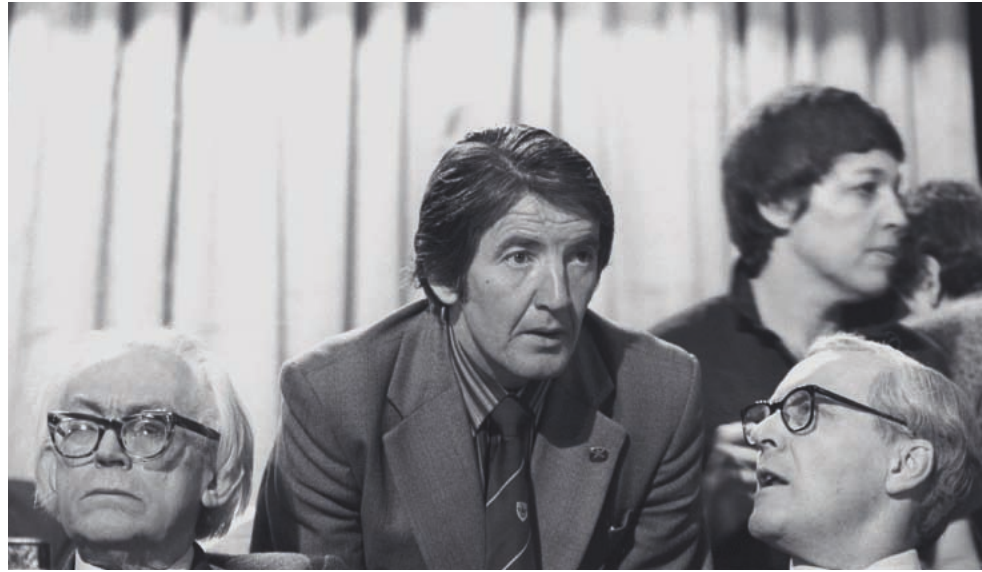
Internal party divisions were damaging, particularly over defence policy. When leader Michael Foot and deputy leader Denis Healey issued a joint statement confirming disagreements within the party, it destroyed any appearance of unity.
Future Labour prime minister Tony Blair reflected on the 1983 manifesto: "I had no doubt at all it would lose us the election. I won my seat in spite of our programme, not because of it." This assessment captures how even Labour's own candidates recognised the manifesto's electoral toxicity.
Author and Labour supporter John O'Farrell commented: "It was said that the Labour campaign started badly and then fell away, but this is being generous. It was the worst campaign in electoral history, and it hurt to watch it."
The Conservative campaign strategy
In stark contrast to Labour's difficulties, the Conservative campaign was meticulously planned and professionally executed. Their manifesto, "Forward — the Challenge of Our Times", projected confidence and promised continued radical reform.
Note
Conservative Campaign Pledges
Key Conservative pledges included:
- Trade union reform, including mandatory secret ballots before strikes and on political funds
- Expansion of privatisation to include British Telecom, British Airways and British Steel
- Maintaining Britain's nuclear deterrent and supporting NATO
- A tough stance against the USSR
The Conservative campaign made sophisticated use of media opportunities. In the four months before the election was called, Thatcher participated in 16 television interviews. She also opened Downing Street to cameras for an ITV documentary "The Woman at Number Ten", which showcased her as a strong, patriotic leader.
Thatcher's campaign tour, conducted via "superbus", was designed for maximum visual impact. Every evening news bulletin featured carefully staged images of her driving trucks or operating computer systems. Her rallies resembled presidential conventions, with warm-up music and Union flags provided for supporters. These were ticketed, invitation-only affairs, ensuring no hostile voices could be heard.
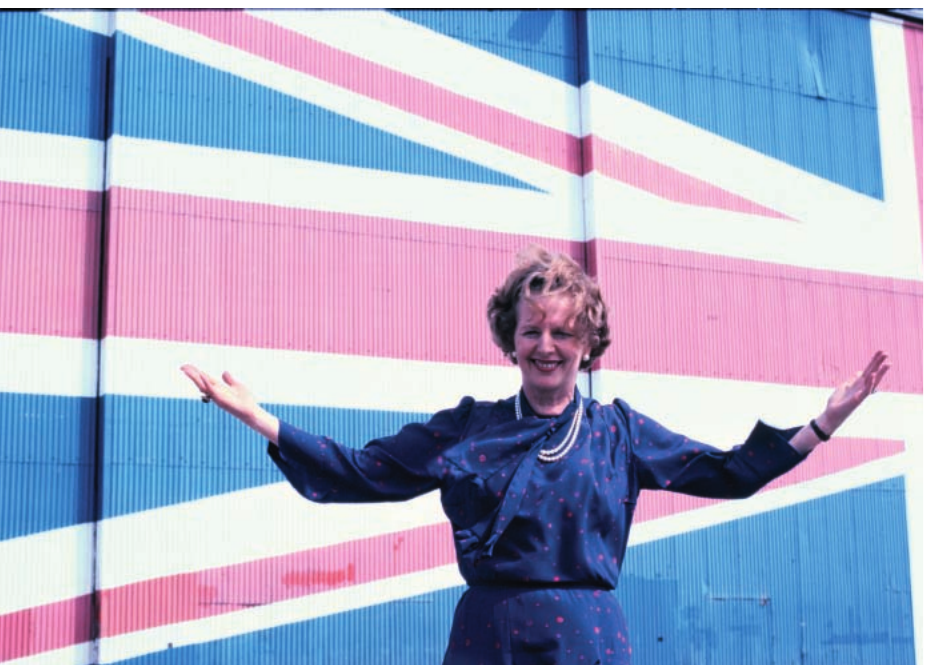
The campaign's final day was particularly significant. Thatcher was flown by helicopter to the British Hovercraft Corporation on the Isle of Wight, where she was photographed with arms outstretched in front of a Union flag painted on hangar doors. This image became one of the defining visual symbols of the campaign, evoking memories of the Falklands victory.
Exam tip: Thatcher's decision to call the election early, when polls showed a clear Conservative lead, is a classic example of how prime ministers could use their power to call elections for party advantage. This power was removed by the Fixed-term Parliaments Act 2011 (though this has since been repealed).
The role of the media
In the pre-social media era, with television required to maintain political neutrality, newspapers wielded enormous influence. The Conservative-supporting press created what has been described as a "Maggie cult", with headlines urging readers to "Vote for Maggie".
Personal attacks on Labour leader Michael Foot were common. The Sun ran the headline: "Do You Seriously Want this Old Man to Run Britain?" These attacks undermined public confidence in Labour's leadership.
Note
Labour faced a hostile press environment. In 1983, they were supported by newspapers accounting for only 22% of circulation (the Daily Mirror and Sunday Mirror). The combination of a hostile right-wing press and a left-wing party platform created disastrous press coverage for Labour.
Where Thatcher excelled at delivering sharp, memorable soundbites for television, Foot was more suited to delivering lengthy speeches to party members. He was less effective at the concise communication increasingly demanded by modern media. Fortunately for him, the election took place before the era of televised leadership debates.
Leadership contrasts
The leadership contrast between Thatcher and Foot was stark and proved decisive. Thatcher projected strength, confidence and competence. Her media presence was commanding, even if her strident tones sometimes alienated voters. She was willing to place herself entirely in the hands of media advisers, despite personally disliking how "elections were being turned into media circuses".
Foot, by contrast, was widely portrayed as left-wing and unsuitable for leadership. Whilst he could deliver rousing speeches to party activists, he struggled with the media demands of modern campaigning. Many of the criticisms levelled at Foot about being too left-wing and unelectable would later be directed at Jeremy Corbyn in 2017 and 2019.
The SDP-Liberal Alliance manifesto
The Alliance offered a manifesto entitled "Working Together for Britain", positioning themselves as a moderate alternative to both main parties. Their key pledges included:
- Reducing unemployment by up to one million
- Reforming the electoral system to proportional representation
- Devolution for Scotland and Wales (a policy later implemented by Tony Blair's 1997 Labour government)
Important
Electoral System Distortion
Despite winning 25.4% of the vote (just 2% behind Labour), the Alliance won only 23 seats. This massive discrepancy between vote share and seats won highlighted the unfairness of the FPTP system for third parties.
How the election affected policy-making
For the Conservatives, their huge majority emboldened them to pursue radical policies. The government pushed ahead with further privatisation of state industries. They also felt confident enough to confront the powerful miners' union, led by the militant Arthur Scargill, in the protracted miners' strike of 1984-85.
The eventual defeat of the miners represented a major victory for Thatcher's campaign against what she viewed as excessive trade union power. However, it left a bitter legacy in mining communities, with pit closures and rising unemployment creating lasting anger towards the Conservative Party in these areas.
Note
For Labour, the 1983 defeat marked the beginning of a wilderness period that would last until Blair's landslide in 1997. The scale of the defeat triggered inevitable recriminations but ultimately forced the party to begin a gradual return towards the centre ground.
Foot's successor as Labour leader, Neil Kinnock, summed up the party's determination to change: "9th June 1983 — never, ever again will we experience that!" The period of reconstruction and modernisation that would eventually produce New Labour began in the aftermath of this devastating defeat.
Exam tip: There is no catalyst to change in party policy quite like a catastrophic election defeat. Both Labour after 1983 and the Conservatives after 1997 underwent fundamental reappraisals of their policies and presentation.
The distortions of the electoral system
The 1983 election provided one of the clearest examples of how FPTP distorts electoral outcomes. It was calculated that 23% of seats in Parliament were held by MPs who would not have been elected under a proportional voting system. This figure was not exceeded until 2015.
Example
Example: FPTP's Disproportionate Impact
The most striking distortion affected the Alliance:
- Alliance vote share: 25.4%
- Alliance seat share: 3.5% (23 seats)
In contrast:
- Labour vote share: 27.6% (just 2% more than Alliance)
- Labour seat share: 32% (209 seats—186 more than Alliance)
This represented a huge mismatch between vote share and representation, with the Alliance winning approximately 1 seat per 338,000 votes, while Labour won 1 seat per 40,000 votes.
The Guardian newspaper commented: "This is a remarkable victory; indeed, with more than 3 million unemployed and rising, a bizarre sort of miracle. Mrs Thatcher, who 2 years ago was the most unpopular British Prime Minister of modern times, has broken the mould of recession-stricken Western politics."
The electoral system's distortions raised questions about the legitimacy of the Conservative victory. Despite commanding an overwhelming majority of parliamentary seats, the Conservatives won little more than 40% of the vote. How strong a mandate did they really have for their radical second-term policies?
However, it has been argued that the Alliance may have actually deprived the Conservatives of an even larger majority. Some voters who supported the Alliance might otherwise have voted Conservative rather than Labour. The Alliance's "spoiler" role may therefore have been more complex than simply splitting the anti-Conservative vote.
Key conclusions
The 1983 election demonstrates several crucial lessons about British politics:
Summary
Key Takeaways from the 1983 Election:
Divided parties do not win elections. Labour's split, with the departure of the Gang of Four and formation of the SDP, handed victory to the Conservatives. Party unity is essential for electoral success.
Leadership matters. The contrast between Thatcher's confident, media-savvy leadership and Foot's less effective communication skills significantly influenced the outcome.
Campaign strategy is crucial. The Conservatives' professional, well-organised campaign contrasted sharply with Labour's chaotic efforts. Modern visual media and careful image management proved highly effective.
FPTP can produce highly distorted outcomes. The election produced a landslide in terms of seats on a reduced vote share for the winners, highlighting the system's tendency to exaggerate victories and penalise third parties.
Foreign policy can influence elections. The Falklands War victory boosted Thatcher's popularity and patriotic credentials, demonstrating that international events can shape domestic electoral outcomes.
Manifestos matter. Labour's left-wing manifesto alienated moderate voters and provided ammunition for opponents. Policy platforms must connect with public opinion to be electorally successful.
Remember!
Summary
Essential Facts to Remember:
-
The 1983 election (9 June) resulted in a Conservative landslide: 397 seats and a majority of 144, despite their vote share falling to 42.4%
-
Divided opposition was key: the Gang of Four had left Labour to form the SDP, which joined with the Liberals to create the SDP-Liberal Alliance
-
Labour's "The New Hope for Britain" manifesto was famously called the "longest suicide note in history" and included controversial policies like unilateral nuclear disarmament
-
The Conservative campaign was meticulously planned, with Thatcher using sophisticated media strategy, whilst Labour leader Michael Foot struggled with modern campaigning
-
The FPTP electoral system severely distorted the result: the Alliance won 25.4% of votes but only 23 seats (3.5%), whilst Labour won 27.6% of votes but 209 seats (32%)
-
The election had lasting consequences: it emboldened the Conservatives to pursue radical policies including the 1984-85 miners' strike, whilst forcing Labour into a long period of modernisation leading to New Labour