Key Elections: 1997 (AQA A-Level Politics): Revision Notes
📚Revision Notes
Key Elections: 1997
Context, background and final result
The 1997 general election delivered a landslide victory for Tony Blair's Labour Party, ending 18 years of Conservative rule. This result marked a dramatic change in British politics, bringing Labour back to power after modernising its policies and image.
Labour's political comeback
Labour completed a remarkable political transformation after successive defeats in 1979, 1983, 1987 and 1992. Under the leadership of Neil Kinnock, John Smith and then Tony Blair (from 1994), the party abandoned many traditional socialist policies. Key changes included:
- Dropping the commitment to unilateral nuclear disarmament
- Abandoning plans for wholesale renationalisation
- Rewriting Clause IV (the party's commitment to public ownership)
- Accepting Thatcher's trade union reforms
- Reducing trade union power within the party
Note
The Third Way was a political ideology combining left-wing values such as social justice with right-wing principles such as free-market economic liberalism. This pragmatic approach allowed Labour to appeal to both traditional working-class supporters and middle-class voters who had previously backed the Conservatives.
Blair repositioned Labour as a "Third Way" party, combining left-wing values like social justice with right-wing principles like free-market economic liberalism. This pragmatic approach broadened Labour's appeal beyond its traditional working-class base.
Conservative decline
John Major had replaced Margaret Thatcher as Conservative leader and prime minister in 1990. While he achieved an unexpected victory in 1992, his majority was just 21 seats. By 1997, several problems had undermined Conservative support:
Deep divisions over Europe - The party was bitterly split on European policy, with Major struggling to maintain unity. In 1995, he was forced to call a leadership election to consolidate control, issuing a "put up or shut up" challenge to his MPs.
Important
The ERM Crisis of 1992
A major crisis occurred in 1992 when the UK crashed out of the European Exchange Rate Mechanism (ERM), causing devaluation of the pound and rising interest rates. This single event destroyed the Conservatives' reputation for economic competence - a reputation they had built since the 1980s. Although the economy recovered by 1997, voters remembered this financial humiliation, known as Black Wednesday.
Economic difficulties - The economy suffered recession and rising unemployment in the early 1990s. Although the economy recovered by 1997, the Conservatives had lost their reputation for financial competence.
Scandals and sleaze - Numerous MPs and ministers became embroiled in scandals, undermining Major's "back to basics" campaign that emphasised traditional values and honesty.
Electoral weakness - By 1997, Major led a minority government after losing several by-elections. He had no option to call an early election and had to serve the full parliamentary term.
Exhaustion after 18 years - There was a sense of inevitability that voters would choose change and fresh faces after nearly two decades of Conservative government.
Labour maintained a consistent double-digit lead in opinion polls from 1992 onwards. The question was not who would win, but the size of Labour's majority.
The final result
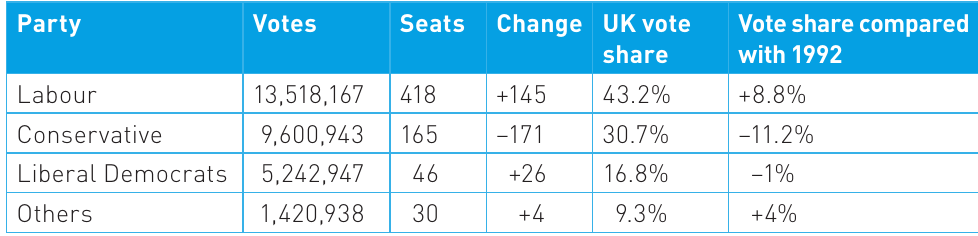
Labour achieved a crushing victory:
| Party | Votes | Seats | Change | UK vote share | Vote share compared with 1992 |
|---|---|---|---|---|---|
| Labour | 13,518,167 | 418 | +145 | 43.2% | +8.8% |
| Conservative | 9,600,943 | 165 | -171 | 30.7% | -11.2% |
| Liberal Democrats | 5,242,947 | 46 | +26 | 16.8% | -1% |
| Others | 1,420,938 | 30 | +4 | 9.3% | +4% |
The Conservatives lost over half their seats, suffering particularly badly in:
- London - vote share fell by 14.1%
- Southeast - vote share fell by 13.1% in their traditional heartland
- Southwest - Liberal Democrats won 8 Conservative seats
- Scotland - all 11 Tory seats were lost
Notable aspects of the result
The Portillo moment - Defence minister Michael Portillo, tipped as a future Conservative leader, lost his Enfield Southgate seat on a massive 17.4% swing to Labour. His defeat became symbolic of the Conservative collapse.
Note
The "Portillo moment" has since entered British political vocabulary to describe the defeat of a high-profile politician in an election. It represents the shock and drama of seeing a senior figure unexpectedly lose their seat, often signalling a broader electoral landslide.
Record representation - A record 120 women were elected as MPs, with 101 representing Labour. However, there was only a small increase of three minority ethnic MPs.
Class dealignment - For the first time, Labour won the same percentage of votes as the Conservatives among the C1 social class (lower-middle classes). This provided further evidence of class dealignment - the weakening of the traditional relationship between social class and voting behaviour.
Age demographics - Labour defeated the Conservatives in every age group, though its lead was smaller among older voters (3% in the 64+ category) compared to younger voters (21% among 18-34 year olds).
Tactical voting - In several constituencies, anti-Conservative voters supported whichever opposition party was best placed to win. For example, in Sheffield Hallam, the Labour vote fell as voters switched to the Liberal Democrats.
Note
Tactical voting occurs when voters support a candidate who is not their first preference to prevent another candidate from winning. In 1997, many anti-Conservative voters coordinated their votes to maximise the number of Tory MPs defeated, particularly benefiting the Liberal Democrats in Conservative-held seats.
Role of the media
The Sun's switch
The most significant media development was The Sun's decision to switch support from the Conservatives to Labour. This tabloid newspaper, with its large circulation, had backed John Major in 1992 and attacked Labour leader Neil Kinnock. By 1997, it decided to back Blair.
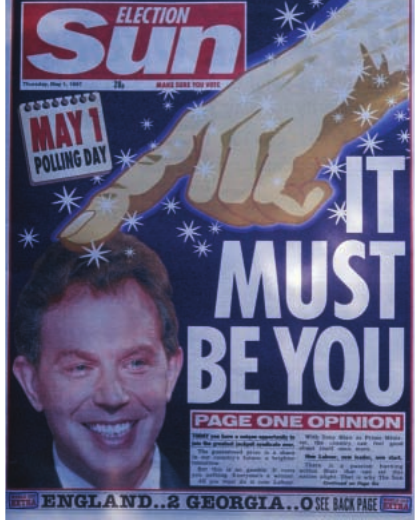
This change reflected both The Sun's preference for backing winners and Blair's deliberate strategy to court media support. In 1995, Blair flew to Australia to meet the newspaper's owner, Rupert Murdoch, at a News Corporation conference. Murdoch joked about their "flirtation", saying: "If that flirtation is ever consummated, Tony, I suspect we will end up making love like two porcupines – very carefully."
The contrast between The Sun's headlines was stark:
- 1992: "If Kinnock wins today, will the last person to leave Britain please turn out the lights"
- 1997: "It Must Be You" (supporting Blair)
Overall media support
Although traditionally pro-Conservative newspapers like the Daily Mail, Express and Telegraph remained loyal to Major, their support was more muted than it had been for Thatcher. Some ran critical stories on the Conservatives.
Note
Pro-Labour newspapers accounted for 62% of overall newspaper readership, providing significant advantage to Blair's campaign. This was a dramatic shift from previous elections where Conservative-supporting papers dominated. However, the exact influence of newspapers on voting behaviour remains debatable - did The Sun follow or lead public opinion?
The significance of party policies and manifestos
Unlike some elections where parties offer polarised choices, the 1997 election featured relatively moderate manifestos from both main parties. Personalities and wider party perceptions mattered more than specific policies.
Labour manifesto
Labour emphasised its modernisation and pragmatic approach. The election message stated: "Our case is simple: that Britain can and must be better" and "New Labour is a party of ideas and ideals but not of outdated ideology. What counts is what works."
Key Labour pledges included:
Welfare - Emphasis on personal responsibility alongside state support. Rights to benefits came with responsibilities.
Law and order - Promise to be "tough on crime and tough on the causes of crime" with zero tolerance for anti-social behaviour and petty crime.
Reform and rights - Active commitment to constitutional reform including:
- Reform of the House of Lords
- Devolution to Scotland, Wales and English regions
- Incorporating the European Convention on Human Rights into UK law
Education - A "middle way" approach rejecting both the 11-plus and traditional comprehensive schools. The pledge was to "favour all-in schooling, which identifies the distinct abilities of individual pupils and organises them in classes to maximise their progress."
Healthcare - Pledges to cut NHS waiting lists and reduce bureaucracy.
The economy - Commitment to balanced government spending without raising income tax. Introduction of a national minimum wage to help low-paid workers. Labour worked to shed its "tax and spend" image.
Conservative manifesto
The Conservative slogan "You can only be sure with the Conservatives" emphasised continuity and security. However, after 18 years in power, it was difficult to appear fresh and innovative.
Key Conservative pledges included:
- Education - Publishing school exam results and encouraging more academic selection at secondary level
- Privatisation - Continuing the programme, extending it to Royal Mail
- Reform - No major constitutional changes, opposing devolution
- Law and order - "Get tough" policies including greater use of CCTV cameras
- The economy - Reducing income tax to 20% and lowering business taxes. Highlighting the economic track record including rising home and share ownership
- Welfare - Crackdown on benefit fraud
Note
The Conservatives faced the challenge all long-serving governments encounter: appearing dynamic while avoiding accusations of "same old, same old". After 18 years in office, it was difficult to position themselves as the party of change, while Labour successfully claimed that mantle.
Impact of leadership and election campaign
Blair's advantages
The election was Labour's to lose. The party stayed united, on message and avoided complacency despite strong poll leads. As Lord Adonis noted, "Tony successfully carried the precious vase of electoral success across the slippery floor."
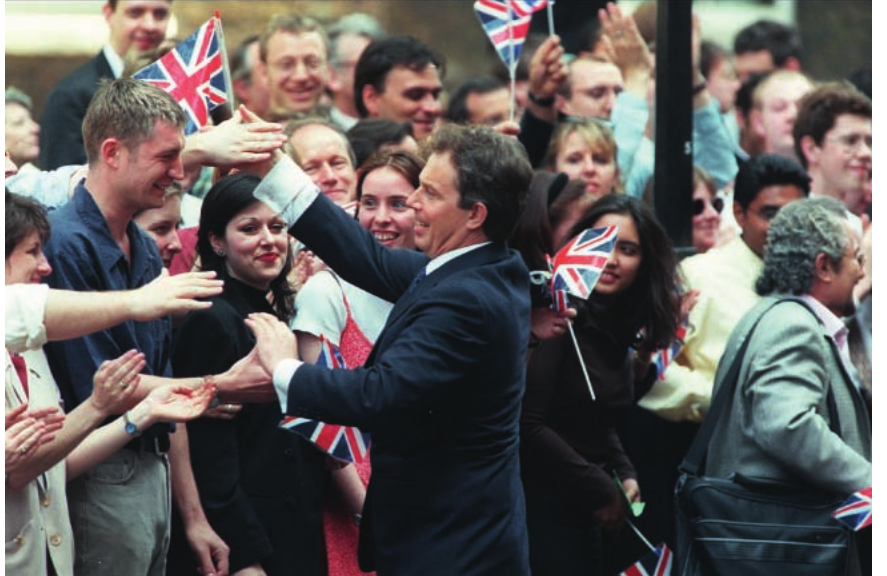
Blair's campaign was tightly managed by trusted aides Alistair Campbell and Peter Mandelson, both media-savvy and committed to New Labour. Blair himself proved an excellent campaigner:
- Young and charismatic
- Energetic and appealing to younger and middle-class voters
- Educated at public school and Oxford, trained as a lawyer
- The campaign even had a theme tune: D's "Things Can Only Get Better"
Deputy leader John Prescott provided balance, appealing to Labour's traditional working-class base with his background as someone who failed the 11-plus and worked as a ship's steward.
Major's weaknesses
Major suffered from an image problem. He was often mocked in cartoons and satirical TV shows as grey and uncharismatic. His party had spent five years deeply divided, particularly over Europe.
Blair highlighted Major's weakness during Prime Minister's Questions in 1995: "I lead my party; he follows his."
Conservative campaign failures
The Conservative campaign became negative, attacking Blair in highly personal terms. The most infamous example was the "demon eyes" poster, which showed Blair's face with red devil eyes and the slogan "New Labour New Danger."
Important
Campaign Backfire: The Demon Eyes Poster
This backfired badly. The poster generated over 150 complaints and the Advertising Standards Authority instructed the Conservatives to withdraw it. One poll found 64% of the public disapproved of the poster campaign. It appeared desperate and confirmed impressions that Conservatives lacked positive ideas.
This serves as a lesson in political campaigning: negative attacks must be credible and measured. When they become too personal or extreme, they can damage the attacking party more than the target.
How the election affected policy-making
Labour's policy delivery
Labour's landslide majority allowed the party to deliver most of its manifesto pledges, including:
- Constitutional reforms (devolution, House of Lords reform, Human Rights Act)
- National minimum wage
- Increased spending on public services without major tax rises
The huge majority set the scene for subsequent Labour victories in 2001 and 2005, though on a smaller scale. However, a strong personal mandate can lead prime ministers to feel invincible. Blair later alienated many in his own party with controversial policies like university tuition fees (1997) and the Iraq War (2003). The official inquiry into Iraq concluded Blair had not been "straight with the nation" over evidence of weapons of mass destruction.
Important
The Dangers of Large Majorities
While Labour's landslide enabled significant reforms, it also created risks. A personal mandate - when a leader wins based on their own popularity rather than just party loyalty - can make prime ministers feel invulnerable to criticism. This contributed to Blair's controversial decisions on Iraq and tuition fees, which damaged his relationship with Labour MPs and party members.
Conservative modernisation
The 1997 defeat marked the start of a prolonged period in opposition for the Conservatives. Like Labour after 1983, the party underwent modernisation and image-updating, though not immediately.
The party worked to lose its "nasty party" image. By 2010 under David Cameron, it adopted a more "One-Nation" approach with the "Big Society" slogan. The party:
- Quietly dropped opposition to devolution and the minimum wage
- Adopted more liberal stances on the environment and gay rights
- Moved away from Thatcherite zealotry while retaining some principles
- Presented Cameron as a "change candidate"
Like Blair, Cameron was educated at public school and Oxford, offering youth and strong communication skills.
The significance of the electoral system
The first-past-the-post electoral system significantly distorted the election result, over-rewarding the winning party and under-rewarding smaller parties:
| Party | Vote share | Share of MPs | Discrepancy |
|---|---|---|---|
| Labour | 43.2% | 63.4% | +20.2% |
| Conservative | 30.7% | 25% | -5.7% |
| Liberal Democrats | 16.8% | 7% | -9.8% |
| Others | 9.3% | 4.6% | -4.7% |
Labour received a 20.2% bonus in parliamentary representation compared to its vote share, while the Liberal Democrats were severely punished with nearly 10% less representation than their votes warranted.
Note
This disproportionality demonstrates how first-past-the-post can exaggerate electoral victories. Labour's 43.2% of the vote translated into 63.4% of seats - giving them a commanding majority despite winning less than half the popular vote. The Liberal Democrats, conversely, won nearly 17% of votes but received only 7% of seats, highlighting the system's bias against smaller parties whose support is geographically spread rather than concentrated.
Summary
Key Points to Remember:
- The 1997 election delivered Labour's greatest twentieth-century majority, ending 18 years of Conservative rule
- Tony Blair transformed Labour into "New Labour" by embracing the Third Way - combining social justice with free-market economics
- The Conservatives were weakened by divisions over Europe, the 1992 ERM crisis, scandals, and exhaustion after 18 years in power
- The Sun newspaper switched support from Conservatives to Labour after Blair courted owner Rupert Murdoch
- Labour's victory led to major constitutional reforms including devolution, Lords reform and the Human Rights Act
- The electoral system gave Labour a 20.2% bonus in seats compared to votes, while severely under-representing the Liberal Democrats
- 120 women MPs were elected (a record), with 101 representing Labour
- The "Portillo moment" - the defeat of defence minister Michael Portillo - symbolised the Conservative collapse