Constitutional Framework (AQA A-Level Politics): Revision Notes
📚Revision Notes
Framework of Government
The US Constitution establishes two fundamental principles that shape how the American government operates: the separation of powers and checks and balances. The framers of the Constitution designed these principles to limit government power and distribute authority across different branches, ensuring that no single institution could accumulate excessive power. Each branch possesses both unique powers and the ability to constrain the others.
Separation of powers
The Founding Fathers drew inspiration from the French political philosopher Montesquieu, whose 1748 work De L'Esprit des Loix ('The Spirit of the Laws') argued that dividing government into distinct branches was the most effective safeguard against tyranny and absolutism.
The Constitution therefore establishes three separate branches:
- Legislature (Congress) - responsible for making laws
- Executive (Presidency) - responsible for implementing and enforcing laws
- Judiciary (Supreme Court) - responsible for interpreting laws
Important
Separation of powers: The doctrine requires that the three elements of government power — executive, legislative and judicial — be held by separate branches of government in order to prevent tyranny.
Each branch is addressed in separate articles of the Constitution, which define their structure and powers. This principle influences not only the constitutional framework but also how each branch functions in practice. However, the separation is not as absolute as it might initially appear.
Note
The constitutional separation ensures that no person can serve simultaneously in more than one branch, preventing the concentration of power that concerned the framers. This structural division forces cooperation between branches whilst maintaining institutional independence.
How significant is the separation of powers?
The importance and effectiveness of the separation of powers in the US Constitution remains a subject of debate:
| Very significant | Less significant |
|---|---|
| Each branch faces clear limits imposed by the other two. | The term 'separation' can be misleading - 'shared powers' may be more accurate. Both president and Congress, for example, have roles in lawmaking. |
| No person can serve simultaneously in Congress and the executive. When appointed secretary of state, Hillary Clinton resigned as senator for New York. Similarly, Deb Haaland resigned as a New Mexico congresswoman when Biden nominated her as interior secretary in 2020. | The vice president serves as both an executive officer and senate president (legislature), with a casting vote in tied situations. Mike Pence used this power several times, including to confirm Betsy DeVos as education secretary (2017) and Jonathan Kobes to the Court of Appeals for the Eighth Circuit (2018). With the 50/50 party split after the 2020 election, Vice President Harris likely faces similar situations. |
| It prevents any one branch from becoming too powerful and avoids an 'elective dictatorship' - a concern sometimes raised about UK prime ministers. Presidents must work with Congress to pass legislation and ensure constitutional compliance. | A president with a supportive Supreme Court and whose party controls Congress can wield substantial power. |
| It helps preserve an independent, non-political judiciary, which is vital for defending civil liberties and entrenched rights. | Few modern democratic judiciaries are as politicised as the US judiciary. Politicians' involvement in nomination and confirmation processes, combined with the Supreme Court's considerable political power, inevitably reduces judicial independence. |
| Presidential pardon power overlaps with judiciary powers, limiting the practical significance of separated powers. |
Note
The debate over separation of powers highlights a fundamental tension in the American system: whilst the structure aims to divide power, practical politics often reveals how interconnected the branches truly are. The framers may have intended separation, but the reality is more accurately described as 'shared powers'.
Checks and balances
Important
Checks and balances: A crucial feature of the Constitution's framework in which each branch of government is limited by the others, so preventing too much concentration of power in any single institution or individual.
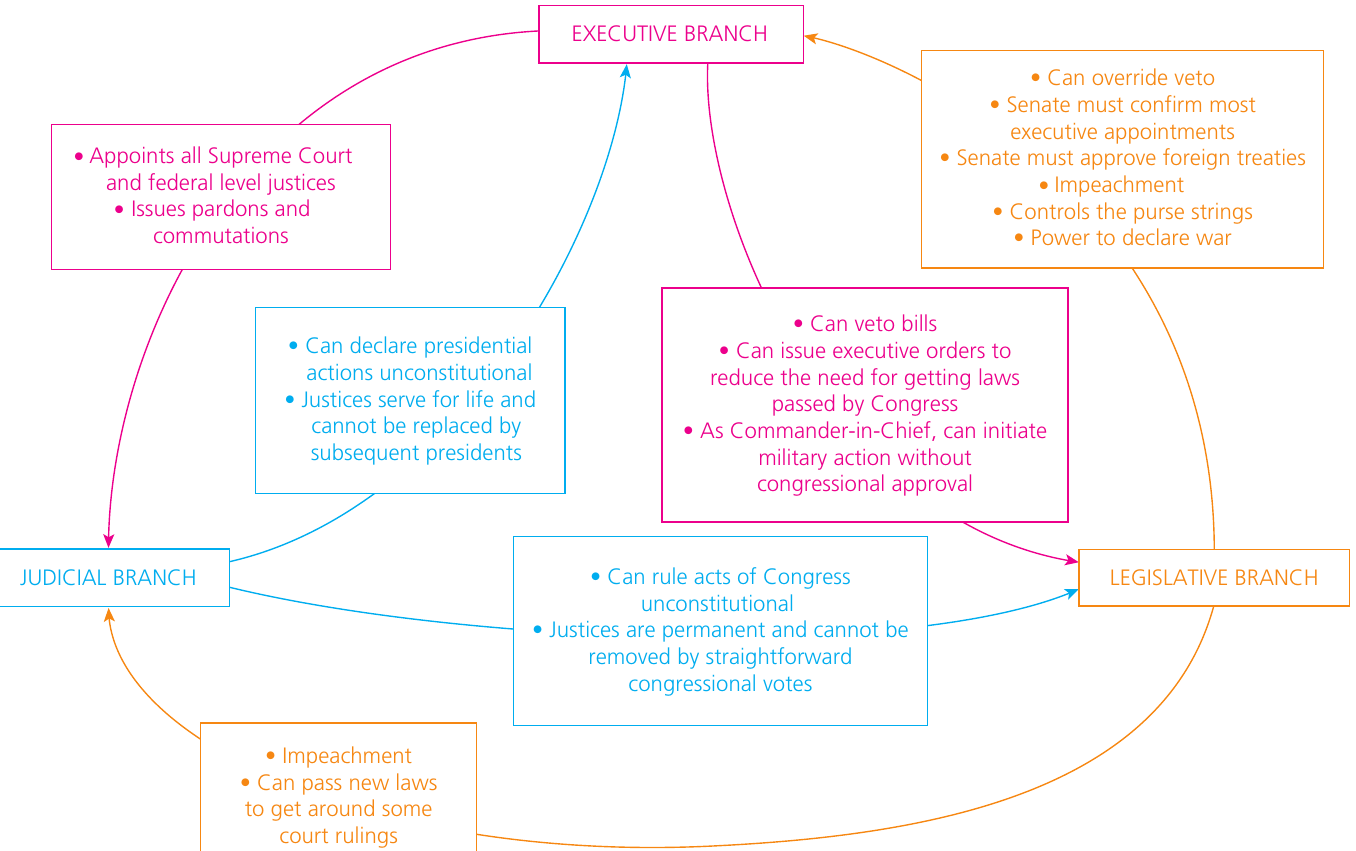
The system operates through various mechanisms that allow each branch to restrict the actions of the others. Understanding these checks requires examining the specific powers each branch holds over the others. This intricate web of mutual limitations ensures that power must be negotiated and shared, rather than concentrated in a single authority.
Presidential checks on Congress
Presidents possess several tools to limit congressional power, ranging from direct rejection of legislation to strategic deployment of executive authority.
Veto power: Presidents can reject acts or resolutions passed by Congress. President Barack Obama vetoed the Keystone XL pipeline bill and issued 12 regular vetoes across his two terms. President Trump vetoed a resolution attempting to revoke his declaration of a national emergency at the US-Mexico border.
Note
Veto threats: The threat of a veto can be as powerful as its actual use, dissuading Congress from passing unwelcome measures. This demonstrates how the potential use of a check can be more influential than its execution.
Example
Example: Obama's 2015 Veto Threats
In his 2015 State of the Union Address, Obama made four veto threats covering:
- Iran sanctions
- The Affordable Care Act
- Wall Street oversight
- Immigration controls
He stated: 'If a bill comes to my desk that tries to do any of these things, I will veto it'. These threats effectively prevented Congress from pursuing these legislative paths.
Executive orders: Presidents can bypass the need for formal legislation by issuing executive orders. In 2017, Trump introduced a travel ban affecting visitors from several predominantly Muslim countries through an executive order.
Commander-in-chief powers: Presidents can deploy US troops overseas without congressional approval to declare war. President George W. Bush ordered the invasions of Afghanistan (2001) and Iraq (2003) using this authority.
Presidential checks on the courts
The president also possesses significant powers over the judicial branch, particularly through appointments and the unique power of clemency.
Judicial nominations: The president nominates all federal justices, including Supreme Court justices when vacancies arise. Obama appointed Sonia Sotomayor and Elena Kagan, whilst Trump appointed Neil Gorsuch, Brett Kavanaugh and Amy Coney Barrett to the Supreme Court.
Important
Pardons and commutations: The president can issue pardons (complete forgiveness of a crime, waiving all punishment) and commutations (reductions in sentence length or severity) for federal crimes.
This power represents a peculiar constitutional feature, traditionally reserved for monarchs as the 'fount of justice'. Its inclusion in presidential powers stems from historical context - it was originally intended to enable presidents to pardon rebels in the nation's early days, promoting national reconciliation.
Example
Examples: Presidential Pardons and Commutations
- President Gerald Ford pardoned his immediate predecessor, Richard Nixon
- Trump pardoned media mogul Conrad Black in 2019, who had written a favourable biography about him
- Obama issued a record 330 commutations on his final day in office
- Trump issued 73 pardons and 70 commutations on his final day as president in 2021, including one for his former chief strategist Steve Bannon, who faced serious fraud charges
Congressional checks on the president
Congress possesses substantial powers to limit presidential authority, making it the most powerful check on executive power in the constitutional framework.
Veto override: A supermajority (two-thirds approval in both houses) can overturn a presidential veto. In 2016, Congress overturned Obama's veto of the Justice Against Sponsors of Terrorism Act (JASTA) - the only veto override he experienced. George W. Bush had 4 of his 12 regular vetoes overridden. Trump had just one of his ten vetoes overridden, on a defence spending bill in January 2021.
Important
Supermajority: Represents approval by two-thirds of all members of both the House and the Senate.
Senate confirmation: The Senate must confirm presidential appointments to the administration and judiciary by simple majority. In 2013, the Senate blocked Obama's appointment of Robert Wilkins to the District of Columbia court of appeals. The last Cabinet nominee formally denied confirmation was John Tower as defence secretary in 1989. The last Supreme Court nominee formally rejected was Robert Bork in 1987.
Note
Threat of Senate rejection: The threat of rejection is often as powerful as actual rejection. Biden's controversial 2020 pick of Neera Tanden as Director of the Office of Management and Budget was withdrawn in March 2021 when it became clear she lacked sufficient Senate support. This demonstrates the preventive power of checks and balances.
Power of the purse: Congress controls funding and can reject presidential budget requests. Congress repeatedly frustrated Trump's attempts to secure full funding for his Mexican border wall.
Legislative obstruction: Congress can simply decline to pass legislation the president desires. Following the Sandy Hook school shooting in 2012, Obama requested several gun-control measures, but Congress passed nothing despite proposals being drawn up. Trump faced similar frustration when attempting to pass his healthcare reforms.
Important
Impeachment: The 'nuclear option' of impeachment can remove a president mid-term. In 2019, the House voted to proceed with an impeachment trial against Trump, though the Republican Senate did not convict him. Uniquely, the House voted to impeach Trump a second time on 13 January 2021, during his final days in office.
Despite its dramatic nature, no US president has ever been successfully removed through impeachment, although President Nixon resigned in 1974 rather than face likely removal.
Treaty ratification: A two-thirds Senate vote is required to ratify treaties negotiated by the president. In 2012, the Senate failed to ratify the Convention on the Rights of Persons with Disabilities. Although it passed 61-38, it needed five more votes for ratification.
Congressional investigations: Congress can launch investigations into presidential actions where wrongdoing or concerns arise. In 2019, the House Oversight and Reform Committee investigated a potential conflict of interest involving increased US air force spending on refuelling at a Scottish airport near Trump's Turnberry golf resort.
Note
Exam tip: Presidential power faces an additional check through the Twenty-Second Amendment (ratified 1951), which limits presidents to two full terms. However, its significance is debatable, as few post-war presidents have been popular enough to win a third term.
Congressional checks on the courts
Congress also possesses important powers over the judiciary, though these are used less frequently than other checks.
Impeachment of judges: Congress can impeach federal justices and remove them from office. In 2010, Louisiana federal judge Thomas Porteous was successfully impeached and removed for corruption in a near-unanimous vote.
Constitutional amendments: Constitutional amendments can overturn Supreme Court verdicts. In 1896, the Court found a national income tax unconstitutional. This was reversed by the Thirteenth Amendment's ratification in 1913. Subsequent attempts to pass amendments banning flag burning and prayer in state schools have been unsuccessful.
Judicial checks on the president
The Supreme Court can significantly limit presidential powers through its power of judicial review, reinforcing the principle that no one is above the law, not even the president.
Important
Judicial review: Courts can rule presidential actions unconstitutional and therefore illegal, effectively nullifying executive actions.
Example
Examples: Judicial Checks on Presidential Power
- In Hamdan v Rumsfeld (2006), the Court ruled against special military commissions established by George W. Bush to try suspected al Qaeda members
- In July 2020, in Trump v Mazars and Trump v Vance, the Court ruled that presidents do not enjoy absolute immunity from state criminal subpoenas - the president is not above the law, even whilst in office
Judicial checks on Congress
The Supreme Court also limits congressional powers through its authority to review legislation against constitutional standards.
Declaring laws unconstitutional: Courts can declare acts of Congress unconstitutional, effectively requiring their repeal. In 2013, the Defense of Marriage Act was ruled unconstitutional in United States v Windsor, marking a major advance for same-sex marriage legalisation across the USA.
The significance of checks and balances
The system of checks and balances has far-reaching implications for how American politics operates. Its significance manifests in several important ways that shape daily governance and long-term political strategy.
Encouraging tactical workarounds
The system often encourages political actors, particularly presidents, to deploy alternative tactics to circumvent constraints. Many presidents prefer negotiating executive agreements over full treaties with international powers (such as Obama's nuclear deal with Iran), or declaring national emergencies to secure additional funding without express congressional approval (as Trump did over the USA-Mexico border). Presidents also frequently issue executive orders that bypass congressional approval, though these can be challenged in courts.
Note
This pattern of workarounds demonstrates both the strength and weakness of the checks and balances system: whilst it successfully prevents unilateral action, it also incentivises creative constitutional interpretations that may undermine the system's original intent.
Concentration of checks on the presidency
Notably, the president faces more checks than any other branch. This clearly indicates the framers' primary fear - in their view, the main threat to good government was concentrating too much power in one person's hands. Yet paradoxically, the presidency has seen the greatest expansion of powers over the decades. This perhaps demonstrates that necessity drives political initiative.
Timing and divided government
Checks and balances affect the timing of presidential initiatives. Presidents face particular difficulties passing legislation when their party lacks congressional control - a situation known as divided government. Presidents often lose popularity midway through their 4-year term, leading to poor midterm congressional election performance and potential loss of one or both chambers.
Important
Midterms: Elections for Congress occurring between presidential elections. The entire House and one-third of the Senate face election during midterms.
The pattern of midterm losses is so consistent that presidents typically push major legislation through during their first 2 years after election, before potential midterm setbacks.
Example
Examples: First-Term Legislative Success
- Obama secured the Affordable Care Act (Obamacare) by early 2010
- Trump passed his Tax Cuts and Jobs Act in 2017
Both presidents faced more difficulty after losing congressional chambers in subsequent midterm elections. Trump's Republican Party lost House control in the 2018 midterms, whilst Obama's Democratic Party lost Senate control in the 2014 midterms.
Gridlock and partisanship
The elaborate checks and balances system means much national-level US politics is characterised by gridlock. With power levers often held by different actors, frequently little positive is achieved. By dispersing power, the Founding Fathers ensured - intentionally or otherwise - that stopping something (like a new law) is much easier than achieving something positive.
Important
This is arguably not the system's fault but how it is currently being played. Whilst the structure was designed to promote bipartisanship and cooperation between different groups and factions, the opposite has occurred. In an era of bitter partisanship, parties show marked reluctance to cooperate and compromise.
Note
Even during the COVID-19 national emergency in 2020, passing the original $2.2 trillion stimulus package (CARES Act) took several days of intense, fraught negotiation. Whilst current political players must share blame for how they are 'playing the game', the rulebook itself arguably invites struggle.
Variable significance of different checks
Not all checks and balances carry equal weight. The most powerful weapons - arguably impeachment - are rarely used and even less likely to succeed. Even the presidential veto is declining in use and perhaps overrated as a political tool. Obama vetoed 12 bills across his two-term presidency compared with Ronald Reagan's 78 vetoes during his two 1980s terms.
Important
Very often, threatened checks and balances - the threat of a veto or denied Senate confirmation - ultimately have the most impact. The potential use of these powers shapes political behaviour more than their actual deployment.
Note
Exam tip: An easily overlooked check and balance exists between the Senate and House. Senators' longer 6-year terms (with re-election by thirds every 2 years) are balanced by the entire House facing re-election every 2 years. This offers potential for greater stability and longer-term outlook in the Senate, whilst resulting in a House more responsive and accountable to popular mood.
Remember!
Summary
Key constitutional principles:
- The US Constitution establishes two main principles: separation of powers (dividing government into three branches) and checks and balances (each branch limiting the others)
- Montesquieu's influence shaped the framers' decision to divide government into Legislature (Congress), Executive (Presidency) and Judiciary (Supreme Court)
- The separation is not complete - it's better described as 'shared powers', as branches have overlapping roles
How checks and balances work:
- Presidents check Congress through vetoes, executive orders, and commander-in-chief powers; they check courts through judicial nominations and pardons
- Congress checks presidents through veto overrides, confirmation powers, impeachment, power of the purse, and treaty ratification
- The judiciary checks both branches through declaring actions unconstitutional and lifetime judicial appointments
Practical implications:
- The system creates gridlock when power is divided between parties, making it easier to block action than achieve it
- Presidents typically push major legislation during their first 2 years, before potential midterm losses
- Threatened checks (like veto threats or potential Senate rejections) often have more impact than their actual use
- The president faces the most checks of all three branches, yet has seen the greatest expansion of power over time