Civil Liberties and Rights (AQA A-Level Politics): Revision Notes
📚Revision Notes
Civil Liberties and Rights
The protection of civil liberties and individual rights under the US Constitution is a highly debated topic. Understanding how effectively the Constitution safeguards these freedoms requires examining several key factors. Most importantly, the majority of individual rights appear in the Bill of Rights (1791) rather than in the original Constitution. Additionally, not all rights enjoy equal levels of protection, and the Supreme Court's interpretation plays a crucial role in determining how rights are actually protected in practice.
Key constitutional rights
The Constitution explicitly protects several fundamental rights through its amendments:
First Amendment - Protects freedom of speech and expression, freedom of the press, and the right to practise religion freely.
Second Amendment - Guarantees the right to bear arms.
Fourth Amendment - Protects against unreasonable searches and seizures.
Fifth Amendment - Ensures the right not to incriminate oneself (often called "pleading the fifth").
Sixth Amendment - Guarantees a swift, fair and public trial.
Seventh Amendment - Provides the right to a jury trial in civil lawsuits.
Other amendments - Various amendments protect Americans against slavery and discrimination in voting based on race or gender.
Note
These amendments form the foundation of American civil liberties. While the original Constitution established the framework of government, it was the Bill of Rights that ensured protection of individual freedoms. Each amendment addresses specific concerns that arose during the constitutional debates of the late 18th century.
Groups without specific constitutional protection
Despite the strong protections outlined above, many groups lack explicit constitutional safeguards. These include:
- People with disabilities
- Children
- LGBTQ+ Americans
Important
Unlike more recent international human rights charters, the US Constitution makes no mention of social rights such as education, healthcare and housing. This means the US approach to constitutional rights can appear patchy and selective, often reflecting the historical period when each amendment was written. Many groups instead rely on congressional legislation or state laws for their protection, which lack the permanence and entrenchment of constitutional rights.
The First Amendment paradox
The First Amendment provides one of the clearest examples of how constitutional rights work in practice. Visitors to US National Parks often encounter an unusual sight: signs designating certain areas as "First Amendment Expression Areas."
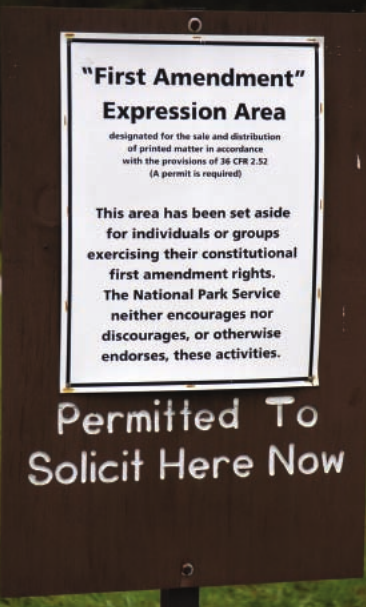
These signs perfectly illustrate the paradox of American free speech - it represents both protection and regulation simultaneously. Free speech does not mean the ability to say anything, anywhere, at any time. The constitutional protection extends to virtually any opinion, however controversial or morally questionable. However, speech that advocates breaking the law or threatens public order can be lawfully regulated and punished.
Landmark case: Schenck v United States (1919)
Example
Landmark Case: Schenck v United States (1919)
Background: Two socialists distributed leaflets encouraging people to disobey military conscription, though they advocated only peaceful resistance. They were convicted under the Espionage Act.
Supreme Court Decision: The Court developed the "clear and present danger test" in this case. This test states that the First Amendment does not protect speech that creates a clear and present danger of significant harm that Congress has the power to prevent.
Key Reasoning: Justice Holmes famously compared the leaflets to "maliciously and falsely shouting 'Fire!' in a crowded theatre" - speech clearly not protected by the First Amendment. The Court reasoned that the leaflets posed sufficient danger of disrupting the conscription process during wartime.
Significance: This case established that constitutional rights are not absolute and can be limited when they pose a clear danger to public safety or national security.
Landmark case: Morse v Frederick (2007)
Example
Landmark Case: Morse v Frederick (2007)
Background: An Alaskan high school student unfurled a banner reading "BONG HiTS 4 JESUS" across the street from his school during a school-supervised event at the 2002 Winter Olympics torch relay. The principal suspended him for promoting illegal drug use.
Student's Claim: The student appealed, claiming his freedom of expression had been violated.
Supreme Court Decision: The student lost the case. The Court ruled that schools can regulate "school speech" when it undermines the school's educational mission or threatens student safety.
Key Distinction: The Court emphasised that had the banner not been displayed at a school-run event, or had it not contradicted an accepted school goal (discouraging illegal drug use), the outcome would likely have been different.
Significance: This case demonstrates that the context and setting of speech matter significantly in determining constitutional protection.
The balance between freedom and regulation
These cases demonstrate that whilst the First Amendment protects speech, it does not provide unlimited freedom. Expression can be lawfully regulated in certain circumstances. Nevertheless, a strong presumption in American law favours freedom, particularly freedom of opinion, unless regulation can be clearly justified.
Beyond individual rights cases, many argue the First Amendment should also protect citizens against the growing security and surveillance state. Modern legislation such as the Patriot Act and Foreign Intelligence Surveillance Acts have raised concerns about their impact on the First and Fifth Amendments. Important cases in this area include Rasul v Bush, Clapper v ACLU and Holder v Humanitarian Law Project.
Note
The tension between national security and individual liberty represents one of the most challenging balances in constitutional law. The post-9/11 era has seen expanded government surveillance powers, leading to ongoing debates about whether these measures violate constitutional protections or represent necessary adaptations to modern security threats.
Evaluating constitutional protection of rights
The effectiveness of constitutional rights protection remains hotly debated. Consider both sides of this important question:
Arguments that the Constitution protects rights very well:
- Many key rights receive explicit protection, particularly in the Bill of Rights, including free speech, expression and the right to a fair trial. These rights are entrenched and inalienable, making them extremely difficult to overturn.
- Supreme Court judgements have discovered new rights within "elastic clauses" of the Constitution, such as "equal protection" and prohibitions on "cruel and unusual punishment". This allows the Constitution to adapt to modern circumstances.
- The Constitution permits rights protection through other means, particularly Acts of Congress. Federal laws address equal pay and disability access, including the Equal Pay Act 1963, the Lilly Ledbetter Fair Pay Act 2009 and the Americans with Disabilities Act 1990.
- The USA has adapted well to evolving concepts of rights. Many rights have been "updated" through judicial review, keeping America largely on par with other democracies. In controversial areas like abortion, some argue this simply rebalances rights between different groups. Many rights concepts are inherently subjective and controversial.
Arguments that the Constitution protects rights less well:
- Many rights and groups lack direct or explicit constitutional protection. For example, the Constitution does not explicitly guarantee free and fair elections, nor does it protect the rights of children and people with disabilities.
- Supreme Court interpretations are inevitably subjective and can (and do) change over time, creating uncertainties and contradictions in how rights are protected.
- Congressional laws can theoretically be reversed, lacking the permanence of constitutional rights.
- The USA maintains some controversial positions on rights compared to other democracies. No European democracies still permit the death penalty (forbidden by the European Convention on Human Rights) or grant entrenched rights to gun owners.
Note
When evaluating these arguments, consider that the debate often centers on whether constitutional flexibility (allowing adaptation to changing values) is a strength or weakness. Supporters argue it enables progress, while critics contend it creates instability and unpredictability in rights protection.
Exam guidance
Important
Exam Success Tips:
When evaluating constitutional protection of rights, always consider:
- The difference between explicit constitutional protection and legislative protection
- The role of Supreme Court interpretation in shaping rights
- Specific case studies to support your arguments
- How American approaches compare to other democracies
- The balance between individual liberty and public safety
Structure answers by examining both strengths and weaknesses of constitutional protection, using specific amendments and cases as evidence. Strong answers will demonstrate understanding of how rights protection works in practice, not just in theory.
Remember!
Summary
Key Points to Remember:
-
Most individual rights appear in the Bill of Rights (1791), not the original Constitution
-
The Supreme Court's interpretation plays a crucial role in determining how rights are actually protected
-
The First Amendment protects free speech, but this does not mean unlimited speech - it can be regulated
-
The "clear and present danger test" from Schenck v United States (1919) sets limits on free speech
-
"School speech" can be more strictly regulated than other speech, as shown in Morse v Frederick (2007)
-
Many groups lack specific constitutional protection, including people with disabilities, children and LGBTQ+ Americans
-
Elastic clauses such as "equal protection" allow the Supreme Court to discover new rights within the Constitution
-
Acts of Congress can protect rights not explicitly mentioned in the Constitution, though these lack the permanence of constitutional rights