Campaign Finance (AQA A-Level Politics): Revision Notes
📚Revision Notes
Campaign Finance
American elections are extraordinarily expensive, involving complex legal frameworks with numerous ambiguities and loopholes. Understanding how campaigns are funded, where the money goes, and the ongoing debates about reform is essential for analysing the US electoral process.
Note
The regulation of campaign finance in the United States involves a complex interplay between federal law, Supreme Court decisions, and constitutional rights. This creates a system with numerous loopholes that candidates and donors can exploit, making effective reform extremely challenging.
The scale of campaign spending
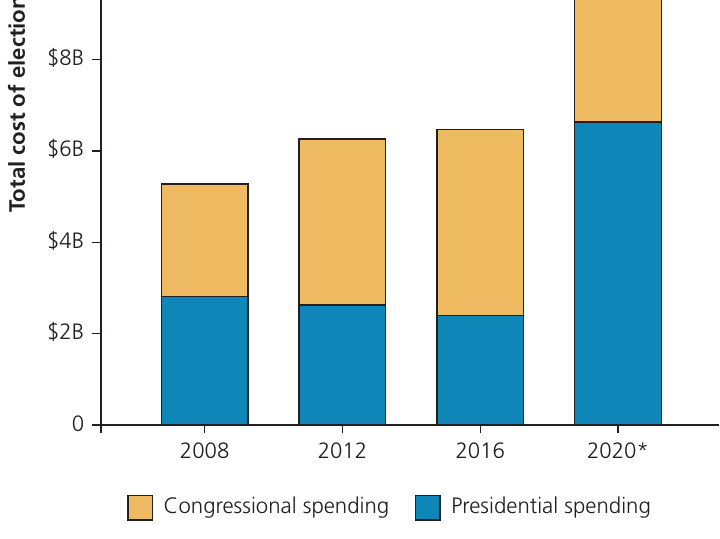
Campaign expenditure in the United States has reached staggering levels. The 2020 election cycle broke all previous records, with total spending across all elections reaching approximately $14 billion. To put this in perspective, this figure exceeded the entire GDP of some nations, including Armenia and Mauritius. This represented more than double the estimated cost of the 2016 election, which stood at $6.5 billion.
Important
The 2020 election represented an unprecedented surge in campaign spending, with total expenditure of $14 billion - more than double the 2016 figure. This level of spending has intensified debates about whether American democracy has become "pay to play."
The presidential race alone accounted for $6.6 billion of the 2020 total, with the remainder spent on congressional contests. Congressional campaign spending concentrated heavily on a relatively small number of competitive races. The most expensive Senate race in 2020 took place in South Carolina, with total expenditure reaching $227 million.
Example
Record-Breaking Primary Spending: The Bloomberg Campaign
The 2020 Democratic primaries witnessed unprecedented personal campaign investment. Multibillionaire Michael Bloomberg spent over $1 billion of his personal fortune (estimated at $\64 billion) on campaign advertisements and staffing.
Despite this massive expenditure, Bloomberg failed to win a single state and secured only five delegates from American Samoa before withdrawing from the race. This demonstrates that even enormous financial resources cannot guarantee electoral success without broader appeal and political momentum.
Meanwhile, second-place contender Bernie Sanders raised close to $170 million by early March, almost double the amount raised by eventual winner Joe Biden.
Where campaign money is spent
Campaign funds primarily cover two major categories: personnel and publicity.
Professional campaigns require extensive staffing across multiple specialisms:
- Political strategists who develop campaign messaging and tactics
- Web designers who create and maintain digital presence
- Communications specialists who handle media relations
- Office staff operating campaign headquarters across the nation
Beyond personnel costs, campaigns face substantial expenses for:
- Travel costs, particularly air travel for national campaigns covering thousands of miles
- Television advertising, especially in swing states where airtime is most competitive
- Social media advertising on platforms like Facebook
Note
By mid-October 2020, the Biden and Trump campaigns combined had spent approximately $175 million on Facebook advertisements alone. This compared to around $750 million spent on traditional television advertising.
While digital advertising has grown significantly and offers precise targeting capabilities, television remains the dominant medium for political advertising, accounting for over four times the spending of social media platforms.
Sources of campaign funding
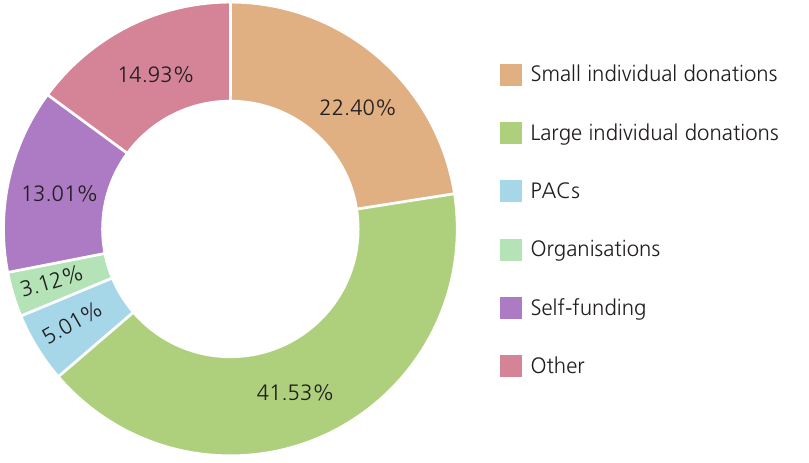
One of the most significant challenges facing campaign finance reform in the USA is the minimal effective regulation of political donations. The current system allows donors of all economic backgrounds to find various routes to fund their preferred candidates or parties. The main funding sources include self-funding, individual donations of varying sizes, and contributions from Political Action Committees.
Self-funding by wealthy candidates
Many millionaires and billionaires choose to wholly or partially fund their own campaigns. Donald Trump invested an estimated $66 million of personal funds into his 2016 campaign, though he reportedly contributed only $8,000 of self-funding in 2020.
Advantages of self-funding:
- Freedom from donor influence or obligations
- Avoidance of accusations of corruption or cronyism
- Complete freedom from government restrictions beyond disclosure requirements to the Federal Election Commission
Disadvantages of self-funding:
- Reinforces the perception that US politics is exclusively for the wealthy
- May prove counterproductive, as voters can view hugely wealthy self-funding candidates as arrogant
- Creates the impression that elections can be bought without broader popular support
Individual donations and hard money
Nearly all candidates for national office accept donations from supporters. Hard money refers to funds contributed directly to a specific candidate's campaign. The Bipartisan Campaign Reform Act (BCRA) 2002 limits these contributions.
Important
Hard Money Contribution Limits (2019-20 regulations):
- No individual can donate more than $2,800 per year directly to a single candidate's campaign
- No individual can donate more than $35,500 to a national political party
However, several mechanisms exist to circumvent these limits through Political Action Committees and soft money expenditure.
Political Action Committees (PACs)
Political Action Committees (PACs) were established in the 1940s. These organisations function as candidate supporters' groups, raising and distributing money to favoured candidates up to a maximum of $5,000 per candidate. Many established politicians also form Leadership PACs to raise money for supporting other candidates' campaigns.
Soft money and Super PACs
The largest portion of donated money takes the form of soft money, also known as independent expenditure. This refers to money spent indirectly to promote candidates or, more commonly, to attack their opponents.
Important
The Key Distinction: Coordination
The crucial criterion for soft money is that Super PACs and other groups raising and spending this money must not formally coordinate with a candidate's official campaign. This legal requirement creates a technical separation between campaigns and their supporting Super PACs, though critics argue the distinction is often artificial in practice.
All major candidates have large, wealthy Super PACs supporting them. For example:
- Future Forward USA backed Joe Biden's 2020 campaign
- Preserve America PAC supported Donald Trump
The influence of major donors extends beyond elections. A total of 38% of Trump's administration appointees were campaign donors. Linda McMahon, the wrestling magnate who chaired America First Action PAC, served in his cabinet as administrator of the Small Business Administration.
Federal government funding
Federal government funding represents the least significant source of political funding. Past attempts introduced voluntary spending caps with the incentive of matching federal funding. The theory suggested that if candidates knew the government would match their fundraising dollar-for-dollar up to a set limit, they would spend less time on constant fundraising.
Although this system worked initially, Barack Obama rejected it in 2008, correctly calculating that he could raise more independently than the funding ceiling would permit. His opponent, John McCain, became the last major party candidate to accept matching federal funding. McCain was a co-sponsor of the BCRA, also known as the McCain-Feingold Bill, which attempted to regulate campaign finance. Neither Biden nor Trump accepted state funding for the 2020 election.
Note
The Collapse of Federal Matching Funding
The decline of federal matching funding is stark:
- 2000: The Federal Election Commission paid out nearly $240 million in matching funds
- 2016: This had plummeted to just $1 million
This dramatic decline demonstrates that major candidates now view federal funding as more restrictive than beneficial, preferring the flexibility of unlimited private fundraising despite the time and effort required.
The relationship between money and electoral success
The connection between campaign spending and election outcomes is more nuanced than it might initially appear. Whilst there is a strong correlation between being the highest-spending candidate and winning, several factors complicate this relationship.
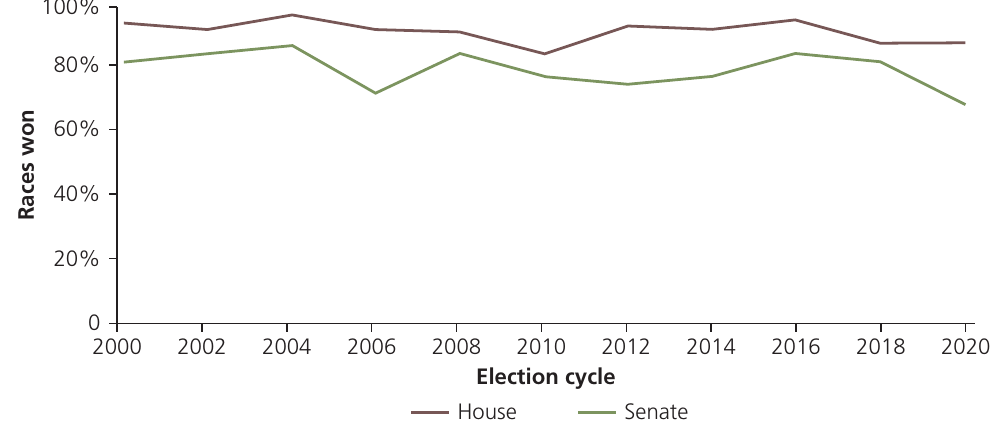
The data shows a consistently high correlation between top spending and electoral success. However, high-profile exceptions exist, such as Hillary Clinton's loss in 2016 despite outspending Donald Trump. In the ten most expensive 2020 Senate races, the highest-spending candidate won in only four contests. By contrast, incumbents won seven of these races, suggesting that incumbency advantage may be more powerful than spending advantage.
Why money follows likely winners
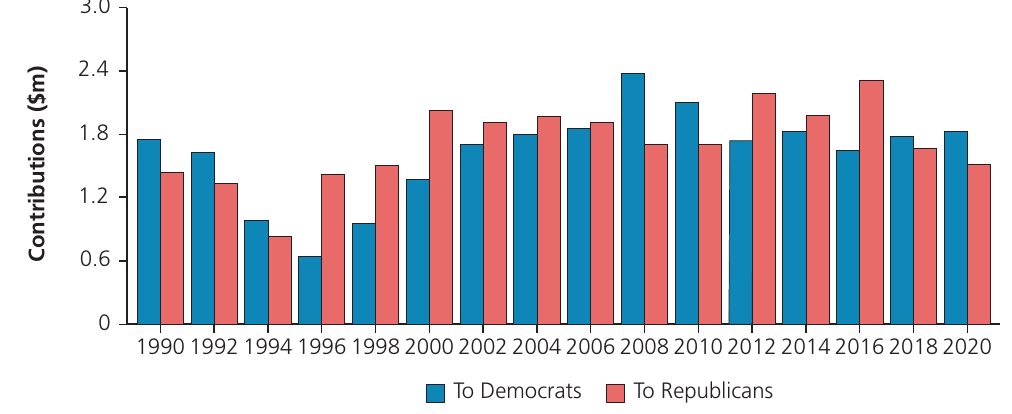
Often, donations simply flow to the candidates most likely to succeed. For many donors, particularly those in industry and business, securing access to lawmakers matters more than ideological alignment. It is important to distinguish between:
Highly ideological groups such as EMILY's List or the National Rifle Association (NRA) that channel funding exclusively to candidates sharing their policy positions.
Non-ideological interest groups that prefer backing likely winners and splitting funding between parties. The National Association of Realtors (NAR) provides a strong example of this approach. As homebuyers and estate agents are equally likely to be Democrats or Republicans, NAR members split their donations relatively evenly between candidates of different parties.
The incumbency advantage
In 2020, incumbent senators raised an average of `$22.2 million, whilst their challengers could only raise an average of just over $`3.7 million. This demonstrates the powerful incumbency advantage - sitting officeholders find fundraising significantly easier than challengers.
Note
As Donald Trump himself once stated when asked about his donations to politicians from both parties: "As a businessman you wanna be friendly with everyone."
This sentiment reflects how donors seek access to those in power, regardless of personal political preferences. Incumbents benefit from their existing relationships, name recognition, and perceived likelihood of winning, creating a self-reinforcing cycle of fundraising success.
Case study: Maryland's 7th Congressional District 2020
Example
Money Cannot Buy Every Election: Maryland's 7th District
The 2020 contest in Maryland's safely Democratic 7th district provides a clear demonstration that money alone cannot guarantee electoral success.
The Candidates:
- Republican challenger: Kimberly Klacik - spent $4.8 million
- Democratic incumbent: Kweisi Mfume - spent only $602,000
The Spending Advantage: Klacik outspent Mfume by nearly 8:1
The Result: Despite this massive spending advantage, Mfume held the seat with ease, securing over 72% of the vote.
Mfume maintained his seat was "not for sale", and the results proved him correct. This case demonstrates that in strongly partisan districts, no amount of spending can overcome fundamental political alignment between representatives and constituents.

In conclusion, whilst money cannot directly buy an American election, there remains a strong perception that candidates must "pay to play" - having substantial financial resources is a practical necessity for running competitive campaigns.
The debate over campaign finance reform
Campaign finance reform represents one of the most contested issues in American politics. The debate essentially centres on the tension between constitutional rights versus preventing corruption.
Arguments for greater regulation
Note
The Case for Stronger Campaign Finance Limits
Proponents of reform argue that the current system undermines democratic principles and creates an uneven playing field. Their key arguments include:
Cost control: Election expenditure has spiralled out of control in recent years. The 2020 election saw more money spent than the previous two elections combined, suggesting an urgent need for limits.
Distraction from governance: The emphasis on fundraising diverts elected representatives from their primary responsibilities of lawmaking and representing all constituents. This problem particularly affects House members, who face re-election every two years, leading to constant campaigning and therefore constant fundraising.
Wealth barrier: The immense cost of elections means only the personally wealthy (such as Trump and Bloomberg) or those with extensive connections to wealthy donors can realistically enter politics and succeed. This heightens the elitist nature of American politics.
Corporate dominance: Business groups vastly outspend labour groups. Among PACs, this margin is roughly 7:1, creating an imbalanced political playing field.
Important
Supreme Court Decisions Weakening Reform
Recent Supreme Court rulings, particularly Citizens United v Federal Election Commission (2010), have exacerbated the problem by removing restrictions on independent political expenditure.
Reformers argue the issue requires a constitutional amendment explicitly allowing Congress to limit campaign finance, as the Court has consistently interpreted the First Amendment as protecting unlimited political spending.
Dark money concerns: Several funding platforms, such as 501(c) groups, do not require donor names to be made public, creating accountability problems.
Loopholes: Reforms are needed to address loopholes exploited through Super PACs, 527 groups, and 501(c) organisations. The existing system allows excessive influence by wealthy vested interests, raising corruption concerns and the spectre of "buying votes" in Congress.
Federal funding decline: Matching funding, first offered in the 1976 presidential election, has virtually disappeared. In 2000, the Federal Election Commission paid out nearly $240 million in matching funds, but only $1 million in 2016, suggesting the system has failed.
Arguments against regulation
Note
The Case Against Campaign Finance Restrictions
Opponents of reform argue that current spending levels reflect democratic participation and that restrictions violate fundamental constitutional rights. Their key arguments include:
Spending fluctuations: The 2016 election actually saw slightly less spent than in 2008 and 2012 in presidential campaigns, showing campaign finance inflation is not continual or inevitable.
Representatives remain accountable: Campaign finance reform is unnecessary because candidates must genuinely listen to a wide range of voters. Many hold town hall meetings to hear constituents' views. Politicians who ignore ordinary voters whilst being influenced only by wealthy donors act unwisely and face electoral consequences.
Democratic participation: Fundraising and political donations constitute a crucial part of the democratic process, allowing supporters to demonstrate additional loyalty to their favoured candidates and causes.
Free market principles: Political donations operate as part of the free market. Popular causes and candidates attract the most funding, whilst unpopular ones struggle to raise funds - this reflects genuine public interest.
Important
First Amendment Protections
The Supreme Court has upheld crucial First Amendment rights regarding freedom in political activity when striking down some campaign reform laws.
The Court also upheld the BCRA in 2003 in McConnell v Federal Election Commission, showing judicial support for appropriate regulation exists. Opponents argue that political spending is a form of protected speech and that limiting it violates constitutional freedoms.
Transparency requirements: Political donations come with transparency and disclosure requirements. Nearly all political funding is traceable through Federal Election Commission records.
Inevitable loopholes: Whatever reforms are passed, wealthy individuals and groups will always find loopholes. As former Supreme Court Justices John Paul Stevens and Sandra Day O'Connor observed, "Money, like water, will always find an outlet."
The ongoing tension between these competing perspectives ensures campaign finance remains a central issue in American political discourse, with no easy resolution in sight.
Summary
Key Points to Remember:
-
US elections are extraordinarily expensive: The 2020 election cost approximately $14 billion, more than double the 2016 cost, with $6.6 billion spent on the presidential race alone.
-
Multiple funding sources exist: Campaign funding comes from self-funding, individual donations (hard money limited to $2,800 per candidate), PACs (limited to $5,000), and Super PACs raising unlimited soft money for independent expenditure.
-
Key legislation has limited impact: The Bipartisan Campaign Reform Act (BCRA) 2002 attempted to regulate donations, but loopholes persist. Supreme Court decisions like Citizens United (2010) removed restrictions on independent spending, whilst federal matching funding has virtually disappeared.
-
Money correlates with success but doesn't guarantee it: Whilst the highest-spending candidate often wins, incumbency advantage frequently proves more powerful than spending advantage. Incumbents raise significantly more money ($22.2m average vs $3.7m for challengers) and win more often.
-
The reform debate centres on rights versus corruption: Opponents of regulation cite First Amendment rights to political expression; supporters argue the system promotes corruption, favours the wealthy, and requires constitutional amendment to address effectively.