Candidate Selection and Nomination (AQA A-Level Politics): Revision Notes
📚Revision Notes
Candidate Selection and Nomination
The American political system uses a unique method for selecting presidential candidates through primaries and caucuses. This process represents a fundamental shift away from the old system where party bosses selected candidates behind closed doors in "smoke-filled rooms". Understanding this process is essential for grasping how American democracy functions at its most fundamental level.
Historical development of primaries
Primaries emerged during the Progressive Era at the turn of the twentieth century. Reformers wanted to make the candidate selection process more democratic and transparent. However, primaries did not become truly influential in determining presidential nominations until the early 1970s. Before then, they were relatively rare and often served merely as "beauty contests" to gauge public opinion about potential candidates.
Example
Historic Example: JFK's West Virginia Victory
A significant early example was the 1960 West Virginia Democratic primary, where John F. Kennedy's victory demonstrated that a Catholic candidate could win in a predominantly Protestant state. This helped pave the way for Kennedy to become America's first Catholic president.
Caucuses are a declining method of candidate selection. By 2020, only three states retained them for the Democratic presidential nomination: Iowa, Nevada and Wyoming. Many states, including Washington, switched to primaries for the 2020 election cycle.
Key features of primaries and caucuses
Purpose and function
The primary purpose of presidential primaries and caucuses is to select delegates who are pledged to vote for a particular candidate at their party's national nominating convention, typically held in the summer of an election year. Primaries also select candidates for state and congressional elections.
Note
Sitting presidents seeking re-election rarely face serious primary opposition. Both Trump in 2020 and Obama in 2012 faced minimal challenges from within their own parties.
Turnout characteristics
Turnout in primaries tends to be relatively low and consists largely of each party's most committed supporters. This creates an important dynamic: candidates often need to appeal to the ideological extremes of their party to win the nomination. Republicans typically veer right to attract conservative base voters, whilst Democrats move left to secure support from their progressive wing.
Types of primaries
The format and eligibility rules for primaries vary significantly from state to state, reflecting America's federal structure:
Closed primaries (e.g. Oregon, New York): Only voters pre-registered with a particular party can participate in that party's primary. This means only registered Democrats can vote in the Democratic primary, and only registered Republicans in the Republican primary.
Open primaries (e.g. Georgia): All registered voters can participate in any party's primary, but they can only vote in one party's primary. Voters are not required to be registered with that party.
Semi-open/closed primaries: Voters pre-registered with a party can only vote in that party's primary, but independent, non-affiliated voters can choose on polling day which party primary to vote in.
Note
Study tip: Be careful to refer to registered or affiliated voters, not party members, when discussing primaries. Registering as a Democrat or Republican does not make you a party member; it only means you are eligible to vote in that party's primary elections.
Campaign atmosphere
Although primaries are contests between candidates from the same party, the level of personal animosity and negative campaigning can be substantial. Candidates often attack each other for being out of touch, too old, too moderate or not ideologically pure enough. The 2016 Republican primaries saw Trump attach unflattering nicknames to his rivals, including "Lyin' Ted" (Ted Cruz) and "Cry Baby Rubio" (Marco Rubio). Watching primary debates, you might not realise the candidates belong to the same party.
Timing and scheduling of primaries
The calendar
The timetable for primaries and caucuses changes with each election cycle, although Iowa (caucus) and New Hampshire (primary) fiercely protect their "first in the nation" status. These two states have traditionally wielded disproportionate influence over the nomination process.
Under both parties' rules, only four states can hold their contests in February: Iowa, Nevada, New Hampshire and South Carolina. Sometimes the parties hold their primaries on different days in the same state. For instance, in 2016, the Democratic primary in South Carolina took place a week later than the Republican one.
Frontloading
States often practise frontloading – moving their primary or caucus closer to the start of the calendar to gain more influence over the final outcome. In 2020, California moved its primary date from June to March. However, national parties are often unhappy with excessive frontloading, preferring a slightly longer contest that allows candidates to build momentum gradually.
Super Tuesday
Many states bunch their contests together on one day in March, known as Super Tuesday. In 2020, Super Tuesday occurred on 3 March when 14 states held their Democratic primaries, awarding over a third of total delegates. This day can be decisive in determining the eventual nominee.
The invisible primaries
The invisible primaries refer to the year or so before the actual primaries begin. This period is often just as crucial as the primary season itself. During this time, potential candidates:
- Announce their intention to run
- Set up exploratory committees and campaign teams
- Work to raise their public profile
- Buy television airtime in early voting states
- Build a "war chest" of political donations
Many candidates never even make it to Iowa and drop out during the invisible primary phase.
Important
Exam tip: When evaluating primaries and caucuses, quote relevant statistics to strengthen your analysis. For example, during the 2020 campaign, the top ten Democratic candidates spent an estimated total of 621 days in Iowa during the state's caucus.
Superdelegates
The Democratic Party still employs superdelegates, more accurately termed "automatic delegates", who attend and vote at the national nominating convention. These are senior party officials including serving members of Congress, former presidents, and state party chairs and vice-chairs. In 2020, they numbered around 770, representing approximately 16% of the total delegate count. This system gives party insiders some influence over the nomination process, even in the age of popular primaries.
Case study: The 2020 Democratic primaries
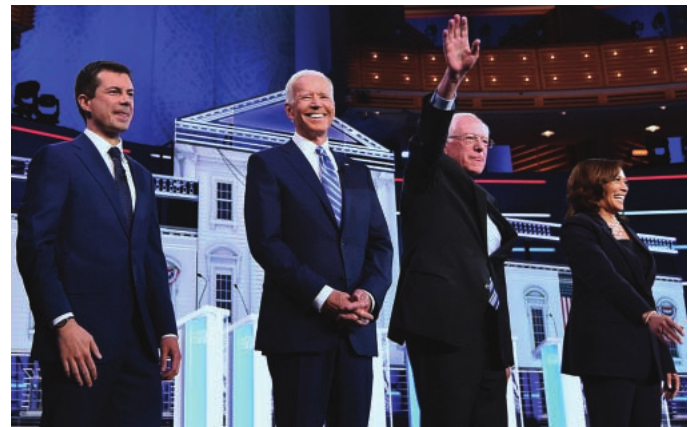
The 2020 Democratic primaries began with no clear frontrunner and 29 candidates in the running. The field was remarkably diverse, including a record six women and the first openly gay major party candidate (Pete Buttigieg), alongside two billionaires such as Michael Bloomberg. Initial candidates included senators, governors, former mayors and a former vice president.
The contest proved long and gruelling in its early stages. Candidates steadily dropped out, often endorsing those who remained in the race.
The battle between head and heart
Eventually, the contest came down to two competing visions for the Democratic Party. The "heart" favoured a liberal progressive candidate who would confront the political and business establishment head-on and embrace a radical expansion of federal welfare programmes – a liberal populist to challenge the conservative populist President Trump. The favourite representing this vision was veteran Vermont senator Bernie Sanders, who had challenged Hillary Clinton in the 2016 primaries.
The Democratic "head", however, tilted towards a more moderate and mainstream candidate: former vice president Joe Biden. Though he was a political insider unlikely to enthuse the party's radical wing, many Democrats believed he was best placed to win back crucial blue-collar states like Michigan that Democrats needed to reclaim to win the 2020 presidential election.
Biden's comeback
Biden initially performed poorly, coming fourth in Iowa and fifth in New Hampshire. His fortunes began to change in South Carolina following an endorsement from African-American congressman Jim Clyburn, the most powerful Democrat in the state. A strong showing there renewed his political viability, reinforced by winning 10 out of 14 Super Tuesday contests.
Biden's campaign gained momentum as he picked up endorsements from Buttigieg, Tulsi Gabbard and Kamala Harris as they withdrew from the race. Despite the diversity of the Democratic Party base, the final frontrunners were two white men in their seventies – facing another white male aged over 70 (Trump).
The Iowa caucus fiasco
Important
Iowa Caucus Disaster
The Iowa caucus proved disastrous. A new app created to report precinct results malfunctioned, and the reporting hotline was overwhelmed with callers. The party did not officially certify results until nearly a month after Iowans caucused. The Iowa Democratic Party chair, Troy Price, resigned, and Iowa's status as "first in the country" was called into question.
COVID-19 impact
The final stages of the primary contest were partially disrupted by the COVID-19 crisis. Many states postponed their primaries until June, whilst Alaska opted for an entirely mail-in ballot.
Final outcome
Summary
The Primary Results
In the end, the "head" won out. Sanders suspended his campaign in April 2020, and Biden emerged victorious. The contest revealed how different candidates appealed to particular demographic groups: Sanders scored highly with younger voters and some Hispanic voters, whilst Biden performed strongly with African-American and blue-collar voters.
Advantages and disadvantages of the primary system
The primary and caucus system generates considerable debate about its merits. Understanding both sides of this debate is crucial for exam success.
Advantages
Increased political participation: Primaries boost opportunities for political participation by allowing ordinary voters to choose their party's candidate. This represents democratic progress compared to the old system of party bosses selecting candidates in private meetings.
Opportunity for outsiders: The system allows political outsiders to run for major office. Trump's successful 2016 campaign exemplifies this, as he had no previous political experience. Less well-known candidates can build momentum and name recognition over time through strong performances in early states.
Democratic legitimacy: In a democracy, it is arguably better to "let the people choose" rather than leaving candidate selection to party insiders and the political establishment.
Testing candidates: Primaries effectively "road-test" candidates' qualities for office, including fundraising ability, media presence, stamina and grasp of policy issues. These are all essential skills for a successful president.
Wider state influence: The staggered length of primary campaigns enables a wide range of states to influence the outcome, especially as larger states like New York sometimes vote later in the calendar.
Political engagement: Caucuses provide opportunities for ordinary voters to discuss the relative merits and weaknesses of candidates, promoting political engagement and awareness of issues.
Disadvantages
Focus on personalities over policy: Primaries increase the focus on individual candidates rather than party platforms or policies. They exacerbate divisions within parties, such as between Hillary Clinton and Bernie Sanders in 2016. Many debates become heated and intensely personal.
Insider advantages persist: Outsiders often lack the Washington connections and experience necessary for such a demanding job. Political insiders frequently win nominations: witness former vice presidents George H.W. Bush in 1988 and Joe Biden in 2020.
Note
Public Scepticism
A March 2016 Pew Research Centre poll found that just 35% of voters said primaries are a good way of selecting the best-qualified nominees. Turnout is also relatively low, suggesting limited public enthusiasm for the process.
Professional judgement: Fellow political professionals are arguably better placed to understand candidates' true qualities, especially those required for governing as opposed to campaigning. The general public is bombarded by political advertisements and campaign slogans that may obscure candidates' real abilities.
Increased costs and voter fatigue: Primaries add to the overall cost and length of campaigns, increasing "voter fatigue". States later in the timetable play a minimal role in influencing the outcome. Too much importance is placed on Iowa and New Hampshire, which are demographically unrepresentative of the wider United States.
Caucus problems: Caucus meetings lack voter secrecy, involve lengthy time commitments and are not suited to modern politics. The 2020 Democratic Iowa caucus proved farcical, with technical failures and delayed results damaging the process's credibility.
Alternative proposals for reform
Even critics of the current system struggle to agree on alternatives. Several possibilities have been suggested:
Note
A single national primary election: This would be the most obvious alternative. All states would hold their primaries on the same day. However, this would remove the federal aspect of the process and disadvantage both small states and relatively unknown candidates who rely on building momentum over a series of contests by gaining endorsements and donations along the way.
Note
Rotating regional primaries: The country would be divided into four regions, with each region holding all their primaries on the same day. The regions would rotate which went first, last, etc. However, candidates with strong support in a particular region might gain a clear initial advantage or disadvantage depending on the order.
Note
The Delaware Plan: Small states would go first, followed by larger states. There would be four categories of states grouped by population size, with voting taking place in increasingly bigger states in a four-stage process. This would protect small states' influence whilst ensuring larger states have their say.
Each alternative has strengths and weaknesses, and no consensus exists on which reform would best serve American democracy.
National nominating conventions
National nominating conventions are effectively the formal "coronations" of successful candidates. They often take place in swing states – the 2020 Democratic convention occurred, albeit largely virtually, in Milwaukee, Wisconsin, a state Trump had narrowly won in 2016. Conventions are held in July or August of an election year, approximately 2–3 months before the November election.
Theoretical vs practical role
In theory, conventions could still play a direct role in choosing candidates. However, the results of preceding primaries and caucuses usually mean the delegate vote is a foregone conclusion. If no candidate has an overall majority among pledged delegates, a brokered convention occurs. Although often rumoured when a race looks tight, none has taken place since 1984, when Democrat Walter Mondale fell 40 votes short of an overall majority. Even then, he secured a swift and clear formal victory.
Modern functions
The modern party convention fulfils three main roles:
Party unity: Conventions provide opportunities to unite divided parties as former rivals line up to endorse and congratulate the eventual winner. The atmosphere resembles a rally rather than a forum for serious political debate.
Campaign momentum: Conventions give momentum to candidates' campaigns through publicity and opportunities to explain and outline their main policy themes. Most conventions are followed by temporary boosts in poll ratings, though this was not the case in 2020, when neither candidate received a post-convention "bounce".
Campaign launch: Conventions mark the formal beginning of the presidential campaign proper, transitioning from intra-party competition to the general election contest.
Remember!
Summary
Key concepts:
- Primaries are elections where party members or registered voters select their preferred candidate for office
- Caucuses are local meetings where party supporters discuss and vote for candidates (now rare)
- Invisible primaries refer to the crucial pre-primary period when candidates build support and raise funds
- Frontloading is when states move their primaries earlier to gain more influence
- Superdelegates are Democratic Party officials who attend the convention with voting rights
Key points to remember:
- Primaries emerged from the Progressive Era to make candidate selection more democratic
- Iowa and New Hampshire jealously guard their "first in the nation" status
- The primary system has both increased participation and created party divisions
- National conventions now serve mainly as party unity rallies rather than decision-making forums
- The current system faces criticism but no consensus exists on alternatives
Exam tips:
- Always distinguish between registered voters and party members when discussing primary eligibility
- Use specific examples (e.g. 2020 Democratic primaries) to illustrate your arguments
- Present both advantages and disadvantages of the primary system in balanced analysis
- Reference the federal nature of the system when explaining variation between states