Parties and Core Voting Coalitions (AQA A-Level Politics): Revision Notes
📚Revision Notes
Parties and Core Voting Coalitions
Understanding core voter groups
Core voter groups are the loyal supporters who form the foundation of each political party's electoral base. Both major parties depend heavily on these groups for success at the ballot box. These voters are the bedrock of party support - they reliably turn out, campaign actively, donate money, and vote consistently for their party.
However, parties face a crucial challenge: they cannot win national elections by appealing only to their core supporters. To achieve victory, parties must also attract moderate and independent voters who aren't firmly aligned with either side. This creates a delicate balancing act in American politics.
Note
Core voter groups provide more than just votes - they supply the campaign volunteers, financial donations, and grassroots enthusiasm that drive successful political movements. Without these engaged supporters, parties would lack the organizational infrastructure needed to compete effectively.
The electoral balancing act
Parties must perform careful political juggling to win elections. They need to:
- Keep core supporters engaged by addressing their key policy priorities
- Avoid alienating moderate voters by not adopting positions that seem too extreme
- Maintain enthusiasm among the base so they actively campaign and donate
Important
The real danger parties face with their core supporters is what's known as "defect to abstention". This means:
- Core voters are unlikely to switch sides and vote for the opposition
- However, if they feel ignored or disappointed, they may simply stay home on election day
- Low turnout among core supporters can cost parties crucial victories
- Keeping the base motivated to actually vote is therefore essential
On the other hand, if parties adopt radical policies loved by their core supporters, they risk pushing away the moderate voters needed to build a winning coalition. This balancing act requires constant attention throughout election campaigns.
Traditional core voting coalitions
Republican core groups
White evangelical Christians
This group represents a major component of the Republican base. Their key policy priorities include:
- Pro-life stance: Opposition to abortion rights
- Pro-Israel policies: Strong support for Israel in foreign policy
- Traditional social values: Particularly regarding LGBTQ+ and transgender rights
- Religious freedom: Protection of Christian values in public life
White evangelical Christians vote reliably Republican and their turnout can determine election outcomes in many states.
Gun owners
Gun rights supporters form another crucial part of the Republican coalition. Their priorities focus on:
- Second Amendment defence: Protecting constitutional gun ownership rights
- Opposition to gun control: Resisting most proposed restrictions on firearms
- Rural and suburban support: Strong presence in areas where gun ownership is common
- Single-issue voting: Many prioritise gun rights above other policy concerns
Note
Gun owners are often considered single-issue voters - meaning their stance on Second Amendment rights can override all other policy considerations when choosing which candidate to support.
Democratic core groups
African-Americans
Black voters represent the most loyal Democratic voting bloc. Their key policy concerns include:
- Civil rights protection: Continued advancement of equal rights and opportunities
- Fair policing: Support for movements like Black Lives Matter addressing police discrimination
- Opposition to voter suppression: Fighting against restrictive ID laws and other barriers to voting
- Poverty reduction: Policies to address economic inequality affecting Black communities
- Criminal justice reform: Addressing mass incarceration and racial disparities
Note
African-Americans vote Democratic by overwhelming margins, typically 85-90% in presidential elections, making them the most consistently loyal demographic group for either party.
Public sector labour unions
Trade unions representing government workers form another core Democratic group. Their priorities include:
- Minimum wage increases: Pushing for higher wages for working people
- Public service investment: Greater funding for education, healthcare, and other services
- Workers' rights protection: Defending union rights, pensions, and healthcare benefits
- Job security: Opposition to privatisation and outsourcing of public sector roles
These unions provide not just votes but also volunteers, money, and organisational support for Democratic campaigns.
Policy balancing in practice
The challenge of balancing core and moderate voters becomes clear in real policy decisions. Consider these examples:
Example
Worked Example: Obama and healthcare reform
When President Obama pursued healthcare reform, he faced pressure from his left flank to adopt a radical single-payer system where the government would provide health insurance for everyone. However, Obama chose a more moderate approach (the Affordable Care Act) because:
The political calculation:
- A radical plan would have increased taxes significantly, alienating moderate voters
- Some union members had negotiated excellent private healthcare deals with their employers
- These unions feared losing their hard-won benefits under a government-run system
- The more moderate approach kept unions on board while remaining acceptable to swing voters
The outcome: By choosing moderation over radicalism, Obama maintained his core Democratic coalition while making the reform palatable to enough moderate voters to pass the legislation.
Example
Worked Example: The Culinary Workers Union in 2020
In the 2020 Democratic primary, Senator Bernie Sanders proposed Medicare for All - a government-run healthcare system. The powerful Culinary Workers Union in Nevada opposed this plan because:
Why unions resisted:
- Their members had negotiated strong private healthcare packages
- They worried a government system would eliminate these benefits
- These benefits were won through years of collective bargaining
The broader lesson: This shows how even Democratic-aligned groups can clash with more radical Democratic proposals. The example illustrates why parties must carefully consider the interests of their core coalitions - even groups that share your political alignment may oppose specific policies that threaten their particular interests.
The Hispanic vote - the "sleeping giant"
The Hispanic vote represents a unique challenge in understanding core coalitions. Often called the "sleeping giant" of American politics, this voting bloc is:
- Growing rapidly: Hispanic population increasing in many key states
- Less firmly aligned: Not as reliably Democratic as African-American voters
- Increasingly important: Crucial in swing states like Florida, Texas, Arizona, and Nevada
- Divided into subcategories: Not a monolithic voting group
Diversity within Hispanic voters
Different Hispanic communities vote very differently:
Cuban-Americans:
- Tend to lean Republican
- In 2020, 58% identified as Republicans
- Strong anti-communist sentiment influences their politics
- Concentrated in Florida, helping Trump win that state in 2020
- Their support helped Republicans gain House seats in Florida
Mexican-Americans:
- Generally support Democratic candidates
- Focus on immigration reform and workers' rights
- Important in states like California, Texas, Arizona, and Nevada
Important
This diversity means parties cannot assume Hispanic voters will automatically support either side. Both parties must actively compete for their support. Treating Hispanic voters as a single, unified voting bloc is a common mistake that can lead to failed campaign strategies.
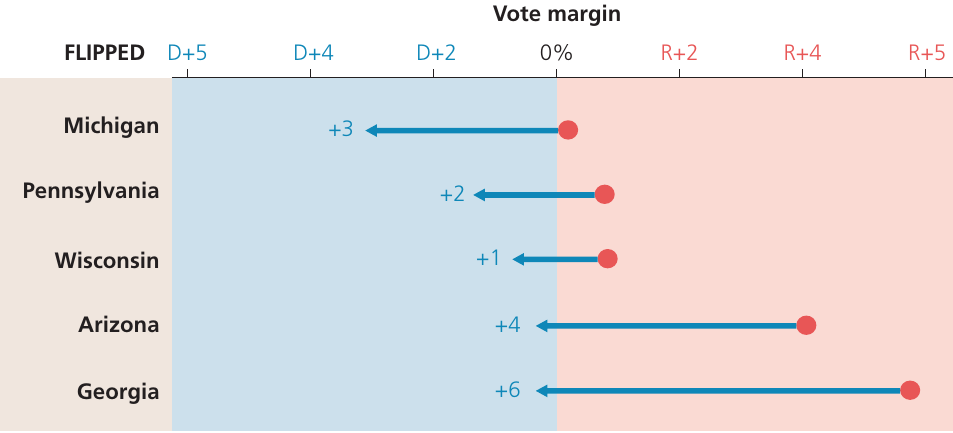
Recent electoral trends and core coalitions
The 2020 election provides evidence that core voting coalitions remain crucial to party success. The diagram above shows five states where Republicans lost ground in 2020:
- Michigan: Swung by 3 points against Republicans
- Pennsylvania: Swung by 2 points against Republicans
- Wisconsin: Swung by 1 point against Republicans
- Arizona: Swung by 4 points against Republicans
- Georgia: Swung by 6 points against Republicans
Note
Despite these losses for Republicans, both parties' core coalitions remained largely intact. The percentage of white evangelicals supporting Trump and African-Americans supporting Biden fell only slightly compared to previous elections.
This demonstrates that whilst swing voters may shift between parties, core supporters generally remain loyal. The shifts in these states were more about turnout and swing voter movement than wholesale abandonment by core coalitions.
The challenge for both parties continues to be energising these core groups to turn out whilst simultaneously appealing to moderate voters in competitive states.
Exam guidance
Note
When writing about core voting coalitions in exam answers:
- Always explain why each group supports their party, not just listing the groups
- Use specific policy examples to illustrate the balancing act parties face
- Remember that Hispanic voters are diverse - avoid treating them as one uniform bloc
- Consider both what core groups want and what parties must do to win moderates
- Use recent election data to support your arguments about coalition stability or change
Remember!
Summary
Key points about core voting coalitions:
-
Core voter groups are essential - they form the bedrock of each party's electoral support through reliable voting, campaigning, and donations
-
The balancing act is crucial - parties must satisfy their base without alienating moderate voters needed for victory; failure to manage this balance can lead to electoral defeat
-
"Defect to abstention" is the real danger - core supporters won't switch sides but may stay home if they feel ignored, costing parties crucial votes
-
Four traditional core groups dominate - Republicans rely on white evangelicals and gun owners; Democrats depend on African-Americans and public sector unions, each with distinct policy priorities
-
Hispanic voters are the "sleeping giant" - this rapidly growing demographic is less firmly aligned than other groups and contains diverse subcategories like Cuban-Americans (Republican-leaning) and Mexican-Americans (Democratic-leaning), making them a key battleground for both parties