Split Ticket Voting and Abstention (AQA A-Level Politics): Revision Notes
📚Revision Notes
Split Ticket Voting and Abstention
Split ticket voting
Split ticket voting occurs when a voter chooses candidates from different parties in the same election. For example, in 2020, a voter might have supported Biden for president whilst voting for a Republican candidate in Senate or House elections.
This practice was once common in American politics but has declined sharply in recent decades.
Historical trends in split ticket voting
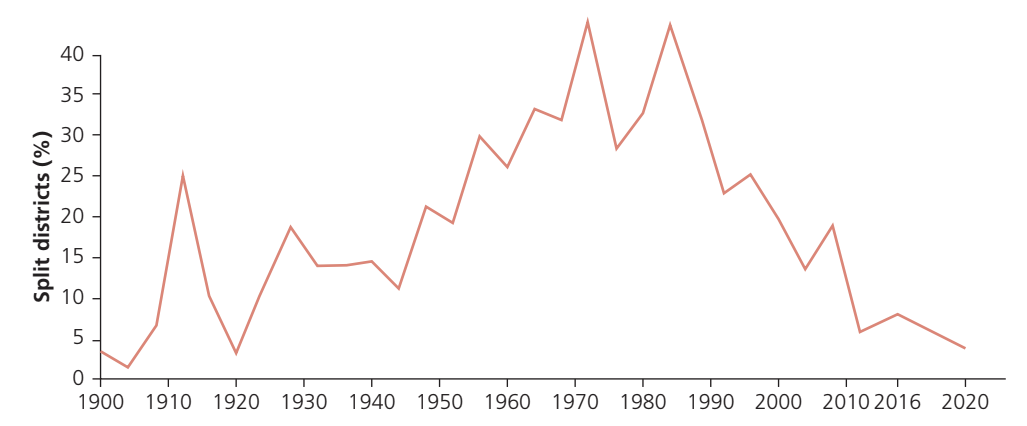
The graph below tracks the percentage of congressional districts where voters supported a presidential candidate from one party whilst electing a House representative from the opposing party.
Note
Key observations from the data:
The data reveals dramatic shifts in voting patterns over recent decades:
- Split ticket voting peaked in the 1970s and 1980s, when over 40% of districts voted this way
- The practice declined dramatically from the 1990s onwards
- By 2020, split ticket voting had fallen to historically low levels (under 5% of districts)
Recent examples
2016: This marked a significant turning point. For the first time in modern US politics, every Senate race result matched that state's presidential vote. Only 35 House districts (about 8%) split their vote between different parties.
2020: The trend continued, with just 16 districts splitting their vote—a record low of under 4% of House districts. One notable exception was Maine, where Republican Susan Collins held her Senate seat whilst the state voted for Biden.
Note
Historical contrast: In the 1982 midterms, Democrats won 17 of the 28 Senate contests in states Reagan had carried just 2 years earlier—a stark difference from today's voting patterns.
Case study: Collin Peterson
Example
Case Study: Collin Peterson and Split Ticket Voting
Democrat Collin Peterson (Minnesota 7th District) provides an interesting example of split ticket voting. He won re-election in 2016 despite his district backing Trump by over 30%. Three factors explain this:
- Peterson was the most conservative Democrat in the House
- He was a long-serving incumbent with 30+ years of experience
- He was one of only two Democrats to vote against Trump's impeachment
However, his winning streak ended in 2020 when he lost by a sizeable margin, suggesting personality politics can only override party loyalty for so long.
Why do voters split their tickets?
Three main factors traditionally encouraged split ticket voting:
- Personality over party: Some voters prioritise the individual candidate's character and experience over party affiliation
- Broadchurch parties: US parties have historically encompassed diverse ideological viewpoints, making it easier to support candidates from both parties (though this is less true today)
- Multiple elected offices: The sheer number of positions voters elect creates numerous opportunities to split the ballot
Consequences of split ticket voting
Split ticket voting can produce three significant outcomes:
Divided government: When different parties control different branches or levels of government. This can occur at both state and federal level.
Split Senate delegations: A state has one senator from each party. In the 2020-22 Senate, six states had split representation, including Ohio, Montana and West Virginia (though this is far less common than in the past).
Note
Modified voting behaviour: Representatives from split districts or states must carefully consider their voting record and the level of support they offer their own party's president. Some of Trump's least enthusiastic Republican Senate supporters came from split states.
Why has split ticket voting declined?
Important
The primary explanation is growing political polarisation. Americans today are more divided on fundamental political values than in previous decades. Voters increasingly hold consistently liberal or conservative views across multiple issues, making them less likely to "vote across the aisle."
The USA has become more partisan, with clearer ideological distinctions between Democrats and Republicans, leading to more straight ticket voting (supporting all candidates from one party).
High abstention levels
Despite having more opportunities to vote than citizens in many other Western democracies, the USA experiences relatively low voter turnout.
Turnout statistics
2016: Only 55.7% of the voting age population (VAP) turned out for the presidential race, though this represented approximately 87% of registered voters.
Note
Comparison with the UK: The 2019 UK general election saw turnout of just over 67%—significantly higher than typical US presidential elections.
Primaries: Turnout is even lower, typically under 30%. Even in competitive contests like the 2020 Democratic primary in New Hampshire (an early and important state), turnout among eligible voters was only around 26%.
Midterms: Traditionally see lower turnout than presidential elections. In 2014, approximately 42% voted, though this increased to a 40-year record in 2018.
The 2020 exception
Turnout soared to a record 66.4% in 2020, reaching as high as 79.9% in Minnesota. Two key factors explain this:
Note
Why 2020 Was Different:
- Trump as a polarising figure: Millions of liberals were energised to vote him out of office, whilst slightly fewer conservatives were equally motivated to keep him in office
- COVID-19 pandemic: Many states made voting easier through expanded mail-in voting and early voting options to maintain social distancing
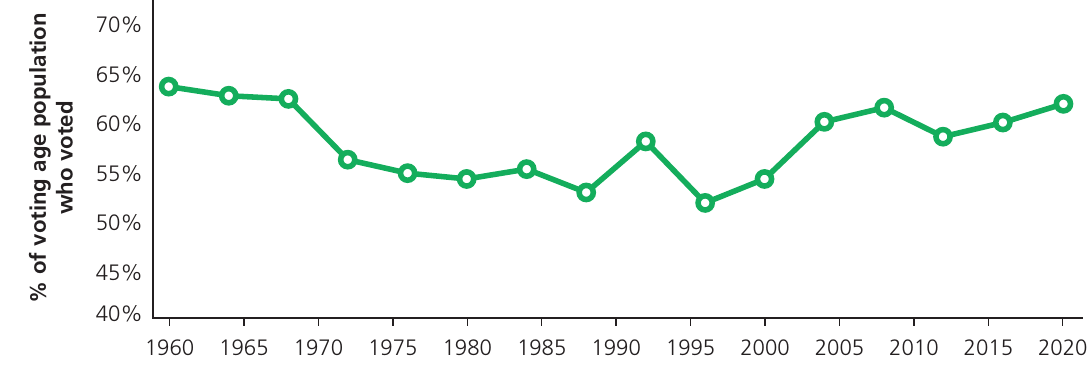
The graph shows voter turnout generally declined from the 1960s through the 1990s before gradually recovering, with 2020 marking a significant spike.
Factors explaining high abstention rates
Structural barriers
Several institutional features make voting more difficult in the USA:
Important
Registration requirements: Americans must proactively register to vote. Unlike the UK, where the government requires all eligible citizens to register by law, the onus falls on the individual in the USA.
Ex-felon disenfranchisement: Certain states bar former felons from voting, even after they've completed their sentences.
Postal voting restrictions: Some states require an "excuse" for absentee or early voting ballots, making it harder for people to vote. By contrast, Colorado, Oregon and Washington have all-mail voting systems. States with easier alternative voting methods unsurprisingly see higher turnout. In 2020, around 68% of ballots were cast early or by post.
Ballot access thresholds: Many states require substantial deposits or nomination signatures to appear on the ballot. This limits candidate choice and can affect turnout. In Indiana, one of the strictest states, a minor party candidate for statewide office must collect 26,699 signatures—a challenging task.
Voter ID laws: Some states have introduced tougher voter identification requirements, ostensibly to prevent voter fraud.
Important
Voter roll purging: States like Georgia have actively removed voters from registration lists. Between 2012 and 2018, more than 1.4 million voter registrations were cancelled in Georgia. Whilst some represented people who had moved or died, others were removed simply for not voting in several election cycles. Democrats argue these measures disproportionately affect African-Americans and younger voters—groups less likely to support Republicans.
Other factors
Beyond structural barriers, several additional reasons explain low turnout:
Limited choice: The two-party dominated system provides little viable alternative for voters dissatisfied with Democrats or Republicans.
Majoritarian electoral system: The USA almost exclusively uses first-past-the-post voting, which discriminates against third-party and independent candidates.
Voter fatigue: With numerous elections and lengthy ballot papers, many Americans feel overwhelmed by the sheer volume of political decisions required of them. Predominantly negative campaigning contributes to disenchantment.
Political efficacy: Many voters believe their individual vote changes very little, particularly in safe seats.
Uncompetitive races: Many states and districts are effectively one-party strongholds. Victory nearly always goes to the same party, making individual votes seem meaningless for determining outcomes.
Impact of low turnout
The consequences of low turnout are particularly significant for primaries. Since only a small minority vote—typically the most ideological and committed party members—candidates often pitch to the extreme wings of their parties. In the general election, they may need to moderate their positions to appeal to centrist voters. When they fail to do this, or when primary voters select an extreme candidate, political upsets can occur.
Example
Case Study: Alabama Senate Special Election
In December 2017, Alabama held a special Senate election. Republicans had selected controversial judge Roy Moore in their primary. Moore lost the general election to the Democratic candidate—a rare upset in a heavily Republican state.
This demonstrates how selecting an extreme candidate in a low-turnout primary can lead to defeat in the general election, even in safe seats.
Important
At a broader level, low turnout raises questions about American democracy itself. It suggests:
- Widespread apathy about politics and politicians
- Limited viable party choice
- Significant barriers preventing many Americans from voting
This presents an unflattering picture for a nation that considers itself a "beacon of democracy."
Summary
Key Points to Remember:
- Split ticket voting has declined dramatically since the 1990s due to increasing political polarisation. By 2020, fewer than 4% of House districts split their vote between parties.
- The decline in split ticket voting reflects Americans becoming more consistently liberal or conservative, making them less likely to vote for candidates from opposing parties.
- Despite numerous voting opportunities, US turnout is relatively low compared to other Western democracies. In 2016, only 55.7% of the voting age population voted (compared to 67% in the UK's 2019 election).
- Structural barriers significantly contribute to low turnout, including voter registration requirements, restrictions on postal voting, tough ballot access rules, and controversial voter ID laws and voter roll purging.
- 2020 was exceptional, with turnout reaching 66.4%—the highest in decades—driven by Trump's polarising presence and expanded mail-in voting during COVID-19.
- Low turnout particularly affects primaries, where the most ideological voters dominate, potentially pushing candidates toward extreme positions that may harm them in general elections.