Organisation of the Parties (AQA A-Level Politics): Revision Notes
📚Revision Notes
Organisation of the Parties
The organisational structure of American political parties differs significantly from parties in other democracies. US parties are characterised by three key features: the absence of a single national party leader, a decentralised state-based structure with relatively weak central bodies, and the involvement of numerous associated organisations and interest groups that support party goals without formal institutional affiliation.
Leadership
Unlike political parties in the UK, US parties do not have a clear, single leader. This reflects both the separation of powers and the federal framework of the American political system, as well as the broader political culture.
Note
This fundamental difference from parliamentary systems like the UK's means that party leadership is fragmented across multiple institutions and levels of government, rather than concentrated in a single individual who serves as both party and government leader.
Presidential authority vs party leadership
Even the president is not the formal party leader. While the president typically has considerable authority within their party and sets much of the political agenda, they lack direct control over their party in Congress. This creates a complex relationship where negotiation and persuasion become essential tools.
Congressional party leaders
Both parties maintain their own leaders in each chamber of Congress. In 2021, these positions were held by:
Senate:
- Mitch McConnell - Republican leader
- Chuck Schumer - Democratic leader
House of Representatives:
- Nancy Pelosi - Democratic speaker and leader
- Kevin McCarthy - Republican leader
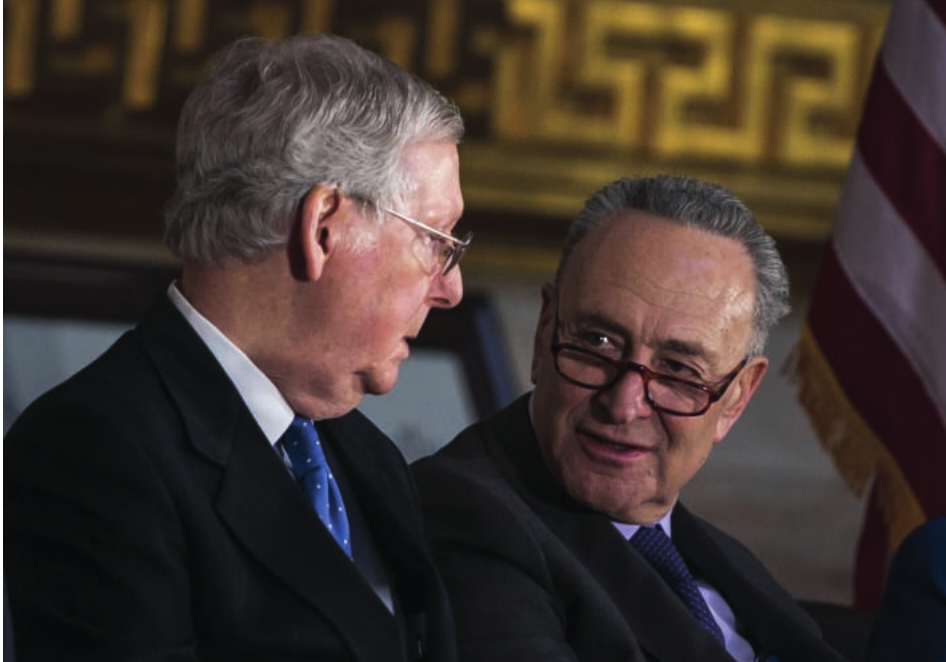
The president or presidential nominee has no direct power over their party's legislators in Congress. While most members of Congress share political views aligned with their party's president or presidential candidate, much negotiation and persuasion is required to achieve legislative goals.
Weak party discipline
Important
The relative lack of party discipline means presidents can find their agenda blocked by opposition from within their own party. This is a crucial difference from parliamentary systems where party discipline is much stronger and party leaders have more control over their members' votes.
A notable example occurred during Trump's first two years in office, when he was unable to pass his healthcare reforms despite Republican majorities in both chambers of Congress. This demonstrated that even unified government does not guarantee legislative success.
Informal leadership structures
Any leadership that exists is therefore largely informal and personality-driven. Trump arguably exerted influence over the Republican Party through his strong personal following among the grassroots base. Republican lawmakers largely remained loyal to him partly out of fear of being primaried for not following his lead.
Note
Primaried refers to when an incumbent congressional legislator faces a strong primary challenge from within their own party. This threat can be a powerful tool for enforcing party loyalty, as losing a primary means the end of a politician's career in their current seat.
Leadership becomes even less visible and effective when the party does not control the White House.
State-based parties and weak central structures
It is sometimes said that there are not two parties in the USA, but 100 - representing 50 state Republican parties and 50 state Democratic parties. This emphasises the significant degree of autonomy and independence enjoyed by state party organisations.
State party autonomy
State parties have their own structures and play an important role in organising primaries. However, they have minimal direct involvement in candidate selection. Local parties typically do not themselves endorse a primary candidate, although leading local party officials may personally endorse individuals in primaries.
An example of state party independence is Minnesota, where local Democrats run on the ticket of the Minnesota Democratic-Farmer-Labor Party, reflecting a 1944 party merger.
National party committees
The Democratic National Committee (DNC) and the Republican National Committee (RNC) are the national party organisations. Their main roles are to:
- Organise the national convention that formally nominates the party's presidential candidate
- Draw up the party's national platform
Beyond these functions, their role in national politics remains limited, particularly as they have no power over candidate selection. Consequently, their chairs (in 2021, Jaime Harrison for the DNC and Ronna McDaniel for the RNC) are rarely household names or major political players.
Hill committees
Four 'Hill committees' aim to get members of their party elected to Congress on Capitol Hill:
- Democratic Congressional Campaign Committee (DCCC)
- National Republican Congressional Committee (NRCC)
- Democratic Senatorial Campaign Committee (DSCC)
- National Republican Senatorial Committee (NRSC)
Note
These committees primarily coordinate campaigns and donors, helping to direct supporters' financial donations either to target seats or to shore up vulnerable incumbents. They also sometimes run their own advertisements and campaigns, often attacking opponents in competitive races.
In the lead-up to the 2020 Senate elections, for example, the NRSC ran a billboard campaign in several states using the same format, simply changing the name of the Democratic candidate to reflect the individual state.
Although these committees have no direct role in choosing candidates, they often encourage and aid promising candidates, particularly those fighting their first national election.
Associated groups
A final element of party organisation is the existence of many loosely affiliated groups. These share characteristics with pressure groups but are more overtly party political.
Democratic Socialists of America (DSA)
The Democratic Socialists of America (DSA) is a good example. While independent of official Democratic Party structures, with a membership of around 50,000, it works to secure the victory of very progressive Democrats in primaries.
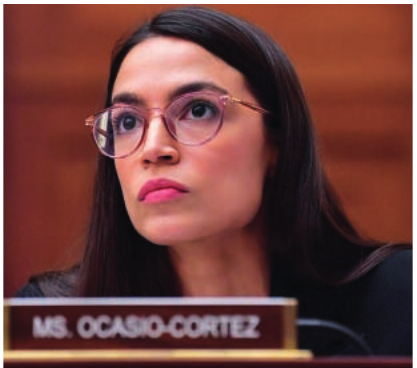
In 2018, the DSA saw two of its endorsed candidates elected to the House:
- Rashida Tlaib
- Alexandria Ocasio-Cortez
Tea Party movement
A similar organisation on the Republican side is the conservative/populist/libertarian Tea Party movement.
Combined influence of party structures
Traditional pressure groups, such as the NRA and NARAL Pro-Choice America, also throw influence, endorsement and funding behind candidates they see as supportive of their positions. This feature of US politics further weakens the power of national party bodies.
Important
One should be careful not to ignore the combined role of central party structures, associated groups and donors in wielding influence. While individual components may appear weak, their collective impact on elections and policy can be substantial.
Case study: Steve King's primary defeat (June 2020)
Example
Case Study: Primary Challenges and Party Influence
In June 2020, controversial Republican House member Steve King (Iowa 4) lost his primary. This was significant because:
- He had a track record of racist comments
- He had been largely ostracised by the Republican House leadership
- Mitch McConnell commented that King was 'unworthy of his elected position'
- King had been removed from House committee assignments including Agriculture, an important sector in his largely rural district
- He was widely seen to have 'lost his voice' in Congress
- He lost several important endorsements, including from conservative evangelical leaders in the state
- He was seen as electorally vulnerable in a usually safe Republican district
King's primary defeat was a rare example of primaries being used to select less polarising and extreme candidates.
Understanding party organisation
All these groups, committees and organisations exemplify the 'unity within diversity' model of the modern US party. There is a strong common purpose - securing election victories - but with parallel avenues of giving and activism. When added to the campaign committees of every individual legislator or candidate, the impression is of a complex network of party organisations and supporters' groups, rather than a single hierarchical party with state branches.
Perhaps the organisation of US parties resembles mighty rivers fed by many separate tributaries and streams. They are all headed in the same direction, despite the whirlpools of internal factionalism, and are also awash with cash.
Note
Factionalism refers to different groups within the same party that often compete for power and influence. Most factions reflect either moderate or more extreme positions within the party.
Exam guidance
When analysing US party organisation in exam questions:
- Contrast with UK parties: US parties lack the centralised structure and clear leadership found in UK parties where national ballots of party members choose the leader
- Emphasise decentralisation: Focus on the state-based nature and weak central structures
- Use specific examples: Reference the Hill committees, DNC/RNC roles, and associated groups like DSA and Tea Party
- Link to separation of powers: Explain how the constitutional structure shapes party organisation
- Consider the impact: Discuss how weak party discipline affects legislative outcomes
Remember!
Summary
Key Points to Remember:
-
No single party leader: US parties lack clear national leaders; even the president is not the formal party leader due to separation of powers
-
Decentralised structure: There are effectively 50 state parties for each main party, with considerable autonomy and independence
-
Hill committees: Four committees (DCCC, NRCC, DSCC, NRSC) coordinate campaigns and direct donations but don't select candidates
-
Associated groups: Organisations like the DSA and Tea Party work alongside but independently of official party structures
-
Weak party discipline: Presidents cannot control their congressional party, leading to negotiation and potential opposition from within their own party
-
Key terms: Primaried (facing a strong primary challenge), factionalism (competing groups within a party), party organisation (formal structures like RNC and DNC)