Pressure Group Funding of Elections (AQA A-Level Politics): Revision Notes
📚Revision Notes
Pressure Group Funding of Elections
Pressure groups play a significant role in US electoral politics by contributing millions of dollars to help elect candidates who support their objectives. This financial involvement shapes the political landscape and influences which candidates succeed in elections.
How pressure groups fund elections
Electoral finance refers to the money used to fund election campaigns. In the US, there are two main types: individual donations to candidates' campaigns (which have legal limits) and independent expenditures (which are unlimited). Pressure groups can spend unlimited amounts through independent expenditures, giving them considerable influence in elections.
Note
The ability to make unlimited independent expenditures gives pressure groups far greater influence than individual donors, who face strict contribution limits to candidates' campaigns. This distinction is crucial for understanding how pressure groups shape electoral outcomes.
Pressure groups typically support candidates whose views align with their aims. For example, unions, pro-choice organisations, LGBTQ+ groups and gun-control advocates generally back Democratic candidates. In contrast, conservative religious groups, pro-life organisations and gun-rights groups usually fund Republican candidates.
However, this pattern is not absolute. Some candidates hold positions that differ from their party's mainstream views, attracting support from groups that would normally back the opposition.
Example
Worked Example: Cross-Party Pressure Group Support
In 2018, Dan Lipinski, a pro-life Catholic Democrat congressman, received support from the Susan B. Anthony List (SBA List), a pro-life group that typically backs Republicans. The SBA List:
- Spent $100,000 on his primary campaign
- Had members canvass 17,000 homes
- Helped Lipinski win by just 2,000 votes
This demonstrates how pressure group involvement can prove decisive in tight races, even when supporting a candidate from an unexpected party.
Case study: the National Rifle Association (NRA)
The NRA provides an excellent example of how pressure groups use funding to influence elections. With approximately 5 million members, it is considered one of America's most powerful pressure groups, largely due to its strategic funding of election campaigns.
Evolution of NRA funding strategy
The NRA's tactics have changed significantly over time as American politics has become more polarised. In 1992, the group directed 37% of its congressional campaign spending towards Democratic candidates. By 2016, this had fallen dramatically, with Republicans receiving 98% of its congressional campaign funding.
Important
This dramatic shift from 37% Democratic support in 1992 to 98% Republican support in 2016 illustrates how pressure groups have become increasingly partisan as American politics has polarised. This transformation reflects broader changes in the political landscape and party positions on gun rights.
Despite this partisan shift, the NRA maintains some flexibility in its approach. It has intervened in Republican primaries to oppose moderate candidates who support gun control. In 2012, the group spent more than $169,000 successfully opposing Senator Richard Lugar's reselection after he received an 'F' rating for his gun control support.
The NRA has also donated to 'Blue Dog' Democrats (a centrist faction) who support gun rights, such as Texas congressman Henry Cuellar. However, this strategy can prove controversial. In 2018, the Blue Dog PAC returned an NRA donation following criticism from members who did not support gun rights.
NRA spending and influence
In the 2016 election season, the NRA spent $52.5 million on electoral campaigning. Much of this funded television and radio advertisements, including one in every eight television adverts in Ohio during October that year.
Despite this massive spending, the NRA's success has not automatically increased its power. After helping elect a Republican president and Senate who supported gun ownership, the group's membership revenue actually fell between 2016 and 2018. This led to the NRA spending approximately half as much on the 2018 midterm elections compared to the 2014 midterms. Gun control groups like Giffords and Everytown for Gun Safety outspent the NRA for the first time in 2018.
Relationship with President Trump
After spending $30 million promoting Trump's 2016 presidential campaign, the NRA did not receive the unconditional support it might have expected.
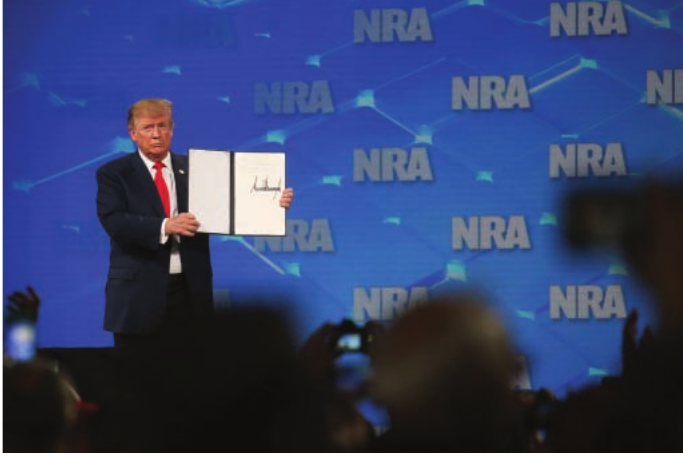
Following the 2018 Parkland high school shooting in Florida, Trump criticised a Republican senator for not including an age limit on his gun background check bill, claiming the senator was 'afraid of the NRA'. Trump told state governors: "Half of you are so afraid of the NRA. There's nothing to be afraid of…if they're not with you, we have to fight them every once in a while, that's okay."
Note
In March 2019, the NRA expressed disappointment when Trump's administration banned bump stocks (devices that make semi-automatic rifles fire faster). This demonstrates that substantial spending does not guarantee influence, even with politicians who have directly benefited from a group's support.
The NRA faced legal challenges related to alleged financial impropriety in 2020, restricting its ability to match 2016 spending levels as funds were tied up in court cases. Nevertheless, it still spent more than $16 million supporting Trump from a total budget of $23 million.
Funding of Washington insiders
Pressure groups concentrate their resources on influential figures in Washington politics. During presidential election years, groups spend heavily on the main two presidential candidates, as the winner gains sole federal executive power. They also invest substantially in campaigns of influential members of Congress, including high-profile party members, important committee chairs and rising stars within party leadership.
Senate versus House funding
Senate campaigns increasingly receive more donations than House contests. In 2020, independent expenditure in Senate races exceeded $1,547 million compared to $702 million for House races (more than double).
Note
Why Pressure Groups Prioritise Senate Campaigns:
Pressure groups focus on Senate races for strategic reasons that provide better return on investment:
- Senators serve 6-year terms, providing longer-term benefits
- There are only 100 senators, giving each greater individual influence
- The Senate has slightly more constitutional power than the House
The NRA exemplifies this strategy, spending 96% of its 2016 budget on just six Senate races and the presidential campaign.
Supporting the establishment
Many pressure groups, corporations and wealthy individuals prefer financing Washington insiders who will maintain the status quo to benefit their organisations. This makes it difficult for outsiders to break through and favours pro-business candidates who generally support the establishment.
Hillary Clinton exemplified this type of candidate in the 2016 presidential campaign, raising far more money than her anti-establishment rival Donald Trump. However, her loss demonstrates that there are limits to the power of money and pressure groups in US elections.
Reinforcing incumbency
The tendency of pressure groups to fund Washington insiders reinforces the incumbency advantage in elections. In every election cycle, incumbent politicians (those already holding office) run against challengers hoping to unseat them.
Incumbents enjoy significant advantages over challengers:
- Higher public profile
- Established record to campaign on
- Existing relationship with constituents
- Easier access to campaign donations
- Greater resources for advertising and promotional materials
Note
These advantages are reflected in incumbency re-election rates. Typically, more than 90% of members of Congress are returned to office, with nearly as many senators successfully defending their seats. This demonstrates how difficult it is for challengers to overcome the combined advantages of incumbency and pressure group support for established politicians.
Iron triangles
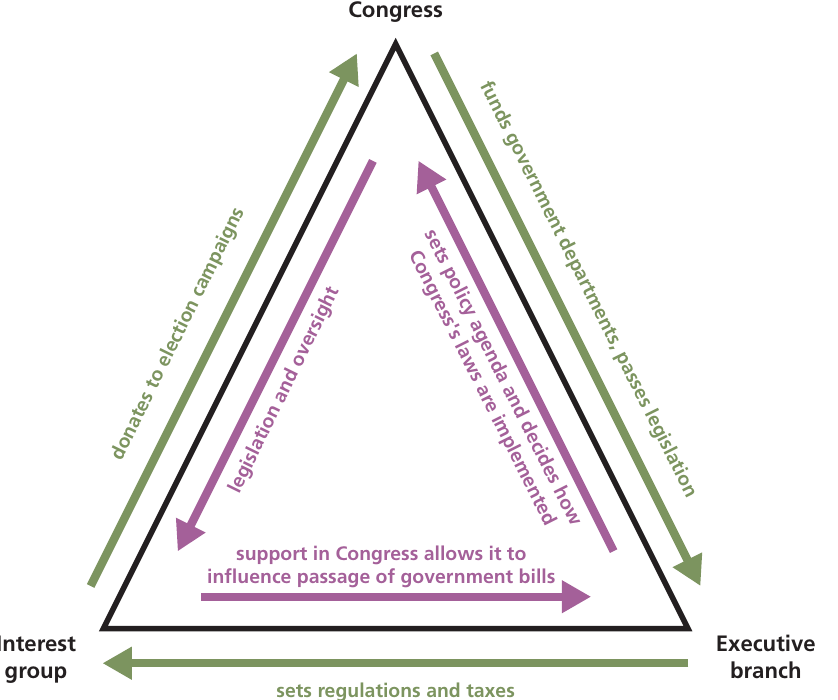
An iron triangle describes the close relationship between three key participants in the policy-making process: interest groups, Congress and the executive branch. These three entities are bound together in a network of mutual advantage, where each benefits from supporting the others.
How iron triangles work
The three points of the triangle interact in the following ways:
Interest groups influence Congress by:
- Making donations to election campaigns
- Providing employment in congressional districts (particularly wealthy companies)
- Using congressional influence to pressure the executive branch
Congress influences the executive by:
- Funding executive departments
- Passing legislation affecting policy areas
- Carrying out oversight via congressional committees
The executive influences interest groups by:
- Creating regulations groups must follow
- Setting the policy agenda
- Determining how Congress's laws are implemented
Important
These relationships can potentially lead to decisions that are not in the public interest, as the three parties prioritise their mutual benefit over broader societal concerns. This represents a fundamental challenge to democratic accountability when powerful actors cooperate to serve their own interests rather than the public good.
Defence: the 'military-industrial complex'
The defence industry provides one of the most significant examples of iron triangles in American politics. President Dwight D. Eisenhower raised concerns about this in 1961, warning that the 'military-industrial complex' was growing too powerful and could lead to defence and foreign policies not in the public interest.
Eisenhower argued that the 1950s development of 'a permanent armaments industry of vast proportions' had 'grave implications' and could cause 'the disastrous rise of misplaced power'. Despite being a former general, he wanted the military budget reduced. However, successive governments have been unable to achieve this due to the political imperative of maintaining America's position as the world's most powerful military force.
Major defence contractors
A small number of huge defence firms have become part of the military infrastructure, including:
- Lockheed Martin
- Boeing
- Raytheon
- Northrop Grumman
Gordon Adams developed the 'iron triangle' concept in his 1981 book The Iron Triangle: the politics of defence contracting.
Lobbying and congressional influence
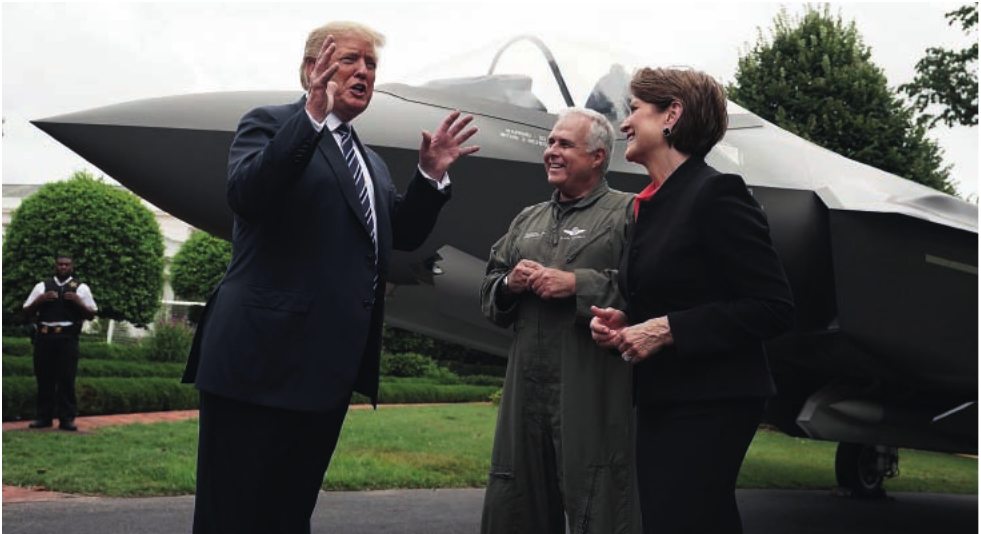
Defence companies spend millions on professional lobbyists to persuade members of Congress to support their objectives. Lockheed Martin, the largest US defence company, spends approximately $14 million annually on professional lobbyists.
The defence industry is dominated by a handful of huge companies with operations across many states and congressional districts. This gives them influence over numerous members of Congress who want to ensure companies keep receiving government contracts that secure employment for their constituents.
Example
Worked Example: Strategic Job Creation Claims
When bidding for the F35 fighter jet contract (America's most expensive weapons system), Lockheed Martin claimed the programme would create:
- 125,000 jobs across 46 states
This strategy pressured those states' members of Congress to support the contract, as voting against it could mean lost jobs for their constituents. This demonstrates how defence companies leverage employment to gain political support across multiple congressional districts simultaneously.
Campaign donations and personal investments
Defence companies donate millions to congressional campaigns. In the 2018 election cycle, these donations totalled more than $30 million. Companies spread donations across many states and congressional districts to maximise influence throughout Congress.
Members of Congress serving on powerful defence committees are likely to receive substantial donations. For example, Joe Courtney, Democratic congressman for Connecticut's second district and chair of the Seapower and Projection Forces Subcommittee, received his largest 2019-20 contributions from defence contractors. Multiple companies including Northrop Grumman, General Dynamics and Raytheon donated to his campaign. Courtney earned the nickname 'two subs Joe' for helping secure funding to construct two submarines annually in his district.
Note
Many members of Congress have personal financial stakes in defence companies. In 2019, 51 members or their spouses owned between $2.3-5.8 million worth of shares in defence companies, meaning they profited directly when contracts were awarded. This included almost one-third of the Senate Appropriations Subcommittee on Defense, which decides Department of Defense funding levels.
Senator Roy Blunt owned up to `$100,000 of Lockheed Martin stock and his subcommittee awarded the company a $1.85 billion contract in 2020.
'Too big to fail'
When defence companies become integral to so many states' economies, the federal government has a strong incentive to ensure they prosper. Academic William Hartung described Lockheed Martin as 'too big to fail', arguing the company had made itself essential to so many weapons systems that continued government support through large contracts became militarily and economically imperative.
Important
The concept of defence companies being 'too big to fail' creates a self-reinforcing cycle where companies deliberately spread operations across multiple states, making themselves politically indispensable. This makes it nearly impossible for Congress to reduce defence spending without facing significant political backlash from affected constituencies.
The revolving door syndrome
The revolving door syndrome contributes significantly to iron triangle formation. Personnel frequently move between the three institutions on the triangle. In defence, individuals 'revolve' between major contractors and the Pentagon (defence department headquarters).
Example
Worked Example: The Revolving Door in Action
Patrick Shanahan's career path illustrates the revolving door:
- Before government: Boeing's senior vice president
- 2017-2019: Trump's deputy defence secretary
- 2019: Acting defence secretary
Once in government, Shanahan oversaw defence spending that directly benefited Boeing, including 20 contracts worth $13.7 billion in September 2018 alone. This demonstrates how former industry executives can influence government decisions that benefit their previous employers.
Drug companies: 'big pharma' and the FDA
The pharmaceutical industry provides another example of iron triangles. Large pharmaceutical companies maintain strong links with the Food and Drug Administration (FDA), the federal agency regulating pharmaceuticals, and with Congress.
Congressional connections
Pharmaceutical companies focus attention on members of key congressional committees, such as the House Energy Subcommittee on Health. Democrat Anna Eshoo, the committee chair, received hundreds of thousands of dollars from pharmaceutical and health companies during the 2020 election cycle.
The revolving door in pharmaceuticals
As with defence, the pharmaceutical industry's relationship with the executive branch benefits from the revolving door.
Example
Worked Example: Revolving Door in Pharmaceuticals
Scott Gottlieb's career path demonstrates the pharmaceutical revolving door:
- 2005-2007: Worked for the FDA
- 2007-2017: Worked for several pharmaceutical companies
- 2017-2019: Trump appointed him to head the FDA
- 2019-present: Joined Pfizer's board of directors (one of America's largest pharmaceutical companies)
This pattern shows how individuals move between regulating and working for pharmaceutical companies, raising questions about potential conflicts of interest when former industry employees regulate their previous employers.
Relative power of pressure groups and political parties
When evaluating whether pressure groups or political parties are more powerful in American politics, consider the following points:
Summary
Arguments for Pressure Group Power:
- Iron triangles allow large corporations and influential interest groups to influence both the executive and Congress
- Campaign donations and professional lobbyists enable pressure groups to influence members of Congress and the president
- Economic importance: Corporations provide essential jobs and can become 'too big to fail'
- The revolving door allows pressure groups to maintain close relationships with Congress and the executive through personnel movement
- Focus: Large, well-organised pressure groups can be more focused than 'big tent' parties containing many conflicting ideas
Arguments for Political Party Power:
- Comprehensive policy-making: Parties formulate policy for all government areas, not just specific sectors or issues like pressure groups
- Candidate selection: They select and support electoral candidates for the legislature and presidency
- Legislative power: They wield power in Congress, especially when controlling both houses
- Executive power: They determine federal government policy when their party holds the presidency
The relative power depends on the context and type of pressure group. Some wealthy, well-organised groups in specific sectors (like defence or pharmaceuticals) wield enormous influence through iron triangles. However, political parties maintain unique powers in candidate selection, comprehensive policy-making and controlling the machinery of government.
Summary
Key Points to Remember:
-
Electoral finance allows pressure groups to spend unlimited amounts through independent expenditures, giving them significant influence in elections
-
The NRA case study demonstrates that even massive spending ($52.5 million in 2016) does not guarantee influence, as shown by Trump's willingness to oppose the group on certain policies
-
Pressure groups concentrate resources on Washington insiders, particularly Senate races, which receive more than double House race funding due to longer terms and greater individual influence
-
Iron triangles create networks of mutual benefit between interest groups, Congress and the executive branch, potentially leading to decisions not in the public interest
-
The military-industrial complex and 'big pharma' exemplify how iron triangles operate, with companies like Lockheed Martin becoming 'too big to fail' and maintaining influence through campaign donations, employment provision and the revolving door syndrome