The Executive Branch: The President (AQA A-Level Politics): Revision Notes
📚Revision Notes
Constraints on the President's Power
The Founding Fathers deliberately designed a system of limited government with separation of powers to prevent the president from becoming too powerful. Having escaped British monarchical authority, they created constitutional mechanisms to ensure no single person or institution could dominate American government.
Checks and balances by Congress
Important
Checks and balances are a crucial feature of the Constitution's framework. They ensure that each branch of government is limited by the others, preventing excessive concentration of power in any single institution or individual.
The Constitution provides Congress with several mechanisms to check presidential power:
Amending, delaying or rejecting the president's legislation
Congress holds a powerful check on presidential legislative ambitions. Without congressional support, a president cannot pass legislation, regardless of public opinion.
Example
Case Study: Sandy Hook and Obama's Gun Control Failure
The 2012 Sandy Hook elementary school shooting demonstrated this constraint effectively. Twenty-six people were killed, including twenty children. President Obama released plans for stricter gun controls, including a ban on assault weapons. Despite majority public support for these reforms, Congress rejected the legislation.
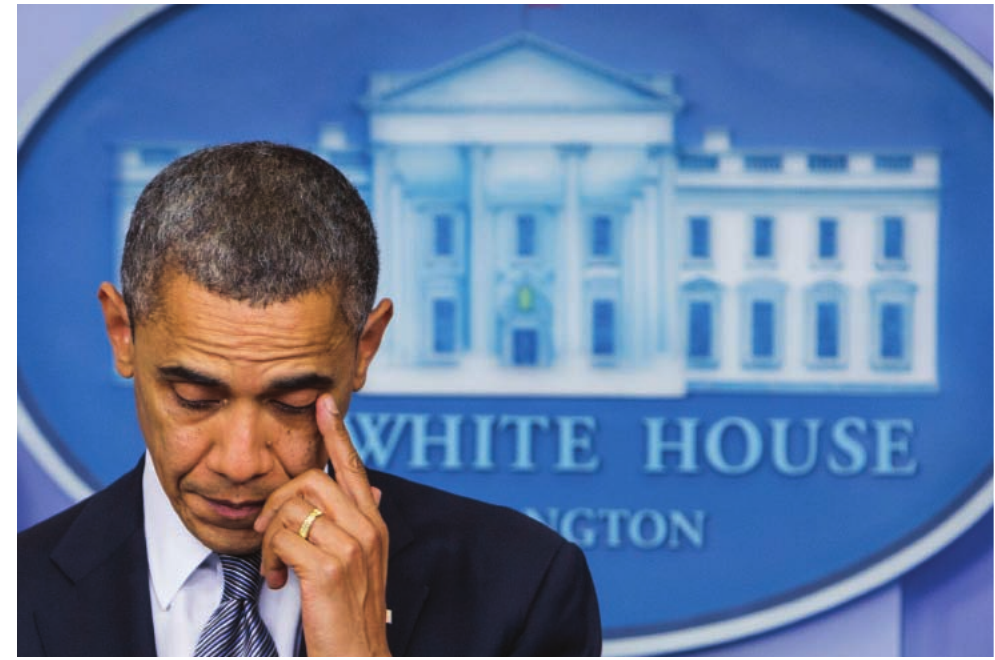
This illustrated how congressional opposition can block presidential initiatives even when public opinion supports them.
This check operates less effectively during unified government, when the president's party controls both houses of Congress. During such periods, Congress is less likely to obstruct presidential legislation. Obama successfully passed legislation from 2009 to 2010 when Democrats controlled both chambers. This changed dramatically when Republicans won a House majority in the November 2010 midterms.
Note
Unified vs Divided Government
Unified government occurs when the president's party controls both the House of Representatives and the Senate. Divided government occurs when the opposing party controls one or both chambers. Presidential success in passing legislation typically varies significantly between these two scenarios.
Overriding a presidential veto
Congress can override a presidential veto, but this requires a two-thirds supermajority in both chambers. This makes overrides extremely difficult to achieve, as significant numbers of Congress members would need to vote against their own president.
Congress managed to override only one of Obama's twelve vetoes: the Justice Against Sponsors of Terrorism Act, which made it easier for US citizens to sue foreign states for acts of terrorism. In September 2016, the Senate voted 97-1 to override and the House 348-77. This occurred at the end of Obama's presidency, when most presidents lose influence. The degree of consensus reflected support for victims of the 9/11 terror attacks, whose families wanted to sue Saudi Arabia for alleged involvement.
Example
Case Study: Overriding Trump's Veto
Similarly, Congress overrode only one of Trump's vetoes. Trump vetoed the annual defence spending bill at the end of his term. Republican Senate majority leader Mitch McConnell sharply criticised this decision, noting that the legislation had been passed '59 years in a row' and was essential to the armed forces.
Despite Republican Senate control, the veto was overridden by 81-13 votes in the Senate and 322-87 in the House, demonstrating the rare bipartisan consensus required for such action.
The power of the purse
The power of the purse represents a powerful check on the president. Congress must pass the federal budget and therefore fund the federal government. Congressional leaders have significant leverage in negotiations with the executive, as they can extract key concessions from the president in return for passing the budget.
If Congress refuses to pass the president's budget, it can force a government shutdown, putting pressure on the president to agree to its demands.
Note
Government Shutdown Explained
A government shutdown occurs when Congress or the president refuses to agree to the federal budget. Most government shutdowns are partial and end after a day or two, but in a full shutdown the federal government is forced to stop its non-essential functions and furlough (send home) many of its employees.
Confirmation of presidential appointments (Senate only)
More than 1,000 presidential appointments to the federal government or the federal judiciary must be confirmed by the Senate via a simple majority vote. The Senate's power to confirm nominees encourages the president to make appointments carefully, given that the professional and ethical reputation of their nominee will be closely and publicly considered.
It is relatively rare for the Senate to formally reject high-profile appointments. In US history, the Senate has rejected just nine cabinet nominees and eleven Supreme Court nominees. However, hundreds more nominees have withdrawn when it became clear they would not win sufficient Senate support.
Important
The Merrick Garland Controversy
Some presidential nominees have expired because the Senate did not consider them before the end of a congressional session. The most controversial example was Obama's Supreme Court nominee, Merrick Garland. The seat remained vacant until Trump became president in 2017 and appointed Neil Gorsuch.
Had Garland been appointed, the Supreme Court would have had a majority of justices appointed by Democrat presidents for the first time since the 1970s. This demonstrates how Senate inaction can be as powerful as rejection.
Ratification of treaties (Senate only)
A two-thirds majority in the Senate is needed to ratify a treaty. This is difficult to achieve, so since the Second World War presidents have increasingly used executive agreements to avoid the ratification process. As a result, the Senate rarely rejects treaties.
The most significant example of treaty rejection occurred in 1920 with the Treaty of Versailles. After the First World War, President Woodrow Wilson played a leading role in writing the treaty, hoping to create a new world order based on an international League of Nations. However, he was unable to convince the Senate to agree to ratification. American isolationism fundamentally weakened the League of Nations, which was unable to check Nazi Germany's actions in the 1930s.
A more recent example is the UN Convention on the Rights of People with Disabilities. In 2012, sixty-one senators voted to ratify this treaty (five votes short of the required two-thirds majority). Thirty-eight Republicans voted against, claiming the treaty would reduce parental rights of children with disabilities.
The power to declare war
In theory, Congress has the power to declare war, but has not done so since 1941. Under the War Powers Act 1973, presidents should ask Congress to approve military action in advance, but this does not always happen.
Investigation
High-profile congressional investigations provide an important form of oversight of the president's administration and generate significant media scrutiny.
Trump's presidential campaign and its possible links to Russian interference in the 2016 elections was investigated by numerous congressional committees, although his administration refused to comply with many requests for information and witnesses. The Senate Intelligence Committee's reports considered the effectiveness of the Obama administration's response to Russian interference and made suggestions to avoid recurrence in the 2020 elections. The committee's vice chair, Democrat Mark Warner, described the scale of Russian interference as 'unprecedented in the history of our nation'.
Example
Case Study: The Watergate Scandal
The Select Committee on Presidential Campaign Activities was set up in 1973 to investigate Richard Nixon's presidential campaign during the 1972 presidential election, including the break-in at the Democratic headquarters in the Watergate office building. Nixon had promised he had no connection to the break-in and was re-elected in a landslide win.
The committee's hearings were broadcast live on national television, with 85% of the population seeing at least portions of the hearings. The investigation and Nixon's refusal to comply with the impeachment inquiry prompted the House to commence a formal impeachment process.
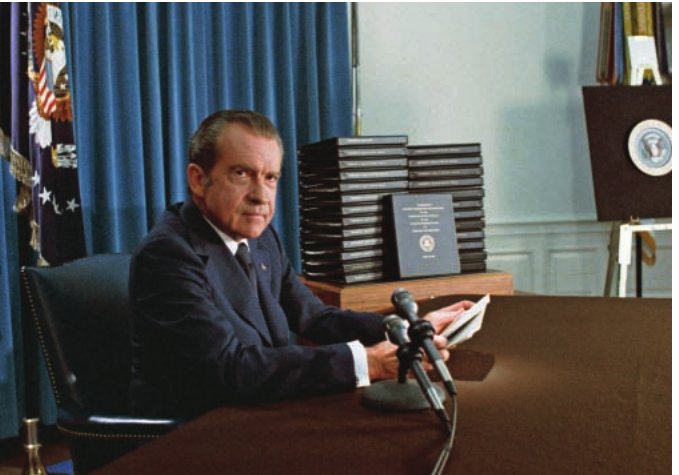
During the trial, the Supreme Court ordered the Oval Office to turn over recorded tapes of conversations between Nixon, administrative officials and White House staff. The tapes revealed that Nixon had conspired to cover up activities taking place after the break-in and tried to use federal officials to deflect the investigation.
Nixon subsequently resigned to avoid impeachment for obstruction of justice and abuse of presidential power. He was replaced by his vice president, Gerald Ford, who told the nation 'Our long national nightmare is over.'
Impeachment and trial of the president
The House of Representatives can impeach the president with a simple majority vote. The president is then tried by the Senate, where a two-thirds majority is needed for a guilty verdict. If found guilty, the president is removed from office.
Note
Three Impeached Presidents in History
Only three presidents have been impeached: Andrew Johnson (1868), Bill Clinton (1998), and Donald Trump (2019 and 2021). All three were acquitted by the Senate. However, even if the president is acquitted, the process of impeachment generates huge media attention and public scrutiny.
Example
Case Study: The Impeachments of Donald Trump
First Impeachment (December 2019)
Donald Trump was impeached by the Democrat-majority House of Representatives in December 2019 for abuse of power and obstruction of Congress. Trump was accused of using aid to compel the Ukrainian president to investigate his political opponent, Joe Biden, and Biden's son.
In January 2019, the Senate acquitted Trump by 52-48 votes. All Democrat senators voted to convict, but only one Republican.
The Constitution specifies that the grounds for impeachment are 'treason, bribery, or other high crimes and misdemeanours'. This language is vague, so one of Trump's defence arguments was that, even if he had threatened to withdraw aid to Ukraine in exchange for a political favour, this was not in itself an impeachable offence as it did not constitute a 'high crime or misdemeanour'. Trump's acquittal set a precedent that may mean future presidents feel freer to use the presidency to further their own interests.
Second Impeachment (January 2021)
In January 2021, Trump became the first president to be impeached twice and the first to be tried for impeachment after leaving office. The Democrat-majority House charged him with 'incitement of insurrection'. Trump had encouraged his supporters to 'fight like hell' moments before they stormed the Capitol.
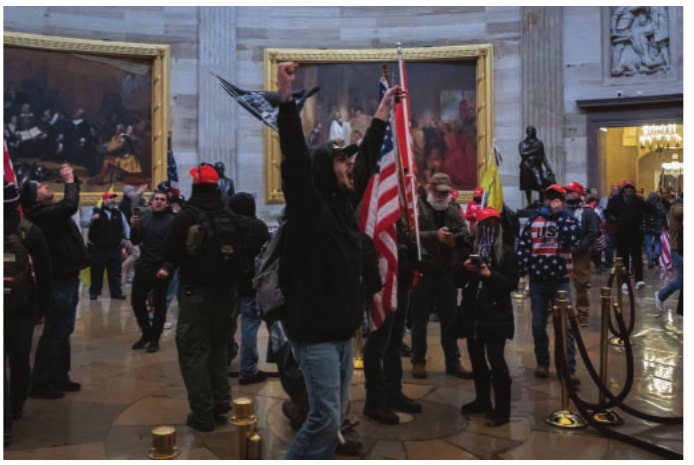
The attack aimed to prevent the confirmation of Joe Biden's presidential win by stopping Congress from certifying the Electoral College votes. One police officer died of injuries sustained during the attack, a protester was shot and killed by police, and three other protesters died. Rioters spoke about hanging Republican Vice President Mike Pence for his willingness to certify the election results. Democrat Alexandria Ocasio-Cortez later said her life was threatened and she thought she was going to die.
Unlike previous presidential impeachments, Trump had already left office when the trial began, so many Republicans thought the trial was unconstitutional. Democrats hoped to secure a guilty verdict and then bar Trump from running for office again.
On 13 February, only five days after the trial began, a majority of senators voted to convict Trump – 57 to 43, including seven Republicans. But two-thirds, or 67 votes, was needed to convict, meaning Trump was acquitted for a second time.
Checks and balances by the judiciary
Judicial review is the process by which the judiciary examines the actions of the executive branch to check that they are lawful. If they are not, the Supreme Court can declare such actions unconstitutional. This is a powerful check on the executive.
When federal courts halted Trump's 2017 ban on travellers from seven majority-Muslim countries, he was forced to amend his original executive order to include North Korea, Venezuela and Chad. The Supreme Court then ruled that the expanded ban was not a 'Muslim ban' and therefore was constitutional.
Important
No One Is Above the Law
In 2020, the Supreme Court ruled that the president had no absolute right to refuse to give his personal financial records to criminal prosecutors. The president's lawyers had argued that his position gave him complete immunity from criminal investigations and proceedings.
Brett Kavanaugh, a conservative justice appointed by Trump, explained that: 'In our system of government, as this court has often stated, no one is above the law. That principle applies, of course, to a president.'
This ruling reinforced that even presidents are subject to judicial oversight and cannot claim absolute immunity.
Other constraints on the president
Beyond formal checks and balances, the president is also constrained by other factors.
Party support in Congress
A president can find that they have, or lack, political support at the federal and state level. Presidents generally find it more difficult to pass legislation or get nominees confirmed during periods of divided government, as they lack party support in Congress.
However, if a president's party is not united and supportive, the president may also find it difficult to pass legislation during periods of unified government. In addition to party loyalty, members of Congress may also be influenced by interest groups, many of whom donate large amounts to election campaigns and then encourage members to vote in particular ways. For example, the National Rifle Association (NRA) successfully convinced many members of Congress to block Obama's gun control reforms in 2013.
| Years | Presidency | House | Senate |
|---|---|---|---|
| 1993–4 | Democrat (Bill Clinton) | Democrat | Democrat |
| 1995–2000 | Democrat | Republican | Republican |
| Jan–May 2001 | Republican (George W. Bush) | Republican | Republican |
| Jun 2001–2 | Republican | Republican | Democrat |
| 2003–6 | Republican | Republican | Republican |
| 2007–8 | Republican | Democrat | Democrat |
| 2009–10 | Democrat (Barack Obama) | Democrat | Democrat |
| 2011–14 | Democrat | Republican | Democrat |
| 2015–16 | Democrat | Republican | Republican |
| 2017–18 | Republican (Donald Trump) | Republican | Republican |
| 2019–20 | Republican | Democrat | Republican |
| 2021– | Democrat (Joe Biden) | Democrat | Democrat |
Bold type indicates periods of unified government
Note
The Slimmest of Margins
Although Joe Biden's Democrats held the Senate in 2021, it was on the slimmest of margins. For only the fourth time in US history, the Senate was split 50:50 between Republicans and Democrats (including two independent senators who caucused with the Democrats).
In her role as President of the Senate, Kamala Harris had the power to cast a tie-breaking vote if senators were evenly divided.
State governors
State governors can actively work against the president's agenda, although their impact is limited to their state. A state governor is the individual elected as chief executive for each state. Like the president, governors are directly elected, but only by voters in their state. There are fifty state governors, many from the opposing party to the president. Governors of large and powerful states such as California, which has one-eighth of the US population and is the world's fifth biggest economy, can work against the president's agenda.
Example
Case Study: California's Resistance to Trump
Democrat Californian governor Jerry Brown campaigned against Trump's decision to withdraw from the 2015 Paris Climate Agreement and signed California up to a separate subnational coalition committed to reducing greenhouse gas emissions.
When Trump signed an executive order removing federal funding from 'sanctuary cities' that did not support federal immigration enforcement, Brown signed a bill passed by the state legislature that made California a sanctuary state.
Continuing the pattern of direct opposition to Trump's immigration policies, Brown's successor, governor Gavin Newsom, withdrew National Guard troops from the Californian border with Mexico in 2019.
This case demonstrates how governors of large states can effectively resist presidential policies within their jurisdictions.
The prevailing judicial philosophy of the Supreme Court
The balance of the Supreme Court is determined by how many of its nine justices are liberal and how many are conservative. Presidents who share the same ideology as the majority of the Supreme Court are more likely to receive favourable rulings on government actions and government-supported legislation. Republican presidents therefore hope for a conservative-majority court, and Democrat presidents a liberal-majority court.
However, a conservative-majority Supreme Court may still make rulings against a Republican president, as Trump found on several occasions.
Attitudes of the media and public opinion
The media can constrain the president's actions by informing public opinion. Many presidents have argued that the media gave them unfavourable coverage. Obama, for example, felt that his administration was unfairly attacked by conservative channel Fox News. However, most presidents have accepted the importance of the media within US democracy and tried to win their support where possible.
Trump took a notably different approach, claiming his agenda was being undermined by 'fake news' and adopting an aggressive approach to liberal-leaning media such as CNN and MSNBC. During the COVID-19 pandemic, he criticised individual reporters during press conferences, accusing one of being a 'terrible reporter' and another of asking a 'nasty question'.
Note
The Impact of Political Polarisation
Despite presidential criticism of the media, the impact of negative reporting is lessened by the tendency for people to watch a news channel or read a newspaper that supports their pre-existing political leanings. This phenomenon reflects growing political polarisation in American society.
Public opinion, once formed, affects a president's impact significantly. Presidents with high approval ratings are more likely to win re-election and generally find it easier to influence Congress. However, in recent years the USA has become more politically polarised and has fewer competitive electoral districts. Presidents who have a strong appeal to their base may worry less about appealing to the whole nation, allowing them to govern with relatively low approval ratings.
Important
Trump's Historic Approval Ratings
Gallup opinion polls stated that Trump had the lowest presidential approval ratings in recorded history, with a high of 49% reached in February 2020, just after his acquittal in his impeachment trial.
In contrast, Obama's highest approval rating was 69%, while George W. Bush reached a record 90% immediately after the 9/11 terror attacks.
However, Trump's approval ratings with his core supporters remained high (around 85–90% among Republicans in 2018, compared with around 40% nationally), highlighting the sharp divisions within US politics and demonstrating how partisan polarisation can insulate presidents from the traditional constraint of low overall approval ratings.
Presidents face very different constraints depending on their political circumstances. Although in theory each president is subject to the same formal checks and balances, in practice the extent to which these are applied varies considerably depending on key variables such as their public approval, party support within Congress, and the balance of the Supreme Court.
Summary
Key Points to Remember:
-
Checks and balances prevent excessive presidential power by ensuring each branch of government limits the others, as designed by the Founding Fathers to avoid tyranny.
-
Congress possesses the most extensive constraints on presidential power, including rejecting legislation, overriding vetoes (with two-thirds supermajority), controlling the budget through the power of the purse, confirming appointments, ratifying treaties, investigating the administration, and impeachment.
-
Unified government does not guarantee presidential success. Even when the president's party controls both houses of Congress, lack of party unity or interest group pressure can obstruct the president's agenda, as demonstrated by Obama's failed gun control reforms after Sandy Hook despite public support.
-
The judiciary provides a crucial check through judicial review, allowing the Supreme Court to declare presidential actions unconstitutional, as seen when federal courts halted Trump's initial travel ban and forced amendments.
-
Informal constraints matter significantly. Party support in Congress, state governors (especially from large states like California), the Supreme Court's ideological composition, media attitudes, and public approval ratings all affect presidential power in practice, with Trump governing despite historically low approval ratings due to strong support from his political base.