Relationship With Other Institutions (AQA A-Level Politics): Revision Notes
📚Revision Notes
Relationship With Other Institutions
As chief executive of the federal government, the president leads a vast bureaucracy. To effectively fulfil their role, presidents are supported by several key institutions that help them govern. Understanding how the president relates to and manages these institutions is crucial to grasping how presidential power actually works in practice.
The institutional structure supporting the president
The president sits at the top of the executive branch, supported by three main institutional structures: the Cabinet, the Executive Office of the President (EXOP), and the wider federal bureaucracy including executive departments and federal agencies.
Note
These three institutional structures each play distinct roles in supporting the president:
- The Cabinet provides specialized departmental advice and leads executive departments
- The EXOP offers close day-to-day support and policy coordination
- The federal bureaucracy implements policy across the entire executive branch
Each of these institutions plays a different role in supporting presidential decision-making and policy implementation. The relationship between the president and these bodies varies significantly depending on the individual president's management style and political circumstances.
The cabinet
What is the cabinet?
The cabinet is a group of advisers chosen by the president to help run the federal government. It consists of the vice president and the heads of the 15 executive departments (such as the secretary of state and secretary of the treasury), and may include other senior advisers.
Important
A Fundamental Difference from UK Cabinet Government
Unlike in the UK system where cabinet government involves collective decision-making, the US Constitution grants sole executive authority to the president. This means cabinet members work for the president and the president does not have to follow their advice. All cabinet officers 'serve at the pleasure of the president' and can be dismissed at any time if the president is dissatisfied with their performance.
Background and composition of cabinet members
Cabinet members are policy specialists who typically provide advice on their specific department rather than broader political strategy. They come from diverse professional backgrounds:
- Former politicians: Hillary Clinton served as Obama's secretary of state (2009-13). Her appointment helped unite different Democratic Party factions after she lost the 2008 primary to Obama
- Academics: Obama appointed Nobel Prize-winning physicist Steven Chu as secretary of energy
- Business experts: Steven Mnuchin, Trump's treasury secretary from 2017, was previously an investment banker and hedge fund manager
- Military officers: Biden appointed retired general Lloyd Austin as defence secretary in 2021
- Lobbyists: Trump faced criticism for appointing former coal lobbyist Andrew Wheeler to head the Environmental Protection Agency in 2018
Presidential influence on cabinet composition
The makeup of a president's cabinet generally reflects their own perspective and priorities:
Example
Examples of Presidential Cabinet Priorities
- George W. Bush (pro-business Republican) appointed many business experts and CEOs
- Barack Obama (former law professor) chose a highly academic cabinet with two-thirds having attended Ivy League universities
- Donald Trump (billionaire businessman) wanted officers who had 'made a fortune', appointing individuals with a combined net worth of $2.3 billion
- Joe Biden promised 'the most diverse cabinet in history', appointing the first African-American defence secretary (Lloyd Austin), first female treasury secretary (Janet Yellen), first openly gay cabinet officer (Pete Buttigieg), and first Native American cabinet officer (Deb Haaland)
Presidential power over cabinet members
Individual cabinet members may have greater influence with the president based on their public profile or personal relationship with the president. However, the president maintains complete control:
- Trump famously sacked secretary of state Rex Tillerson via Twitter in 2018
- In 2019, Trump said he liked having 'acting' cabinet members (those serving temporarily without Senate confirmation) as it gave him 'more flexibility'
- The president can dismiss cabinet officers at will without needing Congressional approval
The Twenty-Fifth Amendment exception
Important
The One Instance of Cabinet Power Over the President
There is one significant instance where cabinet officers have power over the president. The Twenty-Fifth Amendment allows the vice president and a majority of cabinet officers to declare to Congress that the president is unable to discharge their powers and duties. This provision has never been invoked, although it was suggested that Vice President Mike Pence should use it to remove Donald Trump after the 2021 Capitol insurrection. Pence rejected the idea.
Cabinet meetings
US cabinet meetings are chaired by the president and are not a forum for collective decision-making (unlike the UK system). This means they meet less regularly than UK cabinets, typically just a few times per year. The frequency depends entirely on the president's preferences:
Note
Variations in Cabinet Meeting Frequency
- Reagan held many more cabinet meetings than most presidents, suggesting he valued meeting members in person
- Obama held cabinet meetings on average 3.5 times per year (compared with six times yearly under George W. Bush), often using them to brief members on upcoming events or policy launches
- Trump initially held nine meetings per year in 2017 and 2018, falling to four in 2019 and just one by August 2020
Trump often used cabinet meetings as opportunities to address the assembled press, attempting to promote his policies to the public.
The Executive Office of the President (EXOP)
What is EXOP?
The Executive Office of the President (EXOP) is a group of offices that support the president in running the federal government. Key components include:
- White House Office
- National Security Council
- Office of Management and Budget
- Office of the Vice President
- Council of Economic Advisers
EXOP was originally established by Franklin D. Roosevelt in the 1930s as the federal government expanded in response to the Great Depression. The president needed a bureaucracy to help manage the growing executive branch. Today, EXOP employs approximately 3,000-4,000 staff and is headed by the White House chief of staff.
The White House Office
The White House Office is the part of EXOP that works most closely with the president. It is a large organisation with more than 400 employees (as of 2019) and includes several specialised offices:
- Office of the Chief of Staff
- Office of Legislative Affairs
- Office of Cabinet Affairs
- Office of Communications
- Office of the National Security Adviser
Many of these offices are based in the West Wing of the White House, which is considered the heart of the presidency.
Important
A Critical Difference from Cabinet Appointments
Staff in the White House Office do not require Senate confirmation. Appointments are solely at the president's discretion, meaning these advisers are subject to less scrutiny than cabinet officers.
The White House chief of staff often decides who has access to the president, thereby determining the balance of opinions the president receives. This makes the chief of staff arguably the most important relationship within the president's administration.
The National Security Council (NSC)
The National Security Council is the president's main forum for discussing and managing national security and foreign policy issues. It is chaired by the president and its members include:
- Vice president
- Secretary of state
- Secretary of the treasury
- Secretary of defence
- Chair of the Joint Chiefs of Staff (who acts as military adviser)
Note
The NSC coordinates national security and foreign policy across the entire executive branch and all its agencies, including US military forces worldwide. It operates the secure Situation Room in the basement of the White House, where the president and national security team coordinate responses to domestic or international crises.
The federal bureaucracy and federal agencies
Executive departments
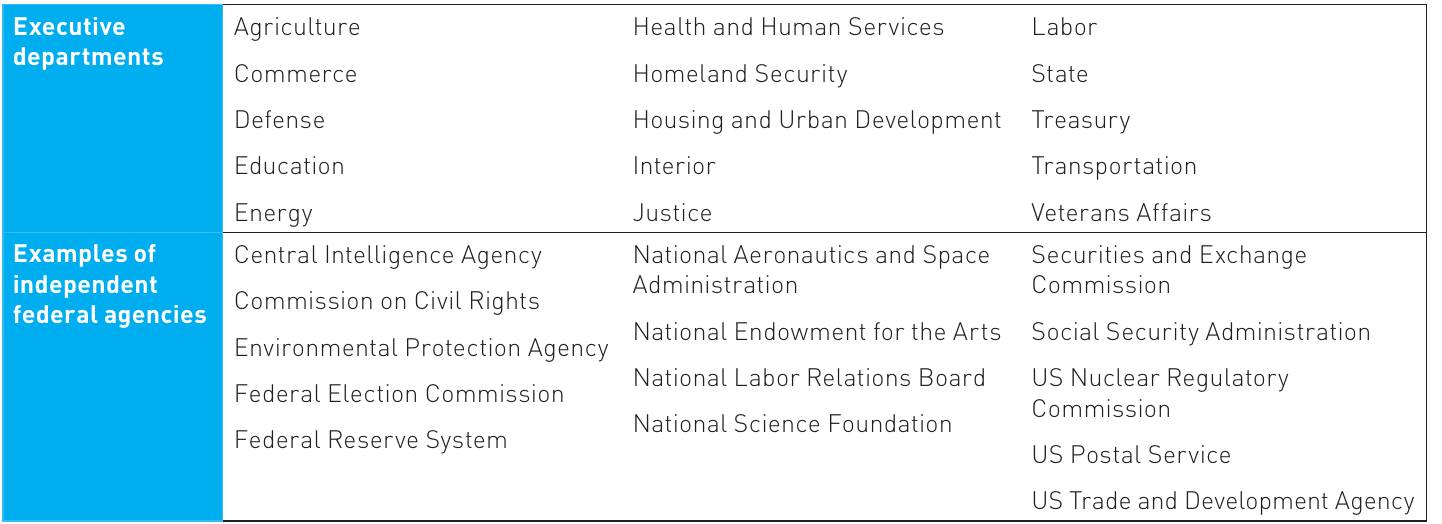
Cabinet officers head the 15 executive departments that make up the federal bureaucracy, such as the Department of Justice, Department of State, and Department of Defence. The leader of each executive department is directly accountable to the president and works to achieve the president's policy objectives.
Federal agencies
There are more than 60 federal agencies that form part of the executive branch but operate independently, such as the Central Intelligence Agency (CIA), Environmental Protection Agency (EPA), and NASA. These agencies have more autonomy from the president than executive departments. While presidents can generally remove the head of an independent agency, this is typically only done for wrongdoing rather than policy disagreements.
Relationships between the presidency and other institutions
The relationship between the presidency and the cabinet, EXOP, and federal bureaucracy varies significantly from one president to another. These relationships depend on several key factors:
- The relationship between the president and their chief of staff
- The president's approach towards their wider staff
- The extent to which the president uses EXOP to dominate the cabinet
- The extent to which EXOP staff act as political operatives
- The president's view of the federal bureaucracy and federal agencies
The relationship between the president and their chief of staff
This is arguably the most important relationship within the president's administration and is crucial to the effective running of the executive branch.
Example
Obama and Rahm Emanuel: A Successful Chief of Staff Relationship
Obama allowed his first chief of staff considerable authority. Emanuel coordinated the work of policy czars, cabinet officers and national security advisers. He checked policy suggestions before they reached the president and was criticised by some for encouraging moderate rather than ideological policies. Under Emanuel's leadership, relationships were tightly organised and Obama's administration achieved important successes, including the Affordable Care Act 2010.
Example
Trump's Chiefs of Staff: Instability and Dysfunction
Trump's relationship with his chiefs of staff was far less stable. His first chief of staff, Reince Priebus, resigned after only six months amid claims of dysfunction. Priebus was replaced by former general John Kelly in July 2017, who attempted to impose order by restricting access to the president. However, Kelly's influence diminished amid arguments with senior staff and criticism from Trump. It was reported that Trump and Kelly were no longer on speaking terms when Kelly resigned in January 2019. Trump appointed a fourth chief of staff (Mark Meadows) in less than four years, suggesting far less stability than George W. Bush, who had only two chiefs of staff over eight years.
The president's approach towards their wider staff
During every presidency, advisers compete for access to the president to increase their influence and status. However, the character of each administration differs significantly:
Obama's administration appeared to run effectively with a sense of shared purpose among staff. In contrast, Trump's administration was characterised by chaos and instability. Trump initially left many positions unfilled—after over two years in office, more than 280 positions requiring Senate confirmation remained vacant. His frequent sacking of officials and numerous senior staff resignations quickly led to reports of dysfunction.
Note
The bestselling 2018 book Fire and Fury described the Trump White House as one where aides battled for the president's favour while fearing the wrath of an irrational and volatile leader. Advisers who disagreed with the president were reportedly sacked or encouraged to resign, resulting in a staff that unconditionally supported the president's ideas rather than challenging him when necessary.
The extent to which the president uses EXOP to dominate the cabinet
Some presidents appoint 'policy czars' in the White House—government officials responsible for particular policy areas, often similar to areas overseen by cabinet officers. For example:
- Paul Volcker acted as economic czar under Obama (2009-11) as chair of the Economic Recovery Advisory Board, while Timothy Geithner was the cabinet officer responsible for the economy as secretary of the treasury
- Peter Navarro acted as Trump's trade czar from 2016, instrumental in pushing for tariffs against China
- Jared Kushner (Trump's son-in-law) acted as policy czar on an unprecedentedly broad range of issues including the border wall, healthcare, US innovation, criminal justice reform, and diplomacy with China and Mexico
Policy czars generally work in the White House and may receive greater access to the president than cabinet officers. Republicans criticised Obama for his widespread use of policy czars, arguing these officials had not been confirmed by the Senate and were therefore subject to less scrutiny. However, policy czars are not a new development—Franklin D. Roosevelt introduced them and Obama's Republican predecessor George W. Bush also used them extensively.
Example
Jared Kushner's Unprecedented Influence as Policy Czar
In 2017, Kushner convinced Trump to overrule objections from his secretary of state Rex Tillerson and defence secretary James Mattis to move the US embassy in Israel to Jerusalem, ignoring fierce Palestinian objections and criticism from European allies. During the COVID-19 pandemic, a special post was created for Kushner at the Federal Emergency Management Agency, allowing him to take charge of the federal response.
The extent to which EXOP staff act as political operatives
The president's advisers are political appointees but should ideally be able to 'speak truth to power' to assist the president in making the best decisions for the country. However, many EXOP staff act primarily as political operatives rather than neutral assistants. For example, Kushner's role as policy adviser within the White House was combined with his leadership of Trump's failed 2020 re-election campaign, blurring the line between governing and campaigning.
The president's view of the federal bureaucracy and federal agencies
Presidents who expand the federal government: Some presidents, generally Democrats, believe the federal government plays a positive role in improving society and aim to increase its scope. Franklin D. Roosevelt dramatically expanded the federal government during the Great Depression in the 1930s. Obama increased the number of federal employees by 8% during his tenure.
Presidents who reduce the federal government: Other presidents, generally Republicans, aim to reduce the size of federal government, fearing the federal bureaucracy is wasteful, inefficient and removes too much power from individual states. Trump promised to 'drain the swamp' in Washington, DC, and in February 2018 announced plans to abolish 22 government agencies. When Congress refused to consent, Trump had to keep the agencies to pass his budget. However, in 2019, acting White House chief of staff Mick Mulvaney explained that relocating agencies to other parts of the USA could cause mass resignations—the US Department of Agriculture Economic Research Service relocation from Washington, DC to Kansas City, Missouri, saw 78% of employees resign. In 2018, the Trump administration disbanded the pandemic response office set up by the National Security Council under Obama.
Note
George W. Bush's Unusual Approach
Bush's approach was unusual for a Republican. Despite promising to cut the size of federal government during his 2000 election campaign, Bush increased the number of federal employees by 13.8%. This was partly due to the national security response to 9/11 and the 'war on terror', but Bush also increased federal spending on education and healthcare and launched a federal economic stimulus in response to the 2008 financial crisis.
Case study: The waxing and waning of Obama's power
Presidential power does not remain constant throughout a presidency. Instead, presidential power waxes (increases) and wanes (decreases). Barack Obama's two terms illustrate this pattern well.

Obama's initial strength (2008-2010)
Obama was elected in November 2008 on a wave of optimism. Not only was he the first Black president, but he also promised a new start in foreign policy after the neo-conservative wars of George W. Bush. His campaign slogan promised 'change we can believe in', and initially he seemed to deliver.
Example
Obama's Early Presidential Success
Despite facing a serious economic crisis, Obama had a productive first 100 days and received the highest approval ratings for that period since the 1970s. Crucially, the Democrats controlled both houses of Congress, allowing him to pass significant legislation:
- Economic stimulus package
- Support for financial and automobile industries
- Environmental reforms
- His signature healthcare policy, the Patient Protection and Affordable Care Act 2010 (Obamacare)
Obama's power begins to wane (2010-2014)
Obama's power began to decline when he lost control of Congress. In the November 2010 midterm elections, the Republicans won a majority in the House. From this point, Obama became increasingly frustrated by Congress and the challenges of divided government. However, his personal popularity remained strong, and he enjoyed some important successes, including overseeing the killing of terrorist Osama bin Laden in 2011. Obama defeated Republican challenger Mitt Romney in the 2012 presidential election, winning a second term.
Nevertheless, Obama was loathed by many conservatives who believed Obamacare expanded the federal government's role too far into people's lives. Politics became more polarised during his presidency, making it harder to pass legislation during divided government. Following the Sandy Hook elementary school mass shooting, Obama could not convince Congress to support gun control, including a ban on assault weapons.
In the November 2014 midterm elections, the Senate was also lost to the Republicans. Obama subsequently found it even more difficult to advance his political agenda through legislation.
Obama as a lame duck president? (2014-2017)
As Obama neared the end of his two terms in office, there was a risk he would become a lame duck president—one whose influence diminishes as their time in office draws to a close. In an attempt to avoid this fate, Obama increasingly relied on executive orders and executive agreements rather than legislation, although this was not always successful.
Important
The Limits of Presidential Power
Obama's executive order to protect some illegal immigrants from deportation was challenged by 26 states and blocked by the Supreme Court in 2016. Perhaps the most significant example of the limits to Obama's presidential power was his 2016 attempt to fill a vacancy on the Supreme Court. In refusing to begin hearings to consider his nominee, the Senate prevented Obama from exercising his formal constitutional power to appoint a Supreme Court justice. This later allowed his successor Donald Trump to achieve a conservative majority on the Court.
Remember!
Summary
Key Points to Remember:
- The president is supported by three main institutions: the Cabinet (15 executive department heads plus vice president), the Executive Office of the President (EXOP) (including the White House Office and National Security Council), and the wider federal bureaucracy
- Unlike UK cabinet government, the US president has sole executive authority—cabinet members work for the president, who does not have to follow their advice
- Cabinet officers 'serve at the pleasure of the president' and can be dismissed at any time
- The White House chief of staff is arguably the most important relationship within the administration, often controlling access to the president
- The relationship between the president and these institutions varies significantly based on the president's management style, use of policy czars, and views on the role of federal government
- Presidential power waxes and wanes throughout a presidency depending on factors like Congressional control, approval ratings, and proximity to the end of their term—Obama's presidency demonstrates this clearly