Inflation and Deflation (Edexcel A-Level Business): Revision Notes
📚Revision Notes
Inflation and Deflation
Understanding economic influences
Businesses operate within an external environment containing many factors beyond their control. These external influences can constrain business decisions and affect growth potential.
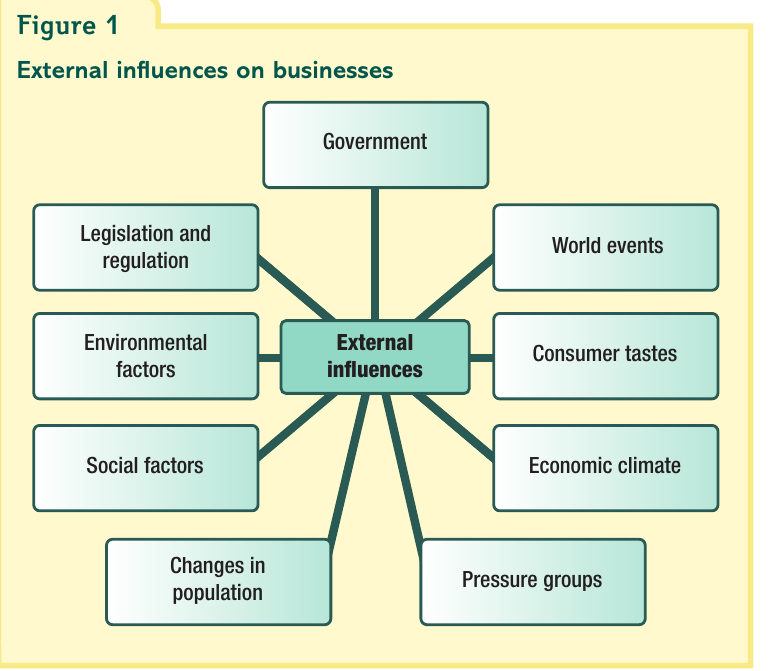
Note
The external business environment includes factors such as political changes, social trends, technological developments, legal requirements, and economic conditions. While businesses cannot control these factors, understanding them is crucial for strategic planning.
Among these external factors, economic influences are particularly significant. Government economic management—including control of inflation, interest rates, taxation and spending—directly impacts business operations. Understanding inflation and deflation is essential for business decision-making.
What is inflation?
Inflation occurs when the general level of prices across the economy rises over time. This means that money loses purchasing power—the same amount of money buys fewer goods and services.
Example
Worked Example: Calculating Inflation Rate
If a basket of goods costs £100 on 1 January 2013, and the identical basket costs £103 on 1 January 2014, we can calculate the inflation rate:
Step 1: Calculate the price increase
- Price increase = £103 - £100 = £3
Step 2: Calculate the percentage change
- Inflation rate = (£3 ÷ £100) × 100 = 3%
This represents an inflation rate of 3% for the year.
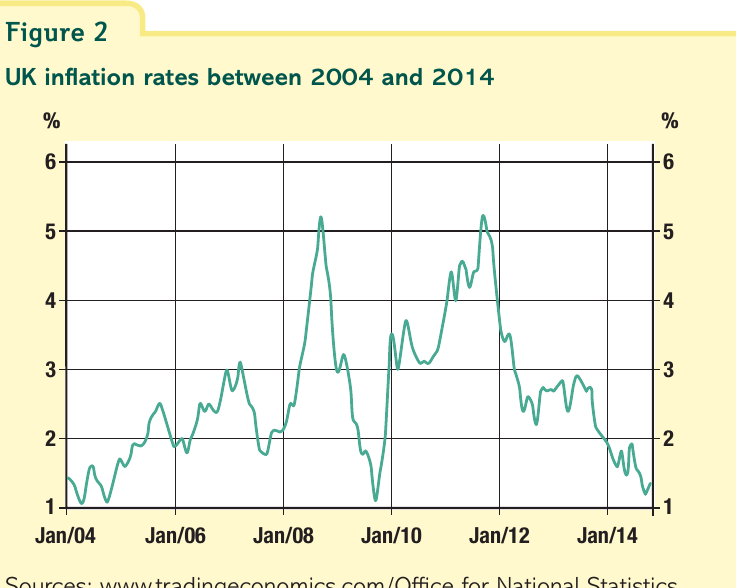
The graph shows UK inflation has fluctuated between approximately 1% and 5% for most of the period 2004-2014. Inflation rates within this range are generally manageable and not considered troublesome for the economy. However, when inflation reaches significantly higher levels—such as the 25% experienced in the UK during the 1970s—it becomes a serious threat to both businesses and the wider economy.
Governments typically aim to maintain price stability by keeping inflation under control, alongside other objectives like reducing unemployment, controlling government borrowing, and promoting economic growth.
Measuring inflation: the consumer price index
The most common method for measuring inflation in the UK is the Consumer Price Index (CPI). This measurement process works as follows:
Data collection: Each month, government statisticians gather price information on approximately 600 different goods and services across the economy. These items represent typical household purchases.
Calculation: From this data, an average price change is calculated and converted into an index number. This allows for straightforward comparison over time.
Note
Understanding Index Numbers
Index numbers provide a way to track changes in a series of figures. One period is given a base value of 100, and all other periods are adjusted proportionally. This makes it easy to see percentage changes over time.
For example, if the base year index is 100 and the following year's index is 103, prices have risen by 3%. If the index falls to 98, prices have decreased by 2%.
Comparing periods: The current month's index can be compared with the previous month, or with the same month one year earlier, to calculate the percentage change in prices—this is the inflation rate published in official statistics.
How inflation affects businesses
When inflation remains low and stable (1-5%), its impact on businesses is relatively modest. However, once inflation reaches double figures or becomes highly volatile, it creates significant challenges for business operations.
Increased operational costs
High or fluctuating inflation imposes several types of costs on businesses:
Shoe leather costs: These represent the time and resources spent researching the market. With suppliers constantly changing prices at different rates, businesses must continuously monitor the market to find the best deals. Similarly, they need to track competitors' pricing to determine when and by how much to adjust their own prices. The term "shoe leather costs" originates from the pre-digital era, when employees literally had to walk around gathering this information.
Menu costs: Changing prices involves substantial expense. Businesses must inform customers about new prices through various channels—reprinting brochures, updating websites, modifying point-of-sale displays, and briefing sales teams. For restaurants, this literally means reprinting menus, hence the term. In an inflationary environment, these menu costs recur frequently.
Pay negotiation costs: Management must dedicate significantly more time to handling worker pay claims. Instead of negotiating multi-year agreements, annual negotiations become necessary. In cases of hyperinflation (inflation exceeding 100% annually), pay discussions may need to occur monthly. The risk of industrial action increases because workers and managers often hold different views about future inflation rates. Workers fear that agreed pay rises will leave them worse off in real terms, making them more willing to strike for higher settlements.
Important
The Danger of Hyperinflation
When inflation exceeds 100% per annum, it creates extreme disruption to business operations. Prices may change daily or even hourly, making normal planning impossible. Historical examples include Germany in the 1920s and Zimbabwe in the 2000s, where hyperinflation destroyed savings and made currency virtually worthless.
Uncertainty and planning difficulties
High and fluctuating inflation creates profound uncertainty for business planning. Businesses struggle to predict what prices will be in three months, six months, or several years ahead—yet they must make decisions now that will affect long-term performance.
Investment decisions: Consider a business evaluating whether to purchase new machinery, open a new shop, or install a computer system. The price of this capital equipment will likely be higher in six months than today. But is the investment worthwhile if borrowing costs are extremely high? What if the business finances the purchase with expensive loans, only to face a recession (a period of falling demand) that makes the investment unnecessary?
Long-term contracts: Inflation uncertainty complicates contractual relationships. Suppose a customer approaches a business requesting regular monthly deliveries for the next two years. How can the supplier price this contract accurately without knowing inflation rates over the 24-month period? Underestimating inflation could mean selling at a loss; overestimating could make the price uncompetitive.
Important
Planning Dilemma
The fundamental challenge of high inflation is timing: businesses must make commitments today (signing contracts, making investments, hiring staff) based on prices that will change unpredictably in the future. This uncertainty often leads to delayed decisions and missed opportunities.
Borrowing and lending dynamics
Inflation creates both opportunities and challenges for businesses with debts:
Erosion of debt value: Inflation reduces the real value of money borrowed in the past. If inflation runs at 100% per annum, money borrowed one year ago is worth only half as much in real terms today. This initially benefits borrowers (including businesses with loans) and harms lenders.
Interest rate response: However, in an inflationary environment, interest rates typically rise to match inflation. With prolonged inflation, lenders often make rates index-linked—directly tied to the price index. Interest might be charged at "inflation plus 5%" or "inflation plus 10%". This eliminates the advantage borrowers initially gain from inflation.
Note
The Real Value of Debt
The "real value" refers to purchasing power—what money can actually buy. A £10,000 debt taken out during low inflation remains £10,000 in nominal terms, but if high inflation occurs, that £10,000 can buy much less. This effectively reduces the burden on the borrower, as they repay with money that's worth less than when they borrowed it.
Consumer reactions and behavior changes
Inflation doesn't just affect businesses directly—it also changes consumer behavior in ways that impact sales and operations:
Increased saving: Prolonged inflation tends to increase saving rates. Consumers become unsettled and less willing to borrow, uncertain about future conditions. Since inflation erodes the real value of savings, people respond by saving more to maintain their previous real wealth. Increased saving means reduced spending, which directly reduces business sales.
Changed spending patterns: Very high inflation dramatically alters when and how consumers spend. Under hyperinflation, where prices change daily, consumers rush to spend wages or income immediately upon receiving them. This creates extreme patterns—on "pay day," shops experience huge activity and must be geared to handle most weekly or monthly turnover in just a few hours. Suppliers, such as fresh produce providers to supermarkets, must deliver most goods on specific days to meet this concentrated demand.
International competitiveness
Inflation rates relative to trading partners significantly affect businesses involved in international trade:
Loss of competitiveness: When UK inflation exceeds that of trading partners, UK businesses become uncompetitive. Their products become relatively more expensive in foreign markets, leading to lost sales and reduced market share overseas.
Import competition: Higher domestic inflation also makes imports relatively cheaper. UK consumers and businesses may switch from buying UK-produced goods to foreign alternatives, since import prices are rising more slowly. This double effect—losing export markets and losing domestic market share to imports—can severely damage businesses exposed to international competition.
Important
The Competitiveness Trap
High domestic inflation creates a double disadvantage for businesses in international markets:
- Export challenge: Your products become more expensive abroad, reducing foreign sales
- Import threat: Foreign products become relatively cheaper at home, taking domestic market share
This combination can be particularly damaging for manufacturers and businesses in globally competitive industries.
Deflation
While much attention focuses on inflation, deflation—where the general price level falls—can also create significant business challenges.
How deflation affects businesses
Deflation typically occurs alongside falling demand, creating a negative spiral:
Delayed consumer spending: When prices are falling, consumers may postpone purchases, expecting to buy more cheaply in the future. This reduced spending further decreases demand.
Postponed investment: Businesses facing falling prices and reduced demand typically delay investment decisions, avoiding the risk of purchasing assets that may become cheaper.
Workforce reductions: Lower demand forces businesses to cut production, often leading to worker layoffs. This further reduces consumer spending power, potentially deepening the deflationary cycle.
Reduced profitability: Businesses may need to lower prices to maintain sales, squeezing profit margins. In some cases, businesses cannot cover costs and face closure.
Note
Historical Context: EU Deflation
In 2014, the EU experienced deflationary pressures following a sharp fall in oil prices, very low inflation, and recession in several member countries. This period highlighted how interconnected modern economies are, with problems in some countries quickly affecting trading partners.
When deflation can be positive
Deflation isn't always harmful—it depends on the underlying cause:
Import price falls: Deflation resulting from falling import prices (perhaps due to a strong domestic currency) may not harm the economy. Cheaper imported goods put downward pressure on the CPI but can benefit consumers and businesses using imported inputs.
Commodity price falls: When prices of key commodities like oil decline, this reduces input costs for many businesses. Lower production costs may actually encourage businesses to increase output rather than cut back, potentially benefiting the economy overall.
Note
Good Deflation vs. Bad Deflation
Not all deflation is harmful:
- Good deflation: Caused by falling costs of imports or commodities—businesses benefit from lower input costs
- Bad deflation: Caused by falling demand—creates a negative spiral of reduced spending, lower production, and job losses
Understanding the cause of deflation is crucial for predicting its economic impact.
Summary
Key Points to Remember:
-
Inflation means rising prices across the economy; deflation means falling prices. Both create challenges for business planning and operations.
-
The Consumer Price Index (CPI) measures inflation by tracking approximately 600 goods and services monthly, calculating average price changes.
-
High or volatile inflation imposes multiple costs: shoe leather costs (price research), menu costs (repricing), and increased management time on pay negotiations.
-
Inflation creates uncertainty that complicates investment decisions and long-term contracts. It also changes the real value of debts and affects consumer spending patterns.
-
International competitiveness suffers when domestic inflation exceeds trading partners' rates, making exports more expensive and imports relatively cheaper.
-
Deflation typically accompanies falling demand, leading to delayed spending, postponed investment, and potential job losses, though it can be positive if caused by falling import or commodity prices.