Controlling Multinational Corporations (MNCs) (Edexcel A-Level Business): Revision Notes
📚Revision Notes
Controlling Multinational Corporations (MNCs)
Introduction
Controlling companies that operate across borders has been a challenge since the 17th century. Today, with interconnected international markets and globalised businesses, controlling multinational corporations (MNCs) is more complex than ever. Many modern global companies have huge economic power and can relocate their headquarters with relative ease. These 'footloose' MNCs can simply threaten to relocate out of a country, taking their foreign direct investment (FDI), tax revenues and employment with them.
Note
This raises critical questions:
- Who is in control over the actions of a company—the shareholders, managers, or governments?
- How can control be effectively enforced across borders?
MNCs must work within the institutional frameworks of both their home and host countries, abiding by all applicable laws and regulations. However, the effectiveness of these controls varies significantly depending on the method employed and the willingness of both governments and corporations to cooperate.
Methods of controlling MNCs
There are four main approaches to controlling MNC behaviour:
- Political influence
- Legal control
- Pressure groups
- Social media
Political influence
Political influence represents one of the most direct ways governments can control business activity. This can take several forms, from direct state ownership to indirect policy measures.
State-owned enterprises (SOEs)
Many countries encourage the creation and protection of state-owned enterprises. For example, China directly owns or controls over 120 companies across almost all sectors, including manufacturing, banks, telecommunications, transport, agriculture and basic commodities.
State ownership provides a very effective method of control because political power can be exercised to create, manage and even close down a business. Political influence over these organisations is therefore extensive.
Example
Example: Brazil's Petrobras Scandal
Brazil's state oil company Petrobras was involved in a major corruption scandal in 2015. A former president and 54 others were accused of taking illegal payments from the company in return for facilitating favourable outcomes. The scandal threatened the entire political establishment and Petrobras lost significant market value.
This example demonstrates both the power and risks of state ownership—while governments have extensive control, they also create opportunities for corruption at the highest levels.
Important
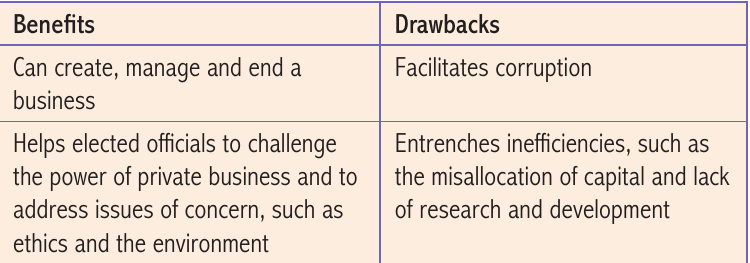
Limitations of State Ownership:
State ownership has significant limitations that can harm economic efficiency:
- Politicians or regulators, rather than the market, decide where funding should go
- Inefficient businesses may receive more money than they need
- Businesses are not subjected to competitive forces that would otherwise drive down prices and improve efficiency
- With reduced competitive pressure, there is less incentive to undertake expensive research and development to create new or better products
However, some state enterprises do benefit the population. For instance, Statoil, the international oil company mostly owned by the Norwegian government, puts a percentage of proceeds into its government pension fund (known as the 'Oil Fund'), while the remainder of shares are publicly traded. This model demonstrates how state ownership can be used responsibly to benefit citizens while maintaining market discipline.
Other forms of political influence
Beyond state ownership, governments can influence business behaviour through various policy tools:
Trade barriers: Tariffs, quotas, regulations and local content requirements can protect domestic businesses from international competitors. For example, Nigeria has a law stipulating the 'minimum amount' (by value) of 'Nigerian content' that must exist in equipment used for oil and gas extraction.
Ownership restrictions: Many countries place direct or indirect ownership restrictions on businesses considered strategically important. Political opposition prevented the Chinese state oil company CNOOC from taking over Unocal, a private US firm.
Subsidies and tax breaks: Countries can support domestic industries through financial incentives designed to:
- Help create factories to produce and distribute goods
- Help consumers buy products
- Assist domestic firms in exporting goods and services
Lobbying: Politicians may lobby to influence business decisions. For example, a politician might try to prevent the foreign direct investment of a competitor that could threaten jobs in their constituency.
Post-political careers: Politicians often take seats on the boards of public limited companies after leaving office. While it's unclear whether this adds value because of knowledge or influence, many businesses actively recruit former politicians.
Legal control
Legal control represents one of the most effective mechanisms for regulating large international businesses through regulation, competition laws and taxation policies.
Competition policy
Competition policy exists to promote competition and ensure markets operate as efficiently as possible. In the UK, the Office of Fair Trading and the Competition and Markets Authority protect producers and consumers from unfair or anti-competitive practices. The EU Competition Commission takes on this role across Europe.
These institutions ensure firms do not:
- Abuse their market power
- Fix prices or use predatory pricing strategies
- Collude against other producers or consumers
Example
Case Example: Microsoft
Microsoft has faced numerous legal challenges asserting it abused its market position through the global operation of its Windows operating system. One particular issue concerned how the operating system prevented interoperability with other firms' systems and applications.
The EU Treaty prevents the abuse by a firm of a 'dominant market position'. In March 2004, the EU Competition Commissioner ruled against Microsoft, ordering it to offer information to rivals so their systems could work with Windows software. Microsoft eventually gave up its appeals and agreed to allow access to open-source software developers.
However, tension existed between national laws—the US disagreed with the EU ruling, arguing it would discourage competition and innovation.
Example
Case Example: Google
Similar issues arose in 2015 with EU regulatory challenges to Google regarding tax avoidance. Britain and the EU were unhappy with Google's complex structures for avoiding tax. The US objected, countering that Google was a victim of commercially driven protectionism by the EU.
This case highlights the challenges of international cooperation when different countries have competing economic interests.
Taxation policy
Governments use taxation policies both to raise revenue and to control MNC activities. However, differing national tax systems create opportunities for regulatory arbitrage—where companies exploit differences between countries' legal and tax systems.
Important
Key Distinction: Tax Avoidance vs Tax Evasion
- Tax avoidance: Using legal methods to reduce the amount of tax a company pays
- Tax evasion: The illegal avoidance of tax (this is a criminal offence)
Tax avoidance is an ethical issue that can bring bad publicity. In 2011, it was revealed that Google had paid just £6 million in tax on a turnover of £395 million in the UK.
Ireland maintains a policy of low corporate taxation (12.5% in 2013 compared to the US's 35%) to attract foreign direct investment. This policy upsets politicians in other countries who see it as an unfair practice allowing businesses to avoid paying their fair share of tax.
Note
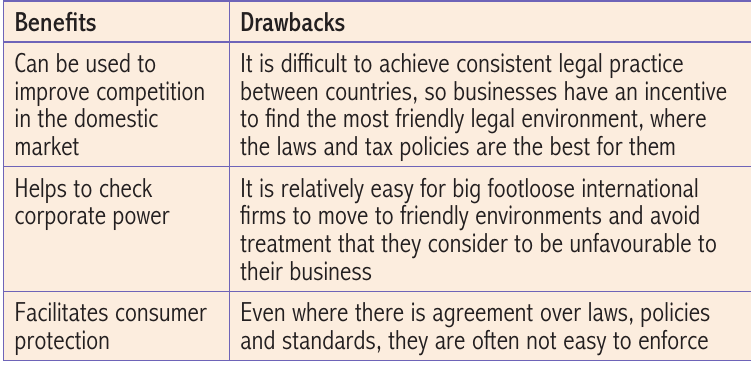
Challenges of Legal Harmonisation Across Borders:
- Difficulty achieving consistent legal practice between countries
- Large MNCs' ability to relocate to favorable jurisdictions
- Enforcement challenges even when international agreement exists
- Competing national interests can undermine cooperation
Pressure groups
Pressure groups are voluntary organisations that operate at all levels of society, including internationally, and aim to change either political or commercial decision-making.
Companies' behaviours may violate acceptable standards without actually breaking any laws. Pressure groups can publicise undesirable behaviour and threaten to damage a firm's image. However, pressure groups can also support business interests—for example, the Confederation of British Industry (CBI) is Britain's biggest business lobbying group with over 190,000 business members.
Methods used by pressure groups
Naming and shaming
Naming and shaming involves publicising behaviour considered unethical as widely as possible, thereby threatening the business's reputation.
Example
Examples of Naming and Shaming Campaigns:
-
Nestlé (1977): Named and shamed for aggressively marketing baby milk formula in less-developed countries. Research indicated breast milk is better, safer and free. Pressure groups started a boycott that continues today.
-
Starbucks, Google and Amazon: Named and shamed in British media for complex tax avoidance schemes where they paid less than their 'fair share' of taxes.
-
DeBeers: Named and shamed for contributing to the problem of 'conflict diamonds' used to finance civil wars in Africa.
-
Apartheid boycott: Firms like Coca-Cola were targeted for continuing to trade with South Africa during the Apartheid era (1948-1994).
Direct action
Direct action is the use of demonstrations, protests, strikes or even sabotage to achieve a political or social goal.
Example
Example: Greenpeace Direct Action
Greenpeace uses direct action for environmental protection. Interventions have included:
- Using ships to interfere with whaling
- Disrupting drilling in the Arctic
- Opposing genetically modified foods (including 'golden rice')
Direct action can be controversial. While Greenpeace opposes all genetically modified food, many health organisations believe golden rice (enhanced to contain additional nutrients) could help save millions of undernourished children in developing countries.
Lobbying
Lobbying involves taking issues directly to government to influence change. Organisations such as Amnesty International and the World Development Movement frequently lobby governments on human rights and development issues. They publish research and make detailed suggestions for addressing concerns.
Large firms also engage in lobbying. The CBI actively lobbies politicians on issues important to its members.
Social media
Social media is an interaction between electronic and mobile devices, applications and people that allows users to create content. This includes online magazines, weblogs, social blogs (Twitter), podcasts, wikis (YouTube, Wikipedia), and social networking (Facebook, Instagram).

Social media acts as a means of controlling business behaviour by:
- Making the collection of information from various sources easier
- Increasing social awareness through communication
- Ensuring greater transparency
- Bringing people together to create social authority that can challenge the power of large companies
Social media in action
Example
Example: Greenpeace Campaigns Using Social Media
Greenpeace has used social media extensively in its 'Save the Arctic' campaign, which included efforts to thwart Lego's partnership with Shell. The campaign began with an animated film using Lego showing the Arctic being flooded with oil. Though watched by millions of viewers, this campaign has not yet achieved its aims.
However, Greenpeace met greater success in its campaign to stop Nestlé's use of palm oil from producers linked to deforestation. Nestlé vowed to remove all potentially offending companies from its supply chain.
Important
The Challenge of Viral Content:
The key challenge with social media is that the speed with which something can go 'viral' means it is increasingly hard to control the message a pressure group may want to convey. Once information spreads rapidly online, the original message can be distorted or misinterpreted, potentially undermining the campaign's objectives or harming innocent parties.
Institutional frameworks
When a firm establishes in a country, it must work within the institutional frameworks of both the home and host country.
Note
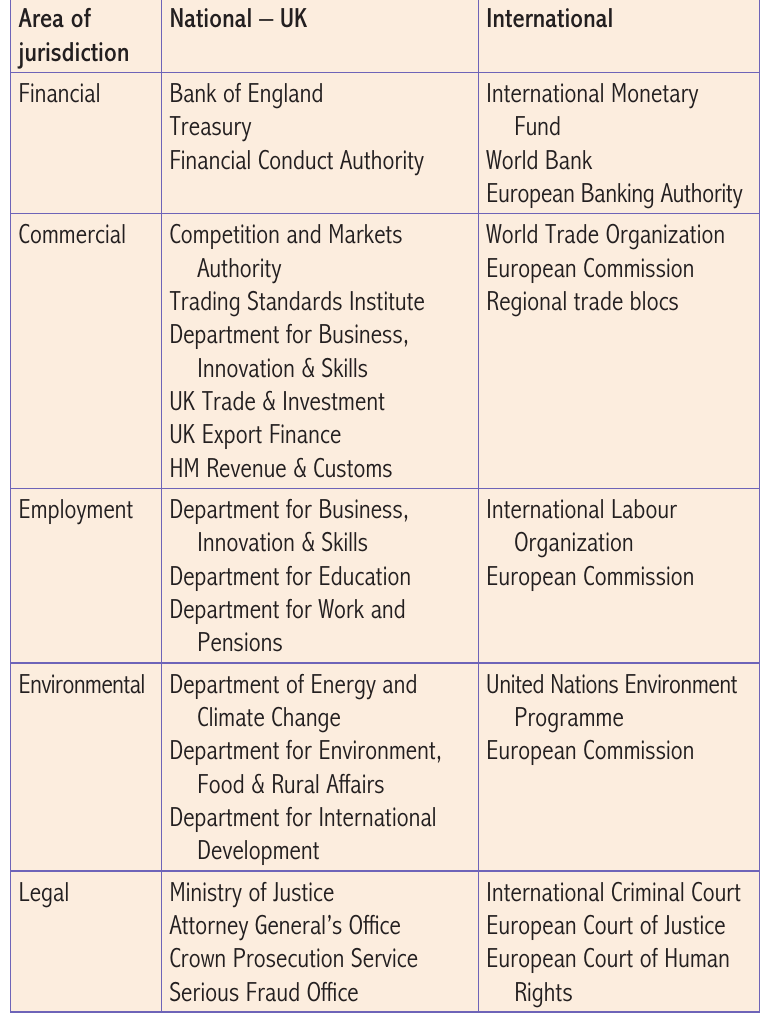
The complexity of operating internationally means MNCs must navigate multiple regulatory bodies at both national and international levels. The table below shows just some of the many institutions that might exert political and regulatory control over a UK-based business operating internationally.
| Area of jurisdiction | National – UK | International |
|---|---|---|
| Financial | Bank of England, Treasury, Financial Conduct Authority | International Monetary Fund, World Bank, European Banking Authority |
| Commercial | Competition and Markets Authority, Trading Standards Institute, Department for Business Innovation & Skills, UK Trade & Investment, UK Export Finance, HM Revenue & Customs | World Trade Organization, European Commission, Regional trade blocs |
| Employment | Department for Business Innovation & Skills, Department for Education, Department for Work and Pensions | International Labour Organization, European Commission |
| Environmental | Department of Energy and Climate Change, Department for Environment Food & Rural Affairs, Department for International Development | United Nations Environment Programme, European Commission |
| Legal | Ministry of Justice, Attorney General's Office, Crown Prosecution Service, Serious Fraud Office | International Criminal Court, European Court of Justice, European Court of Human Rights |
Effectiveness of different control methods
Each method of controlling MNCs has distinct advantages and limitations:
Political influence
Benefits:
- Can create, manage and end a business
- Helps elected officials challenge the power of private business
- Can address issues of concern such as ethics and the environment
Drawbacks:
- Facilitates corruption
- Entrenches inefficiencies such as the misallocation of capital
- Reduces incentives for research and development
Legal control
Benefits:
- Can improve competition in the domestic market
- Helps check corporate power
- Facilitates consumer protection
Drawbacks:
- Difficult to achieve consistent legal practice between countries
- Relatively easy for footloose MNCs to move to favorable jurisdictions
- Even where agreement exists, laws and policies are often difficult to enforce
Pressure groups and social media
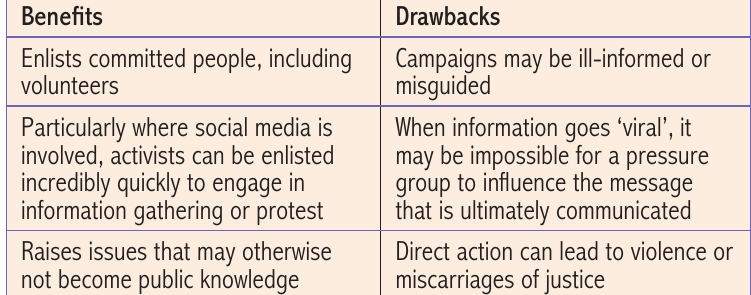
Benefits:
- Enlists committed people, including volunteers
- Can mobilise activists incredibly quickly (especially via social media)
- Raises issues that may otherwise not become public knowledge
- Alerts politicians and authorities to public concerns
Drawbacks:
- Campaigns may be ill-informed or misguided
- When information goes 'viral', message control becomes impossible
- Direct action can lead to violence or miscarriages of justice
Exam focus: Key evaluation points
When assessing the effectiveness of controlling MNCs, consider:
Note
For political influence:
- State ownership provides maximum control but creates inefficiency and corruption risks
- Political measures like subsidies and tariffs can distort markets
- MNCs can threaten to relocate if political pressure becomes too restrictive
Note
For legal control:
- Depends heavily on international cooperation and harmonisation
- MNCs can exploit differences between national legal systems (regulatory arbitrage)
- Enforcement across borders remains challenging even with agreed standards
- Tension can exist between national interests (e.g., US vs EU approaches)
Note
For pressure groups:
- Effectiveness depends on public awareness and media attention
- Can change corporate behaviour without legal action (e.g., Nestlé palm oil case)
- Risk of oversimplification or misinformation damaging legitimate businesses
- Most effective when combined with threat of legal action or consumer boycotts
Note
For social media:
- Enables rapid mobilisation but reduces message control
- Creates transparency but can spread misinformation quickly
- Empowers individuals but can lead to 'mob justice'
- Most effective as amplifier for existing pressure group campaigns
Remember!
Summary
Key Points to Remember:
-
MNCs are difficult to control because they can relocate easily (footloose), taking FDI, tax revenues and employment with them
-
Four main control methods exist: political influence, legal control, pressure groups, and social media—each has distinct benefits and drawbacks
-
Key distinction: tax avoidance (legal but ethically questionable) differs from tax evasion (illegal)
-
Regulatory arbitrage occurs when MNCs exploit differences between countries' legal and tax systems to their advantage
-
Pressure groups use naming and shaming, direct action, and lobbying to influence MNC behaviour without needing legal powers
-
Social media enables rapid information sharing and mobilisation but message control becomes difficult once information goes 'viral'
-
International cooperation is essential for effective legal control, but difficult to achieve consistently across different national interests