Cultural and Social Factors (Edexcel A-Level Business): Revision Notes
📚Revision Notes
Cultural and social factors
When businesses expand internationally, understanding cultural and social differences becomes essential for success. Many companies fail in global markets not because their products are poor, but because they don't recognise how deeply culture affects business practices, communication, and consumer behaviour.
Note
Cultural understanding is not optional in international business—it's a fundamental requirement for success. Companies that ignore cultural differences face communication breakdowns, damaged relationships, and failed market entries.
Understanding ethnocentrism
Ethnocentrism occurs when people believe their own culture, values, and ways of doing business are superior to others. This mindset creates a major barrier to successful international expansion. When businesses view their home market approach as the "correct" way, they fail to adapt to local cultural norms and expectations.
In international business, what seems proper, wise, or right in one culture may be viewed completely differently elsewhere.
Example
Real-World Case: British Company in Vietnam
A British company acquiring a Vietnamese business assumed that London-based management practices would work effectively in Hanoi. However, without understanding Vietnamese business culture and language, this ethnocentric approach led to:
- Communication breakdowns
- Staff departures
- Strategic failure
Important
Overcoming ethnocentrism requires businesses to recognise that different cultural values are equally valid, not inferior. Companies must invest time in understanding local customs, hiring local expertise, and adapting their approach rather than imposing home market practices.

Cultural differences in business settings
National cultures shape every aspect of business interactions, from initial meetings to ongoing negotiations. Companies must carefully research and respect these differences to build trust and avoid causing offence.
Meeting protocols and introductions
First impressions matter enormously in international business, and getting them wrong can derail potential partnerships before discussions even begin. Every country has developed its own formal and informal procedures for business meetings.
In Asian cultures, particularly Vietnam, meetings follow strict protocols. When entering a room, participants must shake hands using both hands while nodding slightly to show respect. This applies both when meeting and when saying goodbye. Failing to follow this ritual signals disrespect and can damage the business relationship.
Business card etiquette

Example
Business Card Protocol in Asian Cultures
In many Asian cultures, business cards carry far more significance than in Western markets. The proper procedure includes:
- Presentation: The card must be presented using both hands
- Reception: Receive the card using both hands
- Review: Pause and study the card thoroughly
- Storage: Place it carefully in a special case
What NOT to do: Simply glancing at a card and stuffing it in a pocket, as might be acceptable in London or New York, causes grave offence in Asian business culture.
Note
Every country and region has developed its own norms for introductions and business meetings. Before attending an international business meeting, thorough research into local expectations is essential. What seems like minor details to outsiders can be critically important to building trust and credibility.
Language and communication challenges
While English dominates international business, relying solely on one language creates significant risks. Language barriers lead to miscommunication, and without understanding local languages, businesses show less sensitivity to cultural differences. More importantly, communication involves far more than just translating words.
High-context versus low-context cultures
Understanding the distinction between high-context and low-context cultures is crucial for international business success. These different communication styles can lead to serious misunderstandings if not recognised.
Important
Low-context cultures (North America and Europe) communicate directly. People say what they mean, and statements can be taken at face value. In British or Danish business negotiations, "yes" means agreement, and "no" means disagreement. These cultures value getting straight to business, with socialising typically happening after deals are completed.
High-context cultures (Arab and Asian countries) communicate indirectly. Words often carry indirect meanings that depend heavily on context. In these cultures, what is said cannot always be taken at face value.
Example
Communication Differences in Practice
Saudi Arabia (High-Context): "Yes, I agree" might actually mean "I hear you" rather than genuine agreement.
Japan (High-Context): Negotiators never use the word "no" directly. When a Japanese partner says "We are going to study your proposal and get back to you" at the end of a meeting, this typically means "no" rather than indicating genuine interest.
UK/Denmark (Low-Context): "Yes" means yes, "no" means no. Communication is direct and can be taken at face value.
In high-context cultures, initial meetings focus on building trust and personal relationships rather than discussing business details immediately. Socialising is a critical part of the negotiation process, not an afterthought. This contrasts sharply with low-context cultures where time spent on relationship-building might seem unnecessary or inefficient.
Understanding whether you're negotiating with a high-context or low-context culture fundamentally changes how you should conduct business discussions. Misreading these signals can lead to failed negotiations and damaged business relationships.
Unintended meanings through gestures
Verbal communication creates challenges, but non-verbal communication can be equally problematic. Hand gestures that seem perfectly normal in one country can cause serious offence elsewhere.
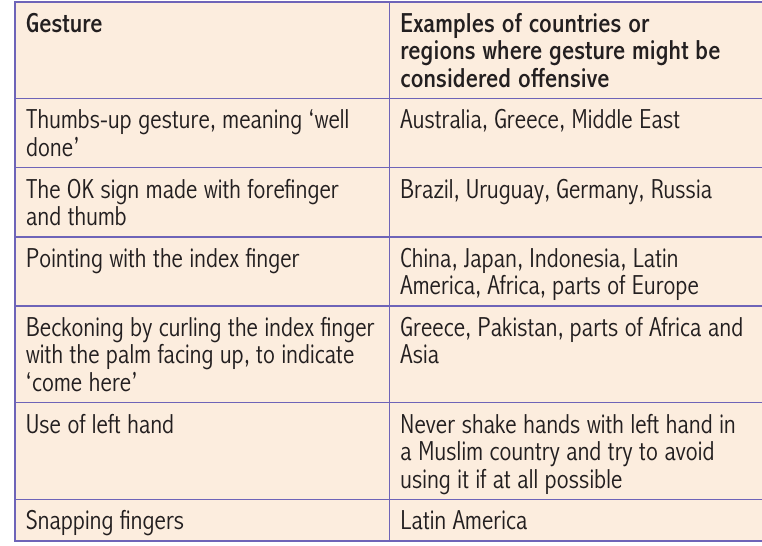
| Gesture | Countries/regions where offensive |
|---|---|
| Thumbs-up gesture (meaning 'well done') | Australia, Greece, Middle East |
| OK sign (forefinger and thumb circle) | Brazil, Uruguay, Germany, Russia |
| Pointing with index finger | China, Japan, Indonesia, Latin America, Africa, parts of Europe |
| Beckoning with curled index finger (palm up, meaning 'come here') | Greece, Pakistan, parts of Africa and Asia |
| Using left hand | Never shake hands with left hand in Muslim countries; avoid using it whenever possible |
| Snapping fingers | Latin America |
Important
Business people must research appropriate and inappropriate gestures before international meetings. What represents approval or agreement in Britain might be deeply insulting in Australia or the Middle East. Physical communication habits that seem natural at home can damage international business relationships if not carefully managed.
Differing tastes and product adaptation
Products that succeed in one market often require modification for others. The extent of adaptation needed depends on cultural and social differences between markets. UK products might need minimal changes for Australia due to cultural similarities, but require substantial modifications for China.
Reasons for product adaptation
Local variants: Some taste differences occur naturally from local ingredients. Coca-Cola uses the same concentrate globally, but mixing it with local water creates slight taste variations between countries. This type of adaptation happens automatically rather than through deliberate business decisions.
Religious considerations: Food products often require significant changes to respect religious beliefs. Fast-food restaurants in Middle Eastern countries commonly use halal meat. In India, international chains avoid selling pork or beef due to Hindu and Muslim religious practices. By respecting these beliefs and adapting their products, international businesses compete effectively against local companies that naturally understand regional requirements.
Legal requirements: Different countries enforce different product standards. Many food ingredients permitted in the US are banned in the European Union. Brands like Pringles and Starburst have removed certain additives from US formulations to meet UK legal standards. Companies must adapt products to comply with local regulations before entering new markets.
Examples of successful product adaptations
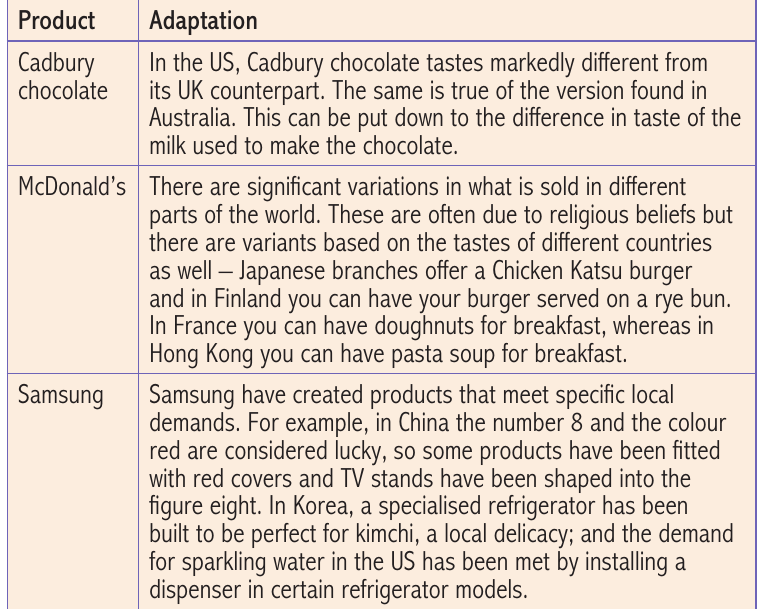
| Product | Adaptation strategy |
|---|---|
| Cadbury chocolate | Taste varies markedly between US, UK, and Australian versions due to differences in local milk used in production |
| McDonald's | Significant global variations based on religious beliefs and local tastes: Chicken Katsu burger in Japan, rye bun option in Finland, breakfast doughnuts in France, pasta soup for breakfast in Hong Kong |
| Samsung | Creates products for specific local demands: red-coloured items and figure-eight TV stands in China (red and 8 are lucky), specialised kimchi refrigerators in Korea, sparkling water dispensers in US refrigerator models |
Note
These examples demonstrate how major international brands succeed by respecting and adapting to local preferences rather than forcing standardised products onto different markets.
Inappropriate branding and promotion
Translation errors, cultural insensitivity, and inadequate market research have created numerous embarrassing and costly mistakes for international businesses.
Translation failures
Sometimes mistakes result from laziness and failure to consult native speakers about translations.
Example
Famous Translation Disasters
Coors (Beer Company): Translated its slogan "Turn it loose" into Spanish, where it meant "Drink Coors and get diarrhoea"
General Motors (Nova Car): Sold its "Nova" car in Latin America, where the name means "No go" in Spanish—hardly ideal for a vehicle
However, not all translation problems stem from carelessness. Some languages lack direct translations for particular words or concepts. Even transferring brands between the UK and US can create issues, as cultural, dialectal, and grammatical differences affect how brand names are received.
Example
Cultural Context Matters: Gerber Baby Food
Gerber, a Nestlé-owned baby food company, replicated its packaging in Africa, displaying an image of a smiling baby. However, due to high illiteracy rates, most African products show images of what's inside the packaging.
Result: Consumers assumed the jars contained babies, creating a serious branding disaster.
Examples of inappropriate brand names
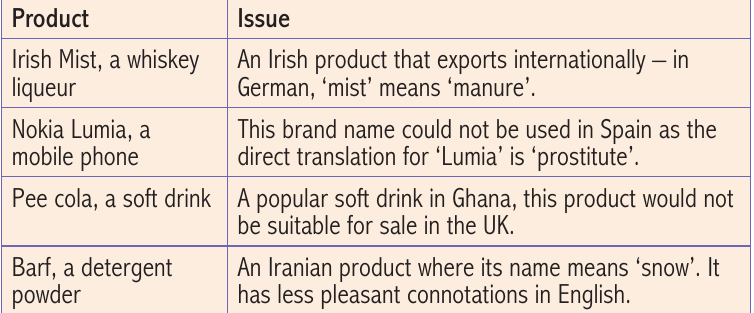
| Product | Problem |
|---|---|
| Irish Mist (whiskey liqueur) | Irish product exporting internationally; in German, "mist" means "manure" |
| Nokia Lumia (mobile phone) | Could not be used in Spain as "Lumia" translates to "prostitute" |
| Pee Cola (soft drink) | Popular in Ghana but unsuitable for UK market due to name |
| Barf (detergent powder) | Iranian product where name means "snow"; has unpleasant connotations in English |
Marketing campaign failures
Creating a global brand image doesn't mean using identical marketing campaigns everywhere. Campaigns must be adapted for different international markets based on cultural norms and audience expectations.
Example
Marketing Campaign Mistakes
Proctor and Gamble (Soap Advertisement): A television advert originally made for the American market featured a husband and wife in a bathroom, showing how soap could make the woman more attractive. When transferred to Japan, many viewers considered it sexist and inappropriate, damaging the brand's reputation.
Heineken (1994 World Cup): Displayed flags of all participating countries on bottles, including Muslim countries where alcohol is forbidden. This prompted numerous complaints and showed poor cultural awareness.
Important
Failing to consider local market cultural norms proves costly. Beyond the immediate expense of advertising campaigns and packaging, businesses face potential long-term damage if sales are adversely affected throughout the product's life cycle in that country.
Exam insight
When evaluating global marketing strategies, consider both short-term costs (research, adaptation, localisation) and long-term consequences (brand reputation, market share, sustained sales). Companies that invest in cultural understanding typically see better returns than those pursuing standardised global approaches.
Remember!
Summary
Key Points to Remember:
-
Ethnocentrism—believing your own culture is superior—creates major barriers to international business success. Companies must recognise that different cultural values are equally valid.
-
Communication styles vary dramatically: low-context cultures (US, UK, Europe) communicate directly, while high-context cultures (Asia, Arab countries) rely on indirect communication where "yes" doesn't always mean yes.
-
Gestures matter: common hand signals in one country can cause serious offence elsewhere. Thumbs-up, OK signs, and pointing all have different meanings across cultures.
-
Products must be adapted for different markets based on religious beliefs, legal requirements, and local preferences. Successful global brands like McDonald's and Samsung extensively customise their offerings.
-
Translation and branding failures can be extremely costly. Companies must thoroughly research local languages and cultural meanings before launching products internationally, using native speakers to avoid embarrassing mistakes.