Global Niche Markets (Edexcel A-Level Business): Revision Notes
📚Revision Notes
Global Niche Markets
What are global niche markets?
Global niche markets are specialised market segments that exist across multiple countries, serving customers with specific needs that are not fully met by mass market products. Unlike mass markets, which are large-scale and serve millions of customers worldwide, niche markets target much smaller, more defined customer groups.
These markets serve subcultures – groups of customers with common interests, hobbies, or specific requirements. For example, while the global toy market contains millions of products for all age groups, the market for interlocking toy bricks (such as Lego) represents a much smaller, specialised niche. Similarly, the neckwear market served by retailers like Ties.com targets customers with specific preferences for quality ties and accessories.
Note
The key characteristic of global niche markets is that customers are willing to pay premium prices for products that precisely meet their particular needs. These customers exist in multiple countries and share similar values and preferences despite geographical separation.
Features of global niche markets
Businesses operating successfully in global niche markets typically demonstrate several distinctive characteristics:
Clear understanding of customer needs – Companies must develop deep knowledge of their target market segment. They need to understand exactly what their customers value and what specific problems their products solve.
Example
Example: Virgin Atlantic Upper Class
Virgin Atlantic's Upper Class service demonstrates precise understanding of business travellers who prioritise comfort, convenience, and luxury over cost. The airline identified the specific needs of this niche segment and designed services to meet them exactly.
Emphasis on quality – Niche market products typically focus on superior quality rather than competing on price. Luxury car manufacturers like Mercedes-Benz build their reputation on engineering excellence and premium materials. This quality focus justifies higher prices and creates brand loyalty.
Excellent customer service – Providing exceptional service helps maintain brand reputation and customer satisfaction. This might include personalised attention, exclusive access, or premium after-sales support.
Product expertise – Businesses must demonstrate specialist knowledge in their product area. This expertise builds credibility and trust with customers who seek specialist solutions.
Prioritising profit over market share – Unlike mass market competitors who aim to maximise sales volume, niche businesses focus on achieving high profit margins from smaller sales volumes. This strategy allows them to remain financially viable despite serving fewer customers.
Innovation – Successful niche businesses continuously develop and improve their products to maintain their competitive advantage and meet evolving customer expectations.
Why customers pay premium prices globally
Several factors explain why customers across different countries are prepared to pay higher prices for global niche brands rather than choosing local alternatives:
Note
The internet and e-commerce
Digital platforms have revolutionised how niche businesses reach global customers. E-commerce enables businesses to access foreign markets and create demand that would be impossible through traditional retail channels. Companies can now market and sell specialised products to customers worldwide without establishing physical presence in each country.
Note
Social media platforms
Facebook, Twitter, YouTube and other social networks have created new marketing opportunities through influencers and vloggers (video bloggers). These content creators review and promote niche products to their subscribers, spreading brand awareness globally. This word-of-mouth marketing through social media helps build aspirational appeal for niche brands across borders.
Note
Ease of international travel
Low-cost airlines and improved transport infrastructure have made international travel more accessible. When people visit other countries, they encounter well-known global brands in foreign locations, which reinforces the international appeal and desirability of these products.
Aspirational brands in one country tend to maintain similar appeal in other countries. This transmission of desirability across borders is fundamental to global niche markets – a premium brand valued in the UK is likely to be similarly valued in other countries.
Cultural diversity considerations
While global niche markets serve customers across countries, businesses must remain sensitive to cultural diversity – the recognition that people across the globe have different interests, values, and cultural norms.
Important
Language differences
Although English is increasingly spoken in many countries, particularly since EU expansion, language barriers can still present challenges. Product names suitable in one country may have inappropriate meanings in another language.
Examples of naming mistakes:
- The French lemonade "Pschitt" would require renaming for the UK market
- Irish Mist whiskey liqueur had to be rebranded for Germany where "mist" translates to a type of manure
These examples demonstrate why careful linguistic research is essential before entering new markets.
Product relevance – Cultural traditions affect product demand. Neckties, for instance, are standard business wear in many Western countries but are not worn in some cultures, making market expansion to these regions unlikely to succeed.
Important
Colour symbolism
Different cultures associate colours with different meanings. In Western countries, black is associated with mourning, while in Far Eastern countries, white carries this association. These differences must be considered when designing products and packaging for global markets.
Cultural standards and practices – Beauty standards vary globally. Fashion models considered appropriate in Western advertising might be viewed as too thin in India. Business practices also differ – payments to officials that might be considered bribes in the UK could be standard business practice in other countries.
These cultural considerations mean businesses must adapt their marketing mix when entering different markets, which increases promotion costs and may impact competitiveness.
Application and adaptation of the marketing mix (4Ps)
Businesses serving global niche markets must distinguish themselves from mass market competitors through careful adaptation of the marketing mix:
Product
Global niche products emphasise quality and exclusivity. Luxury goods like premium cars, watches, and perfumes position themselves as superior alternatives to mass market offerings.
Example
Example: Montblanc's Product Strategy
Montblanc produces exclusive pens, watches, and luggage sold globally and marketed as prestigious, desirable products. The brand's focus on craftsmanship and heritage creates strong product differentiation in the luxury goods market.
Product differentiation is crucial. Virgin Atlantic differentiates its standard flight service by creating the Upper Class package, which includes:
- Chauffeur-driven airport transfers
- Private security channels
- Exclusive airport lounges with complimentary dining
- Leather seats converting to luxury beds
- Extensive in-flight entertainment
This clear product differentiation demonstrates understanding of niche customer needs.
Price
The fundamental point of niche marketing is charging premium prices by providing products not intended for mass markets. Businesses in global niches can charge significantly higher prices because their products meet specific needs with limited competition.
Note
Price inelastic demand characterises many niche products. When products are highly desirable with few close substitutes due to quality or unique features, consumers become less price-sensitive.
For instance, Mercedes-Benz can charge substantially more than mass market car manufacturers because customers willing to pay for luxury vehicles have price inelastic demand – price increases have relatively little impact on demand levels. This pricing power is extremely valuable for niche businesses.
Virgin Atlantic's Upper Class tickets cost several times more than standard flights. Business travellers whose companies pay for flights, or affluent individuals for whom ticket prices represent minor expenditure, are willing to pay these premium prices for the enhanced experience.
Promotion
Promotion strategies for global niches must be more targeted and exclusive than mass market advertising. Marketing typically focuses on reinforcing brand prestige and exclusivity rather than reaching maximum audience numbers.
Language and cultural adaptation is essential. Car manufacturers often use different names for the same vehicles in different countries to ensure cultural appropriateness. While this sensitivity to national and cultural differences increases promotion costs, it's necessary to maintain brand image and effectiveness.
Note
Social media and vloggers play increasingly important roles in promoting niche products to specific audience segments interested in particular product categories. This form of influencer marketing allows brands to reach targeted consumers more effectively than traditional mass media advertising.
Place
Distribution channels require careful selection to maintain brand exclusivity. Networks of exclusive dealers are common for luxury brands. Mercedes-Benz operates exclusive dealerships worldwide rather than selling through general car retailers. Montblanc sells through an exclusive network of authorised retailers, jewellers, and over 360 Montblanc Boutiques globally.
Direct-to-consumer distribution also works for some niche businesses. Online retailers can maintain exclusivity while reaching global customers.
Important
Protecting Brand Image Through Distribution
Distribution strategy directly impacts brand perception. Selling premium surf brand Billabong through supermarkets would compromise its specialist image, so specialist retail distribution maintains the brand's positioning. The choice of where products are sold is just as important as the products themselves.
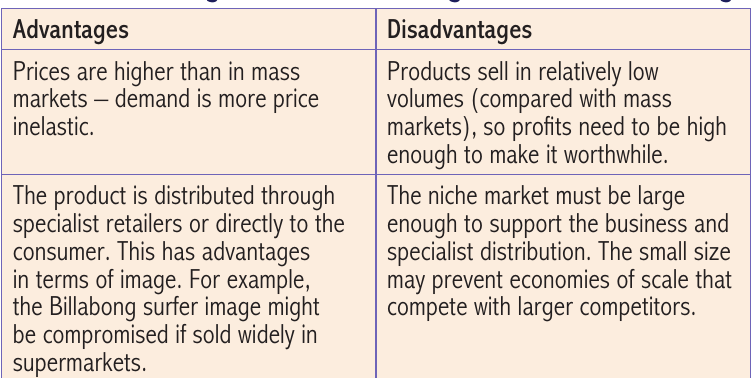
Advantages and disadvantages of niche marketing
Advantages:
Higher prices with inelastic demand – The most significant advantage is the ability to charge premium prices. Because niche products meet specific needs with limited alternatives, demand tends to be price inelastic. This means customers are willing to pay higher prices, and price increases have relatively small effects on sales volumes. Businesses can therefore achieve strong profit margins.
Brand image protection through specialist distribution – Using exclusive retailers or direct distribution helps maintain brand prestige. Controlling distribution channels ensures products are presented appropriately and associated with quality. For example, distributing premium surf brand Billabong through specialist retailers rather than supermarkets maintains its authentic, specialist image.
Disadvantages:
Low sales volumes requiring high profit margins – Compared to mass markets, niche markets generate relatively small sales volumes. Businesses must achieve sufficiently high profit margins on each sale to make operations worthwhile. The market must be large enough to support the business financially.
Limited economies of scale – Small production volumes mean niche businesses cannot achieve the same economies of scale as mass market competitors. Higher unit costs can make it difficult to compete on price if mass market products improve quality. The niche market must be substantial enough to support specialist distribution networks.
Exam technique guidance

Important
Context is Everything
When analyzing global niche markets in exam questions, always consider context. Apply your answer specifically to the case study business and product being examined. For example, when discussing mobile phone markets, contextualise responses by comparing competitors (Samsung, HTC) or referring to alternative communication methods (telephone, email).
Understanding why businesses extend beyond domestic markets into global niches is crucial. The key benefit of targeting niche rather than mass markets is charging higher prices. Explain why customers in different countries pay these premiums using concepts like price elasticity of demand.
Note
Price Elasticity in Global Niches
If a product is desirable with few close substitutes due to quality or features, consumers are less price-sensitive, making demand price inelastic. The latest iPhone demonstrates this principle – whether customers are in New York, London, or Tokyo, the product's niche appeal means relatively high prices don't deter demand. For businesses, achieving low price elasticity of demand is highly valuable, and identifying and filling global niches is one method to achieve this position.
Consider the challenges of translating local niche success to global markets. Success in one country doesn't guarantee international success. Domestic success may result from identifying specific local consumer needs, which may not exist elsewhere. Restaurants serving local cuisine, for example, may struggle to replicate success internationally. Careful marketing, operations, and leadership are essential when translating local niches into global opportunities.
Remember!
Summary
Key points:
- Global niche markets serve customers across multiple countries with specific needs not met by mass markets
- Features include emphasis on quality, excellent service, expertise, and prioritising profit over market share
- The internet, social media, and easier travel enable global niche development
- Cultural diversity requires careful consideration – language, traditions, and symbolism vary globally
- Marketing mix (4Ps) must be adapted: quality products, premium pricing, targeted promotion, exclusive distribution
- Main advantage is charging higher prices due to price inelastic demand; main disadvantage is low volumes requiring high margins
Key terms:
- Global niche market – customers in multiple countries with particular needs not fully met by mass markets
- Subcultures – groups of customers with common interests or hobbies
- Price inelastic demand – when price changes have relatively small effects on quantity demanded
- Premium prices – significantly higher prices charged for exclusive or high-quality products
- Cultural diversity – recognition that people across the globe have different interests and values
- Economies of scale – cost advantages from producing larger quantities