Monopolistic Competition and Market Concentration (Edexcel A-Level Economics A): Revision Notes
📚Revision Notes
Monopolistic Competition and Market Concentration
Introduction to monopolistic competition
Market structures exist on a spectrum between perfect competition and monopoly. Between these two extremes lie intermediate forms of market structure that share some characteristics of both models. This note explores two important intermediate market structures: monopolistic competition and oligopoly, with a focus on understanding market concentration.
Monopolistic competition is a market structure that combines elements of both monopoly and perfect competition. The model was developed in the 1930s by economists Edward Chamberlin in the USA and Joan Robinson in the UK. They sought to explain how markets operate when they function neither as pure monopolies nor under perfect competition conditions.
The model of monopolistic competition
Key characteristics
Monopolistic competition is defined by three essential characteristics that distinguish it from other market structures:
1. Product differentiation
Firms in monopolistic competition produce similar but not identical products. Each firm differentiates its product from competitors to build brand loyalty among customers. This differentiation gives firms some influence over price, allowing them to charge slightly higher prices than rivals if consumers perceive their product as superior or unique.
Product differentiation means that:
- Demand for each firm's product is relatively price elastic (but not perfectly elastic)
- Substitutes exist for each firm's product
- The demand curve facing each firm slopes downward
- Firms have some price-setting power
Note
The key distinction from perfect competition is that firms face downward-sloping demand curves rather than perfectly elastic (horizontal) demand curves. This gives each firm some degree of market power, even though many competitors exist.
2. Freedom of entry
There are no barriers preventing new firms from entering the market. If existing firms earn supernormal profits, new firms can freely join the market. These new entrants typically differentiate their products slightly from existing offerings to attract customers.
This characteristic distinguishes monopolistic competition from monopoly, where high barriers to entry prevent new firms from competing away supernormal profits.
3. Many firms
The market contains numerous firms competing for business. Because there are so many firms, a price change by one firm has negligible effects on the demand for rivals' products. Firms do not need to consider strategic interactions with competitors when making pricing decisions.
Important
This feature distinguishes monopolistic competition from oligopoly, where a few firms must consider each other's likely reactions when making business decisions. The absence of strategic interdependence is crucial to understanding how monopolistically competitive markets operate.
Real-world example: fast-food outlets

The fast-food market in many cities exemplifies monopolistic competition. High streets typically feature numerous takeaway outlets offering burgers, fish and chips, Indian food, Chinese food, fried chicken, and other cuisines. Each outlet:
- Offers a differentiated product (different type of food or brand)
- Competes with many other food outlets
- Can enter or exit the market relatively freely
- Faces a downward-sloping demand curve due to brand loyalty
Equilibrium under monopolistic competition
Short-run equilibrium
In the short run, firms in monopolistic competition aim to maximize profits by producing where marginal revenue equals marginal cost (). Because firms face downward-sloping demand curves and can differentiate their products, they may earn supernormal profits in the short run.
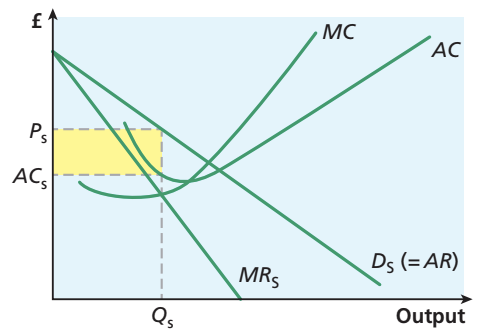
The diagram above illustrates short-run equilibrium. The firm:
- Produces at quantity where
- Charges price (determined by the demand curve)
- Earns supernormal profit shown by the shaded area (the rectangle between price and average cost , multiplied by quantity)
This short-run position closely resembles monopoly equilibrium. The key difference is that in monopolistic competition, free entry means this situation cannot persist in the long run.
The importance of free entry
When firms earn supernormal profits in the short run, the lack of entry barriers attracts new firms to the market. These new entrants have two important effects:
-
Demand shifts left: New firms attract customers away from existing firms, shifting each firm's demand curve to the left
-
Demand becomes more elastic: With more substitutes available, consumers can switch more easily between products, making demand more price elastic
Note
This process continues as long as supernormal profits exist in the market, encouraging further entry. The mechanism of free entry is the driving force that moves the market from short-run to long-run equilibrium.
Long-run equilibrium
The entry of new firms continues until supernormal profits are eliminated. Long-run equilibrium is reached when firms earn only normal profit (where average revenue equals average cost).
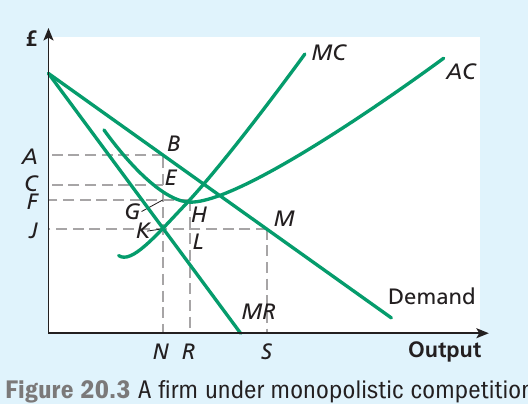
In long-run equilibrium:
- The firm still produces where to maximize profit
- The average cost curve is tangent to (just touches) the demand curve
- Price equals average cost ()
- The firm earns only normal profit (covering opportunity costs)
- There is no incentive for further firms to enter or for existing firms to exit
Firms may engage in advertising to defend their market shares and maintain demand. This advertising pushes up the average cost curve at all output levels, but also helps keep the demand curve from shifting too far leftward.
Efficiency in monopolistic competition
Economists evaluate market structures by examining four types of efficiency:
Productive efficiency
Productive efficiency occurs when firms produce at the minimum point of the long-run average cost curve.
In monopolistic competition, productive efficiency is not achieved. The tangency between the and demand curves occurs before the minimum point of the curve. Firms produce at a higher average cost than the minimum possible, suggesting some economies of scale remain unexploited.
Allocative efficiency
Allocative efficiency requires that price equals marginal cost (), ensuring resources are allocated to their most valued uses.
In monopolistic competition, allocative efficiency is not achieved. Firms charge a price above marginal cost due to their downward-sloping demand curves. This means some consumers who value the product more than its marginal cost of production are priced out of the market.
Important
The failure to achieve both productive and allocative efficiency represents the main economic cost of monopolistic competition. However, these efficiency losses must be weighed against the benefits of product variety and consumer choice.
Dynamic efficiency
Dynamic efficiency refers to efficiency over time, particularly through innovation and product development.
Monopolistic competition may achieve dynamic efficiency. Firms have incentives to:
- Devote resources to developing new or improved products
- Innovate to strengthen product differentiation
- Improve production processes
However, in long-run equilibrium firms earn only normal profits, which may limit resources available for research and development.
X-inefficiency
X-inefficiency occurs when firms use excessive resources for a given output level, operating above their average cost curves.
Monopolistic competition may suffer from X-inefficiency if firms:
- Spend excessively on advertising to differentiate products
- Use too many resources on innovation without proportional benefits
- Become complacent due to some market power
However, the intensity of competition may limit the extent of X-inefficiency.
Evaluating monopolistic competition
Product differentiation and consumer welfare
A key debate concerns whether product differentiation benefits or harms consumers:
Potential disadvantages:
- If firms fully exploited economies of scale, they could produce at lower average cost
- Too many different products may be produced
- Product differentiation keeps demand curves downward-sloping, preventing allocative efficiency
- Excessive advertising wastes resources and raises costs
Potential advantages:
- Consumers value choice and variety
- Consumers willingly pay premium prices for preferred brands, indicating they gain utility from differentiation
- Greater freedom of choice enhances consumer welfare
- Competition through differentiation may be less wasteful than monopoly
Note
An important distinction from perfect competition is that monopolistic competitors would prefer to sell more at the current price but cannot (downward-sloping demand constrains them), whereas perfect competitors can sell any quantity at the market price.
Advertising considerations
Advertising under monopolistic competition serves two purposes:
- Attracting new customers and maintaining consumer perception of product differences
- Building and maintaining brand loyalty to keep demand curves downward-sloping
While advertising raises average costs, it may result in less X-inefficiency than under pure monopoly. The competitive pressure from many firms may encourage more efficient advertising and innovation than monopoly would.
Real-world examples
Road transport market
The road haulage sector in the UK demonstrates monopolistic competition characteristics:
- Many firms operate heavy goods vehicles (HGVs) and vans
- Vehicles come from various countries carrying diverse loads
- Firms differentiate by specializing in particular product categories (building materials, electronics, etc.)
- Some differentiate by trading routes between specific destinations
- Firms advertise specialisms on vehicles or online
- Entry barriers are relatively low
The local taxi market also exhibits monopolistic competition:
- Multiple taxi companies operate in most areas
- Firms differentiate through fleet liveries, pre-booking services, or limousine services
- Some specialize in longer-distance airport trips
- Competition is intense with freedom of entry
Food outlets
Restaurants and takeaway outlets provide clear examples of monopolistic competition:
- The number of food outlets has grown substantially in recent decades
- UK high streets feature many eating places and takeaways
- Each outlet differentiates its product from competitors
- The fast-food sector shows strong product differentiation by cuisine type (burgers, pizza, Indian, Chinese, Thai, Mexican, etc.)
- This variety offers consumers wide choice for fast food
- While not perfectly efficient economically, consumers benefit from the range of options available
Market concentration
Understanding concentration
In real-world markets, few correspond exactly to the theoretical models of perfect competition or monopoly. Most markets display a mixture of characteristics from different models. An important question is whether a market behaves more like a competitive market or more like a monopoly.
Market concentration measures the degree to which a market is dominated by a small number of firms. Understanding concentration helps economists and policymakers:
- Assess market competitiveness
- Determine whether regulatory intervention might be needed
- Predict likely market behaviour and outcomes
- Evaluate potential impacts of mergers and takeovers
The concentration ratio
The most common measure of market concentration is the n-firm concentration ratio. This measures the combined market share of the largest firms in an industry.
Common concentration ratios include:
- Three-firm concentration ratio (CR3): Market share of the three largest firms
- Five-firm concentration ratio (CR5): Market share of the five largest firms
- Four-firm concentration ratio (CR4): Market share of the four largest firms
Concentration can be measured using either:
- Market share of output (more common and useful)
- Market share of employment (may give different results if firms use different production methods)
Calculating concentration ratios
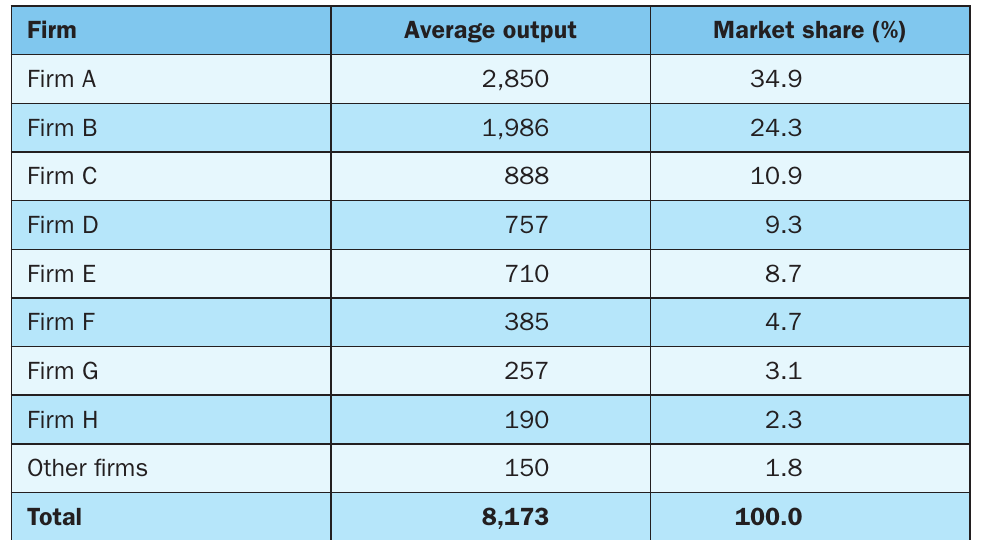
The table above shows average output for firms in an industry. Market shares are calculated by expressing each firm's output as a percentage of total market output.
Example
Worked Example: Calculating Market Share and Concentration Ratios
Step 1: Calculate individual market share
For Firm H:
Step 2: Calculate the concentration ratio
The three-firm concentration ratio equals the sum of the market shares of the three largest firms:
Interpretation: The three largest firms control just over 70% of the market, indicating significant market concentration.
Interpreting concentration ratios
While concentration ratios provide a useful first indication of market structure, they have limitations:
1. Definition of the market
It is crucial to define the market appropriately. The market definition should:
- Include all firms operating in the same market
- Exclude firms operating in different markets
- Use consistent geographic and product boundaries
Important
Incorrectly defining the market can lead to misleading concentration ratios. For example, defining the market too narrowly (e.g., "cola drinks" instead of "soft drinks") will overstate concentration, while defining it too broadly will understate concentration.
2. Simplicity of the measure
Concentration ratios can mask important market dynamics. Consider this comparison:
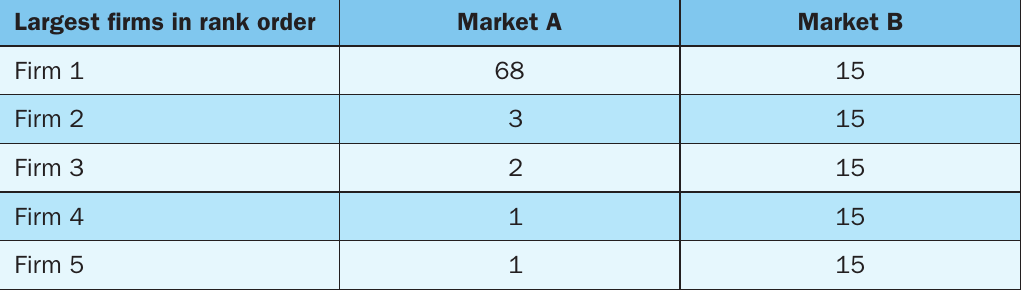
Both markets have identical five-firm concentration ratios of 75%. However:
- Market A: One firm dominates with 68% market share, giving it substantial market power
- Market B: Market share is equally distributed (15% each), indicating intense competition
Note
The markets would function very differently despite identical concentration ratios. Market A is likely to behave much more like a monopoly, while Market B would be highly competitive. This demonstrates why concentration ratios alone cannot fully capture market structure.
Concentration in UK industries
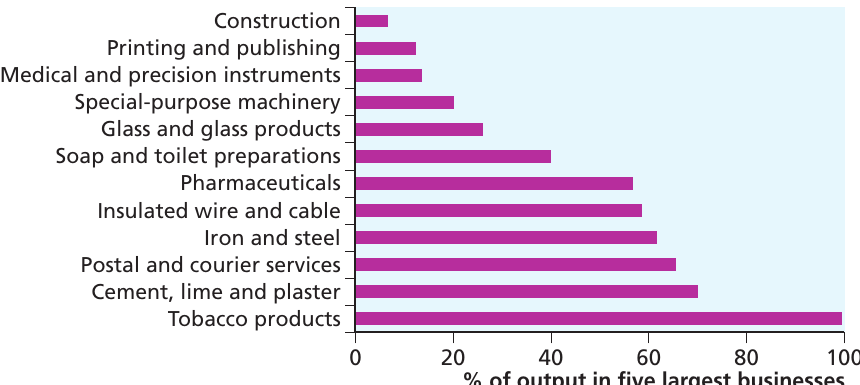
Concentration varies significantly across UK industries. The five-firm concentration ratio ranges from:
- 5% in construction (highly fragmented, many small firms)
- 99% in tobacco products (near-complete concentration, dominated by a few large firms)
Differences in concentration partly reflect:
- Extent of economies of scale in different industries
- Historical development of each sector
- Barriers to entry (capital requirements, regulations, brand loyalty)
- Nature of the product or service
High concentration industries (cement, tobacco, postal services) often feature:
- Significant economies of scale
- High capital requirements
- Established brand dominance
- Regulatory barriers
Low concentration industries (construction, printing, medical instruments) typically have:
- Lower economies of scale
- Easier entry for small firms
- More localized markets
- Diverse product requirements
Oligopoly
Defining oligopoly
Some markets are dominated by a few large firms rather than many small firms. Examples in the UK include:
- Motor vehicle manufacturing
- Commercial banking
- Newspaper publishing
An oligopoly is a market structure with a few sellers, where each firm must consider the behaviour and likely behaviour of rival firms when making decisions.
Key characteristics of oligopoly
Oligopolies display several defining features:
1. Few sellers
The market has a small number of firms, resulting in a high concentration ratio. Each firm controls a significant portion of total market output.
2. Interdependence
Firms are strategically interdependent. Each firm must:
- Consider rivals' likely reactions when making decisions
- Anticipate competitors' future actions
- React to competitors' decisions about prices, output, advertising, or product development
Important
This interdependence distinguishes oligopoly from other market structures and makes oligopoly behaviour more complex to analyze. Unlike in monopolistic competition, oligopolistic firms cannot ignore their competitors' reactions to their decisions.
3. Barriers to entry
Entry into the market is restricted by various barriers, allowing existing firms to maintain their market positions. Barriers might include:
- Significant economies of scale
- High capital requirements
- Brand loyalty and reputation
- Legal restrictions or patents
- Control of essential resources
4. Product differentiation
Products may be differentiated (like cars or mobile phone services) or homogeneous (like cement or steel). The degree of differentiation affects competitive behaviour.
Strategic behaviour in oligopoly
The defining characteristic of oligopoly is strategic interdependence. Each firm must act strategically by:
- Reacting to rival firms' decisions
- Anticipating rivals' future actions
- Considering how rivals will respond to its own decisions
This strategic interaction creates complex competitive dynamics that will be explored in later chapters.
Summary
Key Points to Remember:
-
Monopolistic competition combines features of monopoly (downward-sloping demand, some price-setting power) and perfect competition (many firms, freedom of entry) through product differentiation
-
In the short run, monopolistically competitive firms may earn supernormal profits, but free entry eliminates these in the long run, leaving only normal profit
-
Monopolistic competition achieves neither productive nor allocative efficiency in long-run equilibrium, though dynamic efficiency may be possible through innovation
-
Consumer welfare effects are ambiguous—product differentiation creates variety and choice but prevents full efficiency gains
-
Market concentration measures the extent to which a market is dominated by a few large firms, typically using the n-firm concentration ratio
-
Oligopoly features few sellers with strategic interdependence, high concentration ratios, entry barriers, and potentially differentiated products