Oligopoly (Edexcel A-Level Economics A): Revision Notes
📚Revision Notes
Oligopoly
What is an oligopoly?
An oligopoly is a market structure where there are only a small number of firms operating. Each firm must carefully consider how its rivals will behave and react when making business decisions. This interdependence between firms is what makes oligopolies particularly interesting to study.
Think of industries like car manufacturing, commercial banking, or the newspaper industry in the UK. These are all examples where a handful of large firms dominate the market.
Key characteristics of oligopoly markets
Oligopolies have several distinctive features that set them apart from other market structures:
-
Few sellers dominate the market: The industry has a high concentration ratio, meaning a small number of firms control most of the market share.
-
Firms are interdependent: Each business must make strategic decisions by anticipating what rival firms will do and how they might react. A price cut by one firm will likely prompt responses from competitors.
-
Barriers to entry exist: New firms find it difficult to enter the market. Often this is because existing firms benefit from economies of scale that are significant but not large enough to create a natural monopoly. These economies of scale make it hard for too many firms to operate efficiently at the same time.
-
Products may be differentiated: Firms might sell slightly different products to distinguish themselves from competitors, though this isn't always the case.
-
Strategic behaviour is essential: Firms must act strategically, both when reacting to competitors' decisions and when trying to anticipate their future actions.
Note
Because firms can behave in many different ways, there are numerous models economists use to understand oligopoly markets. Each model captures different aspects of strategic interaction, from price-setting behaviour to output decisions and competitive responses.
Understanding market concentration
Before diving into specific models, it's helpful to understand how economists measure the degree of concentration in a market. One common method is calculating the concentration ratio, which measures the market share held by the largest firms in an industry.
The table below illustrates how market concentration can vary dramatically between different market structures:
| Largest firms in rank order | Market A | Market B |
|---|---|---|
| Firm 1 | 68 | 15 |
| Firm 2 | 3 | 15 |
| Firm 3 | 2 | 15 |
| Firm 4 | 1 | 15 |
| Firm 5 | 1 | 15 |
Market A shows high concentration with one dominant firm controlling 68% of output, while Market B displays equal distribution across all five firms. The stark difference illustrates why measuring concentration matters when evaluating market structure.
Note
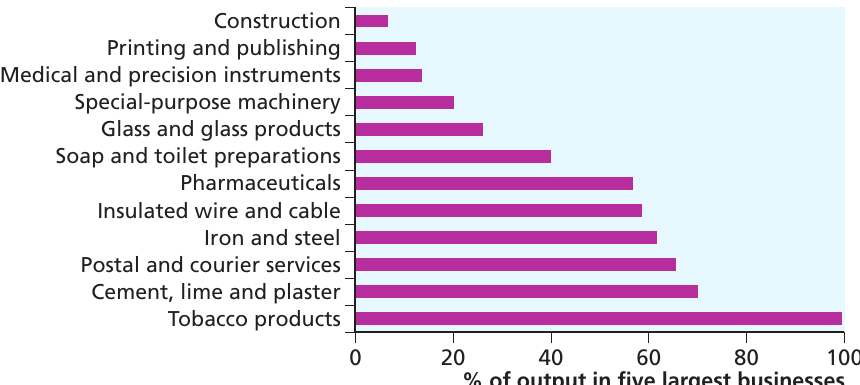
Real-world data shows that concentration varies significantly across UK industries. Industries like tobacco products show extremely high concentration (nearly 100%), whilst construction has very low concentration (around 5%). These differences partly reflect the extent of economies of scale in each sector and help explain the different levels of competition we observe.
The kinked demand curve model
One influential model of oligopoly behaviour was developed by economist Paul Sweezy in the 1930s USA. This model focuses on how firms perceive their demand curve, which is called the kinked demand curve model.
The central problem for any firm in an oligopoly is uncertainty. A firm cannot directly observe its demand curve because it depends on whether rival firms will follow if the firm changes its price. Therefore, the firm must form expectations about consumer reactions and competitor behaviour.
How the model works
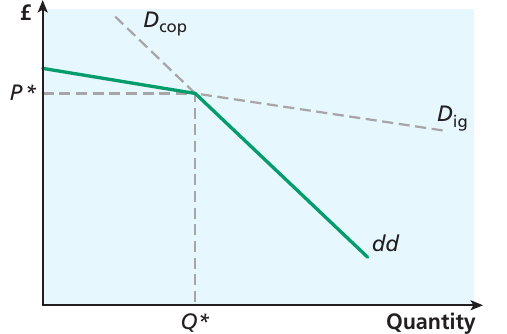
Suppose a firm is currently selling at price and quantity . Now consider what happens if the firm considers changing its price:
If the firm raises its price:
- Rival firms are unlikely to follow the price increase
- This is because a price rise doesn't threaten their market position
- The firm will lose many customers to competitors
- Therefore, demand is relatively elastic for price increases
- The relevant demand curve is (the flatter, more elastic curve)
If the firm cuts its price:
- Rival firms will likely match the price cut to protect their market share
- This is seen as a threatening move
- The firm gains relatively few new customers
- Therefore, demand is relatively inelastic for price decreases
- The relevant demand curve is (the steeper, less elastic curve)
Putting these together, the firm perceives a kinked demand curve (). The kink occurs at the current price .
Implications for price stability
This model has an important implication: price tends to remain stable in oligopoly markets. Here's why:
- If the firm increases price, it expects rivals won't react and will lose customers
- If the firm reduces price, it will face intense competition from rivals and won't gain many customers
- Therefore, the best strategy may be to do nothing and keep price unchanged
This helps explain why prices in oligopolistic markets often remain relatively stable even when costs change.
Important
Study tip: Remember that the kinked demand curve is just one attempt to model strategic behaviour. There are many other ways firms might interact, so this model has limitations. It works best for explaining price rigidity but doesn't explain how the initial price was determined.
Game theory
An alternative and more flexible approach to understanding oligopoly comes from game theory. This is a method of modelling strategic interactions between firms using mathematical frameworks.
Game theory has a long history, with roots in correspondence between mathematicians Pascal and Fermat in the 17th century. However, the key modern development came with the 1944 publication of Theory of Games and Economic Behaviour by John von Neumann and Oskar Morgenstern. Notable contributors include John Nash, Francis Edgeworth, and Augustin Cournot. John Nash, Russell Crowe, and Reinhard Selten shared the 1994 Nobel Prize for their work in this field.
Note
Game theory provides a more versatile framework than the kinked demand curve model because it can represent many different types of strategic situations that firms face, from pricing decisions to output choices and competitive responses.
The prisoners' dilemma
The most famous example in game theory is the prisoners' dilemma, introduced by Albert Tucker in a 1950 lecture. While simple, this example has proven remarkably useful for understanding strategic behaviour in economics.
Example
The Prisoners' Dilemma Scenario:
Two prisoners, Al Fresco and Des Jardins, are being questioned about a major crime. The police know at least one is guilty but lack sufficient evidence to convict both of the major offence. They have enough evidence for a minor offence conviction. The prisoners are held separately and cannot communicate.
The deal offered: Each prisoner can either confess or refuse to deal. The outcomes depend on what both prisoners choose:
| Des | ||
|---|---|---|
| Confess | Refuse | |
| Al - Confess | 10 years each | Al: 0 years, Des: 15 years |
| Al - Refuse | Al: 15 years, Des: 0 years | 5 years each |
Reading the payoff matrix:
- Al's choices are shown in the rows (Confess or Refuse)
- Des's choices are shown in the columns (Confess or Refuse)
- Each cell shows the outcomes (years in jail) for both prisoners
For example, if both confess, they each get 10 years. If both refuse to deal, they each get 5 years for the minor offence only. If one confesses and the other refuses, the one who confesses goes free whilst the other gets the maximum 15 years.
The dilemma
From Al's perspective, he doesn't know what Des will choose:
- If Des confesses: Al gets 10 years by confessing but 15 years by refusing → better to confess
- If Des refuses: Al gets 0 years by confessing but 5 years by refusing → better to confess
So whatever Des does, Al is better off confessing. This is called Al's dominant strategy - his best choice regardless of what the other player does.
The situation is symmetric for Des, so confessing is also his dominant strategy.
Important
The inevitable result is that both prisoners confess and each receives 10 years. Yet if they had both refused to deal, they would each have gotten only 5 years - a much better outcome for both! This paradox is at the heart of the prisoners' dilemma.
A refusal to deal might have led to 15 years in jail, making it too risky a strategy for either prisoner to adopt when they cannot communicate or trust each other.
Application to economics: the duopoly example
Now let's see how this applies to business strategy. Consider two firms, Diamond Tools and Better Spades, operating in a duopoly market (a market with only two firms). Each can choose to produce either 'high' or 'low' output.
Example
Duopoly Game: Output Decisions
The table below shows profits for each firm (in £millions):
| Better Spades | ||
|---|---|---|
| High | Low | |
| Diamond Tools - High | £1m each | Diamond Tools: £3m, Better Spades: £0 |
| Diamond Tools - Low | Diamond Tools: £0, Better Spades: £3m | £2m each |
Finding the Nash equilibrium:
Let's analyze Diamond Tools' best strategy:
- If Better Spades produces high output: Diamond Tools earns £1m with high and £0 with low → high is better
- If Better Spades produces low output: Diamond Tools earns £3m with high and £2m with low → high is better
Therefore, producing high output is Diamond Tools' dominant strategy.
By symmetry, Better Spades also has a dominant strategy to produce high output.
The result is that both firms produce high and each earns £1m profit. This is called a Nash equilibrium - a situation where each player's chosen strategy maximizes their payoff given what the other player has chosen. At this point, neither firm has an incentive to change behaviour.
Important
However, notice that if both firms had produced low output, they would each have earned £2m - double what they actually earn! The joint-profit-maximizing outcome is low-low, earning £4m total, but the Nash equilibrium is high-high, earning only £2m total.
This illustrates how competition between firms can lead to outcomes that are suboptimal from their collective perspective, even though each firm is acting rationally given their rival's behaviour.
Collusion: cartels and price leadership
Looking at the prisoners' dilemma games above reveals an important insight: the inability of firms to communicate with each other creates a serious obstacle to maximizing joint profits. If both firms could agree to produce 'low', they would maximize their combined earnings.
Cartels and overt collusion
If firms could form a cartel - an agreement between firms on price or output with the intention of maximizing joint profits - they could achieve better outcomes. However, cartels face a fundamental problem: each firm has a strong incentive to cheat.
Even after agreeing to the low-low strategy, each firm knows that if it breaks the agreement and produces high whilst the other firm sticks to low, it could earn £3m instead of £2m. This creates constant temptation to defect from the cartel agreement and try to steal additional market share.
Note
This is a common feature of cartels. Whilst collusion can bring high joint profits, there is always temptation for individual member firms to cheat and capture some additional benefit at the expense of other cartel members.
Legality of cartels
Important
Legal Warning: Cartels are illegal in most countries. In the UK, operating a cartel is prohibited under the Competition Act. The Competition and Markets Authority can fine firms up to 10% of their annual turnover for each year the cartel operated.
This means overt collusion - where firms openly work together to agree on prices or market shares - is rare. The most famous example involves not firms but nations: the Organization of the Petroleum Exporting Countries (OPEC), which has operated a cartel to control oil prices over many decades.
Conditions favouring collusion
Even though formal cartels are illegal, certain market conditions make some form of collusion more likely to emerge:
Number of firms: It helps if there are relatively few firms in the market. With many firms, monitoring everyone's behaviour becomes difficult, and coordinating any agreement becomes complex.
Product similarity: If firms produce similar goods, collusion is easier. When products differ significantly, one firm might try to steal advantage by varying product quality.
Market stability: When the economy is booming and demand is growing strongly, it may be harder to monitor market shares since all firms are expanding. This makes it easier for firms to cheat by expanding faster than agreed. Conversely, it also makes possible retaliation quicker when firms can easily observe market shares.
Excess capacity: If firms have spare production capacity, this increases the temptation to cheat by raising output and stealing market share.
Market transparency: The degree of secrecy about market shares and market conditions affects the feasibility of collusion.
Collusion in practice: strategic alliances
Although formal cartels are illegal, firms sometimes find ways to work together through strategic alliances. These are looser arrangements where firms collaborate on certain aspects of their business, perhaps undertaking joint research and development or technology sharing.
Example
Strategic Alliance Example - Tesco and Carrefour (2018):
Tesco formed a strategic alliance with French retailer Carrefour to buy products from over 19,000 stores. This was intended to strengthen their position relative to competitors like Amazon, Aldi and Lidh. The alliance aimed to increase sales of wine, Camembert and other French products in Tesco stores, whilst more British products would be sold in Carrefour's French supermarkets.
Example
Strategic Alliance Example - Airline Alliances:
The airline industry features important strategic alliances like Star Alliance, Oneworld and SkyTeam, which have effectively carved up long-haul routes between them. These alliances offer benefits to passengers (access to wider destinations and business lounges) and to airlines (which can economize on airport facilities by pooling resources). However, the net effect reduces competition, so regulators monitor these arrangements closely.
In 2018, the CMA launched an investigation into the Atlantic Joint Business Agreement, under which several airlines were allegedly influencing the availability of landing and take-off slots at Heathrow and Gatwick airports. The COVID-19 pandemic disrupted air travel, making it difficult for the CMA to proceed, but the investigation remained open with longer-term remedies planned by March 2024.
Tacit collusion and price leadership
Even without formal agreements, firms may engage in tacit collusion - refraining from competing on price without actually communicating or forming a formal agreement. Such collusion may emerge gradually as firms become accustomed to market conditions and to each other's behaviour patterns.
Price leadership
One way tacit collusion develops is through price leadership. If one firm is a dominant producer in a market, it may take the lead in setting price, with other firms following its example. It has been suggested that the OPEC cartel sometimes operated this way, with Saudi Arabia acting as the dominant firm and other members following its pricing decisions.
Barometric price leadership
An alternative form is barometric price leadership, where one firm tests out a price increase and waits to see if other firms follow. If they do, a new higher price has been established without any need for discussions between firms. If other firms don't follow and keep their prices steady, the initiating firm will quickly drop its price back to previous levels or risk losing market share.
Note
The initiating firm doesn't need to be the same one every time. The practice is made easier by computerized ticketing systems that allow firms to quickly check what prices their rivals are charging.
The frequency of anti-cartel cases brought by regulators in recent years suggests that firms continue to be tempted by the potential gains from collusion, despite it now being a criminal act in countries like the UK and USA.
Non-price competition
Firms in a cartel might agree not to compete on price, but there are other ways firms can compete beyond simply adjusting prices. This is called non-price competition - steps firms can take to compete with rivals other than changing price, such as through advertising or product differentiation.
Strategies for non-price competition
Firms may compete by seeking to develop brand loyalty among customers. This can be achieved through several methods:
Advertising: Creating advertising campaigns that distinguish a firm's product from competitors' products helps build brand recognition and customer loyalty.
Loyalty programmes: Launching loyalty card systems encourages customers to stick with a particular brand. For example, offering discounts to customers who return regularly can be very effective.
Clever packaging and marketing: The use of distinctive packaging, clever slogans or targeted marketing campaigns can all attract and retain customers.
Product differentiation: Products may be differentiated through product development, adding new features or improving existing ones. This makes the product seem like a less close substitute to competitors' offerings.
Note
All these strategies aim to make a firm's product appear less like a perfect substitute for rivals' goods, potentially allowing the firm to charge slightly higher prices without losing all its customers to competitors.
Monopsony
So far, our discussion of market structure has focused on the number of sellers in a market and their relationships. However, it's equally important to consider the number of buyers in a market. An extreme situation exists where there is a single buyer of a good or service - this is known as a monopsony.
Examples of monopsony
A single buyer may be able to exert substantial influence over suppliers when negotiating contracts on price and quality of goods.
Computer chips manufacturer: Suppose a firm produces computer chips in competition with similar firms but enters a contract to sell all its output to a particular computer manufacturer. This arrangement gives the firm an assured market, but it may have to agree to competitive pricing and production schedules with the buyer, who effectively acts as a monopsonist. The monopsonist benefits from keeping costs down and securing a regular supply of components. Consumers may gain indirectly from the monopsonist's lower cost base.
Local labour markets: Another example might occur in some towns where there is a single large employer employing a significant proportion of the local workforce. This employer might have market power within that local labour market.
Supermarket buying power: Consider the UK supermarket sector. The substantial buying power of large supermarket chains puts relatively fragmented suppliers in a weak bargaining position. Supermarkets can keep costs down by using their bargaining strength. This has raised concerns among competition authorities. However, in reality there isn't a single buyer - the market is dominated by a few large supermarkets. This might be considered an oligopsony rather than a pure monopsony, as there are a few buyers in the market. Nevertheless, once a supplier enters an exclusive contract to supply a particular supermarket, the relationship becomes more like monopsony.
Evaluation of monopsony
Effects on firms
The monopsonist gains by facing lower costs, which should increase profitability. However, suppliers may be disadvantaged by receiving lower prices for their output. In extreme cases, they might face the possibility of being forced out of business if prices are pushed too low. On the other hand, suppliers benefit from knowing they have an assured regular buyer for their output.
Note
In the mid-2010s there was a high-profile campaign by dairy farmers who argued that supermarkets were forcing them to supply milk at unsustainably low prices. Eventually, the supermarkets agreed to set a minimum price for milk supplies.
Effects on consumers
From consumers' perspective, they may gain from seeing lower prices if the monopsonist minimizes its costs. However, this depends on whether the monopsonist passes lower prices on to consumers or simply keeps them to increase profits. There's also the question of whether the monopsonists' suppliers might economise on quality to meet the demands of the monopsonist, which would mean consumers suffer.
Effects on employees
Workers employed by the monopsonist may or may not be better off. With lower raw material costs, the monopsonist might be able to offer greater job security or even higher wages. However, whether it would choose to do this rather than taking higher profit margins isn't clear. When monopsony exists in the labour market itself, monopsony employers can use their market power to pay lower wages than workers would receive in a competitive market.
Monopsony and efficiency
Important
A monopsony firm pays lower prices and buys less output than would occur under perfect competition. Therefore, allocative efficiency cannot be achieved. The market power of the monopsonist influences production and pricing decisions of its suppliers, so overall productive efficiency will not be reached either.
Remember!
Summary
Key Points to Remember:
-
Oligopoly is characterized by a few dominant firms who must make strategic decisions considering how rivals will react. Market concentration varies significantly across industries.
-
The kinked demand curve model suggests that firms perceive elastic demand for price increases (rivals won't follow) but inelastic demand for price cuts (rivals will match), leading to price stability in oligopoly markets.
-
Game theory provides a flexible framework for modeling strategic interactions. The prisoners' dilemma demonstrates how rational individual decisions can lead to collectively suboptimal outcomes, with the Nash equilibrium often differing from the joint profit-maximizing position.
-
Cartels are agreements between firms to coordinate pricing or output to maximize joint profits, but they face incentives to cheat and are illegal in most countries. Tacit collusion and price leadership offer alternative ways firms might coordinate without formal agreements.
-
Monopsony occurs when there is a single buyer in a market, giving that buyer substantial power over suppliers. This can lead to lower costs but may harm suppliers and reduce both allocative and productive efficiency. Oligopsony describes markets with a few large buyers.