Pricing Strategies (Edexcel A-Level Economics A): Revision Notes
📚Revision Notes
Pricing Strategies
Introduction
Firms operating in markets with imperfect competition face an important strategic decision about how to price their products. Unlike firms in perfectly competitive markets, which must accept the market price, firms with some market power can influence the price they charge. The pricing strategy a firm chooses depends on the objectives it wants to achieve. This might be maximising profits, but firms may also pursue other goals such as maximising revenue, increasing market share, or demonstrating corporate social responsibility.

Note
Key Insight
Understanding pricing strategies is crucial because the price a firm sets affects not only its own profitability but also the competitive dynamics of the market. Pricing decisions are particularly important when considering how existing firms can prevent new competitors from entering their market.
Pricing rules
Firms with market power face a downward-sloping demand curve for their products. This means they are not price-takers like firms in perfect competition. Instead, they can choose different combinations of price and output depending on their objectives. There are several possible pricing rules that firms might follow.
Profit maximisation
When a firm aims to maximise profits, it follows the standard profit-maximising rule. This means the firm produces output where marginal revenue equals marginal cost (). At this output level, the firm is adding as much to revenue as it is to costs with each additional unit, so profit is at its maximum.
In practice, the firm will identify the output level where , then charge the price that consumers are willing to pay for that quantity (found on the demand curve). This pricing rule is the one typically assumed in economic analysis of firm behaviour.
Revenue maximisation
The economist William Baumol suggested that in some situations, managers might pursue revenue maximisation rather than profit maximisation. This can happen when there is a separation between ownership and control in a firm. Shareholders own the company, but professional managers make day-to-day decisions. These managers may have some freedom to pursue objectives other than pure profit maximisation.
A revenue maximiser will produce where total revenue is at its highest point. This occurs when marginal revenue equals zero (). Beyond this output level, selling additional units would actually reduce total revenue. This strategy results in higher output and lower prices compared to profit maximisation.
Sales maximisation
Some firms may aim to maximise their volume of sales whilst still covering their costs. This strategy involves producing at the output level where price equals average cost (). At this point, the firm clears the market and covers all its costs, including opportunity costs, but makes no supernormal profit.
This strategy results in even higher output and lower prices than revenue maximisation. However, producing beyond this point would result in losses because the price would fall below average cost.
Allocative efficiency
From society's perspective, allocative efficiency occurs when price equals marginal cost (). At this point, resources are allocated in the most efficient way possible, with the value consumers place on the product matching the cost of producing it.
However, there is no obvious reason why a firm would voluntarily choose this pricing rule, as it provides no particular advantage to the firm itself. In fact, it would likely result in lower profits than the alternatives.
Important
Understanding the Diagram
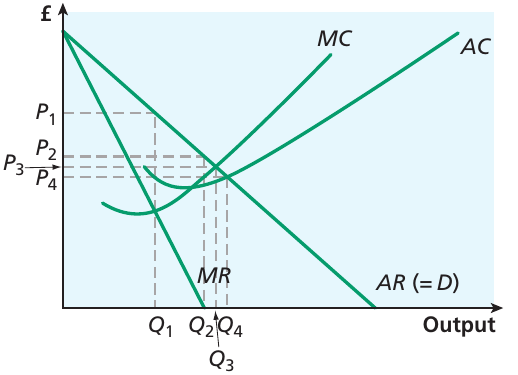
Figure 21.1 is useful for showing how firms with different objectives choose different price-output combinations. Make sure you can draw this diagram correctly and label all curves and axes properly. Remember which pricing rule corresponds to which price and quantity combination:
- Profit maximisation: (lowest output, highest price)
- Revenue maximisation: (medium output and price)
- Sales maximisation: (higher output, lower price)
- Allocative efficiency: (highest output, lowest price)
Corporate social responsibility
Firms may also consider corporate social responsibility when setting prices. This means they might deliberately refrain from charging the highest price the market could bear. One way of demonstrating commitment to social responsibility is to set a 'fair' price for products.
However, this raises questions about what is genuinely the best approach. A firm might gain more positive publicity by maintaining its prices at normal levels and then using some of the profits to benefit the community in other ways.
Note
The concept of fair pricing connects to fair trade schemes. In these arrangements, firms ensure they pay fair prices to suppliers in developing countries. Interestingly, this sometimes means setting higher prices for consumers, who contribute to supporting primary producers through their purchases.
Pricing in practice
In reality, most firms do not have precise knowledge of their revenue and cost curves. This makes it difficult for them to adopt the theoretical pricing rules described above. Instead, firms need practical methods for setting prices.
Cost-plus pricing
A common approach used by many firms is cost-plus pricing (sometimes called mark-up pricing). With this strategy, firms calculate their average cost at their chosen output level, then add a mark-up to generate some profit per unit.
Example
Real-World Evidence: Bank of England Survey
When the Bank of England surveyed British companies about their pricing methods, 37% said they set prices using a mark-up pricing rule. This finding highlights how widespread this practical approach is in real business situations.
The survey revealed important patterns:
- Firms in markets with few competitors set higher mark-ups than those facing many rivals
- Mark-ups were higher in markets producing differentiated products compared to homogeneous ones
- This behaviour is entirely consistent with profit maximisation principles
Does cost-plus pricing contradict the profit-maximising hypothesis? Not necessarily. Whilst it appears different from the theoretical rule, the key question is: what determines the size of the mark-up that firms add to average cost?
In other words, firms may use cost-plus pricing as a practical strategy to move towards the profit-maximising level. They experiment with different prices and observe the effects, gradually iterating towards the optimal price-output combination through trial and error.
Note
Key Points About Cost-Plus Pricing
- Many firms use this approach in practice due to incomplete information about demand
- The strategy is not inconsistent with profit maximisation
- Mark-ups depend on the degree of competition and product differentiation
- Firms may adjust their mark-ups through experimentation to find the optimal level
Price wars
Another finding from the Bank of England survey was that firms strongly wished to avoid price wars. In oligopoly markets with a kinked demand curve, firms recognise that price reductions are likely to be matched by rivals. This leaves all firms with lower profits but has relatively little effect on market shares.
Price wars: an example
Despite firms' general desire to avoid them, price wars do occasionally break out. In the early 2020s, UK supermarkets engaged in price-cutting behaviour on selected popular products to attract customers from their rivals. The aim was to consolidate or increase market shares.
When rival supermarkets began to match these price reductions or introduce their own cuts, profits started to erode. This occurred during a period when online shopping was rising, making it a less profitable time for traditional supermarkets. The experience suggests that the benefits from price-cutting behaviour may not help the firms involved in the long run.
Why initiate a price war?
In some cases, a price war is initiated as a strategic move to drive weaker competitors out of the market altogether. The motivation becomes clear if the initiator ends up with a monopoly or near-monopoly position. This could be argued to represent an attempt to maximise profits in the long run by establishing a dominant market position.
Predatory pricing
Perhaps the most common context where price wars emerge is when existing firms react to defend their market against the entry of new competitors. This can involve predatory pricing – an anti-competitive strategy where a firm sets its price below average variable cost to force rivals out of the market and achieve market dominance.
Example
Airline Industry Cases
When low-cost airlines such as easyJet first entered the market, some established airlines attempted to counter their entry through predatory pricing. They drove prices down to low levels by cross-subsidising from other routes. This strategy was countered by legal action. For example, easyJet took action against KLM in 1996.
Since then, airlines have been accused of predatory pricing on several occasions:
- British Airways in 2007
- Flybe in 2010
Both were investigated by competition authorities. However, proven cases have been rare in recent years, perhaps because firms realise they are unlikely to escape prosecution. More recently, accusations have been made against Amazon for building market share by selling items such as books below cost.
Important
Legal Status
Predatory pricing is illegal under competition law, but proving it has occurred requires careful economic analysis of a firm's costs and pricing behaviour. The challenge lies in distinguishing between aggressive but legitimate competition and anti-competitive predatory behaviour.
Areeda-Turner principle
The courts have supported economic theory regarding predatory pricing. They argue that a pricing strategy should be interpreted as being predatory if the price is set below average variable costs. The only motive for remaining in business whilst making such losses would be to drive competitors out and achieve market dominance. This is known as the Areeda-Turner principle (after the US case where it was first established).
At first glance, consumers might appear to benefit from the resulting lower prices. However, a predator that successfully drives out the competition is likely to recoup its losses by raising prices back to profit-maximising levels afterwards. Therefore, any consumer benefit is short-lived.
Threat of predatory pricing to deter entry
Sometimes the mere threat of predatory pricing may be sufficient to deter entry by new firms, provided the threat is credible. Existing firms need to convince potential entrants that they will fight a price war if entry occurs. Otherwise, potential entrants will not believe the threat.
Note
Making Threats Credible
Existing firms can make their threat credible by publicising that they have surplus capacity. This demonstrates they could quickly increase output to drive down prices if needed. Whether entry will actually be deterred depends partly on the characteristics of the potential entrant.
A new firm may calculate that if the existing firm sacrifices profits in the short run, the rewards from dominating the market must be worth fighting for. It may therefore decide to sacrifice short-term profit to enter the market, especially if it is diversifying from other markets and has resources at its disposal. The winner will be the firm that can last the longest, but clearly this is potentially very damaging for all concerned.
Important
The Role of Perceptions in Oligopoly
Notice the importance of firms' perceptions in this analysis. Firms make decisions based on their perceptions of their own position in the market and their expectations of how rival firms will react. This is a key feature of oligopoly markets and the economic models that attempt to explain firms' behaviour.
Limit pricing
A less extreme strategy than predatory pricing is limit pricing. This assumes that the incumbent firm has some form of cost advantage over potential entrants, perhaps due to economies of scale.
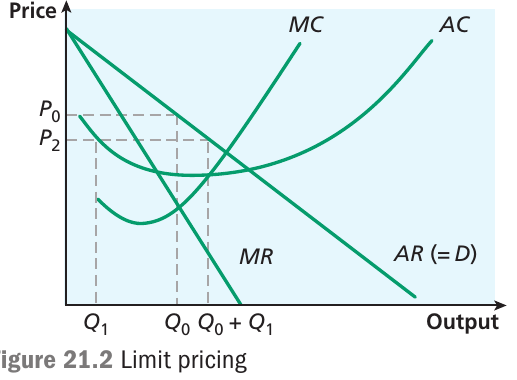
Consider a firm facing a downward-sloping demand curve that is maximising profits. If the firm sets output at the profit-maximising level and charges the corresponding price, it will earn healthy supernormal profits. Suppose the natural barriers to entry in this industry are weak. These supernormal profits will attract potential entrants.
Given the cost conditions, the incumbent firm is enjoying the benefit of economies of scale. If a new firm enters the market on a relatively small scale, the immediate effect on price can be analysed. When the new firm's output is added to the incumbent's output, total market supply increases, pushing the price down.
The new firm, producing on a relatively small scale, is just covering average cost and making normal profits. It feels justified in having joined the market. The original firm is still making supernormal profits, but at a lower level than before. The entry of the new firm has competed away part of the original firm's supernormal profits.
Setting a lower price
One way the incumbent firm could have guarded against entry is by setting a lower price to begin with. For example, if it had set output at a higher level and charged a correspondingly lower price, a new entrant joining the market would push the price down to a level below their average cost. Without the benefit of economies of scale, the new entrant would make losses and exit the market.
Note
If the existing firm has been in the market for some time, it will have gone through a process of learning by doing. Therefore, it will have a lower average cost curve than potential entrants. This makes it more likely that limit pricing can be used.
By setting a price below the profit-maximising level, the original firm is able to maintain its market position in the longer run. This could be a rational strategy, avoiding making excessively high supernormal profits in the short run in order to make sustainable profits in the longer term.
Notice that such a strategy need not be carried out by a monopolist alone. It could also occur in an oligopoly, where existing firms jointly seek to protect their market against potential entry.
Important
Strategic Thinking
Being able to explain why setting a price equal to average cost could be a rational strategy demonstrates good understanding of strategic firm behaviour and long-run profit considerations. This shows how firms may sacrifice short-run profits to protect their market position and ensure long-run profitability.
Barriers to entry and exit
The existence of barriers to entry into a market is especially important in monopoly markets. These barriers enable firms to maintain their market position. Without barriers to entry, the market could become contestable, meaning it would be vulnerable to competition from new entrants.
Some key factors that create barriers to entry include:
- Economies of scale
- High fixed costs
- Cost advantages
- Government regulation
- Switching costs
- Network effects
Some of these barriers arise from government regulation (creating 'legal barriers'). Others emerge from the set-up costs of the market or from cost considerations. There may also be physical barriers. Importantly, some of these barriers are natural, reflecting the nature of the product or market conditions. However, there may be situations where existing firms take strategic action to maintain their position by limiting the extent to which the market is contestable.
Economies of scale
Economies of scale can act as a significant barrier to entry for new firms. If a monopoly firm faces substantial economies of scale, and the minimum efficient scale is close to the extent of market demand, then the firm will always be able to produce at lower cost than any potential entrant. This makes it difficult for new firms to join the market profitably.
In this case, the market is likely to be a natural monopoly, so it would not be contestable. The existing firm's cost advantage, arising from producing at large scale, protects it from competition.
High fixed costs
Situations where firms face substantial economies of scale often involve high fixed costs relative to marginal costs. If a potential entrant knows it needs to invest heavily in set-up costs before being able to produce, this may deter entry.
Existing monopoly firms may be able to consolidate their position by taking strategic action to affect their fixed costs and deter entry. Heavy investment in research and development can make it difficult for potential entrants to become established in a market. They would need to undertake high expenditures before being able to compete with the existing firm. Such strategic action is an attempt to prevent contestability.
Note
Advertising and Brand Loyalty
Advertising can be regarded as a component of fixed costs because expenditure on it does not vary directly with output volume. If firms in an industry typically spend heavily on advertising, it will be more difficult for new firms to become established. They will need to advertise widely to attract customers.
Example
Technology Sector Brand Building
When Apple launches a new iPhone, or Samsung releases a new version of its Galaxy phone, this is always accompanied by high-profile television campaigns designed to reinforce brand loyalty and attract new customers. When existing firms in a market have strong brand image and strong customer loyalty, new firms trying to break into the market face an enormous challenge to gain credibility.
Notice that such advertising costs are sunk costs. They cannot be recovered if the new firm fails to gain a foothold in the market. It has sometimes been suggested that the cost of excessive advertising should be included in calculations of the social cost of monopoly.
Note
Research and Development
A characteristic of some industries is the heavy expenditure undertaken on research and development (R&D). A prominent example is the pharmaceutical industry, which spends large amounts on researching new drugs and developing new cosmetics. This is another component of fixed costs, as it does not vary with the volume of production.
New firms wanting to break into such markets know they will need to invest heavily in R&D if they want to keep up with new and improved products constantly coming onto the market. This creates another barrier to entry.
Cost advantages
A monopoly firm may hold some absolute cost advantage over potential entrants. For example, the firm may have control over a key input needed for the production process. This could be control over a raw material or a supply chain. Alternatively, the firm might have a locational advantage, being situated close to suppliers of a key input or to the market for the good itself.
Such a market would only be contestable if new entrants could find a way of overcoming the cost advantage of the incumbent firm.
Government regulation
In some cases, a firm may have legal protection against competition. A common example is the patent system, whereby a firm may be protected from competition for a period following the introduction of a new innovative product.
The aim of such government action is to encourage research, development and innovation in product development. Such a market could become contestable when the patent expires, allowing other firms to produce similar products.
Switching costs
In some cases, the barrier to entry arises because a firm's customers face high costs in switching to a new substitute product. Such costs may occur because a consumer has signed a contract for a fixed term, or simply because of brand loyalty.
Example
Software Switching Costs
A person who is familiar with using Microsoft products may be reluctant to invest time in learning to use new systems and software from different providers. This customer loyalty makes it harder for competing firms to attract customers away from established brands.
Network effects
Some goods or services have significant network effects. This occurs where people use a product because they know many others also use it. For example, Adobe Acrobat's .pdf format is so widely used that it would be difficult for a new firm to introduce a different file format successfully.
A market where there are substantial network effects may not be readily contestable. The existing firm benefits from the widespread adoption of its product or standard, making it very difficult for new entrants to compete.
Summary
Key Points to Remember
-
Firms with market power can choose from different pricing strategies depending on their objectives: profit maximisation (), revenue maximisation (), sales maximisation (), or allocative efficiency ().
-
Cost-plus pricing is a practical approach widely used by firms in reality. Firms calculate average cost and add a mark-up, with the size of the mark-up depending on the degree of competition and product differentiation.
-
Predatory pricing involves setting prices below average variable cost to force rivals out of the market. It is illegal under competition law but difficult to prove. The Areeda-Turner principle states that pricing below average variable cost indicates predatory intent.
-
Limit pricing is a strategy where incumbent firms set prices below the profit-maximising level to deter new entrants from joining the market. This can be rational for protecting long-run profits even though it sacrifices short-run supernormal profits.
-
Barriers to entry (such as economies of scale, high fixed costs, government regulation, switching costs, and network effects) prevent or deter new firms from entering markets. Some barriers are natural whilst others result from strategic actions by existing firms to prevent contestability.