Wages, Mobility, Intervention, and Other Issues (Edexcel A-Level Economics A): Revision Notes
📚Revision Notes
Wages, Mobility, Intervention, and Other Issues
Labour mobility
Labour markets operate more effectively when workers can move freely in response to changing economic conditions. However, in practice, workers often face significant barriers to movement. This lack of mobility can prevent labour markets from reaching efficient outcomes and contributes to persistent regional and occupational imbalances.
Mobility refers to the ease with which workers can change their employment circumstances. This operates along two key dimensions: geographic mobility (moving between regions) and occupational mobility (moving between different types of work).
Geographic mobility
Geographic mobility describes the ability and willingness of workers to relocate from one region to another in search of employment opportunities. When workers in one area cannot easily move to where jobs are available, labour markets become less responsive to changing patterns of demand.
Note
Geographic immobility is a major source of labour market inflexibility in the UK. Understanding the barriers to movement is essential for explaining why unemployment can persist in some regions even when jobs are available in others.
Several factors restrict geographic mobility in the UK labour market:
Housing costs and availability: Workers living in areas with low housing costs may be unable or unwilling to move to regions where jobs are plentiful but housing is expensive. For example, if employment opportunities exist in London but workers are located in Newcastle, the high cost of housing in London creates a significant barrier. Owner-occupiers need strong incentives to relocate because they must sell their property and purchase another, often at considerable expense. Council house tenants face even greater difficulties because they must reapply for social housing in the new area and typically join the bottom of lengthy waiting lists. Regional variations in house prices add further complications to matching workers with available positions.
Transport and relocation costs: Even when jobs exist in another region, the financial costs of moving can be prohibitive. Workers must consider not only housing expenses but also transport costs and the general expense of relocating household belongings.
Social and family ties: People are often reluctant to leave areas where they have established social networks, family connections, and community roots. Parents may resist disrupting their children's education. Individuals may be unwilling to move away from their favourite local amenities or sports teams. These non-financial considerations can be powerful deterrents to geographic mobility.
Information problems: Workers may not have adequate knowledge about job opportunities in other regions. While the internet has reduced search costs, it remains easier to find employment locally where workers have better knowledge of firms and their reputations. When both partners in a household work, finding suitable employment for both in a new location becomes more challenging. Research evidence suggests that women tend to be less geographically mobile than men.
Difficulty finding suitable employment: Even when workers are aware of opportunities elsewhere, they may struggle to find jobs matching their skills and experience in unfamiliar regions.
International labour mobility
The movement of workers between countries has increased significantly in recent decades, particularly following the expansion of the European Union in 2004 when ten new member states joined. The Single Market framework established in 1992 was designed to enable free movement of people, goods, services, and capital throughout the EU.
Not all existing EU members initially permitted unrestricted labour movement from new member countries, but the UK did allow this free movement. As a result, the UK experienced substantial migration from eastern Europe, especially from Poland. Workers moved in response to wage differentials between countries. Higher productivity levels in the UK compared to Poland and other new member states meant that UK wages were relatively high, creating an incentive for workers to relocate to Britain.

Important
Brexit has fundamentally altered labour mobility between the UK and EU. Movement of workers between Britain and the European Union is now restricted, creating significant challenges for sectors that previously relied on EU workers.
Even before the UK's formal departure, signs emerged in 2018 that the National Health Service faced recruitment difficulties. These challenges intensified during the COVID-19 pandemic when high demand for staff coincided with restrictions on international movement.
Occupational mobility
Occupational mobility refers to the ability of workers to move between different types of jobs and industries. This dimension of mobility is crucial for labour market flexibility, particularly during periods of structural economic change.
When consumer demand patterns shift, some economic sectors need to contract while others expand. For the economy to adjust smoothly, workers must be able to transition from declining sectors to growing ones. As the UK economy has shifted away from manufacturing toward service sector activities, occupational mobility has become increasingly important.
Several factors can impede occupational mobility:
Skills and training requirements: Different occupations require different skill sets. A displaced farm worker cannot immediately become a ballet dancer without extensive retraining. Firms may underprovide training due to the free-rider problem, where firms that invest in worker training risk losing those employees to competitors who have not borne training costs. This creates a potential role for government intervention to ensure adequate training provision.
Costs of retraining: Switching occupations often involves significant costs. Workers may need to undertake formal education or apprenticeships, during which their earning capacity is reduced.
Information barriers: Workers may lack sufficient information to evaluate the benefits of occupational mobility. They may not know their aptitude for different types of work or understand the extent to which a new occupation might provide job satisfaction. These information problems affect not only workers displaced by structural change but also those currently employed who might benefit from career changes.
Note
Structural unemployment arises when workers' skills don't match those required in available jobs. The difficulty people face when moving between occupations is an important source of labour market inflexibility and can result in this type of unemployment.
Over time, patterns of consumer demand naturally change, and economic activity must respond accordingly. If workers cannot easily transition to new sectors, unemployment persists even when jobs are available in expanding industries.
Effects of government intervention in the labour market
Governments intervene in labour markets through various policy instruments. These interventions aim to protect vulnerable workers, improve labour market flexibility, or correct market failures. Key forms of intervention include wage regulations (minimum and maximum wages), unemployment benefits, training programmes, and policies affecting trade union activity.
A minimum wage
The minimum wage establishes a legal floor below which employers cannot pay workers. In its 1997 election manifesto, the Labour Party committed to introducing a national minimum wage (NMW) for the UK. Although minimum wages had previously been set in specific industries, this represented the first time such a policy would apply across the entire economy.
Note
Definition: A minimum wage is a government-set minimum wage rate below which firms are not allowed to pay.
Implementation began in April 1999 after the establishment of a Low Pay Commission to oversee the policy. The level of the NMW varies by age. Initially, the rate was set at £3.60 per hour for workers aged 22 and over, and £3 for those aged 18-21. These rates are revised annually.
The living wage
A more recent development has been the concept of the living wage. The UK Living Wage Campaign launched in 2001 as a community-led initiative and developed into a national movement. The campaign emerged because the NMW was perceived as providing insufficient income for workers to maintain an acceptable standard of living.
The living wage is calculated based on an estimate of the basic cost of living in the UK. It represents the income households need to afford an acceptable standard of living rather than merely survive.
From April 2016, the government introduced a mandatory national living wage (NLW) applying to workers aged 25 and above. The qualifying age was subsequently lowered to 23 and above from 2021. In the Autumn Statement of November 2022, Chancellor Jeremy Hunt announced that the NLW would increase by 9.7% to £10.42. Simultaneously, the NMW rates would be £10.18 for those aged 21-22, £7.49 for those aged 18-20, and £5.28 for under-18s and apprentices.
Note
The Living Wage Foundation continued to argue that the mandatory NLW remained insufficient to cover the true cost of achieving an adequate living standard. In September 2022, it recommended a UK living wage of £10.90, with £11.95 needed to cover higher living costs in London.
Objectives of a minimum wage policy
Minimum wage policy pursues three main objectives:
-
Protecting workers from exploitation: The policy aims to prevent the small minority of unscrupulous employers from exploiting their workforce by paying unreasonably low wages.
-
Improving work incentives: By ensuring that work pays adequately, the policy seeks to tackle voluntary unemployment. Workers may be more willing to accept employment if they know they will receive a reasonable wage rather than subsisting on very low pay.
-
Alleviating poverty: The policy intends to raise living standards for the poorest groups in society by increasing the income of low-paid workers.
Important
The policy has proven contentious, with critics arguing it fails to achieve these objectives effectively. Perhaps the most significant criticism is that rather than providing a supply-side solution to unemployment, a national minimum wage may actually increase unemployment by affecting labour demand.
Some argue that unscrupulous employers can still exploit workers through other means, such as paying on a piecework basis without guaranteeing any minimum hourly rate, or offering zero-hours contracts. Others contend the policy is too blunt an instrument to address poverty effectively, noting that many NMW recipients may not be in poor households (for example, part-time workers whose partners also work) while some poor households contain people not working at all.
A minimum wage in a perfectly competitive labour market
To understand the potential effects of minimum wage policy, we must analyse how it interacts with labour market equilibrium. Consider first the case of a perfectly competitive labour market.
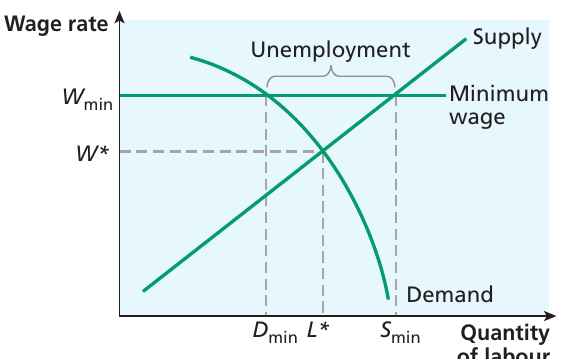
In a perfectly competitive labour market, firms cannot individually influence wage rates. The free-market equilibrium occurs where labour demand equals labour supply. This is shown at point in the diagram, with workers employed.
Example
Analysing Minimum Wage Effects in a Competitive Market
When government sets a minimum wage at (above the equilibrium wage ), firms respond by reducing their demand for labour. At the higher wage, firms wish to employ only workers, while labour supply increases to workers. The difference represents unemployment.
Two distinct effects operate simultaneously:
- Some workers who were previously employed lose their jobs because firms reduce employment from to
- The higher wage rate attracts additional workers into the labour market, so additional workers now seek employment at the going wage rate
These workers want jobs but cannot find them. Thus, unemployment increases for two reasons following the introduction of a minimum wage above market equilibrium.
However, it is not inevitable that minimum wage introduction causes increased unemployment. Consider the situation shown in the following diagram:
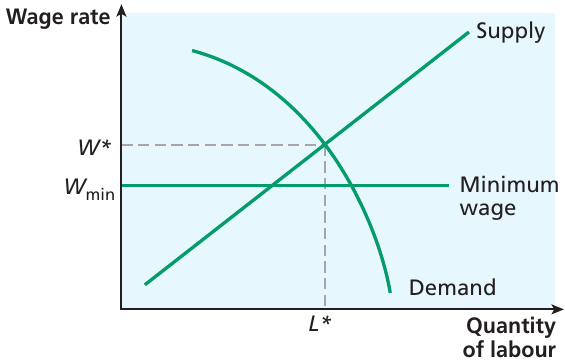
When the minimum wage has been set below the equilibrium level, the market will continue to operate at employing workers. The minimum wage has no effect because firms are already paying above this level.
At the time of the NMW's introduction, McDonald's argued it was already paying wages above the proposed minimum rate, suggesting the policy would not affect its operations.
Note
It is important to recognise that the UK does not have a single unified labour market. A national minimum wage set across the entire country may have different effects in different regional markets. Wage levels vary considerably across UK regions, raising questions about whether the same minimum wage can be equally effective in, for example, London compared to Northern Ireland or northern England.
Extension material: monopsony and the minimum wage
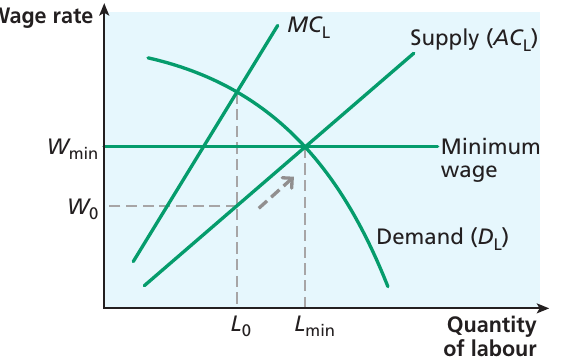
An alternative scenario exists where minimum wage introduction might not lead to unemployment. Consider a labour market with a monopsony buyer of labour (a single large employer dominating the local labour market).
Example
Minimum Wage in a Monopsony Market
In the absence of a minimum wage, the firm hires labour at wage . When a minimum wage is introduced at , the firm now hires more labour up to the point where demand equals supply. As shown in the diagram, this takes the market back toward the perfectly competitive outcome at .
Key insight: Any wage between and will encourage the firm to increase employment to some extent, thereby reducing its market power.
Important
The authorities would need very detailed knowledge to set the minimum wage at precisely the right level to produce this outcome. Setting the minimum wage above the competitive equilibrium level would still lead to unemployment. Therefore, it remains critical to set the wage at an appropriate level if the policy is to succeed in meeting its objectives.
A maximum wage?
Controversy over bonuses paid to bankers and other senior executives has led some commentators to recommend that authorities should set a maximum wage or wage ceiling. This would prohibit employers from paying wages above a specified level, with the aim of stemming excessive executive pay.
Note
Definition: A maximum wage is a policy under which employers face a wage ceiling, being prohibited from paying a wage above a set level.
Proponents of maximum wage policies argue that high salaries and bonuses are needed to provide incentives for effort, but that these incentive effects weaken at very high income levels. They suggest that diminishing marginal utility of income means additional income provides less extra utility as incomes rise. It is also probable that introducing such a measure would encounter significant practical and political difficulties. For example, how would the level of the maximum wage be determined? Political pressures against such a policy would likely be substantial.
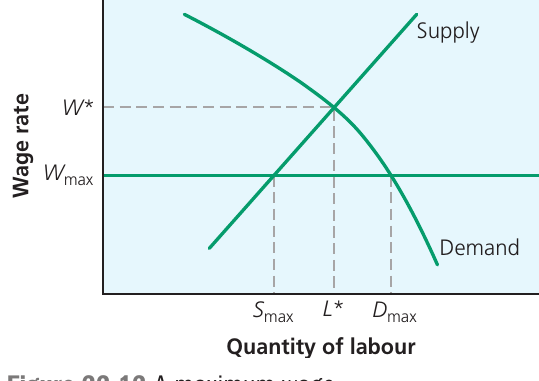
This diagram shows how a maximum wage might operate. Without the wage ceiling, equilibrium occurs where demand equals supply, with wage and employment . If employers cannot pay wages above , the supply of labour falls to . Employers would prefer to employ more workers at this wage (up to ) but cannot recruit as many as they would like.
Note
If employees at this income level are relatively insensitive to pay changes, the supply of labour would be relatively inelastic (less steep than shown in the diagram), and the fall in labour supply would be less pronounced. However, it is possible that in the longer term, highly-paid employees would become internationally mobile and depart for overseas positions where they could command higher salaries.
Extension material: other labour market interventions
Unemployment benefits
The level of unemployment benefit represents an important influence on labour supply, particularly for low-income workers. If unemployment benefit is provided at excessively high levels, it may discourage labour force participation. Some workers in this situation may choose to remain on unemployment benefit rather than accept low-skilled, low-paid employment. Such behaviour could induce an increase in labour supply.
Important
However, such policies must be balanced carefully against the need to provide adequate protection for those genuinely unable to find employment. It is crucial that unemployment benefit rates are not reduced so drastically that workers become unwilling to leave their current jobs to search for better opportunities, as this would inhibit labour market flexibility.
Incentive effects
Similar considerations apply to the taxation system. There are risks in making the income tax system excessively progressive. Most people accept that income tax should be progressive (meaning those on relatively high incomes pay a higher rate of tax than those on low incomes) as a method of redistributing income within society and preventing inequality from becoming extreme.
However, a point may be reached where marginal tax rates become so high that a large proportion of additional income is taxed away. This reduces incentives for individuals to supply additional effort or labour. It is important to balance these incentive effects against the distortion caused by excessive inequality in society.
Training, skills and information
Structural change in an economy may impede occupational mobility for workers seeking new employment, particularly if they have been released from declining sectors and lack the skills required for expanding sectors. The apprenticeship levy introduced in 2017 attempted to address this issue. This levy is a form of tax paid by employers and used to fund apprenticeship training. It is also important for unemployed workers to have access to good information about available jobs.
Trade union reform
The extent to which trade unions affect labour market operations represents another important question. By negotiating wages above equilibrium levels, trade unions may secure higher pay for lower levels of employment. This potential disruption caused by strike action can impede labour market functioning. Over time, the power of trade unions to disrupt labour markets has diminished considerably.
Note
It is important to note that strikes do not occur solely in response to wage claims, but also in relation to working conditions or job security concerns. For example, strikes called by the National Union of Rail, Maritime and Transport Workers (RMT) in mid-2022 focused on wages but also on changes to working practices and redundancies, which were perceived as jeopardising health and safety.
A succession of high-profile strikes in late 2022 took place mainly in response to the cost of living crisis. At this time, the government proposed measures to ensure that industrial action would not endanger the provision of essential services.
Technology and unemployment
Important
One of the greatest misconceptions perpetuated by non-economists is that technology destroys jobs. In fact, new technology and expansion in the capital stock should have beneficial effects, provided labour markets are sufficiently flexible.
Workers released from declining sectors need to possess (or be able to obtain) the skills required for absorption into expanding sectors.
The significance of wage elasticity of demand and supply
Understanding how labour markets respond to shifts in demand or supply requires consideration of the wage elasticity of demand and supply. Whether the main effect is seen in the wage rate or in the quantity of labour employed depends on these elasticities.
Impact of an increase in labour supply
First, consider what happens when labour supply increases, as shown in the following analysis.
The market initially operates with labour supply and equilibrium wage . If the market experiences an increase in labour supply, shifting the supply curve to , the new equilibrium depends on the wage elasticity of labour demand.
Example
Understanding Elasticity Effects When Supply Increases
When labour demand is relatively wage inelastic (shown by demand curve ), there is a larger increase in the quantity of labour (to ) but a smaller fall in the wage (from to ).
In contrast, wage elastic demand (shown by demand curve ) results in a larger fall in equilibrium wage (from to ) but a relatively small increase in the quantity of labour (from to ).
Key insight: When supply shifts, the elasticity of demand determines whether the effect is primarily on wages or employment.
Impact of a decrease in labour demand
When labour demand changes, the wage elasticity of supply becomes the crucial influence on market outcomes. Consider a fall in labour demand from to . The initial equilibrium occurs with wage and quantity of labour .
Example
Understanding Elasticity Effects When Demand Decreases
When labour supply is relatively wage inelastic (shown by supply curve ), the decrease in labour demand leads to a large fall in equilibrium wage (from to ) but a relatively small fall in the quantity of labour (from to ). In other words, labour supply is relatively insensitive to wage changes.
However, when supply is relatively elastic (shown by supply curve ), the quantity of labour adjusts more substantially (falling to ) with a relatively smaller change in the wage rate (to ).
Key insight: When demand shifts, the elasticity of supply determines whether the effect is primarily on wages or employment.
Summary
Key Points About Wage Elasticity:
- When labour supply shifts, the wage elasticity of demand determines the relative size of wage versus quantity effects
- When labour demand shifts, the wage elasticity of supply determines the relative size of wage versus quantity effects
- Inelastic demand/supply means quantity effects are larger relative to price effects
- Elastic demand/supply means price effects are larger relative to quantity effects
- Understanding these elasticity relationships is essential for predicting how labour markets will respond to various economic shocks and policy interventions
Labour market issues
Economic issues affecting labour markets regularly attract media attention. Several important contemporary issues merit examination from an economist's perspective.
Levelling up
Substantial differences in average incomes and unemployment rates persist between various UK regions. Broadly speaking, two possible responses exist: either persuade workers to relocate to regions where more jobs are available, or encourage firms to move to areas where labour is plentiful.
Geographic immobility of workers has already been discussed. But what about persuading firms to relocate to regions where labour is available?
Various measures have been implemented to encourage firms to consider relocating to regions with available labour. These have included leading by example, with some civil service functions moved out of London.
Note
EU funding assisted in this regard, with Scotland, Wales and Northern Ireland all qualifying for grants. Between 1999 and 2012, Regional Development Agencies (RDAs) established by the Labour government held responsibility for promoting economic development in their regions. The RDAs were abolished as part of government efforts to reduce the budget deficit, ceasing operations in March 2012.
During the 2010 Coalition government, George Osborne (then Chancellor of the Exchequer) launched the concept of the Northern Powerhouse. This strategy aimed to provide funding to revitalise cities in northern England, devolving powers from Westminster to local authorities and providing funds for locally-determined projects, including £13 billion for improving transport infrastructure.
This concept became embedded in the 'levelling-up' agenda of the Johnson government, with details outlined in a 2022 White Paper. At the heart of this initiative were 'six capitals':
- Physical capital: infrastructure, machines and housing
- Human capital: the skills, health and experience of the workforce
- Intangible capital: innovation, ideas and patents
- Financial capital: resources supporting company financing
- Social capital: the strength of communities, relationships and trust
- Institutional capital: local leadership, capacity and capability
Improving labour markets is central to this approach.
Brexit
The UK departed from the European Union on 30 January 2020, a process known as 'Brexit'. This had major impacts on the British economy, particularly affecting labour markets and increasing bureaucracy. The demand for labour was notably affected in the public sector, where preparations for Brexit required substantial administrative changes. From 2016, the civil service expanded rapidly. This trend was reinforced by demands of the COVID-19 pandemic, and by 2022 the civil service had grown by almost 100,000 compared to its 2016 level.
Important
During the transition period, the private sector experienced worker shortages in some occupations, notably in transport, where shortages of HGV drivers combined with COVID-19 restrictions created supply-chain problems.
By 2022, the situation facing government had become serious given severe economic problems requiring attention. Boris Johnson announced substantial reductions in civil service staffing, with aims to return to 2016 levels. Later in the year, incoming Prime Minister Rishi Sunak withdrew this specific target.
The COVID-19 pandemic
The pandemic caused widespread disruption to labour markets when lockdowns prevented many people from working. The impact on unemployment was cushioned by the furlough scheme, through which employers could receive support to pay wages of workers unable to work due to the pandemic.
The pandemic produced more lasting impacts on labour markets, reinforced by changes in shopping behaviour. Various effects emerged in the employment patterns of different groups:
- Some economically inactive workers took earlier retirement than they would otherwise have done
- Others withdrew from the workforce due to fear of illness
- Some young people remained in education longer than they might have done
- All these factors affected labour supply in the short run, but could also have long-term effects
Note
Comparing the numbers of people registered as economically inactive between mid-2019 (before the pandemic) and mid-2022, the total had fallen by approximately 2.5%. However, the number designated as 'long-term sick' had increased by 22.5%.
The introduction of home working represented a major change in work practices with potential long-term implications. This also produced side-effects on the hospitality sector, with reduced demand for café and restaurant services. The transport sector was also affected.
Furthermore, some workers displaced from their jobs during the pandemic found employment elsewhere or started their own businesses. Some then chose not to return to their previous occupations when pandemic restrictions were lifted.
Important
These trends were accentuated by the rise of online shopping, which threatened major changes for high-street shops and other businesses. These developments could have long-lasting effects for the retail sector if habits enforced by lockdowns become ingrained in household behaviour over the long run.
Remember!
Summary
Key Points to Remember:
-
Labour mobility operates along two dimensions: geographic (between regions) and occupational (between different types of work). Barriers to mobility include housing costs, social ties, information problems, and skills mismatches.
-
Government interventions in labour markets include minimum wages, living wages, maximum wages, unemployment benefits, and training programmes. These aim to protect workers, improve incentives, and correct market failures.
-
In perfectly competitive labour markets, minimum wages set above equilibrium create unemployment. However, in monopsony markets, appropriately-set minimum wages can actually increase employment.
-
The wage elasticity of demand and supply determines whether labour market shocks primarily affect wages or employment quantities. When demand is inelastic, quantity effects dominate; when demand is elastic, wage effects dominate.
-
Contemporary labour market issues include levelling up (reducing regional inequality), Brexit impacts on labour supply and demand, and COVID-19 pandemic effects including lasting changes to work patterns and the rise of home working.