Public Goods and Information Gaps (Edexcel A-Level Economics A): Revision Notes
📚Revision Notes
Public Goods and Information Gaps
Introduction
Market failure doesn't only occur because of externalities. Sometimes the characteristics of a good or service itself can cause markets to fail, preventing the free market from reaching the socially optimal position. This note explores two important sources of market failure: public goods (which have unusual economic characteristics) and information gaps (where market participants lack equal access to information).
Private and public goods
Understanding private goods
Most goods you consume daily are private goods. When you purchase a can of drink, you consume it, and once it's gone, nobody else can drink it. You could share it with a friend, but drinking it prevents anyone else from doing so. Once consumed, it's gone permanently – nobody else can subsequently consume that drink.
Private goods have two key characteristics:
- Excludability: Other people can be excluded from consuming the good
- Rivalry: Once consumed by one person, it cannot be consumed by another
Note
A private good is a good that, once consumed by one person, cannot be consumed by somebody else. Such goods possess both excludability and rivalry.
Understanding public goods
Not all goods and services share these two characteristics. Some goods, once provided, are available to everyone. People cannot be excluded from consuming them, and they are non-rivalrous in consumption. This means that from the supplier's perspective, additional consumers can be accommodated at zero marginal cost.
Goods that possess the characteristics of non-excludability and non-rivalry are known as public goods. These are goods that consumers cannot be excluded from consuming, and consumption by one person does not affect the amount available for others to consume.
Key definitions:
- Non-excludability: A situation where it is not possible to provide a product to one person without allowing others to consume it as well
- Non-rivalry: A situation where one person's consumption of a good does not prevent others from consuming it as well
- Public good: A good that is non-excludable and non-rivalrous in consumption
Examples of public goods
Common examples of public goods illustrate how these characteristics work in practice:
Example
Example: Street Lighting
Once street lighting is provided in a particular street, anyone walking along that street at night benefits from the lighting. No one can be excluded from consuming it (non-excludable). Additionally, the fact that one person has walked along the street doesn't mean there is less street lighting for later walkers (non-rivalrous).
Example
Example: Lighthouse
Once a lighthouse is constructed and sending out its signal, all boats and ships passing within range can benefit from the service. Furthermore, one ship using the lighthouse doesn't reduce the amount of light available to the next ship.
Example
Example: Nuclear Deterrent
Provides protection to all citizens and cannot be provided to some whilst excluding others. Similarly, it is non-rivalrous as one person's protection doesn't diminish another's.
The free-rider problem
The crucial feature of a market for public goods is that, once the good has been provided, there is no incentive for anyone to pay for it. The market will therefore fail, as no firm will have an incentive to supply the good in the first place.
Important
This is referred to as the free-rider problem: individual consumers can free-ride and avoid paying for the good if it is provided.
A free-rider problem occurs when an individual cannot be excluded from consuming a good, and thus has no incentive to pay for its provision.
The free-rider problem makes it difficult to charge for a public good, so the private sector will be reluctant to supply such goods. In fact, pure public goods are relatively rare, but there are many goods that have some but not all of the required characteristics.
Goods with some public good characteristics
Many goods are either non-rivalrous or non-excludable, but not both:
Note
Football match: If you attend a Premier League football match, your consumption of the match doesn't prevent the person sitting next to you from also consuming it (non-rivalrous, at least for those attending). However, if you don't have a season ticket or haven't purchased a ticket, you can clearly be excluded from consuming the match (excludable, therefore not fully a public good).
Note
Stretch of road: Road users are free to drive along it (non-excludable). However, it is not non-rivalrous, as congestion builds up and affects consumption. This example is also imperfect as a public good because users can be excluded by installing toll barriers.
Where goods have some features of a public good, the free market may fail to produce an ideal outcome for society.
Tackling the public goods problem
For some public goods, the failure of the free market to ensure provision may be regarded as a serious problem. For example, in cases such as street lighting or law and order, government intervention may be needed to ensure that a sufficient quantity of the good or service is provided.
Government provision methods
The government doesn't necessarily have to provide the good itself directly. Several approaches are possible:
- The government can raise funds through taxation and use these to ensure provision
- Private firms can be contracted to supply the good through some sort of subcontracting arrangement
- In the UK, the government often delegates responsibility for provision of public goods to local authorities, which may then subcontract to private firms
Benefits and challenges of local provision
Delegating provision to local areas has benefits, as it ensures decisions are taken at the local level – close to those who benefit. However, local authorities face challenges:
- They need to provide a wide range of services
- They must set priorities between conflicting demands with limited resources
- In many areas around the UK, complaints about potholes in roads suggest local motorists don't always agree with the priorities set by local authorities
Technological change and public goods
Changes in technology may alter the economic characteristics of goods. For example, television programmes were originally provided entirely through the BBC, funded by the licence fee. Subsequently, ITV set up in competition, using advertising as a way of funding its supply.
Note
The advent of satellite and digital broadcasting has reduced the degree to which television programmes are non-excludable, allowing private firms to charge for transmissions. Films and many sports events are now available from Sky or BT only by subscription. Technology has also allowed programmes and films to be downloaded to mobile devices.
Information gaps
The importance of information in markets
If markets are to be effective in guiding resource allocation, it is important that economic decision makers receive full and accurate information about market conditions. Ideally, all traders in a market should have the same information about market conditions.
Symmetric information is a situation in which all participants in a market (buyers and sellers) have the same information about market conditions. Consumers need information about the prices at which they can buy and the quality of products for sale. Producers need to be able to observe how consumers react to prices.
Asymmetric information
However, some markets exist where not all traders have access to good information, or where some traders have more or better access to information than others. This is known as asymmetric information, and it can be a source of market failure.
Important
Asymmetric information is a situation in which some participants in a market have better information about market conditions than others.
This creates an imbalance of power in transactions and can lead to inefficient market outcomes.
Healthcare example
One example of asymmetric information is in healthcare. Suppose you go to your dentist for a check-up. He tells you that you have a filling that needs to be replaced, although you have had no pain or problems with it. In this situation, the seller in a market has much better information about the product than the buyer.

You as the buyer have no idea whether or not the recommended treatment is needed, and without going to another dentist for a second opinion, you have no way of finding out. You might think this is an unsatisfactory situation, as it seems to give a lot of power to the seller relative to the consumer. The situation is even worse where the dentist doesn't even publish prices for treatment until after it has been carried out.
Note
The Office of Fair Trading criticised private dentists for exactly this sort of practice when it reported on this market. Dentists are now required by law to publish prices for treatment.
The same argument applies in the case of other areas of healthcare, where doctors have better information than their patients about the sort of treatment that is needed.
Tobacco example
The market for tobacco is an interesting example of how imperfect market information can contribute to market failure. If you look back at discussions of indirect taxes on cigarettes, you will see that the impact of the tax is to raise the price of cigarettes significantly, with the incidence of the tax falling mainly on consumers. The problem with using a tax in this case is that the demand for cigarettes is inelastic, so a substantial tax has only a modest effect on cigarette consumption.
One reason for this is that tobacco is addictive, but there is also an information gap to consider. The government took the view that, although the link between tobacco and ill health was proven, smokers had not fully assimilated the dangers, or were prepared to discount the future damage to their health in the short run.
Example
Example: Government Response to Tobacco Information Gaps
As a result, cigarette companies are required to add health warnings to cigarette packets in an attempt to correct the information gap.
The controls on information became more stringent over time:
- Bans on advertising and open sales of cigarettes
- Banning of smoking in public buildings
- Prominent health warnings on packaging
All these measures were implemented because smokers failed to take heed of the information about the dangers of smoking and continued to rate the benefits of smoking more highly than was good for society.
Education example
The market for education is another example where information gaps can lead to market failure. Teachers and government inspectors know more about the subjects and topics that students need to study than the students do themselves. This is partly because teachers are able to take a longer view and can see education provision in a broader perspective.
Example
Example: Mathematics in Economics Degrees
Students taking economics at university may have to take a course in mathematics and statistics in their first year, and will always complain that they have come to study economics, not maths. It is only later that they come to realise that competence in maths is crucial these days for the economics that they will study later in their course.
Tackling information failure in education
How could this problem be tackled? If the problem arises from an information gap, then the answer should be to improve the information flow, in this case to students. This might be achieved by providing a convincing explanation of why the curriculum has been designed in a particular way. It may also be necessary to provide incentives for students to study particular unpopular subjects, perhaps by making success a requirement for progression to the next stage of the course.
The economic analysis
By understanding the economic cause of a problem, it is possible to devise a strategy that should go some way towards removing the market failure. What effect would this sort of information failure have on a market?
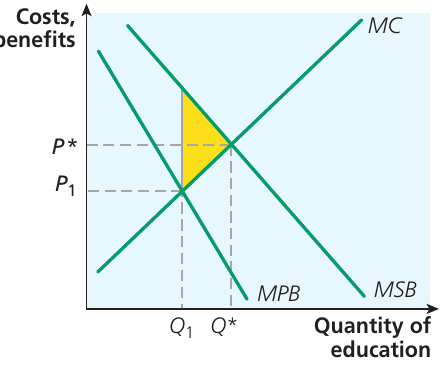
Suppose that education provides benefits to society that are not fully understood by parents and their children. Another way of expressing this is that the perceived marginal private benefits of education are lower than the marginal social benefits that society will gain from having an educated workforce.
Note
In this situation, the best outcome for society would be if education was provided, this being the position in which . In a free market situation, only would be demanded, reflecting the private perception of the value of education to individuals. This is actually an example of a consumption externality, but it arises because private individuals (whether parents or their children) do not have full information about the value of education.
External benefits of education
There are also other externality effects present in relation to education. Research has shown that educated workers are better able to cooperate and work together, becoming jointly more productive than they would be if they were working individually. Furthermore, there are other external benefits:
- Education has health spillovers because it brings a better understanding of nutrition and hygiene
- When education levels in a society are high, crime rates tend to be lower
- There is better-informed political debate and decision making
- More schooling may enable more technological progress to be made
- The social benefits of education may exceed the private benefits to the individuals who receive it
Second-hand cars example
One of the most famous examples of asymmetric information relates to the second-hand (pre-owned) car market. This is because the first paper that drew attention to the problem of asymmetric information, by Nobel laureate George Akerlof, focused on this market.
The 'lemons' problem
Akerlof argued that there are two types of car:
- Some cars are good runners and are totally reliable
- Others are continually breaking down and needing parts and servicing – these are known as 'lemons' in the USA (allegedly from fruit machines, where lemons offer the lowest prize)
The problem in the second-hand car market arises because the owners of cars (potential sellers) have better information about their cars than the potential buyers. In other words, a car owner who decides to sell a car knows whether it is a lemon or a good-quality car, but a buyer cannot tell.
Market consequences
Car dealers buying cars can adopt one of two possible strategies:
- Offer a high price and buy up all the cars in the market, knowing that the lemons will be sold on at a loss but hoping for a return on the quality ones
- Offer a low price, and just buy up all the lemons to sell for scrap
Important
The problem is that, if the lemons make up a large proportion of the cars in the market, this could generate overall losses for the dealers. The alternative is to offer a low price, and just buy up all the lemons to sell for scrap. In this situation, the market for good-quality used cars is effectively destroyed because owners of good-quality cars will not accept the low price – an extreme form of market failure.
Solutions
Again, the solution may be to tackle the problem at its root, by finding a way to provide information. In the case of second-hand cars, AA inspection schemes or the offering of warranties may be a way of improving the flow of information about the quality of cars for sale.
Pensions example
A problem faced by everyone is how they will live when they reach retirement and find that the state pension is not sufficient for them to live in the manner to which they have become accustomed. In today's world, people are living longer and retiring with many years ahead of them.
Information problems in pension markets
The market for pensions is fraught with information problems by its very nature. Information gaps arise from uncertainty and risk:
- Individuals face uncertainty in predicting their need for an adequate pension in the future, which depends on their state of health, their longevity, and so on
- There is risk involved in the sense that pension funds depend critically on movements in the stock market
- There is a vast array of alternative pension schemes available, many of them very complex, making it very difficult for individuals to make a rational decision – especially when their need for a pension is many years in the future
Consequences for society
If people make bad decisions about pensions, this creates problems for the future. Society may find that it needs to cope with care for the elderly, especially when improvements in health mean that more people are living for longer.
Note
Regulations introduced in the UK requiring workers to be automatically enrolled in a workplace pension scheme (unless they consciously opt out) are one attempt to tackle this issue.
The insurance market
People take out insurance to cover themselves against the risk of uncertain future events. Asymmetric information can cause problems with this market in two different ways.
Adverse selection
Suppose an individual approaches an insurance company wanting health insurance. The individual knows more about his or her health and health history than the insurance company. After all, the individual knows whether they are prone to illness or if they are accident-prone. This could mean that the people most likely to take out health insurance are the ones most likely to fall ill or be involved in accidents.
Important
This is known as adverse selection: a situation in which a person at risk is more likely to take out insurance.
This creates a problem for insurance companies as they may end up with a disproportionate number of high-risk clients, leading to higher costs and potentially market failure.
Moral hazard
A second type of information gap in terms of insurance is known as moral hazard. An individual who has taken out insurance may be more likely to take risks, knowing that they are covered by insurance.
Example
Example: Mobile Phone Insurance
If someone has taken out insurance against the loss of their mobile phone, they may be less careful about where they leave it, as they know they are protected against the financial consequences of losing it.
Moral hazard is a situation in which a person who has taken out insurance is prone to taking more risk.
Extension: merit and demerit goods
Merit goods
There are some goods that the government believes will be undervalued by consumers, so that too little will be consumed in a free market. In other words, individuals do not fully perceive the benefits that they will gain from consuming such goods, or do not have enough information to take decisions that are best for society.
These are known as merit goods. Examples include:
- Museums
- Libraries
- Art galleries
These are goods that are provided or subsidised because someone somewhere thinks that communities should have more of them.
Why are merit goods under-consumed?
One situation in which the merit good phenomenon arises is where the government is in a better position than individuals to take a long-term view of what is good for society. In particular, governments may need to take decisions on behalf of future generations as well as the present population. Resources need to be used wisely in the present in order to protect the interests of tomorrow's citizens.
Note
There is a strong political element involved in identifying goods that should be regarded as merit goods. This is because there is a subjective or normative judgement involved, since declaring a good to be a merit good requires the decision maker to make a choice on behalf of the population, which might be seen as being paternalistic. Economists are wary of playing the merit good card too often, as it entails such a high normative element. It is also sometimes difficult to disentangle merit good arguments from externality effects.
Demerit goods
Notice that we could view tobacco as a demerit good. In other words, this is a good that the government believes is overvalued by consumers, so that too much of it is consumed in a free market.
Remember!
Summary
Key Points to Remember:
-
Private goods have characteristics of excludability and rivalry – once consumed by one person, they cannot be consumed by another
-
Public goods are non-excludable and non-rivalrous, meaning people cannot be excluded from consuming them and one person's consumption doesn't prevent others from consuming them
-
The free-rider problem occurs with public goods because individuals have no incentive to pay for something they cannot be excluded from consuming, leading to under-provision by the free market
-
Asymmetric information occurs when some market participants have better information than others, leading to market failure in areas such as healthcare, education, second-hand cars, pensions, and insurance
-
Government intervention may be necessary to ensure adequate provision of public goods and to address information gaps through regulation, provision of information, or direct supply of services