Causes of Tectonic Hazards (Edexcel A-Level Geography): Revision Notes
📚Revision Notes
Causes of Tectonic Hazards
Earthquakes are caused by sudden movements comparatively near to the Earth's surface along a fault.
↳ Fault zones are of pre-existing weakness in the Earth's crust.
Earthquake Waves:
Types of Earthquake Wave:
Primary wave
-
Arrives first
-
Very fast
-
Moves through solid rock and fluids, pushes and pulls in the direction of travel Secondary wave
-
Slower than P wave
-
Only moves through solid rock
-
Up and down movement Surface (love) wave
-
Only travels through the surface of the crust
-
Fastest of the surface waves
-
Moves from side to side (horizontally) as it moves forwards
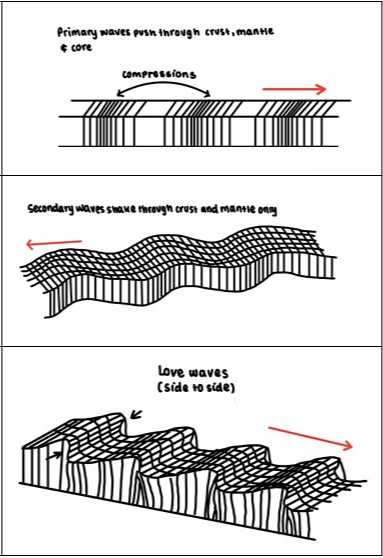
Note
The overall severity of an earthquake is linked to the amplitude and frequency of these wave types. The S and L waves are more destructive than the P waves as they have a larger amplitude and energy force.
Hazards caused by Earthquake Waves:
| Hazard | Description | Effects |
|---|---|---|
| Crustal fracturing (P) | Shockwaves travel fast through solid rock & can increase stress in it, especially if rock types are different as waves can travel at diff speeds through them. Stress causes strain until the rock fractures. | Causes faults, which can rupture the surface, causing subsidence or uplift Anything on these faults can get moved and damaged. |
| Ground shaking (P) | Shockwave ground movements inc. (in order): 1. P-waves → Pushing & pulling 2. S-waves → Up & down 3. L-waves → Side to side Often happens in <60s | Buildings that are not earthquake proof (aseismic) may only survive some types of shaking, and will be severely damaged. |
| Liquefaction (S) | Occurs when shockwaves travel through loose unconsolidated material, shaking it, making it act like a fluid | Cause buildings to tilt over or collapse and the ground to crack. Underground infrastructure such as cables and pipes may be ruptured. |
| Landslides (S) | Occur when there are steep slopes. Shockwaves loosen rock & cause it to move downslope under the influence of gravity | Landslides may hit settlements directly or destroy/block transport and communication infrastructure. |
Hazards caused by Volcanoes:
| Hazard (P=Primary, S=Secondary) | Description |
|---|---|
| Pyroclastic flows (P) | • Responsible for the majority of primary volcanic-related deaths • Bubbles of magma burst explosively to eject the hot gases and pyroclastic material, which contain glass shards, pumice, crystals, and ash • Can be up to 1000°C • Most harmful when they come out sideways from the volcano, at lower levels • Can move at speeds up to 700 km/h |
| Tephra (P) | • When a volcano erupts, it will sometimes eject material such as rock fragments into the atmosphere (tephra) • Can vary in size • The ash and larger materials can cause building roofs to collapse as well as start fires on the ground • Dust can reduce visibility and affect air travel |
| Lava flows (P) | • Molten magma that is erupted from volcanoes flows down the sides until it cools • Basaltic lava flows fastest (thin) • Pose a big threat to human life if they are fast moving • The viscosity of the lava is determined by the amount of silicon dioxide it contains • Can move as fast as 15 m/s |
| Volcanic gases (P) | • Gases are associated with explosive eruptions and lava flows • Mix normally includes water vapour, sulfur-dioxide, hydrogen, and carbon monoxide • Most deaths are associated with CO₂ • Can cause acid rain |
| Lahars (S) | • Mixture of water and erupted volcanic material of various sizes, which flow very fast (60 km/h) down river valleys • Water may come from rainfall, or the melting of a snow cap on the top of a volcano |
| Jokulhlaups (S) | • Where a volcano erupts underneath an ice cap and heat melts some of the ice • The meltwater builds up around the top of the volcano, trapped by the surrounding ice • Eventually, the warm meltwater will melt and lift the ice away from the ground, and then the water bursts out from under the ice and flows rapidly to lower ground • When this happens, anything in its path is washed away |
Tsunamis:
↳ Known as one of the most distinctive earthquake-related hazards.
- Do not resemble normal sea waves as their wavelength is much longer.
- Out at sea not seen as a hazard as they are often low and only when it begins to reach land it grows in height as water becomes shallower.
- Caused by seabed displacement.
- Occur in waves, normally minutes apart. Sometimes can be even hours apart. This is dangerous as people return home between waves thinking its safe.
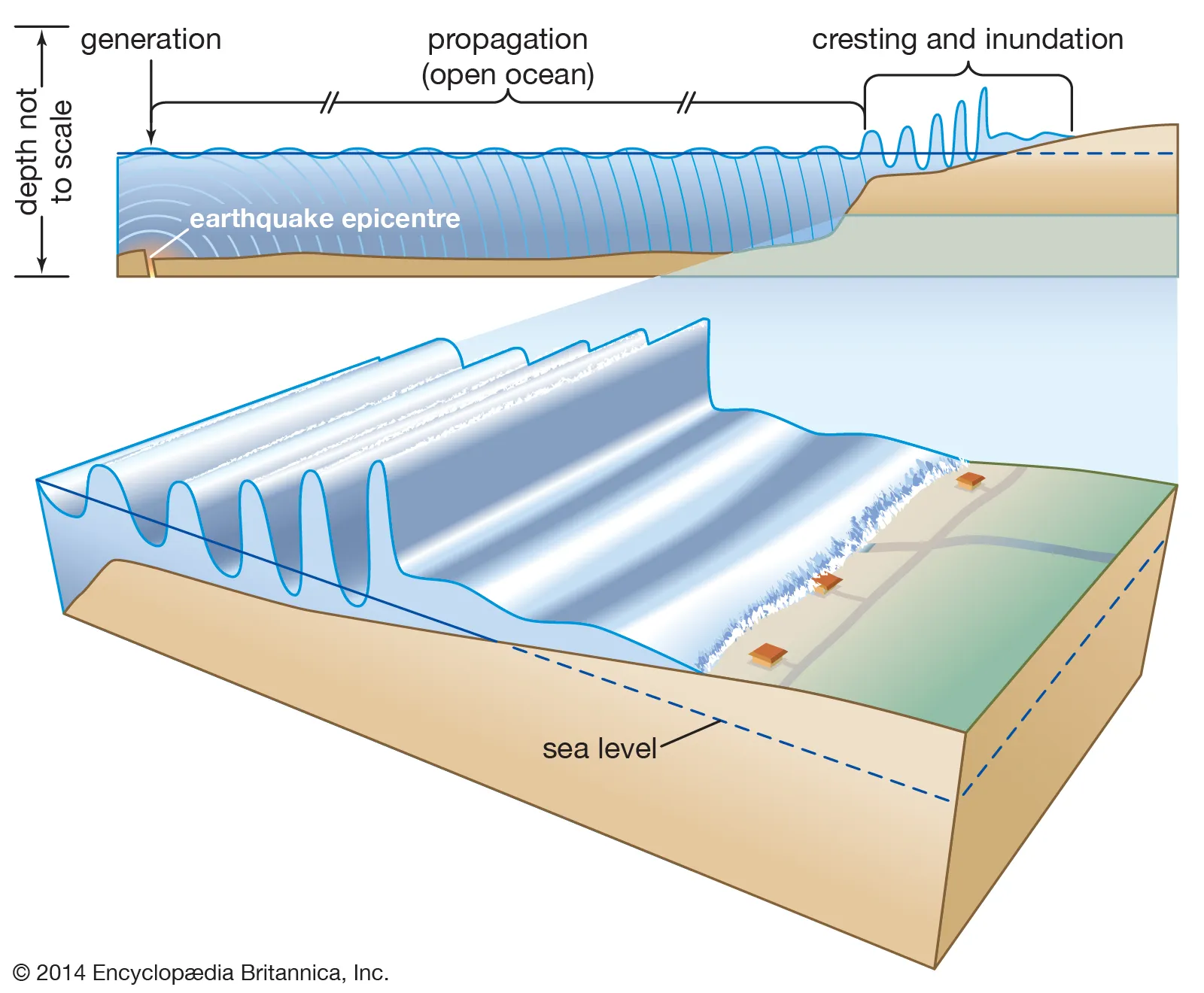
Causes of Tsunamis:
- Undersea earthquake at subduction zone may cause a rapid movement of the seabed
- Violent explosive eruptions of volcanic islands
- Major landslides or volcanic cone collapse into the sea
- Underwater landslides at the edge of continental shelves
Impacts of Tsunamis (dependent on both human & physical factors):
- Duration of event
- Wave amplitude, water column displacement and the distance travelled
- The physical geography of the coast, especially water depth and gradient of the shoreline
- The degree of coastal ecosystem buffer (mangroves)
- The timing of the event - night vs day
- Quality of early warning systems
- The degree of coastal development and its proximity from the coast