Subaerial processes of mass movement and weathering (Edexcel A-Level Geography): Revision Notes
📚Revision Notes
Subaerial processes of mass movement and weathering
Weathering
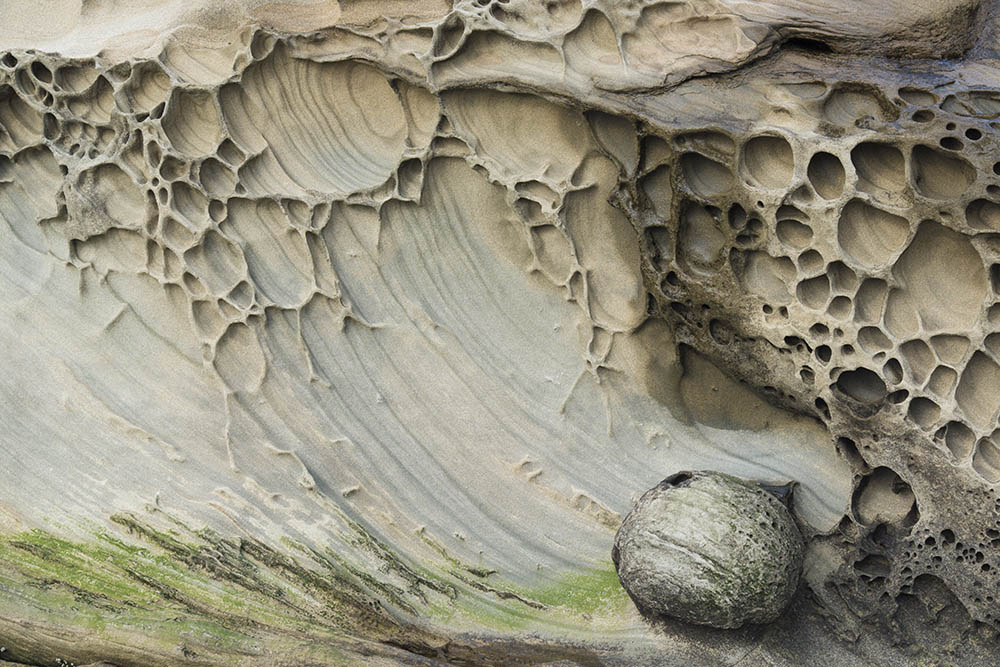
Weathering
Note
Weathering: The in situ breakdown of rocks by chemical, mechanical or biological agents (involves no movement).
Can be classified as mechanical, chemical or biological ↳ Operates between low-tide level and the cliffs or land of the backshore
- Mechanical Weathering 🔗 Breaks down rocks due to the exertion of physical force, it does not involve any chemical change
- Chemical Weathering 🔗 Involves a chemical reaction & the generation of new chemical compounds
- Biological Weathering 🔗 The action of plants, bacteria or animals | Type | Process | Explanation | Vulnerable rocks | |---|---|---|---| | Mechanical | Freeze-thaw | Water expands when it freezes (approx 9%), exerting force w/in cracks & fissures. Occurs repeatedly, worsening cracks each time | Rocks w/ cracks & fissures | | | Salt crystallisation | The growth of salt crystals in cracks exerts pressure, widening cracks | Porous & fractured rock (sandstone) | | Chemical | Carbonation | Carbonic acid in rain dissolves rocks | Limestone & other carbonate rocks | | | Hydrolysis | Rocks broken down to form new clay minerals & materials in solution due to the impact of water & dissolved CO2 | Igneous & metamorphic | | | Oxidation | O2 added to minerals (especially Iron), ∴ increasing their volume, causing mechanical breakdown | Sandstone, siltstone & shale | | Biological | Plant roots | Tree & plant roots grow in cracks/fissures, forcing rocks apart | Any rock on vegetated cliff tops | | | Rock boring | Species of clams & molluscs/birds bore into rock | Sedimentary rocks, especially carbonate |
Mass Movement
🔗 The movement downslope of rocks, sand, clay, till or soil (caused by gravity)
Mass Movement
Types of Mass Movement
| Rockfall | Blocks of rock dislodged by mechanical weathering or by hydraulic action ↳ Often associated with the undercutting of cliffs by the creation of wave-cut notches. Forms a talus scree slope |
|---|---|
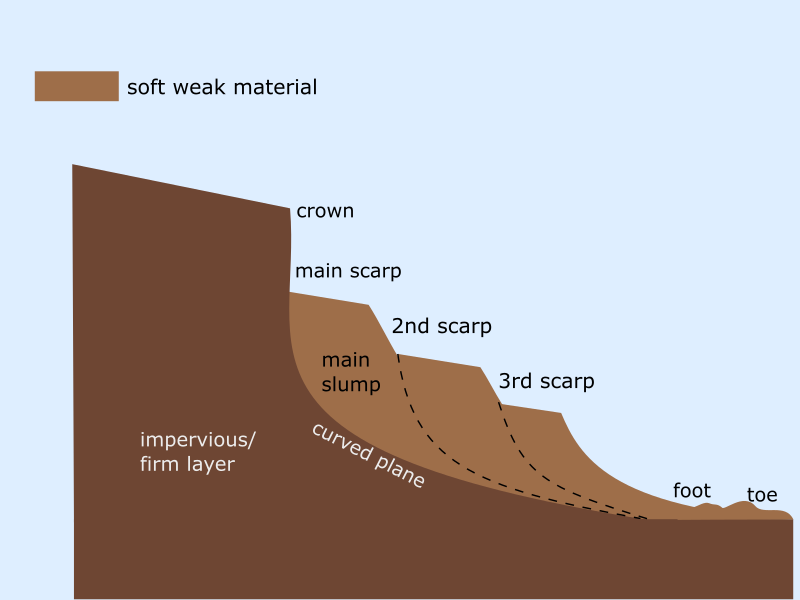
| Rotational slide | A section of cliff remains intact as it moves down a cliff along a curved slip plane ↳ Leaves a crescent-shaped rotational scar above it on the cliff A sequence of slumps like this can result in a terraced cliff profile |
| Mudflow | Common in weak rock (eg. clay, unconsolidated sediment) ↳ Materials become saturated & lose their cohesion → begin to flow downslope (exacerbated by high tides & heavy rainfall) |
| Topple | When rock strata have a very steep seaward dip ↳ Undercutting leads to instability causing blocks of material to topple seaward |