The drainage basin is an open system within the global hydrological cycle (Edexcel A-Level Geography): Revision Notes
📚Revision Notes
The drainage basin is an open system within the global hydrological cycle
The Drainage Basin Water Cycle
-
A subsystem within the global hydrological cycle
-
Open system - Has external inputs and outputs
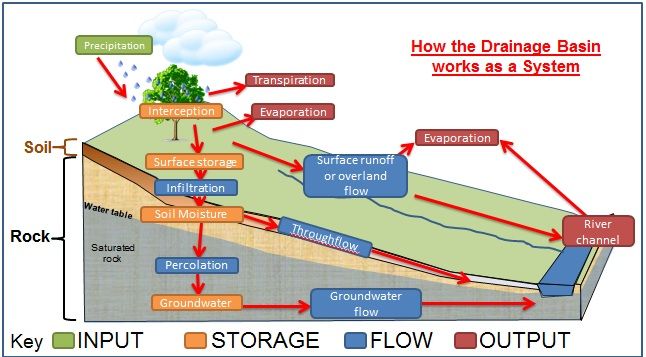
-
Drainage basin → An area of land drained by a river and its tributaries → Catchment (The area of land drained by a river and its tributaries)
-
Boundary around the basin = watershed (high land which divides and separates waters flowing to different rivers)
Drainage Basin System Inputs
Precipitation
For precipitation to form, certain conditions must be met:
- Air cooled to saturation point with a relative humidity of 100%
- Condensation nuclei (eg. dust particles) to facilitate growth of droplets in clouds
- A temp below dew point
Rain Shadow
🔗 A dry area on the leeward side of the mountain. Little rainfall as the mountains shelter it from rain producing weather systems
Types of rainfall
- Convectional rainfall → Often associated with intense thunderstorms
- Cyclonic or frontal rainfall → A period of sustained, moderately intensive rainfall
- Orographic rainfall → Concentrated on the windward slopes and summits of mountains
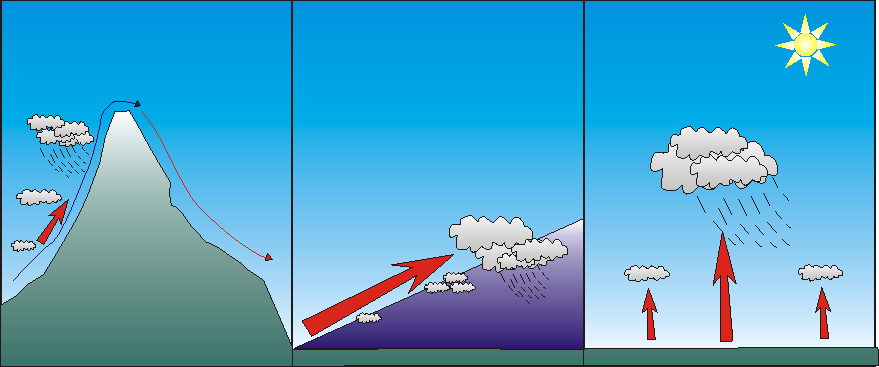
Types of rainfall
Key Influencing Factors on the Drainage Basin Hydrological System
- Amount of precipitation - can have a direct impact on drainage discharge
- Type of precipitation
- Seasonality
- Intensity of precipitation
- Variability (seen in 3 ways):
- Secular variability happens long term
- Periodic variability happens in an annual, seasonal etc basis
- Stochastic variability results from random factors
- Distribution of precipitation within the basin
Fluxes in the Drainage Basin
Interception → Process by which water is stored in the vegetation Components:
-
Interception loss → Water that is retained by plant surfaces and later evaporated or absorbed by the vegetation and transpired ↳ Interception loss from vegetation is usually greatest at start of a storm, especially when following a dry period
-
Throughfall → When the rainfall persists or is relatively intense, and the water drops from the leaves, twigs etc
-
Stem flow → When water trickles along twigs and branches and then down the trunk → Process by which water soaks into (or is absorbed by) the soil Infiltration
↳ The Infiltration capacity is the max rate water can be absorbed by the soil
-
Infiltration capacity ↓ w/ time through a period of rainfall until a relatively constant low value is reached
-
Rate of infiltration depends on the amount of water already in the soil (antecedent soil moisture)
-
Soil Texture - influences soil porosity
-
The type, amount and seasonal changes in vegetation cover
-
Nature and structure of the soil surface - more compacted = inhibit infiltration
-
Slope angle Infiltration is inversely related to surface run-off
-
Surface run-off → The movement of water that is unconfined by a channel across the surface of the ground
Flows and Transfers
Overland Flow (Surface run-off) → Movement of water that is unconfined by a channel across the surface of the ground
↳ Developed by Horton - Saw this flow was the main way rainwater was transferred to the river channel
-
For this flow, precipitation intensity must exceed the infiltration rate (eg. Torrential storms)
-
Primary cause of soil erosion - sediment removed by a range of erosive processes (rain splash, sheet, rill & gully erosion) Throughflow → Lateral transfer of water down slope through the soil via natural pipes and percolines (Lines of conc water flow between soil horizons to the river channel).
-
Slower than direct overland flow but can occur rapidly over porous, sandy soils Percolation → Transfer of water from the surface or from the soil into the bedrock beneath - permeable (joints/pores)
-
Much more likely in humid climates w/ vegetated slopes Saturated Overland Flow → The upward movement of the water table into the evaporation zone
-
Much slower process
-
Common after successive winter storms causing the water table to rise to the surface in depressions and at the base of hill sides ↳ Saturated overland flow ∴ contributing to channel flow (is a component of flooding) Groundwater Flow → Very slow transfer of percolated water through pervious and porous rock
-
Vital to maintain a steady level of channel flow in droughts and other varying weather conditions → Flow of water in streams or rivers Channel Flow
-
From 3 transfer processes: Overland flow, through flow or groundwater flow
-
Direct channel precipitation is added to channel storage (Storage of water in streams or rivers)
Drainage Basin System Outputs
Evaporation → Process by which moisture is lost directly into the atmosphere from water surfaces & soil
-
Results from the effects of the Sun's heating & air movement
- Rates ↑ in warm, windy and dry conditions
-
Climatic factors: Temperature, hours of sunshine, humidity and wind speed
-
Other factors: Size of water body, depth of water, water quality, type of vegetation cover & colour of surface (determines the albedo → A measure of the proportion of the incoming solar radiation that is reflected by the surface back into the atmosphere and space Transpiration → Water lost from plants through stomata and transferred to the atmosphere
-
Depend on: Time of year, type & amount of vegetation cover, degree of availability of moisture in atmosphere & length of growing season
-
Evapotranspiration (EVT) → Combined effect of evaporation and transpiration
-
Potential evapotranspiration (PEVT) → Water loss that would occur if there was unlimited supply of water in the soil by use by vegetation
Physical Factors That Influence the Drainage Basin Cycle
- Climate → Influences type and amount of precipitation overall and the amount of evaporation. Climate also has an indirect impact and the vegetation type
- Soils → Determine the amount of infiltration and throughflow and, indirectly, the type of vegetation
- Geology → Can impact on subsurface processes such as percolation and groundwater Indirectly, geology alters soil formation
- Relief → Altitude can impact precipitation Slopes can affect the amount of run-off.
- Vegetation → Major impact on the amount of interception, infiltration & occurrence of overland flow alongside transpiration rates
Human Factors that Influence the Drainage Basin Cycle
- Precipitation Impact
- Introduction of iodine pellets, ammonium nitrate etc to act as condensation nuclei
- Evaporation and Evapotranspiration
- Interception
- Deforestation → ↓ evapotranspiration & ↑ surface run-off. ∴ flooding potential ↑ → ↓ surface storage
- Infiltration and Soil Water