Connected Bodies - Ropes & Tow Bar (Edexcel A-Level Mathematics): Revision Notes
📚Revision Notes
3.2.2 Connected Bodies - Ropes & Tow Bar
Newton's Third Law
Statement: This law states that every force has an equal and opposite reaction force.
In connected bodies problems (ropes or tow bars), multiple objects are linked and move together.
Note
Here's a summary of the key steps:
- Identify all forces: Draw separate free body diagrams for each object. Include forces like tension (in ropes), the weight of each object, normal reaction, and applied forces.
- Apply for each body: For each object, write separate equations for the net force using . Take care to maintain consistent acceleration for all bodies since they are connected.
- Consider tension: For ropes or tow bars, tension acts in opposite directions on the connected objects. For example, if object A pulls on object B with tension , then object B pulls on object A with the same magnitude of , but in the opposite direction.
Note
Examples:
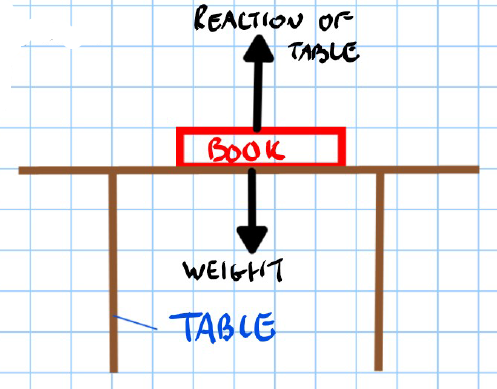
- A Book on a Table:
- The weight of the book acts downward.
- The table exerts an equal and opposite reaction force upward.
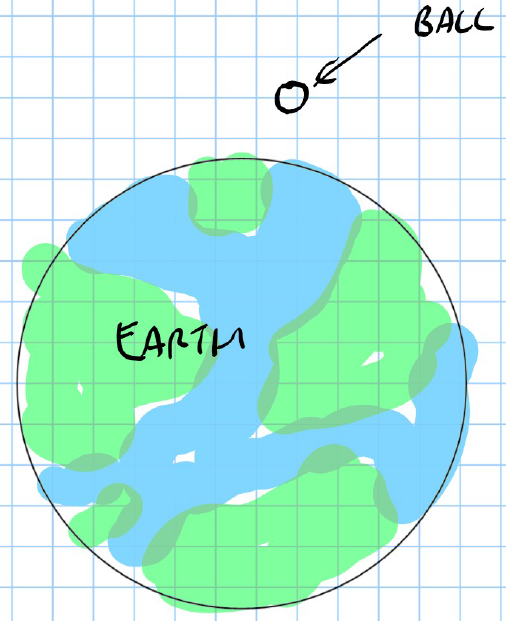
- A Ball Falling Towards Earth:
- When the ball is dropped, it is pulled towards the Earth by gravity.
- Simultaneously, the Earth is pulled towards the ball with the same magnitude of force.
Problem:
Note
Given:
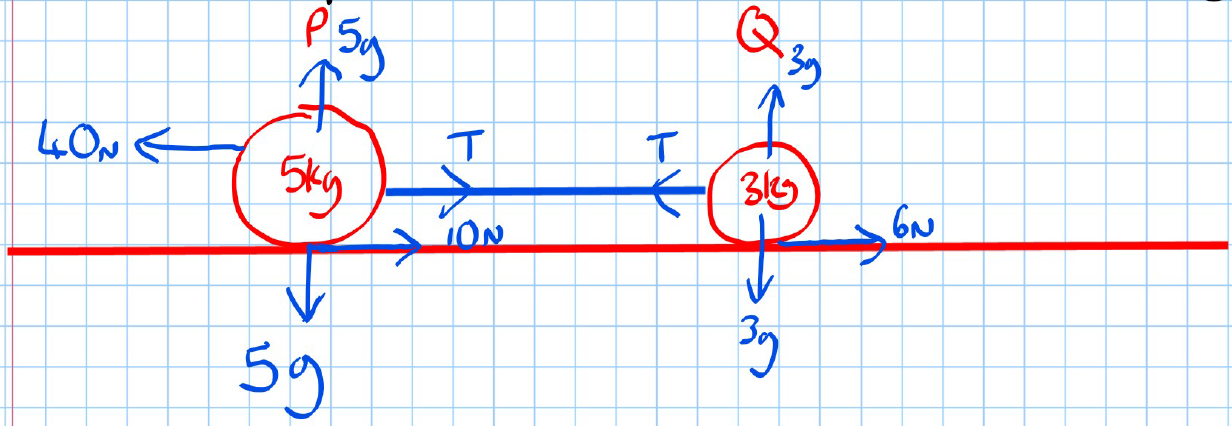
- Two particles P and Q of masses 5 kg and 3 kg, respectively, are connected by a piece of light inextensible string.
- Particle P is pulled by a horizontal force of 40 N along a rough horizontal plane.
- Particle P experiences a 10 N frictional force, and Q experiences a 6 N frictional force. Questions:
- Find the acceleration of the particles.
- Find the tension in the string.
Solution:
Step 1: Draw a Diagram with All Forces Acting on Particles
Note
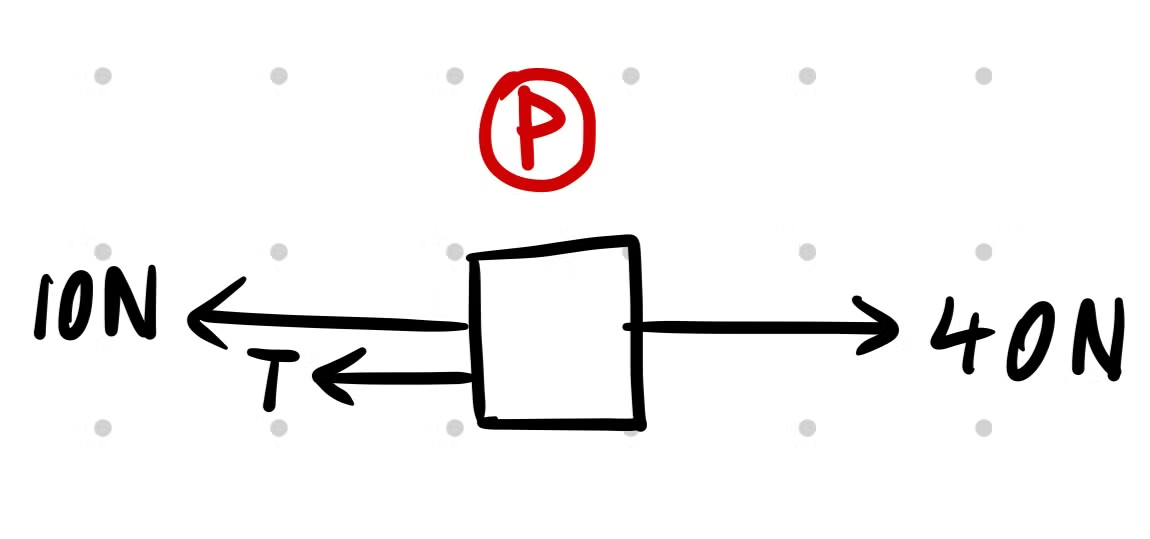
- For Particle :
- Horizontal to the right.
- Tension in the string acting to the left.
- Frictional to the left.
Note
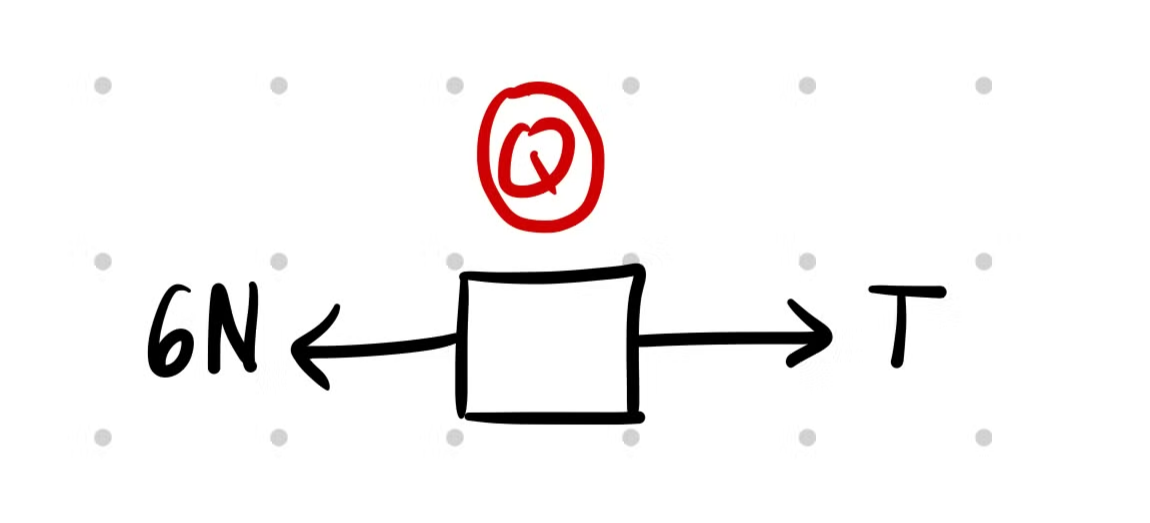
- For Particle :
- Tension in the string acting to the right.
- Frictional to the left.
Step 2: Resolve forces and use for each particle
Note: Choosing the direction of motion as the positive direction usually leads to easier calculations.
Note
For Particle :
Note
For Particle :
Step 3: We now have Simultaneous equations that we can solve to find a
- Add Equation and Equation :
- Substitute back into Equation to find T**:**
Note:
Note
- The string being light is important as if it were not, it would add extra weight to the particles, affecting accelerations.
- The string being inextensible (i.e., not elastic) is important as this implies both particles accelerate at the same rate.