Connected Bodies - The Lift Problem (Edexcel A-Level Mathematics): Revision Notes
📚Revision Notes
3.2.3 Connected Bodies - The Lift Problem
The "Lift Problem" is a classic example of a connected bodies problem in mechanics. It typically involves a lift (elevator) and a person or object inside it. The problem is analysed using Newton's second law of motion, considering the forces acting on both the lift and the object/person inside it. Understanding this problem helps in mastering concepts related to forces, tension, and acceleration in systems with connected bodies.
1. Understanding the Lift Problem
Note
- Scenario: Consider a lift of mass moving vertically with an acceleration . Inside the lift is a person or object of mass .
- Objective: Determine the tension in the cable supporting the lift and the apparent weight of the person or object inside the lift under various conditions.
2. Forces Acting on the System
Note
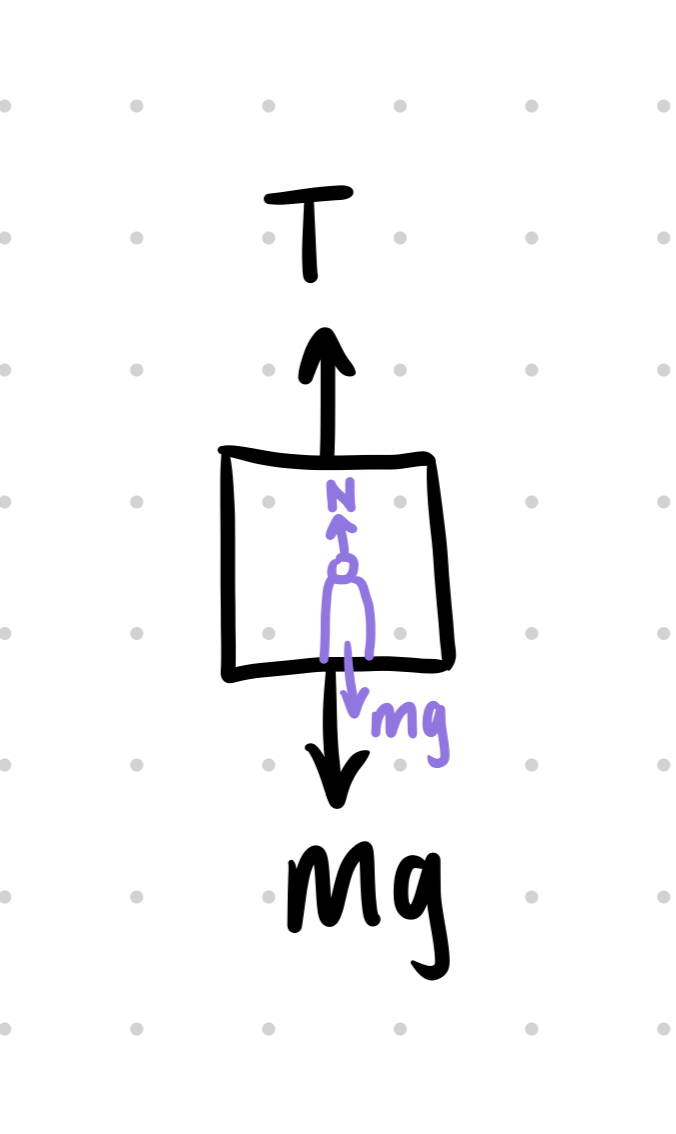
- On the Lift:
- Weight of the Lift: (acting downward).
- Tension in the Cable: (acting upward).
- Net Force on the Lift: Determines the acceleration of the lift.
Note
- On the Person/Object Inside the Lift:
- Weight of the Person/Object: (acting downward).
- Normal Force (Apparent Weight): (acting upward). This is the force exerted by the floor of the lift on the person or object.
3. Newton's Second Law Applied to the Lift
Note
Using Newton's second law, , for the lift:
Where:
- is the tension in the cable.
- is the mass of the lift.
- is the acceleration of the lift.
4. Apparent Weight of the Person/Object
The apparent weight is the normal force exerted by the floor of the lift. This changes depending on the acceleration of the lift.
Applying Newton's second law to the person/object inside the lift:
- If the Lift is Stationary or Moving at Constant Speed ( ):
The apparent weight equals the actual weight.
- If the Lift is Accelerating Upwards ( ):
The apparent weight increases. The person/object feels heavier.
- If the Lift is Accelerating Downwards ( ):
The apparent weight decreases. The person/object feels lighter.
- If the Lift is in Free Fall ( ):
The apparent weight is zero. The person/object experiences weightlessness.
5. Example Problems
Note
Example 1: Lift Accelerating Upwards
- Given:
- Mass of lift
- Mass of person
- Acceleration (upwards)
- Find:
- Tension in the cable
- Apparent weight of the person
- Solution:
- Tension in the Cable:
- Apparent Weight of the Person:
Note
Example 2: Lift Accelerating Downwards
- Given:
- Mass of lift
- Mass of person
- Acceleration (downwards)
- Find:
- Tension in the cable
- Apparent weight of the person
- Solution:
- Tension in the Cable:
- Apparent Weight of the Person:
6. Summary
Note
The lift problem involves applying Newton's second law to both the lift and the person or object inside it. By analysing the forces acting on the system, you can determine the tension in the cable and the apparent weight of the person or object under various conditions of acceleration. Understanding these principles is crucial for solving more complex problems involving connected bodies in A-Level Mechanics.