Resolving Forces & Inclined Planes (Edexcel A-Level Mathematics): Revision Notes
📚Revision Notes
3.3.1 Resolving Forces & Inclined Planes
Note
When dealing with resolving forces on inclined planes, follow these steps:
- Draw a free body diagram: Show all forces acting on the object, including weight, normal force, friction (if present), and any applied force.
- Resolve forces into components: Break the forces into two perpendicular directions:
- Parallel to the plane: The component of weight is , where is the angle of inclination.
- Perpendicular to the plane: The component of weight is . The normal force acts in this direction.
- Apply : For equilibrium or motion along the plane, apply Newton's second law separately to the parallel and perpendicular directions. Use to find acceleration, tension, or friction. By resolving forces carefully and applying Newton's laws, you can solve for the forces acting on an object on an inclined plane.
Forces on a Slope
Situation:
Consider a situation in which a particle is placed at rest on a slope and then left to freely roll down the slope.
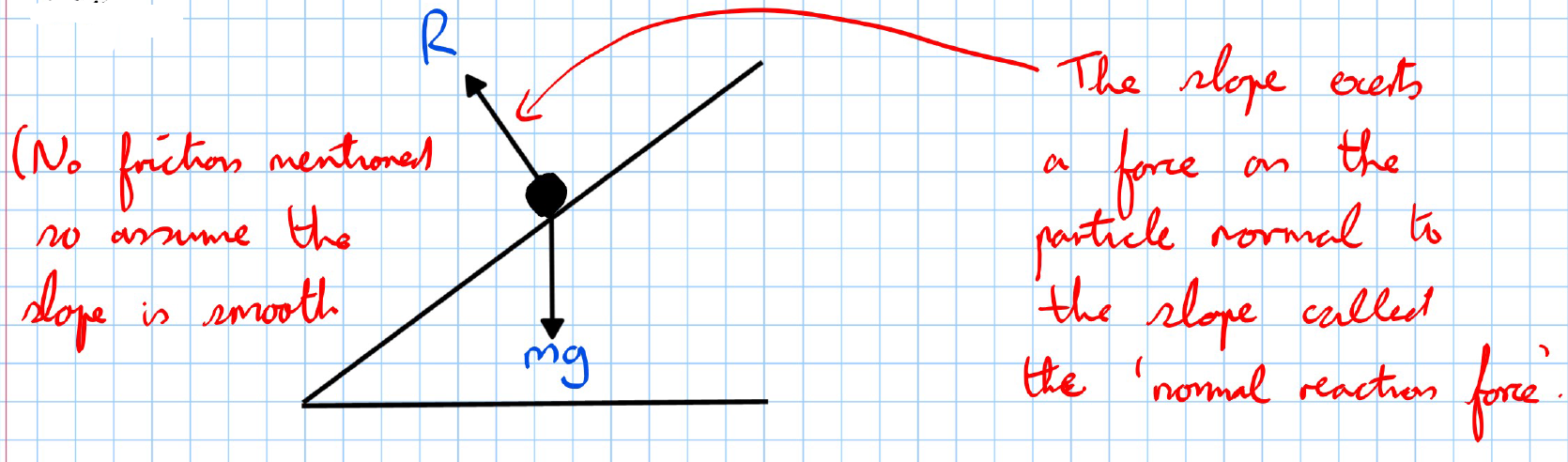
- Assumption: Since no friction is mentioned, assume the slope is smooth.
- Forces acting on the particle:
- The force due to gravity acts vertically downward.
- The slope exerts a force on the particle normal to the slope, called the normal reaction force .
Resolving Forces on a Slope
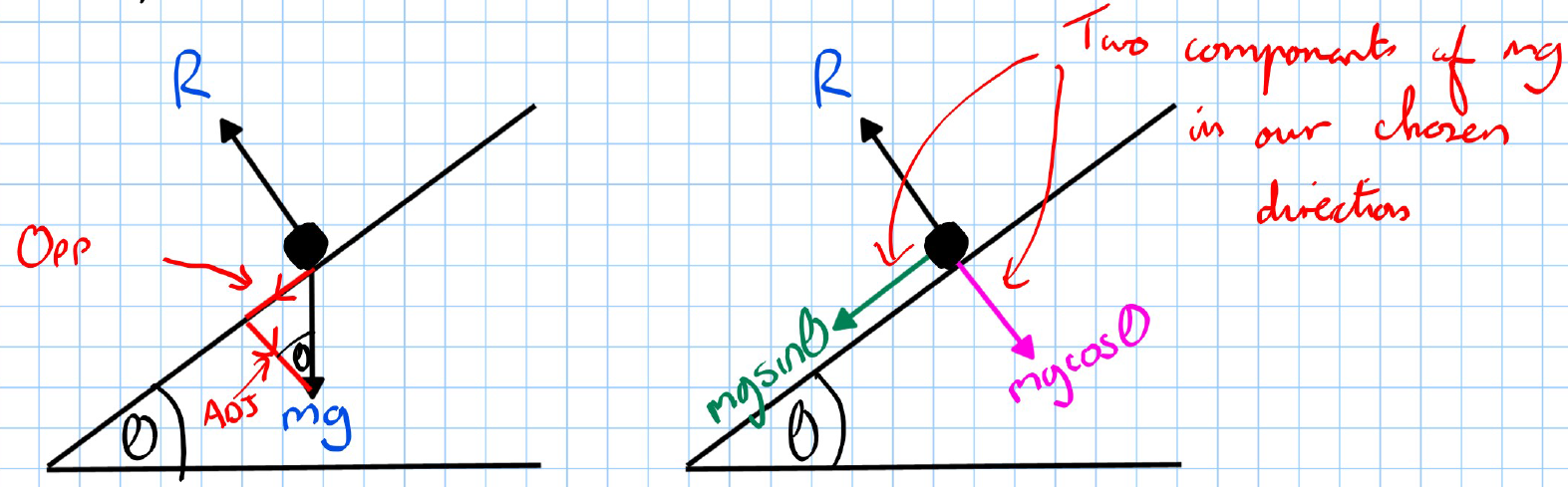
Directions to consider when resolving forces on a slope:
- Parallel to the slope : This is the direction in which the particle will likely move.
- Perpendicular to the slope : This is the direction of the normal reaction force.
Components of the gravitational force :
- The component parallel to the slope is .
- The component perpendicular to the slope is .
Steps to Resolve Forces:
- Draw the slope with the particle and indicate all the forces acting on it.
- Resolve the gravitational force ( mg) into two components:
- Parallel to the slope:
- Perpendicular to the slope:
- Identify the normal reaction force acting perpendicular to the slope. Note: It is often beneficial to draw a separate diagram with the forces already resolved for clarity and easier calculations.
Resolving Perpendicular Forces
Concept:
- Forces can act with each other, adding to each other's effect, or against each other, cancelling or reducing each other's effect.
- When forces completely cancel each other out, it is called equilibrium.

Example
Example of Equilibrium:
- If two forces of each act in opposite directions, they cancel each other out.
- The total force is , so the object is in equilibrium.
Note
Example Problem:
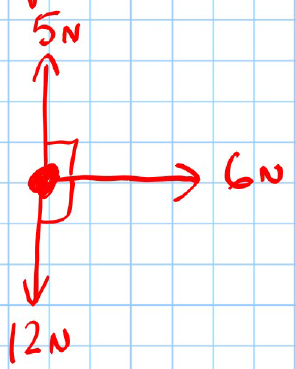
Problem: Find the resultant force and its direction for the following situation:
- Forces acting:
- 5 N upward
- 12 N downward
- 6 N to the right
Solution:
Step 1: Consider the forces in the horizontal and vertical directions.
- Horizontal Force (Rightward):
- Vertical Force (Net Force Downward):
Step 2: Calculate the resultant force F_R.
- Use the Pythagorean theorem:
Step 3: Find the direction of the resultant force.
- The angle with the horizontal (rightward) is given by:
- Since is downward, the direction of the resultant force relative to the positive x-axis is:
Note
Example 1: Finding the Values of F and R for a Particle at Rest on a Slope
Problem Statement:
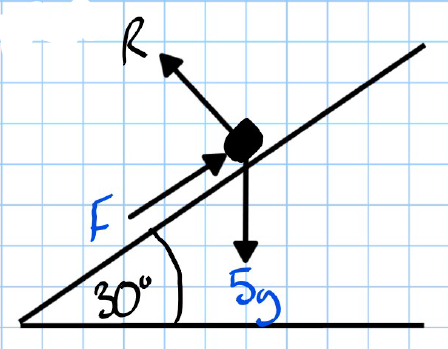
- A particle of weight g is held at rest on a slope inclined at .
- Find the values of the force and the normal reaction .
Solution:
- Forces acting on the particle:
- The gravitational force acts downward: g.
- is the force parallel to the slope.
- is the normal reaction force perpendicular to the slope.
- Resolve forces along the slope:
- The component of weight along the slope: .
- Since the particle is at rest, .
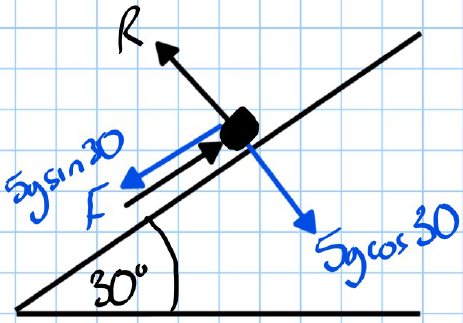
- Resolve forces perpendicular to the slope:
- The component of weight perpendicular to the slope: .
- Since the particle is at rest, .
Answer:
Note
Example 2: Finding the Magnitudes of P and Q in Equilibrium
Problem Statement:
- A system is in equilibrium on a slope with forces and acting on a particle.
- Find the magnitudes of and .
Solution:
- Forces acting:
- The particle is subject to a normal force , a frictional force , and additional forces and .
- Resolve forces along the slope:
- Horizontal components:
- Solving for :
- Resolve forces perpendicular to the slope:
- Vertical components:
- Solving for :
Answer:
Problem: Force on a Particle on a Slope
Note
Problem Statement:
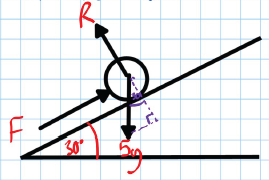
- A force is applied to a particle of mass , which holds it at rest on a smooth slope inclined at above the horizontal.
- Calculate the force .
Solution:
- Forces Acting:
- Gravitational force acting vertically downward: g.
- Normal reaction force acting perpendicular to the slope.
- Force F acting up the slope to keep the particle at rest.
- Resolving Forces Perpendicular to the Slope (Normal Reaction R):
- Resolving up the Slope (Force ):
Final Answer:
- The force F required to hold the particle at rest on the slope is .
Problem: Forces on a Mass on a Smooth Inclined Plane
Note
Problem Statement:
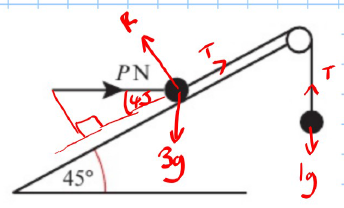
- A mass of kg rests on a smooth plane inclined at to the horizontal. The mass is attached to a cable that passes up the plane along the line of greatest slope and then passes over a smooth pulley at the top of the plane.
- The other end of the cable carries a mass of kg freely suspended.
- The masses are modelled as particles, and the cable as a light inextensible string
- There is a force acting horizontally on the kg mass, and the system is in equilibrium. Calculate:
- The magnitude of .
- The normal reaction between the mass and the plane.
- State how the assumption that the pulley is smooth was used in the calculations.
Solution:
Part (a): Magnitude of
- Resolving Forces Parallel to the Plane (Up the Slope):
- Substituting values: ,
- Resolving Forces Perpendicular to the Plane:
- For the Hanging Particle ([kg**):**
- Substitute into the equation:
Part (b): Normal Reaction R
- Substituting into the perpendicular force equation:
Part (c): Smooth Pulley Assumption
-
The assumption that the pulley is smooth implies that the tension in the string is the same on both sides of the pulley. This allowed us to equate the tension on the side of the kg mass to the tension on the side of the kg mass. Final Answers:
-
-
-
The smooth pulley ensures equal tension throughout the string.
Tips:
Note
- Align axes with the plane: Make the plane one axis (usually parallel and perpendicular to the slope). This simplifies resolving forces into components like and
- Use clear trigonometry: Always resolve the weight into parallel () and perpendicular () components relative to the inclined surface.
- Check for friction: If friction is present, remember it opposes motion and acts parallel to the plane. Use , where is the coefficient of friction and