Exponential Growth & Decay (Edexcel A-Level Mathematics): Revision Notes
📚Revision Notes
6.3.1 Exponential Growth & Decay
Exponential Growth and Decay
If a quantity grows or decays exponentially, this means that its equation has a variable in the index power. Examples include:
- (decay since as increases, decreases)
1. Exponential Growth
Note
Exponential growth occurs when a quantity increases at a rate proportional to its current value. The general formula for exponential growth is:
- : Initial value (value at )
- : Growth rate constant ( for growth)
- : Time
- : Euler's number (~2.718)
Key Features:
- The rate of change (growth) increases as the quantity grows.
- Commonly seen in population growth, investments, and the spread of diseases.
Example:
If a population of bacteria doubles every 3 hours, the growth can be modelled by , where depends on the doubling time.
:::
2. Exponential Decay
Note
Exponential decay occurs when a quantity decreases at a rate proportional to its current value. The general formula for exponential decay is:
- : Decay rate constant ( for decay)
Key Features:
- The rate of change (decay) slows down as the quantity decreases.
- Commonly seen in radioactive decay, depreciation of assets, and cooling processes.
Example:
A radioactive substance with a half-life of 5 years can be modelled using , where is related to the half-life.
:::
3. Key Concepts:
- Doubling Time (for growth) and Half-Life (for decay) are specific intervals that describe when a quantity doubles or halves.
- Rate of Change: The rate at which the quantity grows or decays depends on the value of .
Doubling Time Formula (for growth):
Half-Life Formula (for decay):
Features of Exponential Growth/Decay
Note
Example 1:
| x | -2 | -1 | 0 | 1 | 2 | 3 |
|---|---|---|---|---|---|---|
| y | 2 | 4 | 8 | 16 | 32 | 64 |
- We can see that every time we add 1 to the power x, we multiply y by 2.
Note
Example 2:
| x | -2 | -1 | 0 | 2 | 3 | 4 | 5 | 6 | 7 | 8 | 9 |
|---|---|---|---|---|---|---|---|---|---|---|---|
| y | 0.0625 | 0.063 | 0.064 | 0.25 | 1 | 4 | 16 | 64 | 256 | 1024 | 4096 |
- The power goes up by every time we add to .
Note
Example 3:
| x | -2 | -1 | 0 | 1 | 2 | 3 |
|---|---|---|---|---|---|---|
| y | 1296 | 216 | 36 | 6 | 1 |
- Every time we increase by , is divided by .
Exponential Growth and Decay Problems
Note
Problem 1: A quantity is increasing exponentially.
Given that at time , and that at time :
a) Find the value of when .
b) Find the value of when .
Solution:
- a) The pattern shows that doubles every units of time.
Therefore, when .
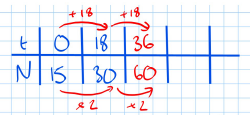
- b) Extending the doubling pattern:
corresponds to .
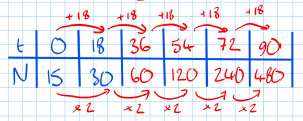
Note
Problem 2: A quantity N is decreasing such that at time :
Given the equation :
a) Find the value of when .
b) Find the value of when .
c) Find the rate at which is decreasing when .
Solution:
a) Substitute into the equation:
6.767 (to 4 sf)
b) Set and solve for :
Take the natural logarithm on both sides:
Solve for :
14.07 (to 4 sf)
c) The rate of change is given by:
Substituting :
-1.353 (to 4 sf)
Radioactive Decay Problem
A radioactive substance is decaying such that its mass, grams, at a time years after initial observation is given by:
Note
Given that when , find: a) The value of the constant .
b) The time it takes for the mass of the substance to be halved.
Solution a):
Find the value of :
Given:
Substitute into the equation:
Divide both sides by 240:
Take the natural logarithm on both sides:
Solve for :
Solution b):
Find the time for the mass to be halved:
The initial mass is when :
Half the initial mass is:
Substitute into the equation:
This simplifies to:
Take the natural logarithm on both sides:
Solve for :
Substituting the value of :