Classification (OCR A-Level Biology A): Revision Notes
📚Revision Notes
How Classification Works
Classification is the systematic organisation of living and extinct organisms into hierarchical groups based on shared characteristics and evolutionary relationships. This system brings order to Earth's immense biodiversity and allows scientists worldwide to communicate clearly about species.
The development of binomial nomenclature
Early naming systems
Before standardised naming, identifying organisms presented significant challenges. In the seventeenth century, John Ray surveyed plant species and assigned descriptive Latin names. However, by the mid-eighteenth century, these polynomials (meaning "many names") had become impractically long and difficult to remember.

Note
Latin was chosen as the international language of science because it was universally taught among educated Europeans and provided a neutral, standardised medium for scientific communication across different countries and cultures.
For example, the strawberry tree was known as Arbutus caule erecto, foliis glabris serratis, baccis polyspermis, which translates to "Arbutus with upright stems, hairless, saw-toothed leaves and many-seeded berries". This demonstrates the impractical length of early naming systems.
Different languages had different common names for the same organism, making scientific communication confusing and error-prone.
Linnaeus and the binomial system
The Swedish biologist Carl Linnaeus (1707–78) revolutionised biological nomenclature by standardising the binomial system. This system gives every species exactly two names, similar to a surname followed by a first name. Linnaeus named over 11000 species using this approach.
Important
Definition: Binomial System
The binomial system is a method of naming species where each species receives exactly two names:
- A generic name (genus) – shared by closely related species
- A specific epithet (species descriptor) – unique within that genus
Together, these two names uniquely identify each species.
Rules for writing scientific names
When writing scientific names, specific formatting rules must be followed:
Important
Critical Formatting Rules for Scientific Names:
- The generic name begins with a capital letter
- The specific epithet begins with a lowercase letter
- In printed text, both names appear in italics: Taraxacum officinale
- In handwritten work, both names are underlined: Taraxacum officinale
- Once a species name has been used in full, it can be abbreviated to the first letter of the genus followed by the full specific epithet (e.g., T. officinale)
- Both words together form the species name
Common mistake: Never capitalise the specific epithet, even if it's derived from a person's name or place.
Origin and meaning of scientific names
Scientific names typically use Latin grammatical forms, though many derive from ancient Greek and other languages. Names often describe characteristics of the species.
Example
Worked Example: Understanding Scientific Names
The wood mouse is Apodemus sylvaticus, which translates as "not house, wood" – highlighting that it was frequently confused with the house mouse, Mus musculus.
Breaking down the name:
- Apodemus = "apo" (not/away from) + "demus" (house)
- sylvaticus = relating to woods or forests
This name emphasises the key distinguishing feature – its woodland habitat rather than domestic setting.
Some species are subdivided into subspecies, in which case a third name is added to the binomial.
Note
Generic names are unique within animal genera and within plant genera separately. However, the same generic name can apply to both an animal genus and a plant genus. In contrast, specific epithets like "vulgaris" (meaning "common") appear across many unrelated species.
The hierarchical classification system
Hierarchical classification arranges organisms into groups of different ranks. The lowest rank is the species. Similar species group into the next rank (genus), continuing upward to the highest rank: the domain.
Taxonomic ranks
Linnaeus established a hierarchical system where large groups subdivide progressively down to individual species. The system uses these taxonomic ranks in descending order:
Important
The Eight Major Taxonomic Ranks (from most to least inclusive):
- Domain – the highest, most inclusive rank
- Kingdom – major divisions of life
- Phylum – major body plans within a kingdom
- Class – subdivisions sharing specific characteristics
- Order – groups of related families
- Family – groups of related genera
- Genus – closely related species
- Species – the fundamental unit
Memory aid: "Dear King Philip Came Over For Good Soup"
Each level represents a taxon (plural: taxa) – a group of organisms at any rank in the classification scheme. For example, Mammalia (the class containing all mammals) is a taxon, as is Rodentia (the order containing rodents).
Classification in practice
The hierarchical system works by progressively narrowing down groups. At higher ranks like kingdom or phylum, organisms share only broad characteristics. At lower ranks like genus or species, organisms share many specific features and close evolutionary relationships.
Note
Names for taxa above genus level can be written as Latin names with capital letters (Animalia, Chordata) or as anglicised names (animal kingdom, chordate phylum, rodent order). Both forms are acceptable in scientific writing.
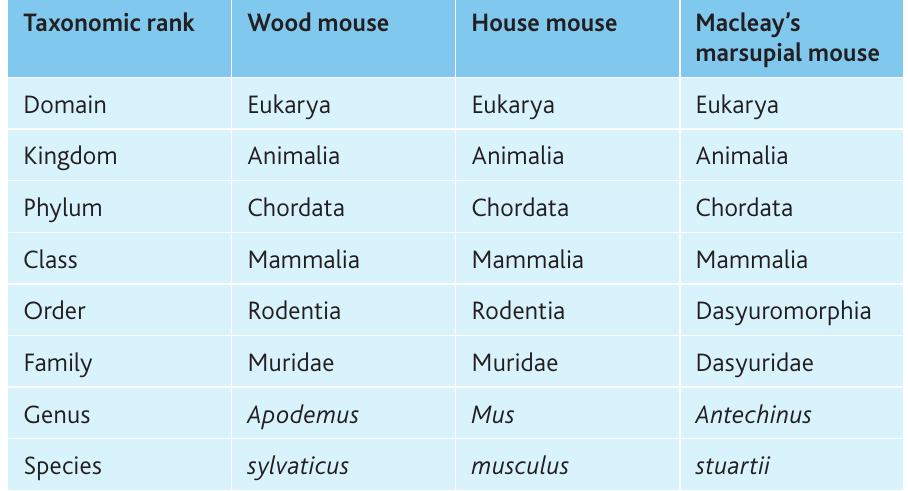
The following table compares the classification of three superficially similar mammals, demonstrating how the system reveals true evolutionary relationships:
Example
Worked Example: Revealing True Relationships Through Classification
Comparing three "mouse" species:
The wood mouse (Apodemus sylvaticus) and house mouse (Mus musculus) are both placental mammals in the order Rodentia, sharing classification down to family level (Muridae).
However, Macleay's marsupial mouse (Antechinus stuartii) – despite its mouse-like appearance and common name – belongs to a completely different order (Dasyuromorphia) and family (Dasyuridae).
Key insight: The wood mouse and house mouse are genuinely closely related (same order and family), while the marsupial mouse is only superficially similar due to convergent evolution. Classification reveals evolutionary relationships rather than superficial similarities.
Taxonomy and classification terminology
Taxonomy is the study and practice of naming and classifying species, as well as organising them into the hierarchical system. Scientists who specialise in this field are called taxonomists.
Biological classification refers to the organisation of living and extinct organisms into systematic groups based on similarities and differences between species. Classifications can be:
Note
Two Types of Classification Systems:
-
Natural classifications – attempt to show evolutionary relationships using many features of organisms. These reflect the actual evolutionary history and can predict characteristics.
-
Artificial classifications – devised for specific practical purposes (such as identification keys) using only a few features. These serve immediate practical needs but don't reflect evolutionary relationships.
Why this matters: Natural systems reflect evolutionary history and can predict characteristics, whereas artificial systems serve only their immediate practical purpose.
Regulation of scientific names
International organisations maintain codes to regulate organism naming:
Note
International Naming Codes:
- International Code of Zoological Nomenclature (for animals)
- International Code of Nomenclature for Algae, Fungi and Plants
- International Code for Nomenclature of Bacteria
These codes ensure consistency and prevent the same name being used for multiple species within the same kingdom.
Remember!
Summary
Key Points to Remember:
-
The binomial system gives each species two names: a generic name (genus) and specific epithet, written in italics or underlined
-
Scientific names follow strict formatting rules: generic name capitalised, specific epithet lowercase, both in italics when printed
-
Hierarchical classification organises life into nested ranks from domain (most inclusive) to species (least inclusive)
-
The taxonomic ranks in order are: Domain, Kingdom, Phylum, Class, Order, Family, Genus, Species
-
A taxon is any named group at any rank (e.g., Mammalia is a taxon at class level)
-
Classification reveals evolutionary relationships – organisms sharing lower taxonomic ranks are more closely related than those sharing only higher ranks