Darwin's Observations (OCR A-Level Biology A): Revision Notes
📚Revision Notes
Darwin's Observations
Introduction to convergent evolution
Before examining Darwin's key observations, it helps to understand how similar environments can shape organisms in comparable ways. Around 50 million years ago, marsupials migrated to Australasia and evolved to occupy various ecological niches, including underground habitats. The marsupial moles of western and northern Australian deserts demonstrate remarkable similarities to European placental moles, despite not sharing a recent common ancestor.
Note
Both species share several adaptations for subterranean life:
- Powerful forelimbs with large claws suited for digging
- Ear openings concealed beneath fur rather than external ear structures
- Reduced vision (marsupial moles have non-functional eyes; placental moles can only detect light)
- Dense, smooth fur texture
These shared features arose through convergent evolution – the independent development of similar characteristics in unrelated species facing comparable environmental challenges. The species differ in some respects: marsupial moles possess a hardened head region and uniquely fused neck vertebrae, whilst European moles have elongated snouts.
Darwin's four key observations
When developing his theory of natural selection, Charles Darwin identified four fundamental observations about living organisms:
1. Overproduction of offspring
All organisms produce far more offspring than will ultimately survive to adulthood. Darwin calculated that a single pair of elephants could theoretically produce million descendants over approximately – years if all offspring survived and reproduced.
2. Population stability
Whilst population numbers fluctuate, they generally remain relatively constant over time. Populations do not show the exponential growth that would occur if all offspring survived.
3. Intraspecific variation
Individuals within a population show variation in many characteristics. This intraspecific variation arises during sexual reproduction through processes such as:
- Crossing over during meiosis
- Independent assortment of chromosomes
- Random fusion of gametes
4. Inheritance of characteristics
Offspring resemble their parents because features are transmitted from one generation to the next. Although Darwin did not understand the mechanism (genes and alleles were unknown at the time), he recognised that gametes must carry information determining an organism's characteristics.
Important
These four observations form the foundation of Darwin's theory of natural selection. Understanding each observation is essential for comprehending how evolution occurs through natural selection.
Darwin's inferences from his observations
From these observations, Darwin drew several important conclusions:
1. Competition for limited resources
With more organisms produced than can survive, there exists what Darwin termed a "struggle for life". Individuals within the same population compete for finite resources such as:
- Food and water
- Space and shelter
- Mates
- Light (for plants)
2. Differential survival based on adaptation
Organisms possessing features that make them better adapted to their environment have a higher chance of surviving long enough to reproduce. Those less well adapted face greater risk of death before reaching reproductive age.
3. Inheritance of advantageous characteristics
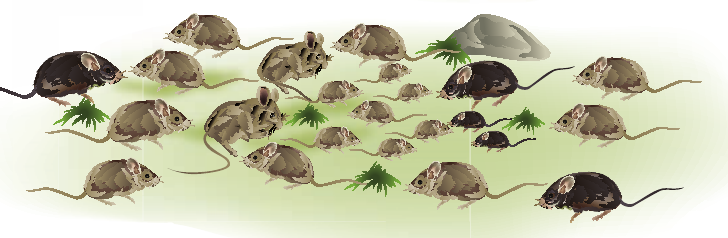
Successful organisms pass their inherited characteristics to offspring. The next generation therefore contains a higher proportion of individuals with advantageous features compared to those less well adapted.
4. Gradual population change
This unequal survival and reproduction leads to gradual shifts in population characteristics, with certain adaptations becoming more frequent across generations.
Competition and environmental pressures
Resources in any environment exist in limited quantities. When more organisms are present than the environment can support, many individuals die, maintaining relatively stable population sizes across generations.
Note
Heterotrophic organisms (consumers) face environmental factors including:
- Food availability
- Water supply
- Disease prevalence
- Predation pressure
Autotrophic organisms (producers) are controlled by:
- Disease and herbivory
- Light intensity
- Carbon dioxide concentration
- Water availability
- Mineral ion supply
Poorly adapted individuals have reduced survival chances and higher mortality rates before reproduction.
Natural selection
Natural selection describes how environmental factors affect a population such that individuals best adapted to prevailing conditions have a higher chance of surviving, reproducing, and passing their advantageous alleles to future generations. It represents the primary mechanism driving evolutionary change.
Organisms better equipped to:
- Obtain resources efficiently
- Avoid lethal diseases
- Escape predation
are more likely to survive to reproductive age, find mates, and transmit their alleles to subsequent generations. These individuals are "selected" by environmental conditions.
Natural selection in stable versus changing environments
When environmental conditions remain stable, natural selection maintains existing species characteristics. However, if conditions change, selection pressures shift. Features previously disadvantageous may become beneficial, allowing organisms with these traits to compete more successfully.
Important
The continuous generation of variation within each generation enables species to adapt to changing conditions. This demonstrates the interconnection between variation, adaptation, and selection in evolutionary processes.
In changing environments, individuals at one extreme of the natural variation range often show highest survival. For example, in colder climates, larger mice with smaller surface area to volume ratios survive better.
Understanding "survival of the fittest"
Darwin's theory is often reduced to the phrase "survival of the fittest", which many misinterpret as "survival of the strongest". This oversimplification misses the subtlety of natural selection.
In biology, fitness has a specific meaning: the ability of organisms to survive to adulthood and reproduce successfully. By this definition, the fittest organisms are simply those that survive and reproduce – making the phrase somewhat circular and less meaningful than the detailed explanation of natural selection mechanisms.
Note
The true principle involves organisms with any advantageous features (not just strength) – such as cunning in predators, camouflage, disease resistance, or efficient resource use – having higher reproductive success.
Worked example: beach mice evolution
The oldfield mouse (Peromyscus polionotus) typically lives in overgrown agricultural fields across the USA and possesses dark brown fur. However, populations colonising light-coloured sand dunes and barrier islands along the Florida and Alabama coasts have evolved much lighter fur colouration. These are known as beach mice.
Beach mice feed primarily at night on seeds and construct extensive burrow systems. Their main predators include owls, foxes, and domestic cats. Predation experiments demonstrated that owls (night-hunting predators) captured conspicuously coloured mice most frequently.
Example
Worked Example: How beach mice evolved from oldfield mice
Step 1: Among the original oldfield mouse population, natural variation in coat colour existed
Step 2: Mice colonising beaches and sand dunes faced significant predation pressure
Step 3: Night-hunting owls more easily detected and caught darker-coloured mice against light sand
Step 4: Lighter-coloured mice possessed better camouflage, making them better adapted to beach habitats
Step 5: These better-camouflaged individuals had higher survival rates and greater reproductive success
Step 6: Alleles for lighter coat colours (white, yellow, light brown) were passed to offspring more frequently
Step 7: Over time, these alleles increased in frequency within the beach population
Step 8: Eventually, the beach population developed characteristically lighter colouration compared to inland populations
Why beach mice remain the same species
Beach mice and oldfield mice are classified as the same species because they:
- Can interbreed to produce fertile offspring
- Share many common features
- Have very similar DNA sequences
Potential for speciation
Beach mice could evolve into a separate species through:
- Reproductive isolation: Geographical barriers separating beach and inland populations
- Mutation accumulation: New mutations arising independently in the beach population
- Natural selection: Beneficial mutations becoming "fixed" through selection for beach adaptations
- Genetic divergence: Accumulation of differences over time until interbreeding becomes impossible
Summary
Key Points to Remember:
-
Darwin identified four key observations: overproduction of offspring, stable populations, intraspecific variation, and inheritance of characteristics
-
These led to four inferences: competition for resources, differential survival, inheritance of advantageous traits, and gradual population change
-
Natural selection is the process by which environmental factors determine which individuals survive and reproduce, not just a simple "survival of the fittest"
-
Fitness in biology means surviving to adulthood and reproducing successfully, not just being strongest
-
Variation within populations is essential for natural selection to operate, particularly when environmental conditions change