Natural Selection in Action (OCR A-Level Biology A): Revision Notes
📚Revision Notes
Natural Selection in Action
Evolution is often perceived as a process requiring millions of years, yet observable evolutionary changes can occur within remarkably short timescales. Drug resistance in bacteria and pesticide resistance in insects demonstrate how natural selection can rapidly alter populations when strong selective pressures are applied. These modern examples show evolution happening in real time, with serious implications for medicine and agriculture.
Note
While evolution is commonly associated with geological timescales, the emergence of drug-resistant bacteria and pesticide-resistant insects shows that evolution can occur within human lifetimes when selective pressures are strong enough.
Drug resistance in bacteria
The emergence of antibiotic resistance
Antibiotics became widely available in the late 1940s and revolutionised the treatment of bacterial infections such as tuberculosis. However, within years of their introduction, doctors observed that some antibiotics were becoming less effective. This occurred because a small number of bacteria possessed genes that enabled them to survive exposure to these drugs. When an antibiotic is used to treat an infection, it creates a powerful selective pressure. Bacteria without resistance genes die, while those carrying resistance genes survive, reproduce, and pass these advantageous alleles to their offspring. Over successive generations, the proportion of resistant bacteria in the population increases dramatically.
Origins of antibiotic resistance
Bacteria acquire antibiotic resistance through two main routes. First, a spontaneous mutation may occur in a chromosomal gene, producing a variant that codes for a polypeptide unaffected by the antibiotic. Second, bacteria can obtain a plasmid (a small circular piece of DNA) carrying resistance genes from another bacterium through horizontal gene transfer. This transfer can even occur between different bacterial species, allowing resistance to spread rapidly through diverse bacterial populations.
Important
Resistance genes can be transferred between different bacterial species through plasmids, meaning resistance can spread beyond the original population to create multi-species resistance problems.
Mechanisms of antibiotic resistance
Resistance genes operate through several distinct mechanisms:
- Some code for enzymes that chemically break down the antibiotic molecule before it can harm the cell. For example, penicillinase is an enzyme that cleaves penicillin, rendering it ineffective. Penicillin normally kills bacteria by preventing cell wall synthesis, but bacteria producing penicillinase are protected from this effect.
- Other resistance genes produce membrane proteins that actively pump antibiotic molecules out of the cell as quickly as they enter, preventing the drug from reaching concentrations high enough to be lethal.
- Many antibiotics work by binding to and inhibiting key proteins involved in DNA replication, transcription, or translation. Mutations can alter the three-dimensional structure of these target proteins, eliminating the binding site for the antibiotic whilst preserving the protein's normal function.
Note
Memory aid for resistance mechanisms: EPT
- Enzymatic breakdown - enzymes destroy the antibiotic
- Pump out - membrane proteins expel the drug
- Target modification - altered proteins prevent drug binding
Bacterial genetics and rapid selection
Bacteria are haploid organisms, possessing only a single circular chromosome and therefore just one copy of each gene. This means that any mutation conferring antibiotic resistance has an immediate effect on the bacterium's phenotype, unlike diploid organisms where recessive mutations may be masked by dominant alleles. When antibiotics are present in the environment, resistant bacteria gain an enormous selective advantage.
Bacteria reproduce asexually through binary fission, where the chromosome is replicated and the cell divides into two identical daughter cells. Under optimal conditions, this process occurs very rapidly. A single resistant bacterium can potentially produce million descendants within hours. This explosive reproductive capacity means that resistance can spread through a bacterial population with remarkable speed.
Example
Example: Bacterial Reproduction Rate
Starting with just 1 resistant bacterium:
- After 24 hours: million descendants
- All descendants carry the resistance gene
- This rapid reproduction allows a resistant strain to quickly dominate a population when antibiotics are present
Clinical consequences
When a patient takes antibiotics to treat a bacterial infection, susceptible bacteria are killed and the few resistant individuals should be eliminated by the immune system. If the full course of antibiotics is completed correctly, the entire disease-causing bacterial population is usually destroyed. However, if patients stop taking the antibiotic when they start feeling better, some less susceptible bacteria may survive. These survivors form a partially resistant population, and subsequent infections may not respond to the same antibiotic.
Important
The Danger of Incomplete Treatment
Stopping antibiotics early doesn't just risk your own recovery - it creates partially resistant bacterial populations that can spread to others and become untreatable. Always complete the full prescribed course, even when symptoms improve.
The consequences for public health are severe. Medical authorities warn that we are approaching a post-antibiotic era. Despite careful stewardship, strains of bacteria now exist that are untreatable with available antibiotics. Bacteria such as Mycobacterium tuberculosis and methicillin-resistant Staphylococcus aureus (MRSA) have developed resistance to multiple antibiotics. No new class of antibiotic has been discovered since the 1980s, though researchers announced in January 2015 the discovery of teixobactin, a compound isolated from previously unculturable soil bacteria that showed activity against Mycobacterium and Staphylococcus aureus without detectable resistance.
Strategies to reduce antibiotic resistance
Healthcare systems have implemented several strategies to slow the spread of resistance:
- Antibiotics should only be prescribed when absolutely necessary and not for viral infections or as a precautionary measure
- Patients must complete the full course of treatment to ensure all bacteria are killed
- Doctors and hospitals rotate the antibiotics they use, preventing continuous exposure to a single type
- Some antibiotics are reserved as 'last resort' treatments, used only when all other options have failed
- Finally, sustained investment in research to discover new antibiotics is essential, though the economics of antibiotic development present significant challenges
Note
PREFER Strategy for Antibiotic Stewardship:
- Prescribe wisely - only when necessary
- Rotate antibiotics - prevent continuous exposure
- Ensure completion - full courses only
- Find new drugs - invest in research
- Emergency reserves - save last-resort antibiotics
- Research - continue discovering new treatments
Pesticide resistance in insects
Pesticides and agricultural pests
Pesticides are chemicals designed to kill organisms that damage crops, transmit disease, or compete with desired species. This broad category includes:
- Insecticides (for insects)
- Fungicides (for fungi)
- Herbicides (for weeds)
- Molluscicides (for slugs and snails)
- Rodenticides (for rodents)
Insecticides are used both to control crop pests and to reduce populations of disease vectors such as Anopheles mosquitoes (which transmit malaria) and tsetse flies (which transmit sleeping sickness).
The problem of monocultures
Modern agriculture often involves growing a single crop species over large areas of land, a practice called monoculture. This removes food availability as a limiting factor for specialist pest populations. For example, a field of potatoes provides abundant resources for Colorado potato beetles (Leptinotarsa decemlineata). When other environmental conditions such as temperature are favourable, pest numbers can increase exponentially, causing significant crop damage and reduced yields.
Note
Monocultures create ideal conditions for pest population explosions because they provide unlimited food resources for specialist pests. A diverse crop system naturally limits pest numbers by reducing food availability.
Farmers apply insecticides to control these pest populations. However, if even a small number of individuals possess genetic variants conferring resistance to the pesticide, these insects will survive whilst susceptible individuals die. With reduced competition for food and other resources, resistant insects are more likely to survive and reproduce successfully.
Selection for resistance
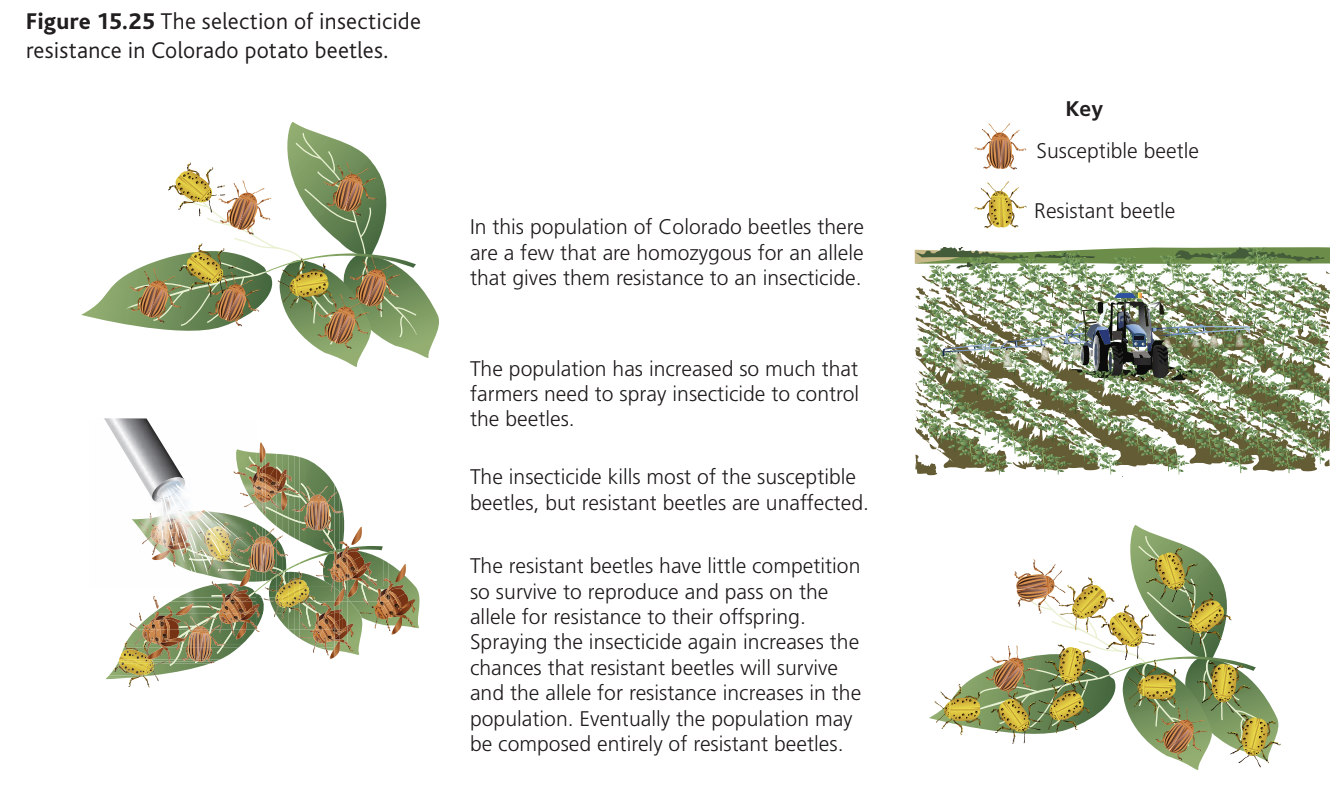
The selection process in insect populations mirrors that in bacteria. Within a population of Colorado beetles, a few individuals may be homozygous for an allele providing resistance to a particular insecticide. When farmers spray the field, susceptible beetles are killed whilst resistant individuals survive. These resistant beetles face little competition and successfully reproduce, passing the resistance allele to their offspring. Repeated applications of the same insecticide progressively increase the frequency of the resistance allele. Eventually, the entire population may consist of resistant individuals, rendering the insecticide ineffective.
Example
Example: Selection for Resistance in Colorado Potato Beetles
Initial population: Mixed susceptible and resistant beetles ↓ First insecticide application: Susceptible beetles killed, few resistant survive ↓ Reproduction: Resistant beetles breed with reduced competition ↓ Next generation: Higher proportion of resistant individuals ↓ Repeated applications: Resistance allele frequency increases each cycle ↓ Final result: Population becomes predominantly or entirely resistant
In this example, the insecticide acts as a selective agent – an environmental factor that influences survival and reproduction, thereby driving natural selection. The same principle applies to antibiotics acting on bacterial populations.
Managing pesticide resistance
Pesticide manufacturers and agricultural advisors have developed strategies to delay the evolution of resistance:
- Farmers are advised to limit applications of any single pesticide to a specified number of times before switching to a different chemical with a different mode of action. This rotation strategy prevents continuous selection for resistance to one pesticide type.
- Mixing two or more pesticides with different mechanisms before application means an individual insect would need resistance to multiple chemicals simultaneously to survive, substantially reducing the probability of resistance evolving.
- Farmers are discouraged from applying insecticides as a preventative measure or 'insurance policy' against potential pest invasions. Instead, they should monitor their crops carefully and only apply chemicals when pest populations reach levels that pose a genuine threat to yield.
Important
Preventative pesticide application accelerates resistance evolution. Apply pesticides only when monitoring shows pest populations have reached economically damaging levels, not as a precautionary measure.
Integrated pest management combines multiple control strategies to reduce reliance on chemical pesticides:
- Biological control involves introducing or encouraging natural predators and parasites of pest species
- Plant breeders use selective breeding to develop crop varieties with natural resistance to pests
- Genetic modification can introduce genes enabling crops to produce toxins lethal to specific pests
- These approaches, combined with judicious use of chemical pesticides only when necessary, help maintain effective pest control whilst minimising the evolution of resistance
Selective agents in evolution
A selective agent is any environmental factor that influences which individuals within a population survive and reproduce. In the examples discussed, antibiotics and insecticides serve as powerful selective agents, creating strong directional selection favouring resistant individuals. Other selective agents include predators, availability of food or nesting sites, disease, temperature extremes, and competition for mates. Understanding how selective agents operate is essential for predicting and managing evolutionary change in populations.
Note
Definition: Selective Agent
Any factor in the environment that influences organism survival and reproduction, thereby bringing about natural selection. Selective agents can be biotic (predators, disease, competition) or abiotic (temperature, pH, chemicals).
Summary
Key Points to Remember:
-
Evolution can occur rapidly when strong selective pressures are applied, as demonstrated by drug and pesticide resistance
-
Bacteria acquire antibiotic resistance through spontaneous mutations or by receiving plasmids from other bacteria, even from different species
-
Resistance mechanisms include:
- Enzymatic breakdown of drugs (e.g., penicillinase)
- Membrane pumps that expel drugs from cells
- Modifications to target proteins that prevent drug binding
-
A single resistant bacterium can produce million descendants in hours through binary fission, allowing resistance to spread extremely rapidly
-
Combating resistance requires careful stewardship:
- Complete antibiotic courses - never stop early
- Rotate pesticides - don't use the same one repeatedly
- Use combination treatments - require multiple resistances simultaneously
- Implement integrated pest management - reduce reliance on chemicals
- Monitor before applying - only treat when necessary