Reasons for Maintaining Biodiversity (OCR A-Level Biology A): Revision Notes
📚Revision Notes
Reasons for Maintaining Biodiversity
Maintaining biodiversity is essential for ecological, economic, agricultural, and aesthetic reasons. Understanding these reasons helps explain why conservation efforts are so important for both natural ecosystems and human society.
Overview of reasons
There are four main categories of reasons for maintaining biodiversity:
- Ecological – maintaining ecosystem stability and function
- Economic – providing materials and services that support human economies
- Agricultural – supporting food production and soil health
- Aesthetic – preserving natural beauty and cultural value
Ecological reasons
Ecosystem stability
High biodiversity provides ecosystems with greater stability and resilience. Ecosystems with many different species can better withstand environmental changes such as storms, droughts, or temperature fluctuations. When these ecosystems experience damage, they also recover more rapidly and thoroughly compared to ecosystems with lower biodiversity.
Note
Two key concepts describe ecosystem stability:
Resistance is the ability of ecosystems to withstand environmental change without significant disruption.
Resilience is the ability of ecosystems to recover after experiencing damage or disturbance.
The role of keystone species
Important
Keystone species are organisms whose presence contributes more to ecosystem function than their population size or abundance would suggest. When a keystone species disappears from an ecosystem, species diversity decreases dramatically, interactions between species become simpler, and the entire ecosystem becomes unstable.
Keystone species create a "domino effect" when they disappear. Their loss triggers the loss of other species, and the intricate connections among the remaining organisms begin to unravel. Species losses cascade through the habitat as each loss prompts further losses.
Pacific sea otter example
Example
Case Study: Pacific Sea Otter as Keystone Species
The Pacific sea otter (Enhydra lutris) was one of the first identified keystone species. Sea otters prey on sea urchins, which feed on kelp stalks.
The cascade:
- When overhunting removed sea otters from the Pacific coast of North America, sea urchin populations exploded
- This led to devastation of kelp forests and loss of many species associated with kelp
- After legislation protected sea otters from hunting, their numbers increased, sea urchin populations came under control, and kelp forests recovered
Elephant examples
Example
Contrasting Keystone Roles: Forest vs. Savannah Elephants
Different elephant species demonstrate keystone roles in contrasting ecosystems:
Forest elephants (Loxodonta cyclotis) in West and Central Africa are the only animals able to disperse seeds of many tree species. Without elephants, approximately of tree species would disappear, changing forest composition and reducing biodiversity.
Savannah elephants (Loxodonta africana) prevent grassland from changing to forest by eating or uprooting acacia trees before they become established. Without elephants, trees would form a canopy, grasses would be shaded out, and large grazers such as zebras and wildebeest would disappear.
Apex predators and trophic cascades
Apex predators are top predators with no natural predators of their own. They are typically large, fierce animals with small populations extending over wide areas. Some keystone species are apex predators, though many are not.
Note
Apex predators create trophic cascades – effects that extend from their prey populations down through multiple trophic levels to producers. These cascading effects can be observed when apex predators disappear from or are reintroduced to ecosystems.
Loss of apex predators
Example
Impact on Human Populations: Ghana Case Study
The loss of apex predators can have serious consequences for human populations. In Ghana, decreased populations of lions and leopards led to an increase in olive baboons, whose numbers were previously controlled by these predators.
Consequences:
- With fewer predators, baboon populations increased dramatically
- Baboons began attacking livestock
- Baboons damaged crops
- Baboons spread intestinal parasites to human populations
Reintroduction of apex predators
Example
Ecosystem Recovery: Gray Wolves in Yellowstone
The gray wolf (Canis lupus) was reintroduced to Yellowstone National Park in the USA with effects that spread throughout the food web:
- Wolves reduced elk (Cervus canadensis) populations
- This decreased grazing of vegetation along river banks
- Vegetation recovery increased habitats for beavers
- Carcasses abandoned by wolves provided food for bears and many other bird and mammal species
Identifying keystone species
Identifying keystone species is much more difficult than identifying apex predators. The process often involves long-term monitoring of an ecosystem following loss or removal of the organisms concerned, then determining whether substantial changes occur in biodiversity, community structure, and energy flow.
Case study: Merriam's kangaroo rat
The Chihuahuan Desert in Mexico contains several species of seed-eating rodents. Merriam's kangaroo rat (Dipodomys merriami) has been identified as a keystone species because of its influence on plant diversity and energy flow in the desert ecosystem. This species has a very large skull for its overall body size, allowing it to crush larger or harder seeds than other rodents can eat.
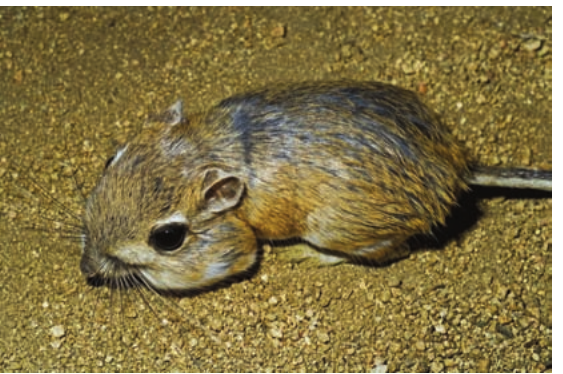
Researchers investigated feeding relationships among different rodent species using an exclusion experiment. They erected fences around experimental plots ( m) that small rodents could enter but kangaroo rats could not. Control plots were identical except that kangaroo rats could enter through the fences.
The experiment lasted over years, during which researchers measured species composition and energy use of rodent populations in both experimental and control plots.
Example
Key Findings from the Exclusion Experiment:
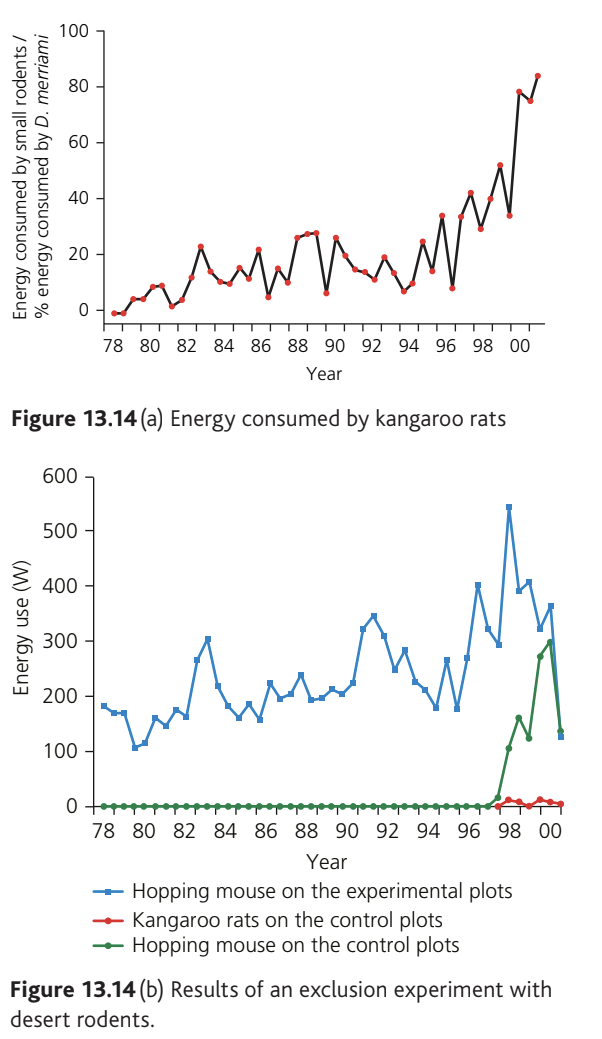
Six seed-eating species colonised the experimental plots with population densities twice as large as on control plots. In 1996, a larger rodent species, the hopping mouse (Chaetodipus baileyi), invaded from a population approximately km away. The population of hopping mice on experimental plots was 20 times larger than on control plots.
Without kangaroo rats, smaller rodents consumed increasing amounts of energy over time. By 2000, all rodents in experimental plots were consuming nearly 80% of the energy taken by kangaroo rats in control plots. Despite this increased consumption, uneaten seeds never accumulated, suggesting other animals (invertebrates or birds) were also eating seeds.
The hopping mouse has a smaller skull than the kangaroo rat, allowing it to squeeze through fence holes. On experimental plots without kangaroo rats, hopping mice competed successfully for seeds. On control plots, hopping mice were outcompeted by kangaroo rats.
Conclusion: This experiment demonstrated that kangaroo rats are keystone species – their presence limits populations of other seed-eating rodents and affects energy flow through the entire ecosystem.
Economic reasons
Natural ecosystems provide direct economic benefits through materials and ecosystem services.
Materials from natural ecosystems
Although monocultures provide most human food, natural ecosystems still supply important products:
- Food sources – fish and other wildlife
- Timber – wood for construction and fuel
- Medicinal compounds – important drugs discovered in plant and animal species
- Industrial chemicals – substances difficult to synthesise artificially
Note
Examples of Economically Important Species:
The thermophilic bacterium Thermus aquaticus provides heat-stable DNA polymerase used in the polymerase chain reaction (PCR). This enzyme has applications in industry, medicine, and forensics.
Sisal (Agave sisalana) provides fibres used to make rope, paper, carpets, and dart boards. When habitats disappear, wild populations of commonly grown plants are reduced. This affects plants like African violet (Saintpaulia), a common house plant whose wild populations are declining.
Important
Without genetic diversity in wild populations, plant breeders find it harder to breed new varieties, reducing income for the horticultural industry.
Ecosystem services
Ecosystem services are the benefits that natural ecosystems provide to support life and human wellbeing. These include fresh water, oxygen, and a suitable climate.
Note
Examples of Ecosystem Services:
- Water cycle contribution – plants transpire water vapour, contributing to the water cycle and providing drinking water
- Water filtration – water is filtered through soils and rock before entering water supplies
- Soil fertility maintenance – nutrient cycling by decomposers and microbes that convert nitrogen, phosphorus, and sulfur compounds
- Waste breakdown – organic waste material added to waters is decomposed
- Coastal protection – reefs and mangrove forests protect coasts from erosion
- Climate moderation – habitats moderate floods, droughts, and extremes of wind and temperature
- Pollination – insects and other pollinators fertilise crop plants like fruit trees, oilseed rape, and sunflowers
- Pest and disease control – diverse habitats support organisms that interact to keep pests and diseases in check
- Carbon storage – forests and peat bogs absorb carbon dioxide and help reduce atmospheric carbon dioxide increases; they act as carbon sinks (e.g., the Flow Country in northern Scotland)
Placing monetary values on material products from ecosystems is straightforward, but valuing ecosystem services is more difficult. However, expressing ecosystem value in monetary terms helps people realise that conserving ecosystems and species is worthwhile.
Agricultural reasons
Biodiversity plays an important role in maintaining soil structure and fertility. Continual monocultures reduce soil biodiversity significantly.
Note
Impact of Monocultures on Soil Biodiversity:
A survey of soil bacterial biodiversity in soybean monocultures in Argentina found fewer bacterial species than in both local natural ecosystems and farmland managed with crop rotation.
Maintaining good soil structure with plenty of decomposing organic material helps bind soil particles together, preventing soil erosion and nutrient loss.
Diverse soil communities support nutrient cycling, improve water retention, and contribute to overall soil health – all essential for sustainable agriculture.
Aesthetic reasons
Natural beauty and cultural value
Areas of natural wilderness and managed countryside are appreciated as beautiful places that should be conserved for future generations. Many people value the aesthetic appeal of diverse species and natural landscapes. Amateur ornithologists and botanists enjoy observing wildlife, and the natural world provides inspiration for artists, photographers, poets, writers, and other creative people.
Biophilia and nature connection
Note
Biophilia is a term coined by E.O. Wilson to describe the innate human love of nature. As more than half the world's population now lives in urban rather than rural environments, providing natural places for people to experience has become increasingly important.
Important
The term "nature-deficit disorder" describes people who have little or no interaction with nature – a growing concern in modern urbanised societies.
Ecotourism
Ecotourism generates significant income for many countries. Costa Rica and Belize in Central America, Dominica in the Caribbean, and the Maldives in the Indian Ocean all promote ecotourism as an important part of their economies. Whale-watching alone was estimated to generate over $1 billion in 2008, with over million people participating in countries.
Flagship and umbrella species
Note
Flagship species are charismatic species that become subjects of conservation campaigns. Examples include mountain gorillas in Rwanda, giant pandas in China, and ospreys in Scotland. People often visit specific locations to see these spectacular species, as when visiting reserves like the Masai Mara in East Africa.
Umbrella species are organisms whose conservation indirectly protects many other species in their ecosystem. Conserving these species in their natural habitat inevitably involves conserving their entire life-support systems and the biodiversity of their ecosystems.
Example
Umbrella Species in Action: Golden Eagles
Golden eagles (Aquila chrysaetos) serve as umbrella species. Breeding populations require extensive open upland and good prey supplies.
Conservation benefit: Protecting golden eagles indirectly protects their prey and other species that depend on large areas of mountain habitat.
Summary
Key Points to Remember:
- Four main reasons exist for maintaining biodiversity: ecological, economic, agricultural, and aesthetic
- Keystone species have disproportionately large effects on ecosystems relative to their population size; their loss triggers cascading species losses
- Ecosystem stability depends on biodiversity – high biodiversity provides both resistance to environmental change and resilience for recovery after damage
- Ecosystem services (water cycling, pollination, carbon storage, etc.) provide essential life-support functions that are difficult to value monetarily but are critical for human survival
- Conservation of flagship species (like golden eagles or giant pandas) protects entire ecosystems and acts as an umbrella for many other species