Gaseous Exchange System in Mammals (OCR A-Level Biology A): Revision Notes
📚Revision Notes
Gaseous Exchange System in Mammals
Surface area to volume ratio
As organisms increase in size, their volume grows faster than their surface area. This creates a decreasing surface area to volume ratio (SA
ratio), which poses a challenge for gas exchange.When an organism is small, its SA
ratio is high, allowing sufficient oxygen absorption and carbon dioxide removal through simple diffusion across the body surface. However, as size increases, the volume of the organism increases by a greater factor than the surface area. This means oxygen demand exceeds the supply capacity of the surface, and carbon dioxide production exceeds the removal capacity.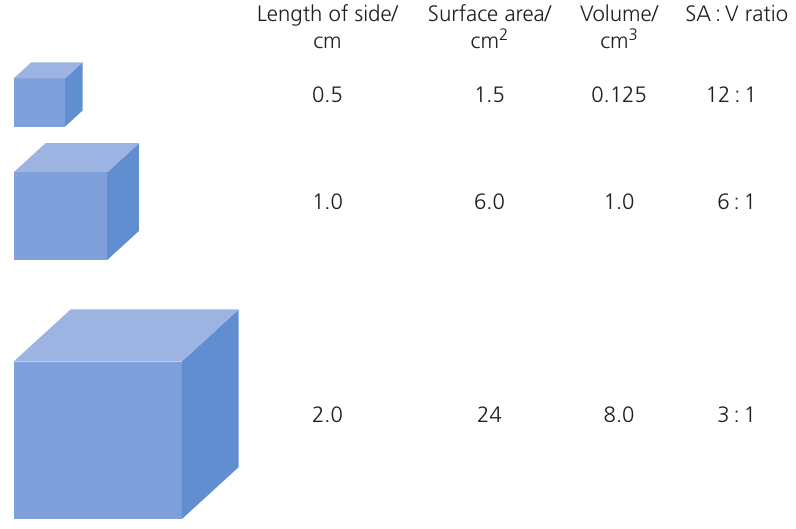
Example
Worked Example: SA
Ratio CalculationsConsider three cubes with different side lengths:
Cube 1 (side = ):
- Surface area =
- Volume =
- SA ratio =
Cube 2 (side = ):
- Surface area =
- Volume =
- SA ratio =
Cube 3 (side = ):
- Surface area =
- Volume =
- SA ratio =
Notice how doubling the size reduces the SA
ratio by half!Although animals have more complex shapes than cubes, they possess compact bodies, making the cube a valid model for understanding this concept.
Note
For the gas exchange surface itself, absolute surface area matters rather than SA
ratio. However, when considering the whole organism, the SA ratio determines whether a specialized gas exchange system is required.Structure of the mammalian respiratory system
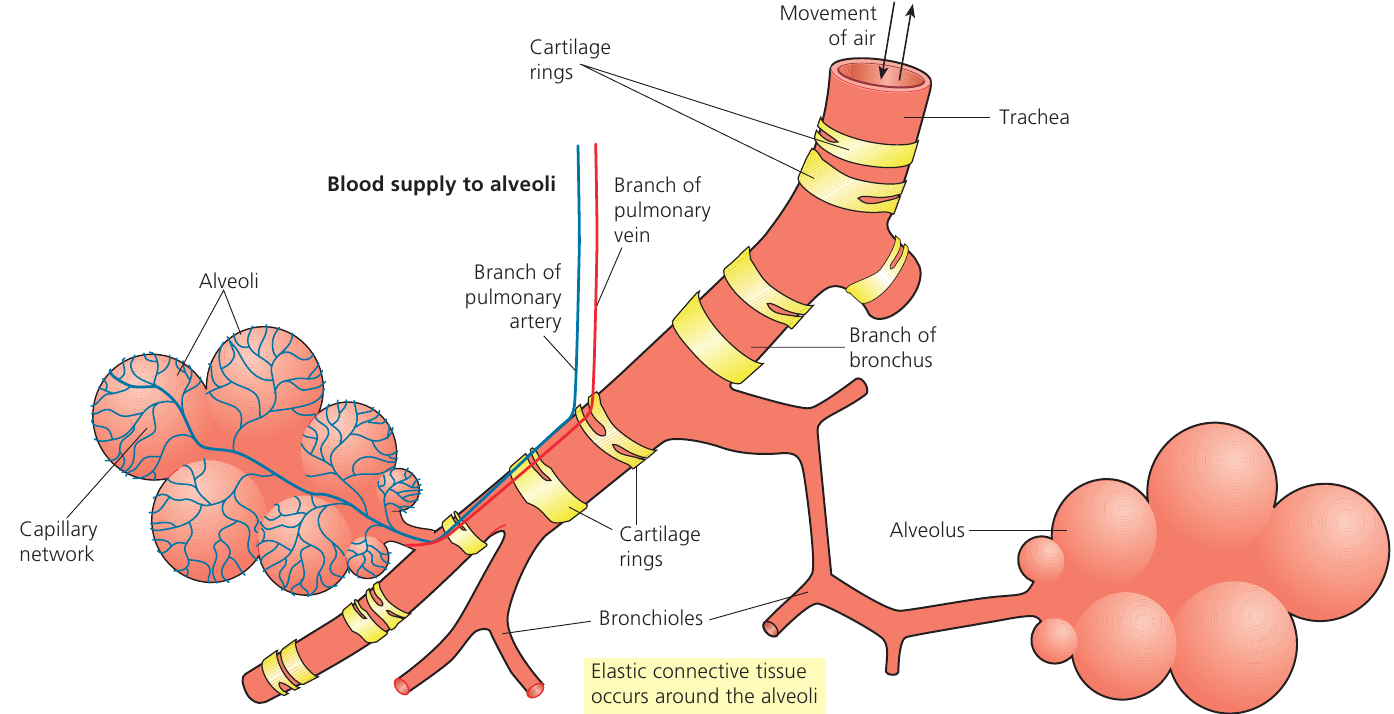
Mammals exchange gases at specialized structures called alveoli (singular: alveolus), which are air sacs located within the lungs.
Pathway of air
Air enters through the mouth and nose, passing into the trachea (windpipe). The trachea divides into two bronchi (singular: bronchus), with one branch supplying each lung. Each bronchus further subdivides into smaller tubes called bronchioles, which terminate in clusters of alveoli where gas exchange occurs.
Note
Air Pathway Mnemonic: Remember "The Big Brown Alligator"
- Trachea → Bronchi → Bronchioles → Alveoli
Thoracic cavity anatomy
The lungs occupy the thoracic cavity within the rib cage, which provides protection. Between the ribs lie the internal and external intercostal muscles, which move the rib cage during breathing, particularly during deeper respiration.
The lungs are enclosed by a double membrane called the pleural membranes. Between these membranes lies the pleural cavity, which contains pleural fluid. This fluid provides lubrication, reducing friction between the lungs and rib cage during breathing movements.
At the base of the thoracic cavity sits the diaphragm, a sheet of muscle that forms part of the ventilation mechanism.
Adaptations for efficient gas exchange
The mammalian gas exchange system possesses several structural features that optimize gas exchange efficiency. These adaptations are common across many animal groups, though different structures may be involved (such as gills in fish).
Important
Five Key Adaptations for Efficient Gas Exchange:
Remember "Large Thin Blood Vessels Move":
- Large surface area
- Thin walls
- Blood supply (extensive)
- Ventilation mechanism
- Moist surface
Large surface area
Gas exchange occurs across the alveoli, and an adult human possesses approximately 500-700 million alveoli. This provides a total surface area of 70-100 m² for gas exchange, maximizing the rate of diffusion.
Thin exchange surface
The alveolar walls consist of a single layer of simple squamous epithelium (flattened cells), as do the capillary walls through which gases must pass. This arrangement creates a short diffusion pathway.
Since diffusion is a slow process, minimizing the distance gases must travel is essential for efficient exchange. The combined thickness of the alveolar wall and capillary wall is only one cell thick on each side.
Extensive blood supply
Alveoli are surrounded by dense networks of capillaries that absorb oxygen and deliver carbon dioxide. Blood circulation continuously removes oxygenated blood and brings deoxygenated blood containing carbon dioxide. This maintains steep concentration gradients for both gases, ensuring diffusion continues rapidly.
Ventilation mechanism
The concentration gradient within alveoli is maintained by breathing, which acts as a ventilation mechanism. Breathing continuously removes air containing waste carbon dioxide and depleted oxygen levels, replacing it with fresh air containing high oxygen and low carbon dioxide concentrations. This maintains the gradient necessary for effective diffusion.
Moist surface
The gas exchange surface must be moist to function effectively. Oxygen molecules dissolve in the water layer lining the alveoli before diffusing across the epithelial cells into the blood. Carbon dioxide follows the reverse pathway.
Gas exchange mechanism
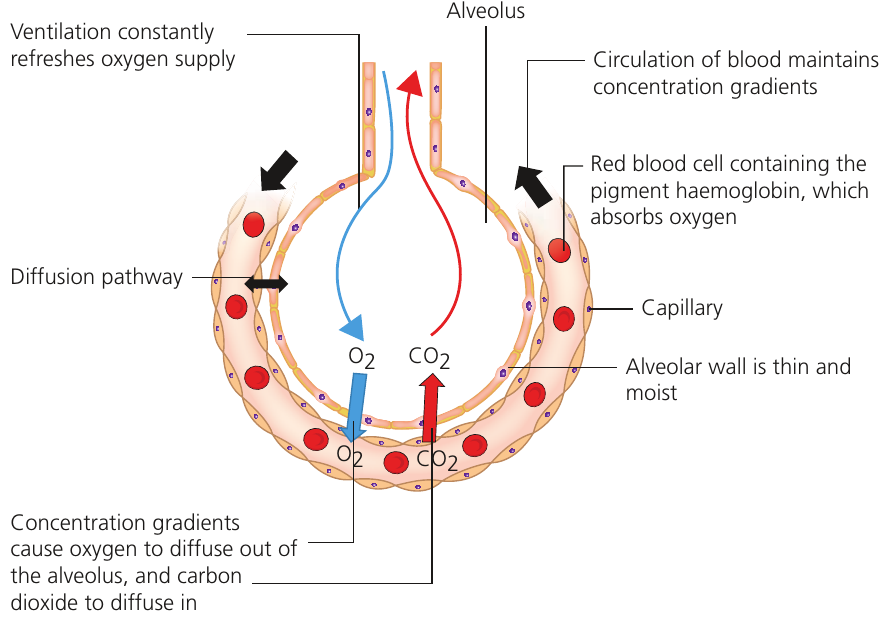
Gas exchange in an alveolus operates through diffusion driven by concentration gradients:
Oxygen movement: Oxygen concentration is higher in the alveolar air than in the blood arriving at the lungs. Oxygen dissolves in the moisture lining the alveolus and diffuses across the thin alveolar wall and capillary wall into the blood plasma. Red blood cells contain the pigment haemoglobin, which binds to oxygen molecules, absorbing them from the plasma.
Carbon dioxide movement: Carbon dioxide concentration is higher in the blood arriving at the lungs than in the alveolar air. Carbon dioxide diffuses from the blood, across the capillary and alveolar walls, and into the alveolar space, where it is removed during exhalation.
Note
Maintaining gradients: Two mechanisms ensure concentration gradients are maintained:
- Ventilation constantly refreshes the air in the alveoli, maintaining high oxygen and low carbon dioxide concentrations
- Blood circulation continuously removes oxygenated blood and delivers deoxygenated blood containing carbon dioxide
The terms concentration gradient and diffusion gradient are interchangeable and both describe the difference in concentration that drives diffusion.
Summary
Key Points to Remember:
- As organisms increase in size, their SA ratio decreases, requiring specialized gas exchange systems rather than relying on simple diffusion across the body surface
- Air travels through: trachea → bronchi → bronchioles → alveoli (the gas exchange surface)
- Five key adaptations enable efficient gas exchange: large surface area (70-100 m²), thin walls (one cell thick), extensive capillary networks, ventilation mechanism, and moist surface
- Gas exchange occurs by diffusion – oxygen moves from alveolar air into blood (absorbed by haemoglobin), whilst carbon dioxide moves from blood into alveolar air
- Ventilation and blood circulation work together to maintain the concentration gradients necessary for continuous gas exchange