Transport in Plants (OCR A-Level Biology A): Revision Notes
📚Revision Notes
Transport System Role and Structure
Why plants need transport systems
Flowering plants absorb water and mineral ions from the soil through their roots, while glucose is produced in the leaves through photosynthesis. All cells throughout the plant require these substances to function properly, so materials must be moved over considerable distances — sometimes many metres in large plants.
Note
Glucose is transported in the form of sucrose rather than as glucose itself. This conversion occurs because sucrose is non-reducing and therefore less reactive during transport, making it more suitable for long-distance movement through the plant.
To move these essential materials efficiently, flowering plants have evolved two distinct transport systems:
- Xylem — transports water and dissolved mineral ions upward from roots to leaves
- Phloem — transports nutrients (such as photosynthates and amino acids) both upward and downward throughout the plant
High surface area to volume ratio
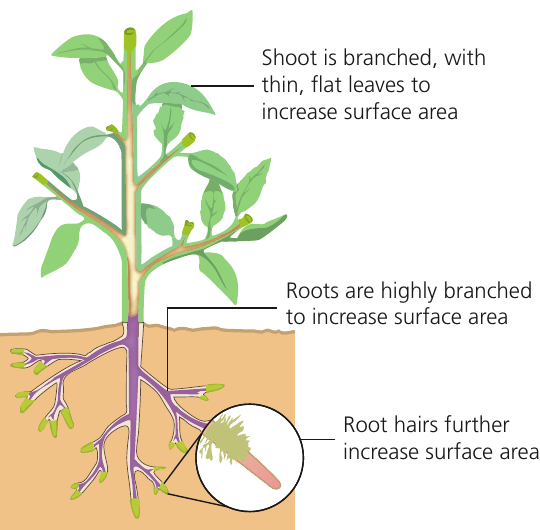
Plants possess a branching body structure that creates a very high surface area to volume ratio, even in large specimens. This is important because it reduces the distances over which diffusion must occur. Several features contribute to this:
- Leaves are thin and flat, maximising their surface area for light absorption and gas exchange
- Roots branch extensively underground, increasing the area available for water and mineral absorption
- Root hairs extend from root surfaces, greatly increasing surface area further
Note
Unlike larger animals, plants do not require a specialised system for transporting oxygen and carbon dioxide. This is because:
- The high surface area to volume ratio allows adequate gas exchange by diffusion
- Leaves and stems contain chloroplasts that generate oxygen and consume carbon dioxide during photosynthesis
- Plant tissues have relatively low metabolic rates, reducing oxygen demand for aerobic respiration
Structure of the vascular system
Plants possess a vascular system consisting of two separate networks of tubular tissues:
- Xylem vessels — transport water and mineral ions upward from roots to aerial parts
- Phloem sieve tubes — transport assimilates and minerals bidirectionally (both up and down the plant)
These vascular tissues are arranged differently depending on the plant organ (stem, root, or leaf), but they always occur together in vascular bundles.
Location in dicotyledonous plants
Important
Dicotyledonous plant: A flowering plant with two embryonic seed leaves (cotyledons), which usually emerge from the seed at germination.
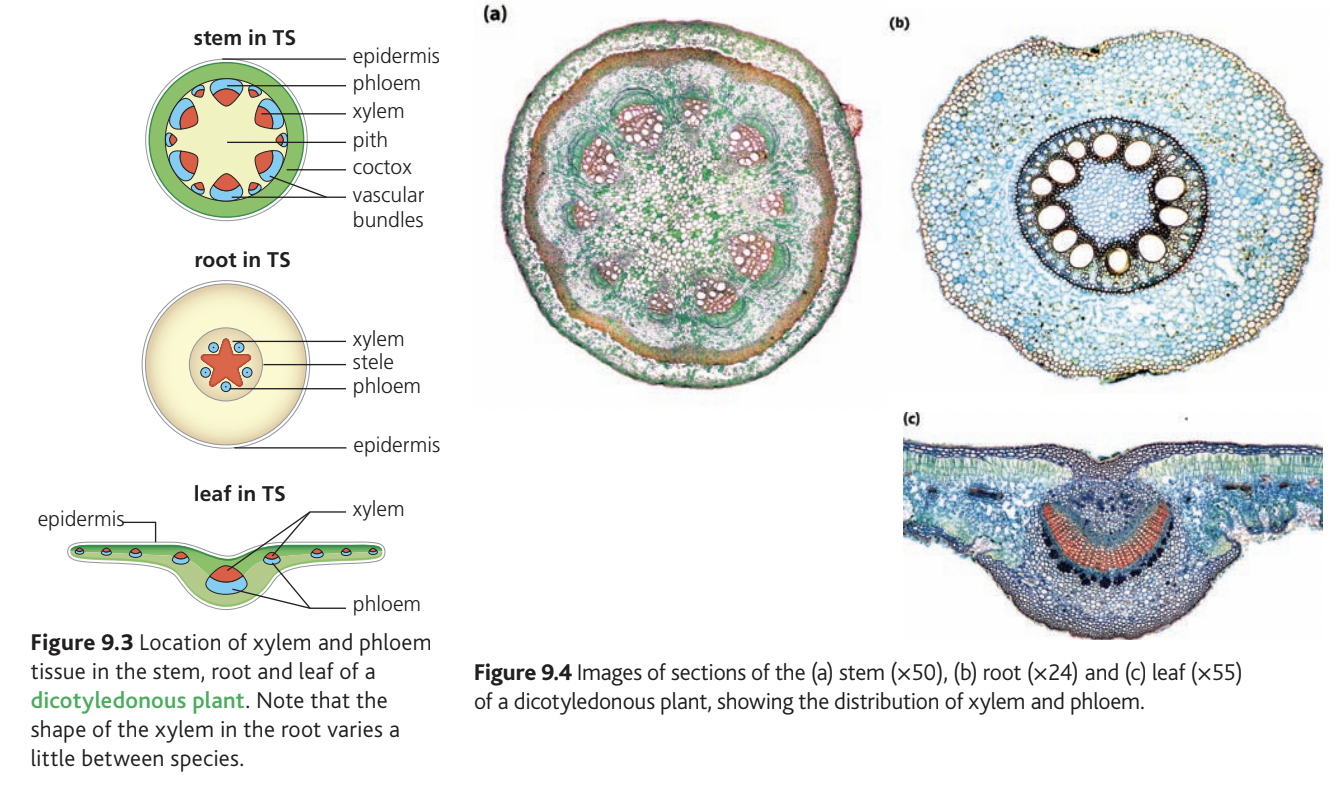
In dicotyledonous plants, the arrangement of xylem and phloem varies by organ:
- Stem — vascular bundles are arranged in a ring near the outer edge, with xylem toward the inside and phloem toward the outside
- Root — xylem and phloem form a central vascular cylinder called the stele, with xylem typically forming a star shape in the centre
- Leaf — vascular bundles (also called veins) run through the leaf, with xylem above and phloem below
Xylem structure and function
Xylem tissue contains multiple cell types — vessels, tracheids, fibres, and parenchyma — but the cells primarily responsible for transport are xylem vessel elements. These cells stack vertically to form continuous xylem vessels that can extend throughout the entire plant.
Adaptations for water transport
Xylem vessel elements are highly specialised for transporting water and dissolved mineral ions efficiently. Their structure also provides mechanical strength to support the plant.
Important
Key Structural Features for Water Transport:
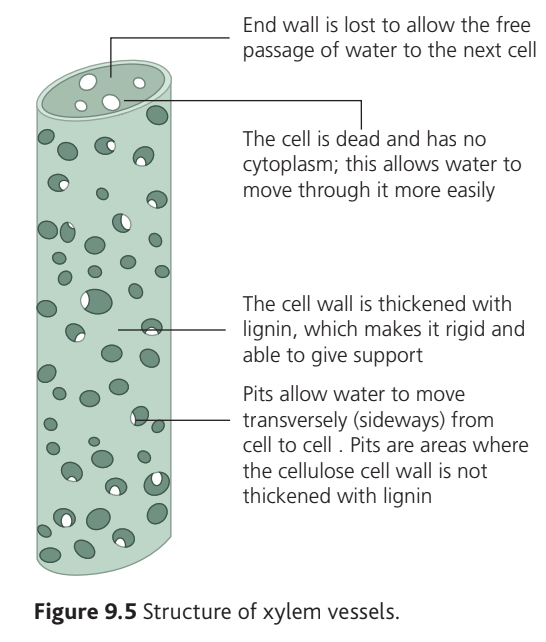
Xylem vessel elements have four main adaptations that make them perfectly suited for water transport:
-
Dead cells with no cytoplasm — once mature, xylem vessel elements die, leaving hollow tubes. This allows water to flow through them with minimal resistance
-
Lost or perforated end walls — the end walls between adjacent vessel elements break down completely or develop large perforations, creating a continuous tube for uninterrupted water flow
-
Lignified cell walls — cell walls become thickened and strengthened with lignin deposits. Lignin is a rigid, waterproof polymer that makes the vessels strong enough to withstand the negative pressure created during water transport. This also enables the xylem to provide structural support to the plant
-
Pits — areas where the cellulose cell wall remains unlignified. These gaps allow water to move laterally (sideways) from one xylem vessel to another, which is useful if one vessel becomes blocked or damaged
Patterns of lignin thickening
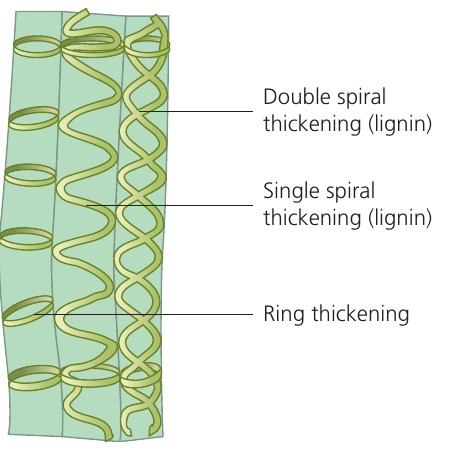
The lignin does not coat the entire cell wall uniformly. Instead, it is deposited in distinct patterns that vary between different xylem vessels:
- Ring (annular) thickening — lignin forms separate horizontal bands around the vessel
- Spiral (helical) thickening — lignin winds around the vessel in a single or double helix
- Reticulate thickening — lignin forms a network pattern
- Pitted thickening — lignin covers most of the wall except at pits
Note
These different patterns provide flexibility while maintaining strength. For example, spiral and ring thickening allow the vessel to stretch as the plant grows, while still providing support. This is particularly important in young, growing parts of the plant where tissue expansion is still occurring.
Dual function of xylem
Xylem serves two important roles:
- Water and mineral transport — the hollow tubes allow efficient upward movement of water and dissolved ions from roots to leaves
- Structural support — the rigid, lignified walls prevent the plant from collapsing under its own weight and help it stand upright
Phloem structure and function
In contrast to xylem, phloem tissue comprises living cells. The two main cell types involved in transport are sieve tube elements and companion cells.
Sieve tube elements
Sieve tube elements stack end-to-end to form continuous sieve tubes running through the plant. Each sieve tube element has distinctive features:
- Living but highly modified — the cells remain alive but lack a nucleus, have few organelles, and contain very little cytoplasm
- Reduced contents — this simplification may aid the transport of assimilates by reducing obstructions to flow
- Sieve plates — the end walls contain pores forming a sieve-like structure, which allows substances to pass from one element to the next
Important
Sieve tube elements cannot survive independently due to their lack of essential cellular machinery. This is why they must be supported by companion cells.
Companion cells
Each sieve tube element is associated with at least one companion cell. These cells act as a 'life support system' for the sieve tube elements:
- Metabolically active — companion cells contain a nucleus, numerous mitochondria, and other organelles
- Provide materials — they carry out metabolic functions and supply the sieve tube element with the proteins and ATP it needs to remain alive
- Connected via plasmodesmata — these cells are linked to sieve tube elements by plasmodesmata
Important
Plasmodesmata (singular: plasmodesma): Microscopic channels through plant cell walls, connecting the cytoplasm of two cells. These channels are lined with plasma membrane and allow molecules to move directly between cells without crossing the cell wall or extracellular space.
Comparison of xylem and phloem
| Feature | Xylem vessels | Phloem sieve tubes |
|---|---|---|
| Cell viability | Dead at maturity | Living cells |
| Nucleus | Absent | Absent in sieve tube elements; present in companion cells |
| Cytoplasm | None | Very little; reduced |
| Cell wall | Thickened with lignin | Cellulose only |
| End walls | Lost or perforated | Sieve plates with pores |
| Function | Water and mineral transport; support | Nutrient transport (bidirectional) |
| Direction of flow | Unidirectional (upward) | Bidirectional (up and down) |
Summary
Key Points to Remember:
-
Plants have two separate transport systems: xylem for water and minerals, phloem for nutrients like sucrose and amino acids
-
Plants achieve a high surface area to volume ratio through branching structure, flat thin leaves, and extensive root systems with root hairs
-
Xylem vessels are dead, hollow tubes with lignified walls that transport water upward and provide structural support
-
Lignin strengthens xylem walls and is deposited in various patterns (rings, spirals, or reticulate), with unlignified pits allowing lateral water movement
-
Phloem consists of living sieve tube elements (with no nucleus or organelles) supported by companion cells connected via plasmodesmata