Water Absorption and Transport (OCR A-Level Biology A): Revision Notes
📚Revision Notes
Water Absorption and Transport
Water potential and movement
Water movement in plants follows the principle of water potential gradients. Water potential is a measure of the tendency of water to move from one region to another. Water always moves from areas of higher water potential to areas of lower water potential.
Note
The concept of a water potential gradient is fundamental to understanding all water movement in plants. Think of it like water flowing downhill—it always moves from high to low, but in this case, it's following a gradient in water potential rather than gravitational potential.
In the context of transpiration, water typically exits the leaf because the water potential inside the leaf is higher than the water potential of the surrounding air. Similarly, when water enters roots from the soil, it moves down a water potential gradient. As water enters the roots and exits through the leaves, a continuous water potential gradient is established throughout the plant. The roots have the highest water potential, and the leaves have the lowest water potential, creating a gradient that drives water movement upward through the stem.
Water uptake by roots
Water enters plant roots from the soil, moving down a water potential gradient. This uptake is enhanced by root hair cells, which are specialised epidermal cells with long extensions that project into the soil. These extensions dramatically increase the surface area available for water absorption, making the uptake process more efficient.
After entering through the root hair cells, water must travel across the root cortex and pass through the endodermis before reaching the xylem vessels. From the xylem, water can then be transported upward through the stem to the rest of the plant.
Pathways across the root
Water crossing the root cortex can take one of two main routes: the apoplastic pathway or the symplastic pathway.
Apoplastic pathway
The apoplastic pathway refers to the route water takes through the cell walls and the spaces between cells. This pathway is part of the apoplast, which is the non-living extracellular space in plant tissue, consisting of cell walls and intercellular gaps.
Note
Memory aid: Think "APO-PLASTIC = AROUND Protoplasts"—the apoplastic pathway goes around the living parts of cells rather than through them.
Cell walls are freely permeable to water, so this pathway offers little resistance to water movement. Consequently, most water travels along the apoplastic route. One significant characteristic of this pathway is that dissolved substances in the water, such as mineral ions, move along with the water without any selectivity.
Symplastic pathway
The symplastic pathway involves water moving through the cytoplasm of cells. The symplast is a continuous network of interconnected plant cell protoplasts (the living contents of cells), linked together by plasmodesmata. These plasmodesmata are microscopic channels that pass through cell walls, connecting the cytoplasm of adjacent cells and creating a continuous pathway for water and dissolved substances.
Note
Memory aid: Think "SYM-PLASTIC = SAME Protoplasts"—the symplastic pathway connects cells through the same continuous cytoplasm.
Water travelling via the symplastic pathway must pass through the plasma membrane to enter the cytoplasm, and then moves from cell to cell through the plasmodesmata.
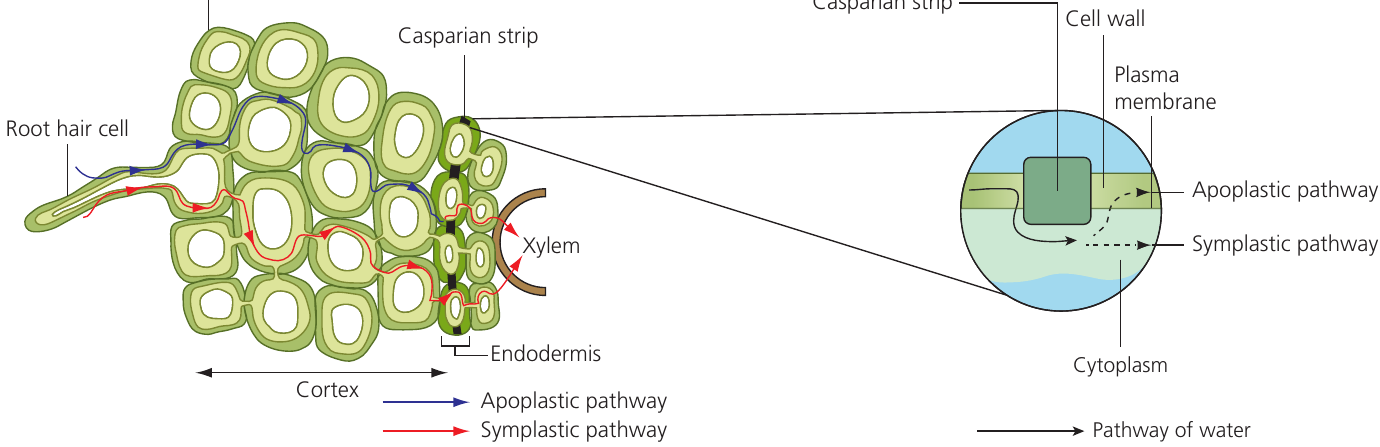
Role of the Casparian strip
A potential problem with the apoplastic pathway is the lack of selectivity. Since everything dissolved in water travels along with it through the cell walls, the plant has no mechanism to control which substances enter. This issue is resolved by the Casparian strip, a specialised structure found in the cell walls of endodermal cells.
Important
The Casparian strip is crucial for plant survival as it provides the only mechanism for controlling which mineral ions enter the xylem. Without it, toxic substances could freely enter the plant's vascular system.
The Casparian strip is a continuous waterproof band that encircles each endodermal cell. It is composed of suberin, a waxy, waterproof substance that prevents water from passing through. By blocking the apoplastic pathway at the endodermis, the Casparian strip forces water and dissolved ions to enter the cytoplasm of the endodermal cells.
To cross this barrier, water must pass through the plasma membrane, which is selectively permeable. This gives the plant control over which substances are allowed to enter the xylem. The plasma membrane of endodermal cells contains various protein carriers that can regulate active transport of specific ions. Once inside the cytoplasm, water can continue through the symplastic pathway or re-enter the apoplastic pathway on the other side of the endodermis, before continuing into the xylem vessels.
Note
Memory aid: "CATS" for Casparian strip—Controls And Tests Substances entering the xylem.
Water transport up the xylem
Once water enters the xylem, it must travel upward through the plant. This can be a considerable challenge, particularly in tall plants. The tallest trees exceed in height, and scientists have calculated that the theoretical maximum height limit for trees is around , possibly because there is a physical limit to how high a water column can be pulled. Measurements in xylem have recorded suction pressures as high as . Understanding how such powerful suction forces are generated requires examining the mechanism of water transport.
The cohesion-tension theory
The most widely accepted explanation for water movement up the xylem is the cohesion-tension theory. This theory attributes the upward movement of water to transpiration—the evaporation of water from leaves.
The theory is based on the cohesive properties of water molecules. Cohesion refers to the tendency of water molecules to stick together. This property arises because water is a polar molecule. The slightly negative oxygen atom of one water molecule forms a hydrogen bond with the slightly positive hydrogen atom of another water molecule. These hydrogen bonds create strong attractive forces between water molecules.
Example
Worked Example: Understanding Cohesion-Tension
Imagine drinking through a very tall straw:
Step 1: When you suck on the straw, you create a low pressure (tension) at the top.
Step 2: Water molecules stick together (cohesion via hydrogen bonds), forming a continuous column.
Step 3: The tension at the top pulls the entire column upward because the molecules don't want to separate.
This is exactly how transpiration pulls water up the xylem—the evaporation at the leaf surface creates the tension, and cohesion between water molecules allows the entire column to be pulled upward.
When a water molecule evaporates from a cell inside the leaf, it pulls other water molecules along with it due to these cohesive forces. As water molecules evaporate from the interface between water and air in the cell wall, they draw more water molecules from the xylem in the leaf. This, in turn, pulls water from the xylem further down in the stem, and so on, creating a continuous pull all the way from the roots.
The 'tension' component of the theory's name refers to the suction force created at the top of the xylem column. This tension results from the cohesion between water molecules and is generated by the evaporation of water at the leaf surface.
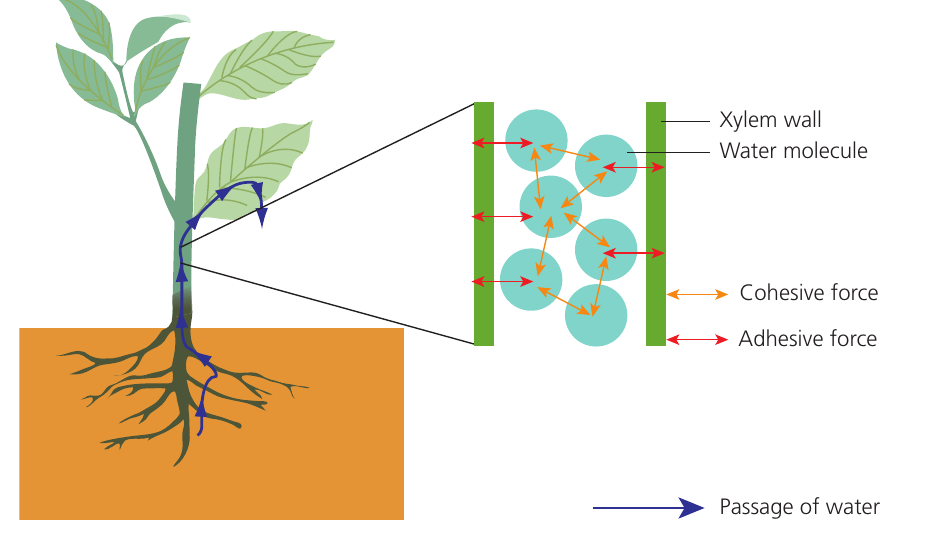
Important
For the cohesion-tension mechanism to work effectively, the water column in the xylem must remain continuous with no breaks. The water molecules must be close enough to each other to form hydrogen bonds.
Common problem: If air enters the xylem, it creates an airlock that interrupts water movement. This is why plant stems must be recut underwater when setting up experiments or arranging cut flowers—cutting in air allows air to be drawn into the xylem, breaking the tension in the water column.
However, airlocks are rarely a serious problem because water can move laterally from one xylem vessel to another through pits in the vessel walls, allowing the water to bypass any air bubbles.
Role of adhesion
Cohesion is not the only force involved in maintaining the water column. Water molecules also exhibit adhesion to the walls of xylem vessels. This means water molecules are attracted to and stick to the cellulose and lignin in the xylem walls.
Note
Adhesion plays an important role in keeping the water column in position even when transpiration is not occurring, such as at night. Without adhesive forces, gravity could cause the water column to fall back down the xylem.
Remember!
Summary
Key Points to Remember:
- Water moves down a water potential gradient from roots (high water potential) to leaves (low water potential).
- Two pathways exist for water crossing the root: the apoplastic pathway (through cell walls) and the symplastic pathway (through cytoplasm via plasmodesmata).
- The Casparian strip in the endodermis blocks the apoplastic pathway, forcing water through selectively permeable membranes and allowing the plant to control mineral uptake.
- The cohesion-tension theory explains upward water transport: cohesion between water molecules (due to hydrogen bonding) allows transpiration to pull water up the xylem, while adhesion to xylem walls maintains the water column.
Memory aid: Remember "CAT" for the cohesion-tension theory: Cohesion, Adhesion, and Tension work together to move water up the xylem.