Exam Preparation (OCR A-Level Biology A): Revision Notes
📚Revision Notes
Exam Preparation
Overview
Effective exam preparation starts from your first biology lesson and continues throughout your course. Top-performing students take control of their own learning rather than relying solely on classroom teaching. Success at A-Level requires more than simple recall of facts – you must demonstrate understanding and apply knowledge in unfamiliar contexts.
Develop a strong foundation by ensuring thorough familiarity with core topics whilst building broader biological knowledge. When concepts seem unclear or information appears incomplete, investigate independently using textbooks, internet resources, scientific magazines and television programmes. This exposure to diverse examples and contexts reinforces understanding and connects different areas of the specification.
Important
Familiarise yourself thoroughly with the OCR specification – this document defines precisely what you need to know and describes the assessment process. Understanding the exam paper format and practical assessment requirements is essential for effective preparation.
Reading around the subject throughout your course embeds fundamental facts into long-term memory, reducing revision time later. However, thorough and strategic revision remains necessary. Your final grade depends not only on knowledge and understanding but also on exam technique – answering precisely what questions ask and communicating clearly.
Different students learn effectively in different ways. This chapter provides guidance and strategies, but you must discover the working practices and revision techniques that suit you best.
Examinations
AS Level structure
The AS Level biology course comprises four modules:
- Module 1 – Development of practical skills in biology
- Module 2 – Foundations in biology
- Module 3 – Exchange and transport
- Module 4 – Biodiversity, evolution and disease
At the end of AS, you sit two exams testing material from all four modules. Each paper lasts minutes with equal weighting but different structures:
Paper 1: Breadth in biology contains two sections – multiple-choice questions and structured questions.
Paper 2: Depth in biology consists entirely of structured questions and extended-response questions.
Note
No coursework exists at AS Level, but both papers include questions on enquiry and practical skills.
Synoptic assessment
Both papers include synoptic assessment, which tests your understanding of connections between different specification elements. You must identify and explain links between topics and apply principles of experimental and investigative work across different areas, including data analysis and evaluation.
Important
Students with strong general biological knowledge who have researched beyond basic content perform best on synoptic questions. Memorising isolated information proves insufficient – extend your knowledge and stay current with biological advances during your course.
Assessment objectives
Examinations test three assessment objectives:
Assessment Objective 1 (AO1): Demonstrate knowledge and understanding of scientific ideas, processes, techniques and procedures.
Assessment Objective 2 (AO2): Apply knowledge and understanding of scientific ideas, processes, techniques and procedures in theoretical contexts, practical contexts, and when handling qualitative and quantitative data.
Assessment Objective 3 (AO3): Analyse, interpret and evaluate scientific information, ideas and evidence to make judgements, reach conclusions, and develop and refine practical design and procedures.
The mark allocation varies between papers:
| Component | AO1 (%) | AO2 (%) | AO3 (%) |
|---|---|---|---|
| Breadth in biology (Paper 1) | |||
| Depth in biology (Paper 2) | |||
| Total |
Paper 1 emphasises factual recall more heavily, whilst Paper 2 focuses on applying knowledge, analysis, interpretation and evaluation.
Note
Communication skills are assessed throughout both papers (except Paper 1 multiple-choice section). This assessment integrates into the overall mark scheme – communicate ideas with detail, clarity and precision at all times. Examiners do not interpret vague statements or provide benefit of doubt for unclear explanations.
Mathematical skills are also assessed throughout papers. The full range of required mathematical competencies appears in the specification on the OCR website.
Using the OCR website
The OCR website provides essential resources and information:
- Specification: Details exactly what you need to know – only biological terms mentioned here can be directly tested in exams
- Past papers and mark schemes: Download for practice
- Exam dates: Find current examination schedules
Important
Use the specification to guide your learning. Only content explicitly mentioned requires knowledge. However, the depth of understanding needed may not always be clear – textbooks and revision guides help clarify this.
Attempting past-paper questions forms a vital part of exam preparation. This reveals question types and, with mark schemes, the depth of answers required. Little value exists in attempting questions without access to mark schemes. In early years of new specifications, few past papers exist – papers from previous specifications remain useful as much content overlaps. Awarding bodies typically publish specimen papers for new specifications.
Workflow
Become thoroughly familiar with content when first encountering it. The following workflow enables this:
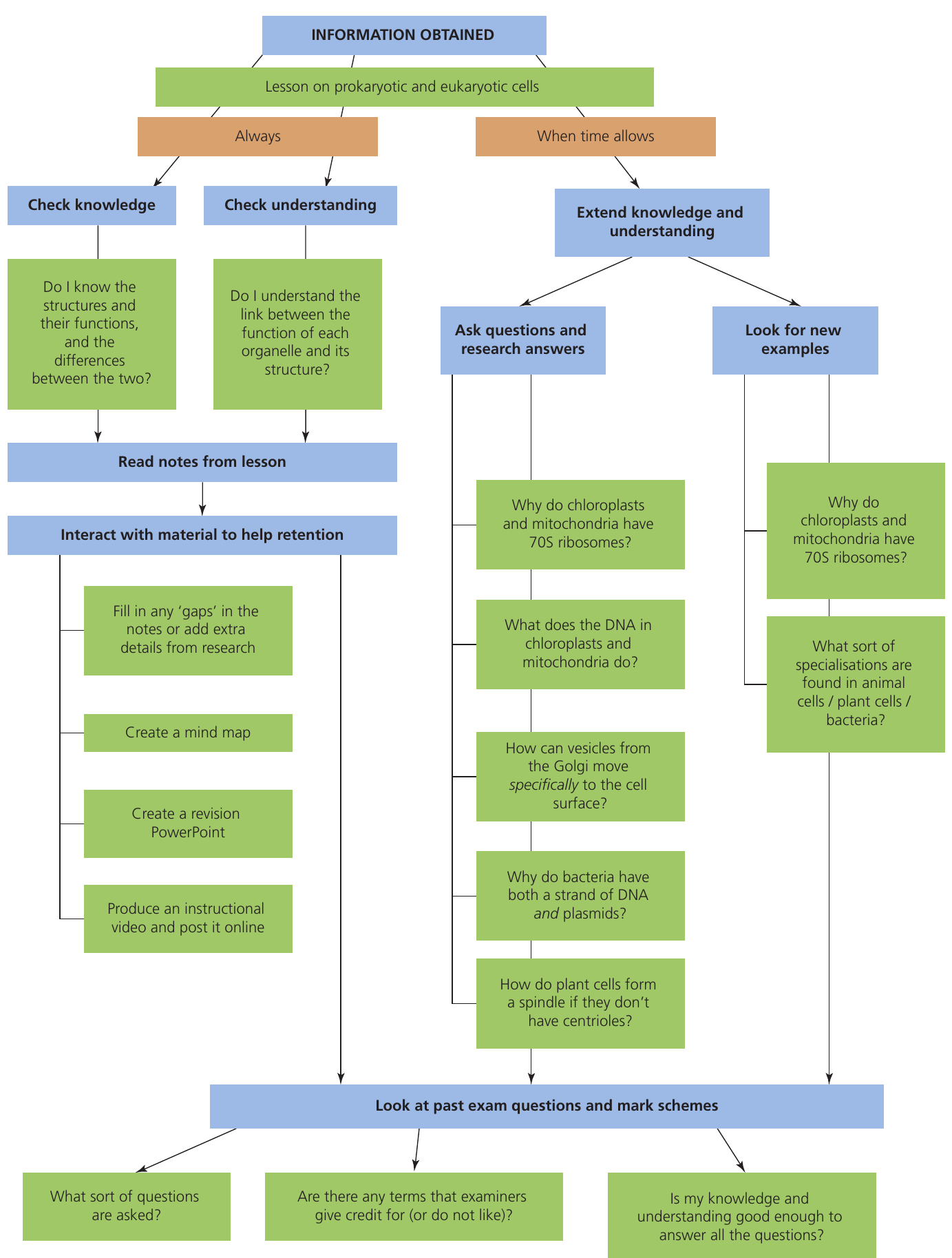
The workflow diagram illustrates systematic learning using prokaryotic and eukaryotic cells as an example. Different suggestions appear for interacting with material, asking questions, and researching answers. These represent possible approaches – choose working practices matching your interests and learning style.
Always check both knowledge (structures, functions, differences) and understanding (links between structure and function). Read lesson notes then interact with material to aid retention through activities like:
- Filling gaps in notes or adding research details
- Creating mind maps
- Producing revision PowerPoint presentations
- Making instructional videos
When time allows, extend knowledge by asking questions and researching answers, for example:
Example
Extension Questions: Cell Structure
- Why do chloroplasts and mitochondria contain ribosomes?
- What does DNA in these organelles do?
- How do Golgi vesicles move specifically to cell surfaces?
- Why do bacteria have both DNA strands and plasmids?
- How do plant cells form spindles without centrioles?
Look for new examples showing specialisations in different cell types.
Finally, examine past questions and mark schemes to understand:
- Question types asked
- Terms examiners credit (or disfavour)
- Whether your knowledge and understanding suffices for answering all questions
This workflow ensures thorough understanding and familiarity with biological terminology and explanation methods. This reduces revision time needed before exams whilst developing vital communication skills.
Revision
How memory works
Understanding memory function aids effective revision. When receiving information (first encounter or complete revision), it enters your working memory (short-term memory). Working memory fades rapidly and proves useless for exams. To remember learned material, transfer information into long-term memory by paying close attention and making sense of it.
Important
Meaningless information fails to reach long-term memory. Ask teachers or search online when concepts seem unclear.
However, storing information in long-term memory represents only half the challenge – you must retrieve it again. Evidence suggests information persists in your brain long-term (possibly permanently), but retrieval ability may fade.
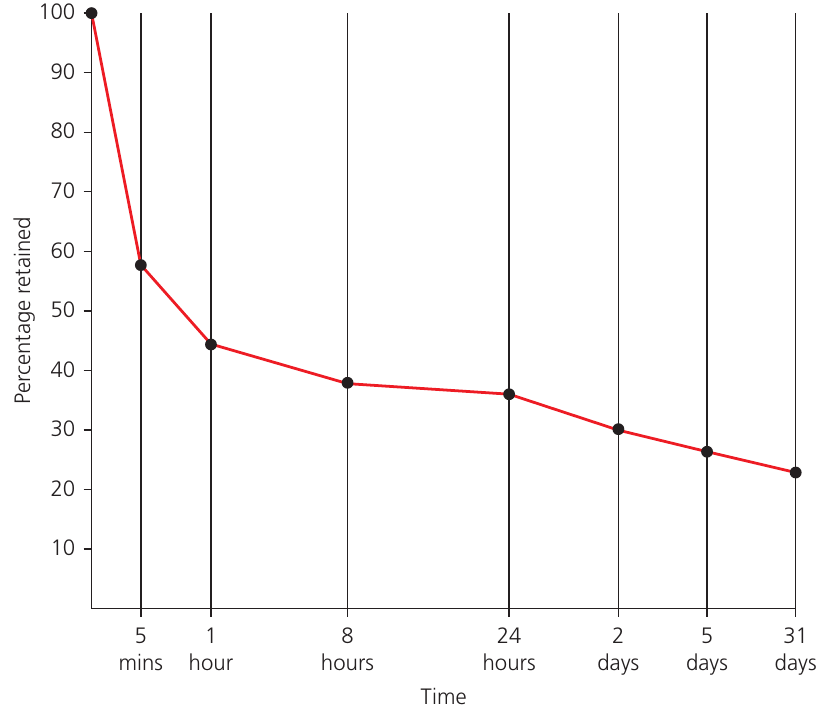
Effective revision methods optimise information retrieval, though you will always forget some learned content. This matters less than it appears – retain core ideas rather than exact wording. Several established techniques greatly improve retention:
Effective revision techniques
Repetition: Review new or revised material approximately one week after encountering it. This requires only brief memory refreshing, not complete relearning. Conduct regular reviews throughout the course so much material remains familiar when intensive revision begins.
Form memory cues: Link information with existing knowledge – other course sections or personal experiences. Human biology aspects suit this particularly well (breathing, sweating, reflexes, knowing someone with diabetes).
Note
Mnemonics: Formulae or rhymes assisting memory. Common forms use initial letters from word lists to create memorable sentences. For mitosis stages (prophase, metaphase, anaphase, telophase), use "Penguins march around trees". Choose visual, slightly absurd sentences for best memorability. Mnemonics form memory cues mainly useful for lists.
Translate information into different forms: Create mind maps, pictures, presentations, or explain learned material to someone unfamiliar with A-Level Biology. Inability to make others understand may indicate incomplete personal understanding.
Take regular breaks: Most brains cannot absorb information continuously beyond approximately minutes without breaks. Short few-minute breaks refresh mental capacity and improve revision efficiency.
Structure your revision: Research shows optimal learning occurs at session beginnings and endings. Start with difficult material, finish with similar content (or review start material), and cover easier content mid-session. Breaks create additional "beginnings" and "endings", enhancing learning.
Exam technique
Your grade depends on knowledge, understanding, communication ability and exam technique. Acquire good technique by attempting past-paper questions whilst studying mark schemes carefully to identify credited and non-credited elements. Practise extended writing in exam answers and notes, having others assess clarity.
Essential exam technique points
Important
Read questions carefully ensuring answers precisely target requirements. Mark schemes specify exact requirements – correct but irrelevant points receive no credit.
Read complete questions from the beginning rather than jumping to actual questions then backtracking. This approach risks missing important information.
Note
Question writers include only useful information. If unused information remains at question end, this signals problems. When stuck, examine questions carefully for answer clues.
Communication must always be clear and detailed. Avoid vague, general comments lacking factual content.
Mark numbers indicate required points. For multi-mark questions, provide one more piece of information than marks available (you cannot know exact mark scheme content). When specifically asked for (for example) two reasons, giving three proves pointless – generally only the first two receive marks.
Use scientific terms in extended answers – but only when confident of correctness. If doubtful, describing structures or processes proves safer.
Avoid attempting "scientific" language. This does not truly exist – plain English usually makes answers clearer.
Important
Do not spend excessive time struggling with difficult questions. Move forward and return to challenging items after completing the paper.
Never leave questions worth three or more marks blank. You may hit marking points even when feeling uncertain. No answer absolutely guarantees zero marks.
Activity: Communication skills
Example
Practice Exercise: Improving Answer Clarity
Improve these factually correct but unclear answers:
-
The folded membrane of a mitochondrion is an adaptation for more efficient respiration.
-
The reason for the higher blood pressure in the left ventricle is because it needs to pump blood all around the body.
-
Natural selection involves "survival of the fittest". Animal populations show variation and some variations make them better suited to the environment. The fittest animals will survive and pass on their features to the next generation.
Remember!
Summary
Key Points for Exam Success:
- Exam preparation begins from your first lesson – build knowledge continuously throughout the course
- Understand the three assessment objectives and how marks are allocated between recall (AO1), application (AO2), and analysis/evaluation (AO3)
- Use the OCR specification to guide learning and practise past papers with mark schemes regularly
- Memory works best with repetition, memory cues, mnemonics, and translation into different forms
- Take breaks during revision sessions ( minutes maximum) and structure sessions to start and end with difficult material
- In exams, read questions carefully, answer precisely what is asked, communicate clearly with scientific terminology, and never leave multi-mark questions blank