Measuring Enthalpy Changes (OCR A-Level Chemistry A): Revision Notes
📚Revision Notes
Measuring enthalpy changes
Introduction to measuring energy changes
When conducting experiments to determine enthalpy changes, it's essential to understand the distinction between the chemical system and its surroundings. The thermometer is positioned in the surroundings, which means you're actually measuring the temperature change of the surroundings rather than the reacting chemicals themselves.
Note
Why measure the surroundings?
The thermometer cannot be placed directly in the reacting chemicals, so it measures the temperature change of the surroundings instead. The energy transferred from the chemical reaction causes a measurable temperature change in these surroundings.
The surroundings typically consist of the materials that experience the temperature change during the reaction - most commonly water or aqueous solutions. This temperature change in the surroundings provides the data needed to calculate the enthalpy change of the chemical reaction.
The Kelvin scale of temperature
Scientists commonly use the Kelvin temperature scale for thermochemical measurements. This scale begins at absolute zero (0 K), which corresponds to -273°C. The Kelvin scale forms part of the International System of Units (SI units).
Important
Identical Temperature Changes
An important feature of the Kelvin scale is that temperature changes are identical in both Kelvin and Celsius. A 1 K rise in temperature equals a 1°C rise in temperature. This means that when recording temperature differences using a thermometer graduated in °C, the value of the temperature change is exactly the same whether expressed in °C or K.
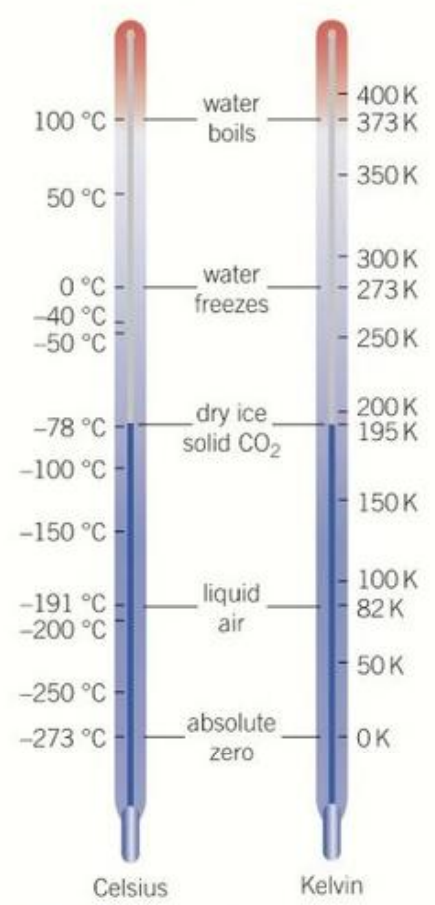
Converting between temperature scales:
- To convert from Celsius to Kelvin: add 273
- To convert from Kelvin to Celsius: subtract 273
For example:
- Water freezes at 0°C = 273 K
- Water boils at 100°C = 373 K
Calculating energy changes
The energy change in the surroundings can be calculated using three key quantities: mass, specific heat capacity, and temperature change. Understanding each of these components is crucial for accurate enthalpy calculations.
The mass of the surroundings
You can determine the mass by weighing the materials that change temperature during the experiment. Mass is typically measured in grams (g) to match the units commonly used in experimental calculations. For liquids like water, you need to identify which materials are experiencing the temperature change - this is usually the water or aqueous solution in your apparatus.
Note
When working with aqueous solutions, remember that the solution itself acts as the surroundings. You need to measure the total mass of the solution that undergoes the temperature change, not just the mass of the reactants.
The specific heat capacity of the surroundings
Different materials require different amounts of energy to produce the same temperature change. The specific heat capacity () represents how much energy is needed to increase the temperature of 1 g of a substance by 1 K.
Each substance has its own characteristic specific heat capacity:
- Good thermal conductors (such as metals) have small values of
- Good thermal insulators (such as foam plastic) have large values of
For most experiments involving aqueous solutions, you'll be measuring the temperature change of water or dilute aqueous solutions.
Important
Standard Value for Water
The specific heat capacity of water is a key value you'll use repeatedly in calorimetry calculations:
This value is used in nearly all A-Level calorimetry calculations. Make sure you memorize this constant!
The temperature change of the surroundings
The temperature change () is determined directly from thermometer readings using the formula:
This calculation gives you the change in temperature experienced by the surroundings during the reaction.
The energy change equation
Once you have values for mass (), specific heat capacity (), and temperature change () from your experiment, calculating the energy change is straightforward. Heat energy is given the symbol , and the energy transferred (in joules, J) can be calculated using:
Where:
- = energy change in joules (J)
- = mass of substance changing temperature in grams (g)
- = specific heat capacity in J g⁻¹ K⁻¹
- = temperature change in K (or °C)
Important
Common Mistake: Which mass to use?
In the equation , represents the mass of the substance that changes temperature (the surroundings), not the mass of the reactants. This is a frequent source of error in calculations.
Determining enthalpy change of combustion
Combustion is simply the reaction of a substance with oxygen. This type of reaction is one of the most straightforward enthalpy changes to determine experimentally.
For example, the combustion of methanol can be represented by the equation:
Spirit burner method
Liquid fuels such as methanol can easily be burnt using small spirit burners. This simple apparatus allows you to measure the enthalpy change of combustion effectively.
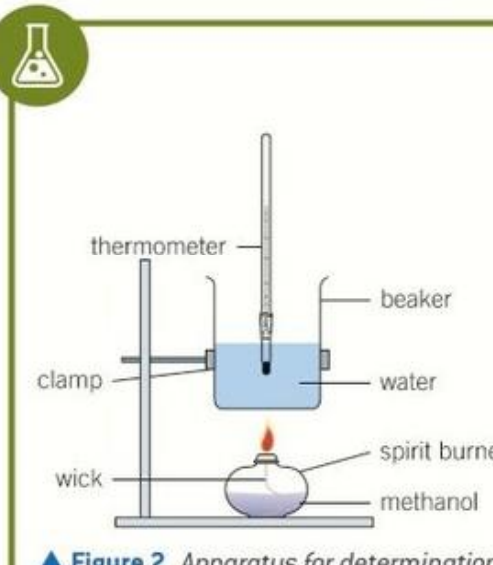
Experimental procedure:
-
Using a measuring cylinder, measure out 150 cm³ of water. Pour the water into the beaker. Record the initial temperature of the water to the nearest 0.5°C.
-
Add methanol to the spirit burner. Weigh the spirit burner containing methanol using a balance.
-
Place the spirit burner under the beaker as shown in the diagram. Light the burner and burn the methanol whilst stirring the water with the thermometer.
-
After approximately three minutes, extinguish the flame. Immediately record the maximum temperature reached by the water.
-
Re-weigh the spirit burner containing the methanol. Assume that the wick has not been burnt during the experiment.
Example
Worked Example: Determination of of methanol
Let's work through a complete calculation using experimental data.
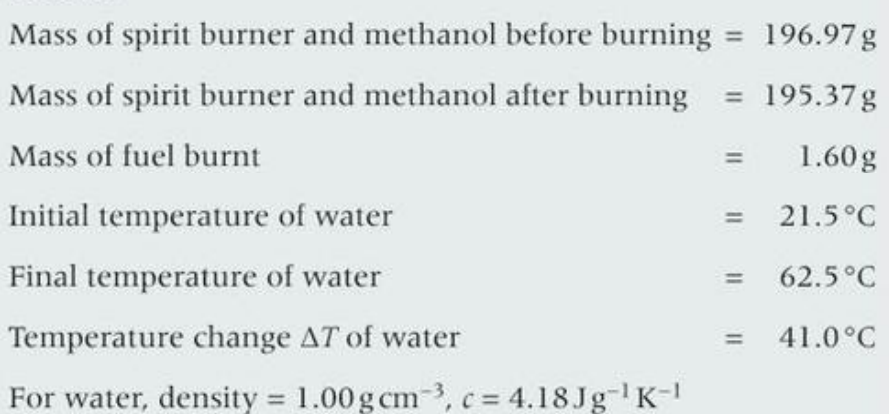
Step 1: Calculate the energy change of the water in kJ.
From the data, the density of water is 1.00 g cm⁻³, so 150 cm³ of water has a mass of 150 g.
Note: Always divide by 1000 to convert joules to kilojoules.
Step 2: Calculate the amount, in mol, of CH₃OH burnt.
Step 3: Calculate in kJ mol⁻¹.
represents the enthalpy change for the complete combustion of 1 mol CH₃OH.
In the experiment, 0.0500 mol CH₃OH transfers 25.707 kJ of energy to the water.
The water gained 25.707 kJ of energy from the combustion of 0.0500 mol CH₃OH.
Therefore, 1 mol CH₃OH has lost of energy on combustion.
When rounding calculations, leave rounding until the final answer to get the most accurate result. Working out the uncertainty introduced in the final answer by rounding the answer gives:
- Three significant figures: most accurate
- Two significant figures: less accurate
Important
Determining the Sign of
only appears at the end of the calculation. This indicates the point where you decide on the sign. Since the water has gained energy, the combustion of methanol must have lost the same quantity of energy. Therefore is negative and the reaction is exothermic.
Accuracy of experimental combustion values
The data book value for of methanol is -726 kJ mol⁻¹. This seems significantly different from the experimental value of -514 kJ mol⁻¹ obtained above. Data book values are obtained using much more sophisticated apparatus than a spirit burner and a beaker of water.
Clearly, much less heat was transferred to the water in our experiment than expected. Several factors explain why experimental values are typically less exothermic than data book values:
Heat loss to the surroundings other than the water
This includes the beaker but mainly the air surrounding the flame. Heat is continuously being lost to the environment throughout the experiment.
Incomplete combustion of methanol
There may be some incomplete combustion occurring, with carbon monoxide and carbon being produced instead of carbon dioxide. Evidence of this would be carbon appearing as a black layer of soot on the beaker.
Evaporation of methanol from the wick
The burner must be weighed as soon as possible after extinguishing the flame. Otherwise, some methanol may have evaporated from the wick. Spirit burners usually have a cover to reduce this source of error.
Non-standard conditions
The data book value is a standard value, measured under precisely controlled conditions. The conditions for this experiment are unlikely to be identical to standard conditions, introducing further discrepancy.
Note
All but the last of these factors would lead to a value for that is less exothermic than expected.
Minimising errors: Using draught screens and an input of oxygen gas could help minimise errors from heat loss and incomplete combustion.
Important
Comparing Negative Values Correctly
When comparing experimental and data book values, be very careful with negative numbers. The experimental value of -514 kJ mol⁻¹ and the data book value of -726 kJ mol⁻¹ should not be described simply by saying "the experimental value is less".
You must state that the experimental value would be less exothermic or less negative.
Remember: -514 is actually more than -726 as -514 is less negative!
Determining enthalpy change of reaction
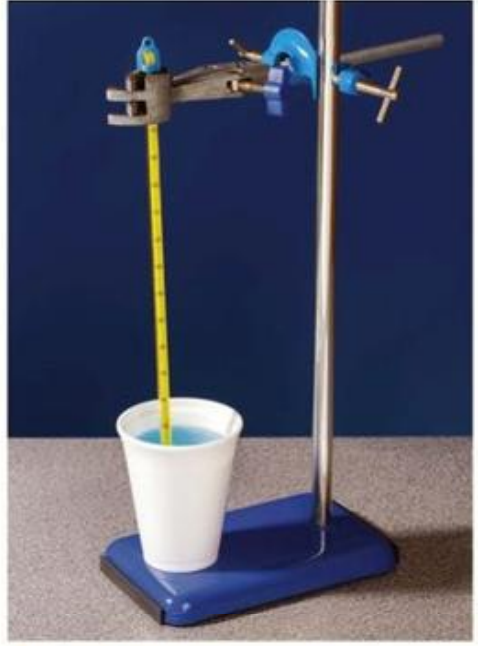
Many reactions take place between two solutions, or between a solid and a solution. The enthalpy change of these reactions can be determined using plastic cups made of polystyrene foam. These cups are inexpensive, waterproof, lightweight, and provide good insulation against heat loss to the surroundings.
When carrying out reactions between aqueous solutions, the solution itself is the immediate surroundings. The chemical particles within the solutions may react when they collide, and any energy transfer occurs between the chemical particles and water molecules in the solution. A thermometer placed in the solution will record any temperature change, allowing the heat energy change to be calculated using .
Example
Worked Example: Determination of for a solid and a solution
An excess of zinc powder is added to 50.0 cm³ of 1.00 mol dm⁻³ copper(II) sulfate. The mixture is stirred until a maximum temperature is obtained.
Find for:
Results:
- Initial temperature of solution = 22.5°C
- Final temperature of solution = 60.5°C
- Temperature change of solution = 38.0°C
For the solution, density and specific heat capacity are close to those of water (density = 1.00 g cm⁻³; = 4.18 J g⁻¹ K⁻¹)
Calculation:
Step 1: Calculate the energy change in the solution in kJ.
Density = 1.00 g cm⁻³ so 50.0 cm³ of the solution has a mass of 50.0 g.
Step 2: Calculate the amount, in mol, of CuSO₄ that reacted (Zn is in excess).
Step 3: Calculate in kJ mol⁻¹.
is for the reaction:
The balanced equation shows: 1 mol Zn reacts with 1 mol CuSO₄ to produce 1 mol Cu and 1 mol ZnSO₄
In the experiment, 0.0500 mol CuSO₄ transfers 7.942 kJ of energy to the solution.
Therefore, 1 mol CuSO₄ has lost of energy to the solution.
Cooling curves
The cooling curve method provides a way to correct for heat loss during experiments. This technique measures the enthalpy change for reactions similar to those on the previous pages, but the method has been adapted to account for heat loss through extrapolation.
This correction method can be used to improve accuracy in other similar enthalpy experiments.
Method
-
Pipette 25.0 cm³ of 1.00 mol dm⁻³ CuSO₄ into a polystyrene cup. Weigh out an excess of zinc powder.
-
Start a stop-clock and take the temperature of the solution every 30 s until the temperature stays constant.
-
Add the zinc to the solution and stir the mixture. Record the temperature every 30 seconds until the temperature has fallen for several minutes.
-
Plot a graph of temperature against time.
Note
Correcting for Heat Loss
To correct for cooling, extrapolate the cooling curve section of the graph back to the time when the zinc was added. Draw a vertical line from the time that the solutions were mixed to the extrapolated cooling curve. This gives you the corrected maximum temperature.
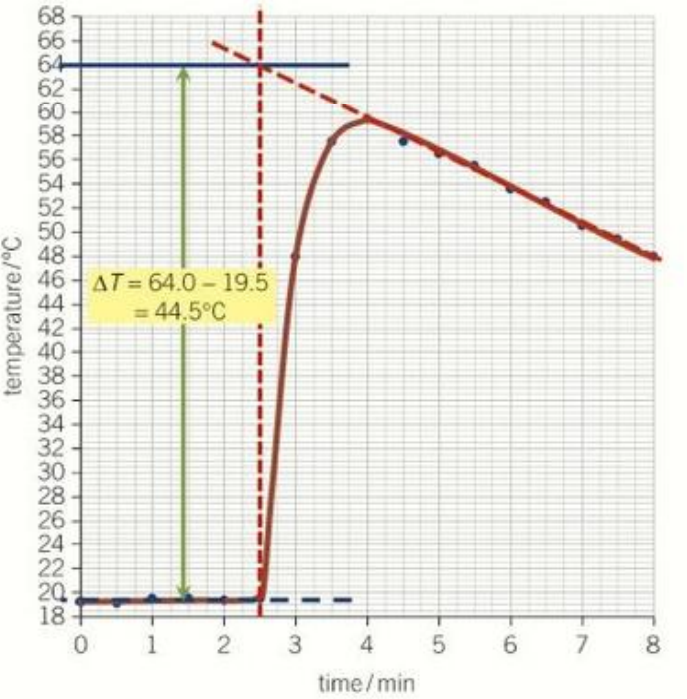

Using the results shown in the graph and table, . This compares with -159 kJ mol⁻¹ for the method on the previous page. The cooling curve correction provides a more accurate value by accounting for heat that would otherwise be lost to the surroundings.
Determining enthalpy change of neutralisation
This procedure is very similar to the previous example for reactions in solution. The only difference is that two solutions react together, rather than a solution and a solid.
Example
Worked Example: Determination of
A student measures out and mixes 35.0 cm³ of 2.40 mol dm⁻³ NaOH and 35.0 cm³ of 2.40 mol dm⁻³ HCl. The temperature rises by 16.5°C.
Specific heat capacity of the mixture is 4.18 J g⁻¹ K⁻¹. The density of the mixture is 1.00 g cm⁻³.
Calculate the enthalpy change of neutralisation, in kJ mol⁻¹.
Step 1: Calculate the energy change in the solution in kJ.
Total volume of solution changing temperature = 35.0 + 35.0 = 70.0 cm³
Density of mixture is 1.00 g cm⁻³, so 70.0 cm³ has a mass of 70.0 g.
Step 2: Calculate the amount, in mol, of NaOH and HCl that reacted.
Step 3: Calculate in kJ mol⁻¹.
is defined as the enthalpy change required for the neutralisation of an acid by an alkali to form 1 mol H₂O(l).
Reacting quantities:
Balanced equation: 1 mol + 1 mol → 1 mol + 1 mol
Experiment: 0.0840 mol + 0.0840 mol → 0.0840 mol
Formation of 0.0840 mol H₂O transfers 4.8279 kJ of energy to the solution.
Formation of 1 mol H₂O loses of energy to the solution.
Summary
Key Points to Remember:
-
The Kelvin scale starts at absolute zero (0 K = -273°C). Temperature changes have the same value in both °C and K.
-
Energy changes are calculated using the equation , where is the mass of the surroundings (not reactants), is specific heat capacity, and is temperature change.
-
For combustion experiments, use a spirit burner to burn fuel beneath water. Calculate energy gained by water, then enthalpy change per mole of fuel burnt.
-
For solution reactions, use polystyrene cups for insulation. The solution itself acts as the surroundings, with density and specific heat capacity close to water values.
-
Cooling curve corrections improve accuracy by extrapolating temperature data back to the mixing time, accounting for heat loss.
-
Experimental values are typically less exothermic than data book values due to heat loss, incomplete combustion, evaporation, and non-standard conditions.
-
When calculating , the sign is determined at the end: if surroundings gain energy, the reaction has lost energy, making negative (exothermic).