Periodic Trends in Bonding and Structure (OCR A-Level Chemistry A): Revision Notes
📚Revision Notes
Periodic Trends in Bonding and Structure
Introduction to metallic and non-metallic elements
One of the fundamental patterns in the periodic table is the transition from metallic to non-metallic character as you move from left to right across each period. This change doesn't happen abruptly but follows a diagonal line running from the top of Group 13 (Group 3 in older notation) down to the bottom of Group 17 (Group 7). Understanding this trend helps explain why elements behave so differently across the periodic table.
Elements positioned near this dividing line exhibit properties that fall between typical metals and non-metals. These intermediate elements include boron (B), silicon (Si), germanium (Ge), arsenic (As), and antimony (Sb), and are known as semi-metals or metalloids. Moving down Groups 14 to 17, there's a clear progression from non-metallic to metallic character, with the divide being most obvious in Group 14 where carbon (a non-metal) contrasts sharply with lead (a metal). Silicon and germanium occupy the middle ground as semi-metals.
Note
The periodic table contains far more metallic elements than non-metallic ones - approximately 92 metals compared to just 22 non-metals. Despite being outnumbered, non-metallic elements play crucial roles in chemistry and biochemistry, particularly carbon, hydrogen, nitrogen, and oxygen, which form the basis of organic chemistry and biological systems.
Metallic bonding and the structure of metals
At room temperature, all metals except mercury exist as solids. The 92 known metallic elements display a remarkable range of physical properties - some are exceptionally strong and hard (like tungsten, W), others are relatively soft (like lead, Pb), some are lightweight (like aluminium, Al), whilst others are extremely dense (osmium, Os, is twice as dense as lead). However, one property remains constant across all metals: their ability to conduct electricity. This seemingly simple characteristic is actually remarkable for a solid material, as it requires charge carriers to move freely within a rigid structure.
You've already encountered ionic and covalent bonding in your studies. Metallic bonding represents a special type of bonding unique to metallic elements. In a solid metal structure, each metal atom contributes its outer-shell electrons to a shared pool of electrons. These electrons become delocalised, meaning they spread out and move freely throughout the entire metallic structure rather than remaining associated with individual atoms.
When atoms release their outer electrons, they become positive ions known as cations. These cations consist of the nucleus and inner electron shells of the metal atoms. The cations remain fixed in position, maintaining the structure and shape of the metal, whilst the delocalised electrons are mobile and can move throughout the structure.
Important
Key Concept: Only the electrons move in metallic bonding - the metal ions themselves stay in place. This is what allows metals to maintain their solid structure while still conducting electricity.
The actual bonding in metals arises from the strong electrostatic attraction between the positively charged cations and the negatively charged delocalised electrons. In structures containing metal ions with a charge, twice as many negatively charged electrons are present to balance the overall charge. These vast numbers of metal atoms held together by metallic bonding form what we call a giant metallic lattice.
Properties of metallic elements
The physical properties of metals can be explained by understanding their giant lattice structure and the nature of metallic bonding. Most metals share several characteristic properties.
Electrical conductivity
Metals can conduct electricity in both solid and liquid states, which distinguishes them from ionic compounds that only conduct when molten or dissolved. When a voltage is applied across a metal, the delocalised electrons move through the structure, carrying electrical charge. This contrasts dramatically with ionic compounds, which have no mobile charge carriers in the solid state and therefore cannot conduct electricity until melted.
Melting and boiling points
Most metallic elements possess high melting and boiling points. The strength of the metallic bonds holding atoms together in the giant metallic lattice determines these temperatures. To melt a metal, you must provide sufficient energy to overcome the strong electrostatic attraction between the cations and electrons.
Note
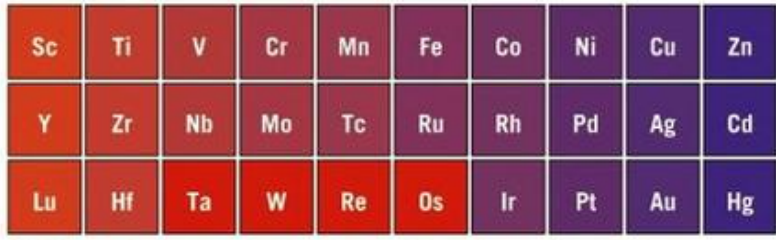
Tungsten exemplifies this property with the highest melting point of all metals at 3422°C - this is why it's used in halogen lamp filaments where other metals would melt. At the other extreme, mercury melts at , which explains why it's liquid at room temperature.
The transition metals show particularly interesting variation in melting points, with those in Group 1 of the periodic table all melting below due to relatively weaker metallic bonding.
The high melting and boiling points observed in most metals result from the large quantity of energy needed to overcome the strong electrostatic forces holding the structure together.
Solubility
Metals do not dissolve in any common solvents. Whilst you might expect some interaction between polar solvents and the charges present in a metallic lattice, any such interactions would lead to chemical reactions rather than dissolution. For example, sodium reacts vigorously with water rather than dissolving in it.
Giant covalent structures
Many non-metallic elements exist as simple covalently bonded molecules. In their solid state, these molecules form simple molecular lattice structures held together by weak intermolecular forces, resulting in characteristically low melting and boiling points.
However, the non-metals boron, carbon, and silicon deviate from this pattern significantly. Rather than forming small molecules held by weak intermolecular forces, vast numbers of atoms bond together through a network of strong covalent bonds, creating a giant covalent lattice. These structures differ fundamentally from simple molecular structures in their properties and behaviour.
Carbon and silicon, both in Group 14 of the periodic table, have four electrons in their outer shells. In diamond (one form of carbon) and in silicon, these four electrons form covalent bonds with other carbon or silicon atoms. This creates a tetrahedral structure where each atom bonds to four others.

Note
The Tetrahedral Structure of Diamond
The tetrahedral arrangement of atoms in diamond shows several key features:
- Bond angles of 109.5° result from electron-pair repulsion
- Each carbon atom connects to four others through strong covalent bonds
- The structure extends in three dimensions throughout the material

Silicon dioxide (), the main component of sand, also possesses a giant covalent lattice structure similar to diamond. The strong covalent bonds throughout these structures make them remarkably stable and generally unreactive.
Properties of giant covalent structures
Melting and boiling points
Giant covalent lattices exhibit very high melting and boiling points because covalent bonds are extremely strong. Breaking down the structure requires enormous amounts of energy to overcome these strong covalent bonds throughout the lattice. This explains why substances like diamond and silicon have melting points exceeding thousands of degrees Celsius.
Solubility
Giant covalent lattices are insoluble in virtually all solvents. The covalent bonds holding atoms together in the lattice are far too strong to be broken by interaction with solvent molecules. Even aggressive solvents cannot overcome the strength of the extensive covalent network.
Electrical conductivity
Giant covalent lattices generally do not conduct electricity. In carbon (diamond) and silicon, all four outer-shell electrons participate in covalent bonding, leaving none available for conducting electricity. This makes these substances electrical insulators.
Important
Exception to the Rule: Carbon forms some exceptional structures where electrical conductivity becomes possible. Graphene and graphite are both forms of carbon that can conduct electricity, making them unique among giant covalent structures.
Graphene and graphite
Beyond diamond, carbon forms giant covalent structures based on planar hexagonal layers, creating two related materials with fascinating properties.
Structure and bonding
Both graphene and graphite are giant covalent structures of carbon built from planar hexagonal layers. In these structures, only three of carbon's four outer-shell electrons participate in covalent bonding, with bond angles of 120° resulting from electron-pair repulsion. The remaining electron becomes delocalised across all atoms in the structure. These carbon-containing structures with planar hexagonal layers act as good electrical conductors.
Graphene
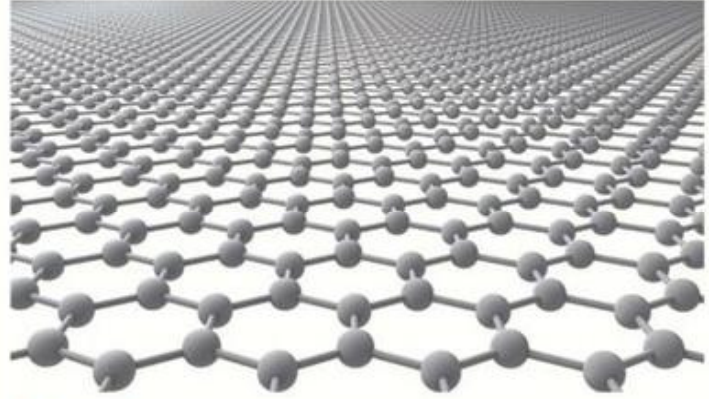
Graphene consists of a single layer of carbon atoms arranged in a hexagonal pattern and linked by strong covalent bonds. This remarkable material shares the same electrical conductivity as copper and ranks as the thinnest and strongest material ever created.
Note
A Nobel Prize Discovery
Scientists Andre Geim and Konstantin Novoselov discovered graphene in 2004 at the University of Manchester, earning them a Nobel Prize in 2010. Remarkably, Geim created graphene using sticky tape to repeatedly peel single layers of carbon atoms from graphite's surface - a brilliantly simple technique that led to groundbreaking work.
Graphite
Graphite consists of parallel layers of hexagonally arranged carbon atoms, essentially forming a stack of graphene layers. Weak London forces (intermolecular forces) hold these layers together.
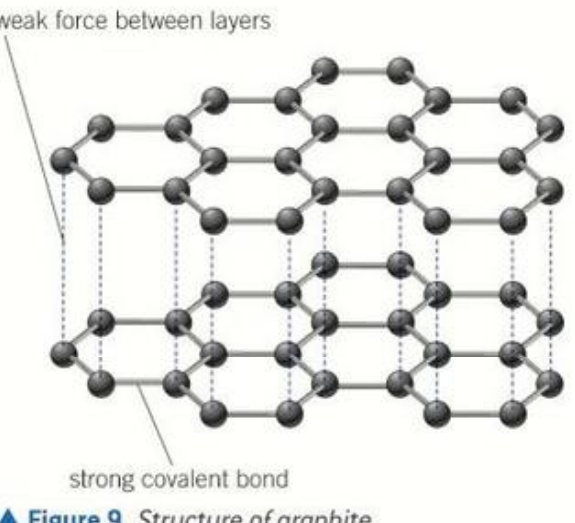
The bonding in hexagonal layers uses only three of carbon's four outer-shell electrons. The spare electron delocalises between the layers, enabling electrical conduction similar to metals. This unique feature distinguishes graphite and graphene from other giant covalent structures.
Periodic trends in melting points across periods
Examining the melting points of elements across Period 2 and Period 3 reveals clear periodic patterns that relate directly to bonding and structure.
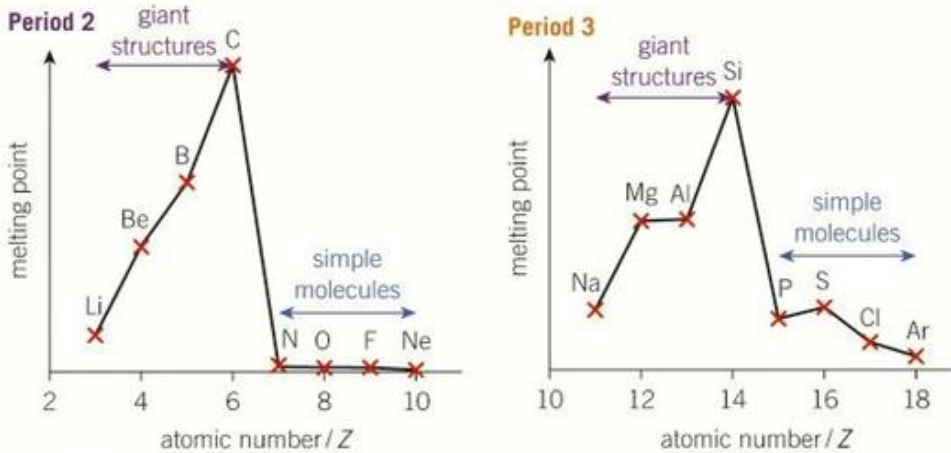
Across both Period 2 and Period 3:
- Melting points increase progressively from Group 1 to Group 14
- A sharp decrease occurs between Group 14 and Group 15
- Melting points remain comparatively low from Group 15 to Group 18
Important
Critical Transition Point: The dramatic decrease in melting point marks a fundamental change from giant to simple molecular structures. This transition occurs at the diagonal divide between metals and non-metals in the periodic table.
When substances with giant structures melt, strong forces must be overcome, resulting in high melting points. Simple molecular structures have weak intermolecular forces to overcome, leading to much lower melting points. This pattern repeats consistently across Period 2 and Period 3, and continues across the s- and p-blocks from Period 4 downwards.
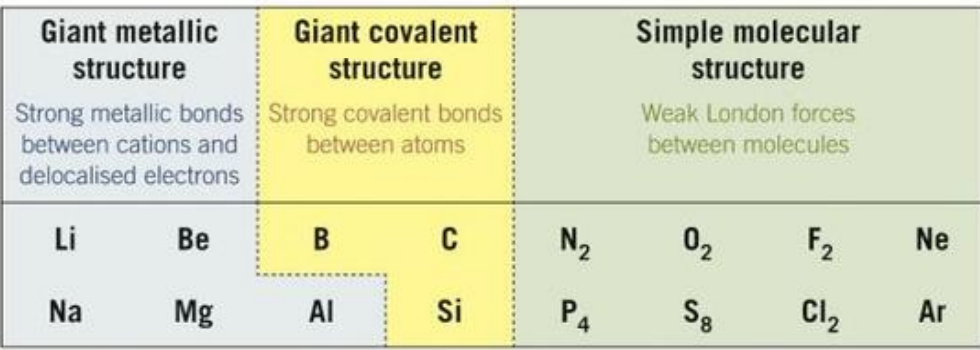
Comparison of structure types
Giant metallic structures (Li, Be, Na, Mg) contain strong metallic bonds between cations and delocalised electrons, resulting in high melting points.
Giant covalent structures (B, C, Al, Si) feature strong covalent bonds between atoms throughout the lattice, producing the highest melting points of all structure types.
Simple molecular structures (N, O, F, Ne, P, S, Cl, Ar) consist of molecules held together by weak London forces (intermolecular forces), leading to low melting points.
The trend demonstrates that elements forming giant structures require substantial energy input to break apart their strong bonding, whilst simple molecular structures need relatively little energy to overcome their weak intermolecular forces.
Summary
Key Points to Remember:
-
Metallic bonding involves strong electrostatic attraction between fixed positive metal ions (cations) and mobile delocalised electrons spread throughout the structure
-
Giant covalent lattices consist of billions of atoms connected by strong covalent bonds in an extensive three-dimensional network
-
Graphene and graphite are exceptional forms of carbon that conduct electricity because one electron per atom remains delocalised rather than participating in bonding
-
Melting point trends across periods show high values for giant structures (metallic and covalent) and low values for simple molecular structures, with a sharp transition at Group 14/15
-
The periodic table shows a diagonal divide from Group 13 to Group 17 separating metals from non-metals, with semi-metals occupying the boundary region