Reaction Rates (OCR A-Level Chemistry A): Revision Notes
📚Revision Notes
Reaction rates
Introduction to reaction rates
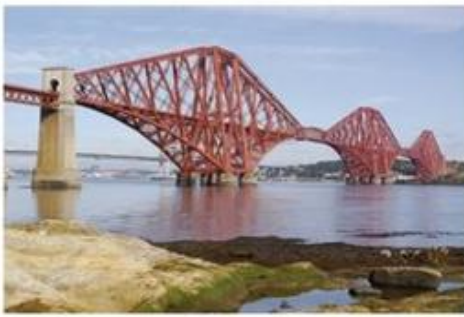
Chemical reactions occur at widely varying speeds. Some reactions are extremely rapid, such as explosions and fireworks displays that produce dramatic effects in fractions of a second. Other reactions proceed much more slowly, such as the rusting of iron structures which can take many years. Understanding and controlling the speed of chemical reactions is essential in both industrial processes and everyday applications.

Note
The ability to control reaction rates has profound practical applications. In industry, faster reactions mean higher productivity, while in food preservation, slowing down reactions prevents spoilage. Understanding these principles allows chemists to optimize processes ranging from drug manufacturing to environmental protection.
Defining rate of reaction
The rate of a chemical reaction quantifies how quickly reactants are consumed or how rapidly products are generated during a chemical process. This can be measured by tracking either the decrease in reactant concentration or the increase in product concentration over a specific time period.
The mathematical expression for reaction rate is:
Important
The standard units for reaction rate are (moles per cubic decimetre per second). Always ensure your calculations result in these units, or convert appropriately if you're working with other measurements like gas volume or mass.
How reaction rates change over time
During a chemical reaction, the rate does not remain constant but varies in a predictable pattern:
-
At the beginning: The rate is at its maximum because reactant concentrations are highest, meaning particles are at their most concentrated state.
-
As the reaction progresses: The rate gradually decreases because reactants are being consumed, reducing their concentrations and the frequency of particle collisions.
-
At completion: When one reactant has been entirely used up, the concentration stops changing and the rate becomes zero. The reaction has reached completion.
Note
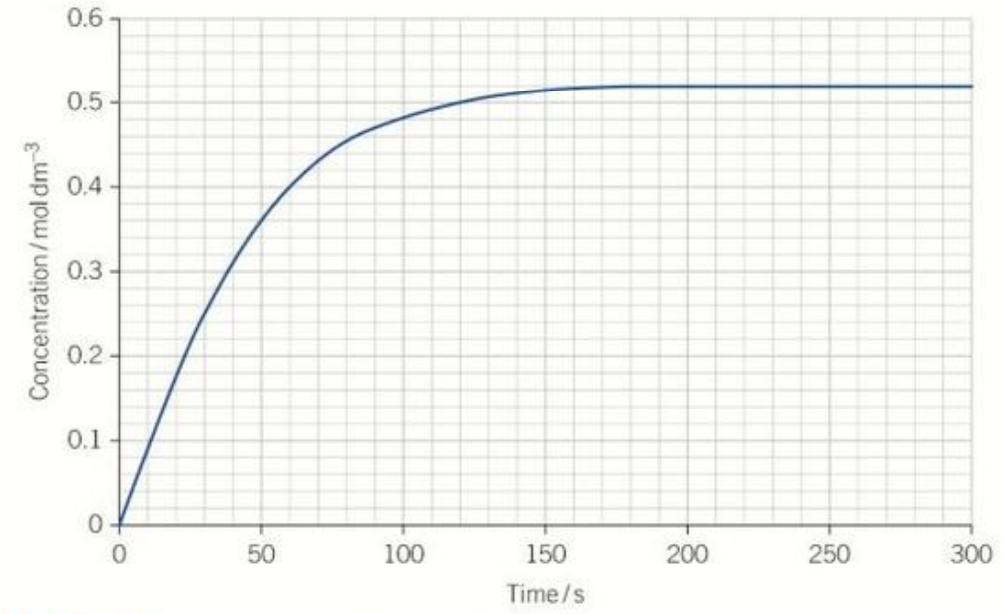
A concentration-time graph clearly illustrates this behaviour. The curve begins with a steep slope (indicating a fast rate), which progressively becomes less steep as the reaction slows down. Eventually, the curve levels off to form a horizontal line when the reaction is complete. The steepness of the curve at any point is directly related to the reaction rate at that moment.
Factors that influence reaction rate
Several factors can alter how quickly a chemical reaction proceeds:
- Concentration (or pressure for gaseous reactants)
- Temperature
- Use of a catalyst
- Surface area of solid reactants
Understanding why these factors affect reaction rate requires considering what happens at the particle level during chemical reactions.
Collision theory
The collision theory provides a particle-level explanation for chemical reactions. According to this theory, for a reaction to take place, reacting particles must physically collide with one another. However, not all collisions lead to a reaction - most collisions are actually ineffective.
During most particle collisions, the molecules simply bounce off each other without any chemical change occurring. These are ineffective collisions. For a collision to be productive and result in a chemical reaction, two essential conditions must be satisfied:
Important
Two Essential Conditions for Effective Collisions:
-
Correct orientation: The particles must collide with the proper alignment for bonds to break and form.
-
Sufficient energy: The colliding particles must possess enough kinetic energy to overcome the activation energy barrier of the reaction. This minimum energy requirement allows bonds to break and new bonds to form.
When both conditions are met, an effective collision occurs and a chemical reaction takes place.
Concentration effects
Note
Understanding Concentration Through Analogy
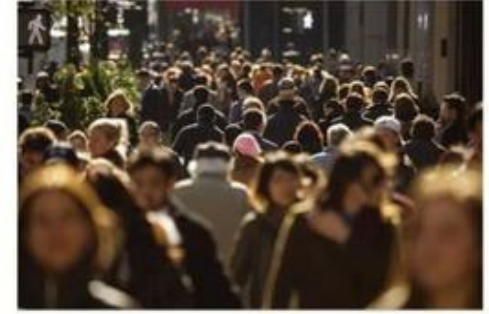
Think of concentration like the density of people in a crowded space. In a more crowded environment, people are more likely to bump into each other simply because there are more people in the same area. The same principle applies to particles in a chemical reaction.
When the concentration of a reactant increases, the rate of reaction typically becomes faster. This happens because:
- Higher concentration means more reactant particles occupy the same volume of space
- The particles are positioned closer together on average
- This proximity increases the collision frequency between particles
- More collisions per unit time means more effective collisions (assuming the same proportion are effective)
- Therefore, more product is formed in the same time period, increasing the reaction rate
Example
Practical Example: Marble Chips and Hydrochloric Acid
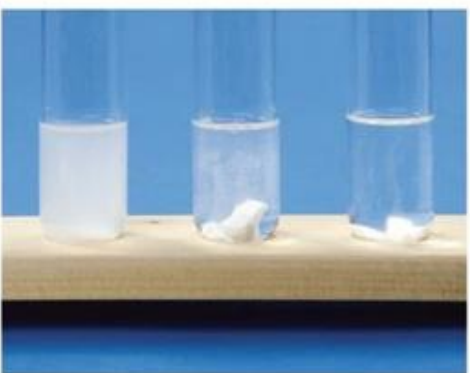
When marble chips (calcium carbonate) react with hydrochloric acid to produce carbon dioxide gas, using a more concentrated acid solution results in more rapid gas production.
The increased concentration of ions means more frequent collisions with the marble surface, accelerating the reaction. If you use twice the concentration of acid, you'll observe bubbles forming much more vigorously and the reaction completing in less time.
Pressure effects on gaseous reactions
When a gas is compressed into a smaller volume, its pressure increases along with an increase in reaction rate. The mechanism is similar to concentration effects:
- Compressing a gas into a reduced volume increases the pressure
- The same number of gas molecules now occupy less space
- The gas molecules are forced closer together
- This results in more frequent collisions between gas molecules
- More collisions lead to more effective collisions per unit time
- Therefore, the reaction rate increases
Note
The relationship between pressure and concentration in gases is direct: increasing pressure is equivalent to increasing concentration for gaseous reactants. Both achieve the same result - particles that are closer together and collide more frequently.
Methods for monitoring reaction progress
To determine the rate of a chemical reaction experimentally, you need to track how the reaction proceeds over time. This can be accomplished by:
- Monitoring the disappearance of a reactant (measuring the decrease in reactant concentration)
- Following the appearance of a product (measuring the increase in product concentration)
The choice of monitoring method depends on the physical and chemical properties of the substances involved. Measurable properties that can change as the reaction proceeds include:
- Volume of gas produced
- Mass of solid reactants or the reaction mixture
- Colour intensity
- Concentration (determined through titration or spectroscopy)
Reactions producing gaseous products
When a reaction generates a gas, two practical methods can be employed to measure the reaction rate:
- Gas collection method: Collecting and measuring the volume of gas produced at regular time intervals
- Mass loss method: Monitoring the decrease in mass of the reaction vessel as gas escapes
Note
Both the volume of gas produced and the mass lost are directly proportional to the amount of reactant consumed or product formed. Therefore, tracking either of these quantities with respect to time provides a valid measure of the reaction rate. Choose the method that best suits your equipment and the specific reaction you're studying.
Gas collection technique
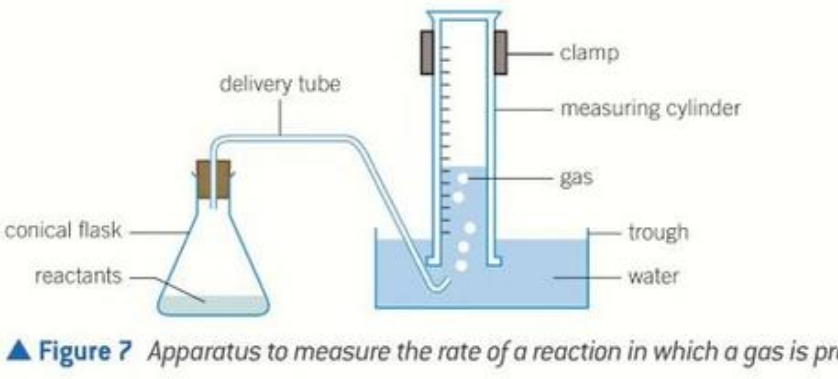
This technique is particularly useful for reactions that produce measurable quantities of gas. A practical example is the decomposition of hydrogen peroxide:
Experimental procedure:
- Add hydrogen peroxide solution to a conical flask and insert a bung with delivery tube
- Record the initial volume of gas in an inverted measuring cylinder positioned over a water trough
- Quickly add manganese dioxide () catalyst to the flask and replace the bung
- Start timing immediately
- Record the volume of gas collected at regular time intervals until the reaction is complete
- The reaction is finished when no more gas is produced
The gas produced displaces water in the inverted measuring cylinder, allowing the gas volume to be measured directly from the cylinder graduations.
Note
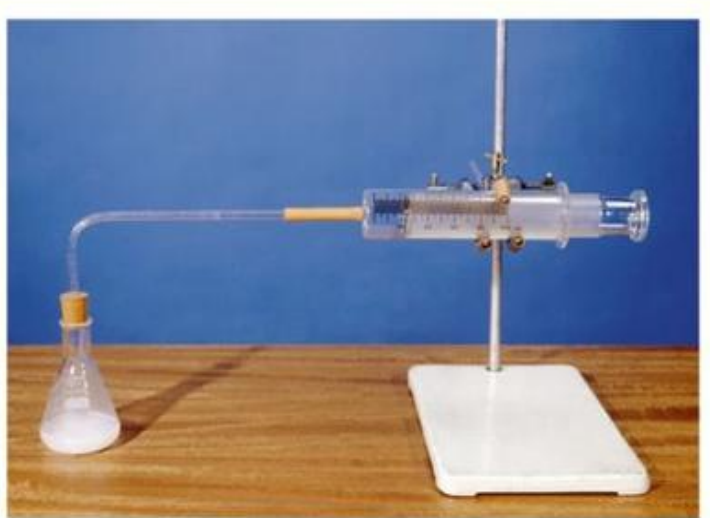
Alternative Apparatus: Gas Syringe
A gas syringe can replace the measuring cylinder for collecting gas. This apparatus often provides more precise volume measurements and is easier to read. Gas syringes are particularly useful for reactions that produce smaller volumes of gas or when you need greater accuracy in your measurements.
Calculating rate from gas volume data
Once you have collected volume-time data, you can determine the reaction rate by graphical analysis:
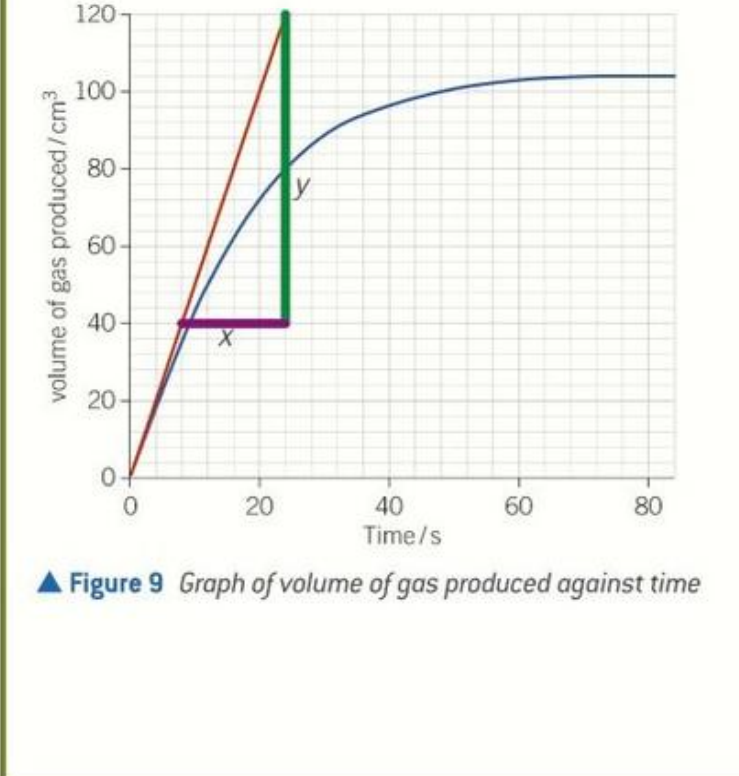
Step 1: Plot a graph with volume of gas produced (y-axis) against time (x-axis).
Step 2: To find the initial rate, draw a tangent to the curve at (the starting point).
Step 3: Calculate the gradient of this tangent line. The gradient represents the rate of reaction.
where is the vertical change and is the horizontal change along the tangent.
Example
Worked Example: Calculating Reaction Rate from Gas Volume
A student monitored the volume of oxygen gas produced during the decomposition of hydrogen peroxide. From the graph:
Initial rate calculation:
- Draw a tangent at (red line)
- Measure the vertical rise: cm³
- Measure the horizontal run: s
Rate at a specific time:
To determine the rate at any point during the reaction, draw a tangent at that specific time point. For example, after 24 s, the rate has decreased to approximately because reactants have been partially consumed.
Key observation: Notice how the rate decreases over time - this is a characteristic feature of most chemical reactions as reactants are used up.
Mass loss technique
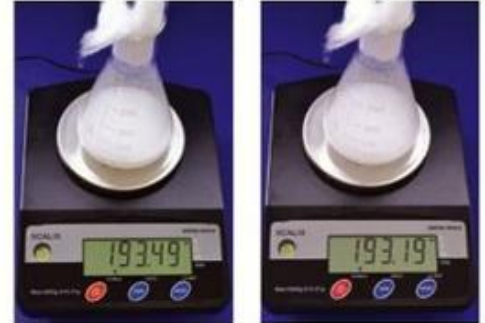
For reactions that produce a gas which can escape from the reaction vessel, monitoring mass loss provides another effective method for determining reaction rate.
Example reaction: The reaction between calcium carbonate (marble) and hydrochloric acid:
Experimental procedure:
- Place a conical flask containing the reactants on an electronic balance
- Allow the carbon dioxide gas to escape (flask left open)
- Record the initial mass of the flask and contents
- Record the mass at regular time intervals
- The reaction is complete when the mass stops decreasing (no more gas is being produced)
- Plot a graph of mass lost against time
Note
The mass decreases as carbon dioxide gas is released into the atmosphere. Since the gas is the only substance leaving the system, the mass loss directly corresponds to the amount of carbon dioxide produced. This makes the mass loss method particularly straightforward for interpretation.
Calculating rate from mass loss data
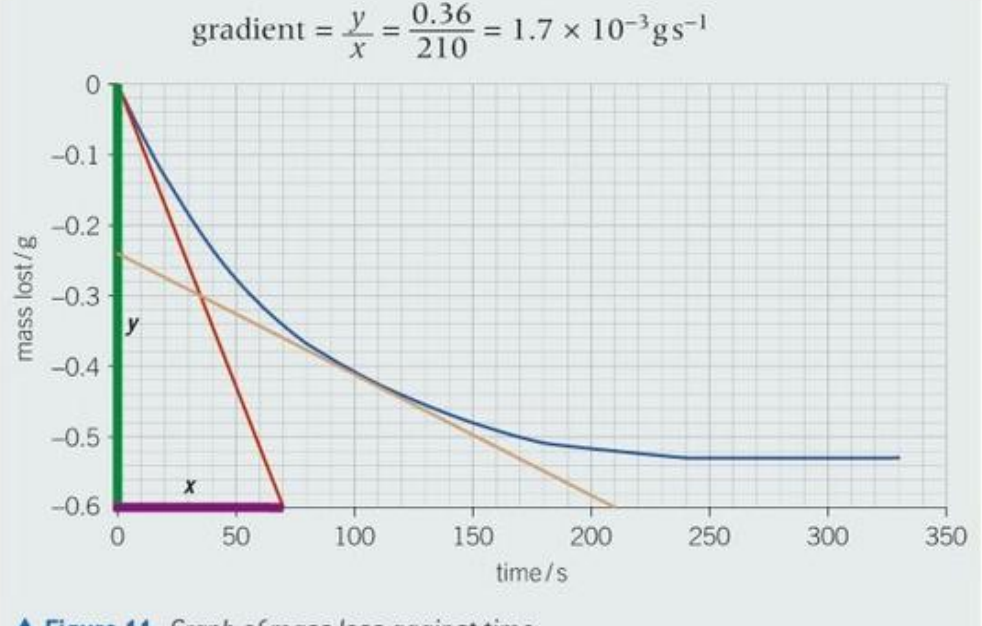
The procedure for calculating reaction rate from mass loss data mirrors that for gas volume:
Step 1: Plot mass lost (y-axis) against time (x-axis).
Step 2: Draw a tangent to the curve at to find the initial rate.
Step 3: Calculate the gradient of the tangent.
Example
Worked Example: Calculating Rate from Mass Loss
Initial rate calculation:
Rate after 100 s:
To find the rate at 100 s, draw a new tangent at that point (shown in orange on the graph):
Analysis: Notice that the rate after 100 s () is significantly slower than the initial rate (), demonstrating how the reaction rate decreases as reactants are consumed. The rate has decreased by approximately 80%, showing the dramatic slowdown that occurs as the reaction progresses.
Important practical considerations
Important
For gas collection experiments:
- Ensure the water level in the measuring cylinder starts close to zero on the scale for accurate readings
- Make sure all connections are airtight to prevent gas leakage
- Start timing as soon as the catalyst or second reactant is added
For mass loss experiments:
- The balance must be sensitive enough to detect small mass changes
- Ensure the flask is not completely sealed (gas must be able to escape)
- Keep the apparatus steady to avoid measurement fluctuations
General considerations:
- The tangent method provides an instantaneous rate at a specific point in time
- The gradient is steepest at the start, indicating the fastest rate
- As the curve flattens, the gradient decreases, showing the reaction is slowing down
- When the curve becomes horizontal, the gradient (and rate) is zero - the reaction is complete
Summary
Key Points to Remember:
-
The rate of reaction measures how quickly reactants are consumed or products are formed, with units of .
-
Reaction rates are fastest at the start when reactant concentrations are highest, then slow down as reactants are consumed, reaching zero when the reaction is complete.
-
According to collision theory, particles must collide with the correct orientation and sufficient energy (to overcome the activation energy) for a reaction to occur.
-
Increasing concentration of reactants or increasing pressure of gases causes particles to collide more frequently, leading to more effective collisions and a faster reaction rate.
-
Reaction rates can be determined experimentally by monitoring gas volume produced or measuring mass loss, then calculating the gradient of a tangent to the concentration-time or mass-time graph.