Circular flow of income (OCR A-Level Economics): Revision Notes
📚Revision Notes
1.1 Circular flow of income
DEFINITIONS:
- Leakages: where money flows out of the circular flow of income
- Injections: where money flows into the circular flow of income
- Gross Domestic Product (GDP): the total level of economic activity carried out in an economy in a given period of time
Explain:
- The circular flow of income, with injections and leakages It is a simplified, closed model of an economy, considering only 2 economic agents, firms and households. It assumes that all factors of production are owned and supplied to firms by households.
- Households provide factors of production (land, labour, capital, and entrepreneurship) to firms and receive income in return (wages, rent, interest, and profits).
- Firms produce goods and services, which households purchase, creating an expenditure flow. In this model, the total income received by households is spent on goods and services produced by firms, creating a continuous loop of economic activity.
| LEAKAGES | INJECTIONS |
|---|---|
| savings | investment expenditure |
| taxes | government expenditure |
| import expenditure | export expenditure |
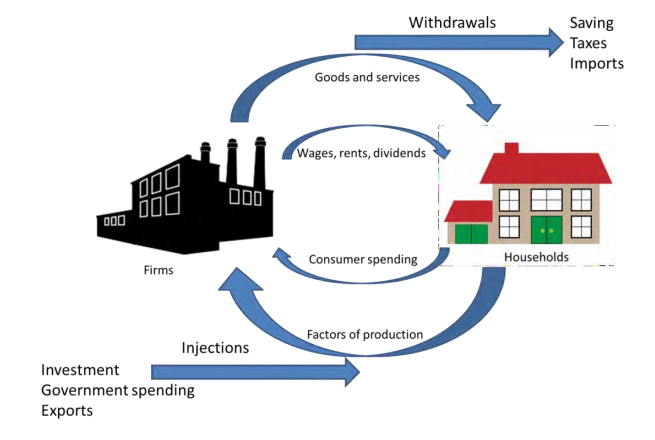
- The methods of measuring national income, output and expenditure There are 3 ways to measure GDP, represented in the circular flow of income:
| METHOD | EXPLANATION |
|---|---|
| Output | the total value of goods and services produced |
| Income | the total sum of income received (e.g. wages, rent, interest and profit) |
| Expenditure | the total sum of all expenditures made by individuals |
All 3 methods should provide the same answer where: output=income=expenditure