The interaction of aggregate demand and supply (OCR A-Level Economics): Revision Notes
📚Revision Notes
1.4 The interaction of AD and AS
Note
Aggregate Demand (AD)
Aggregate Demand is the total quantity of goods and services demanded across all levels of an economy at a particular price level and in a given time period. It is represented by the equation:
AD = C + I + G + (X - M) where:
- C is consumption
- I is investment
- G is government spending
- (X - M) is net exports (exports minus imports)
Note
Aggregate Supply (AS)
Aggregate Supply is the total output of goods and services that firms in an economy are willing and able to produce at a given price level in a given time period.
- Short-Run Aggregate Supply (SRAS): SRAS is upward sloping because higher prices can lead to higher profits and thus an increase in output.
- Long-Run Aggregate Supply (LRAS): LRAS is vertical, reflecting that in the long run, output is determined by the economy's resources, technology, and institutions, not by the price level.
Interaction of AD and AS
The interaction of AD and AS determines the equilibrium price level and output of the economy.
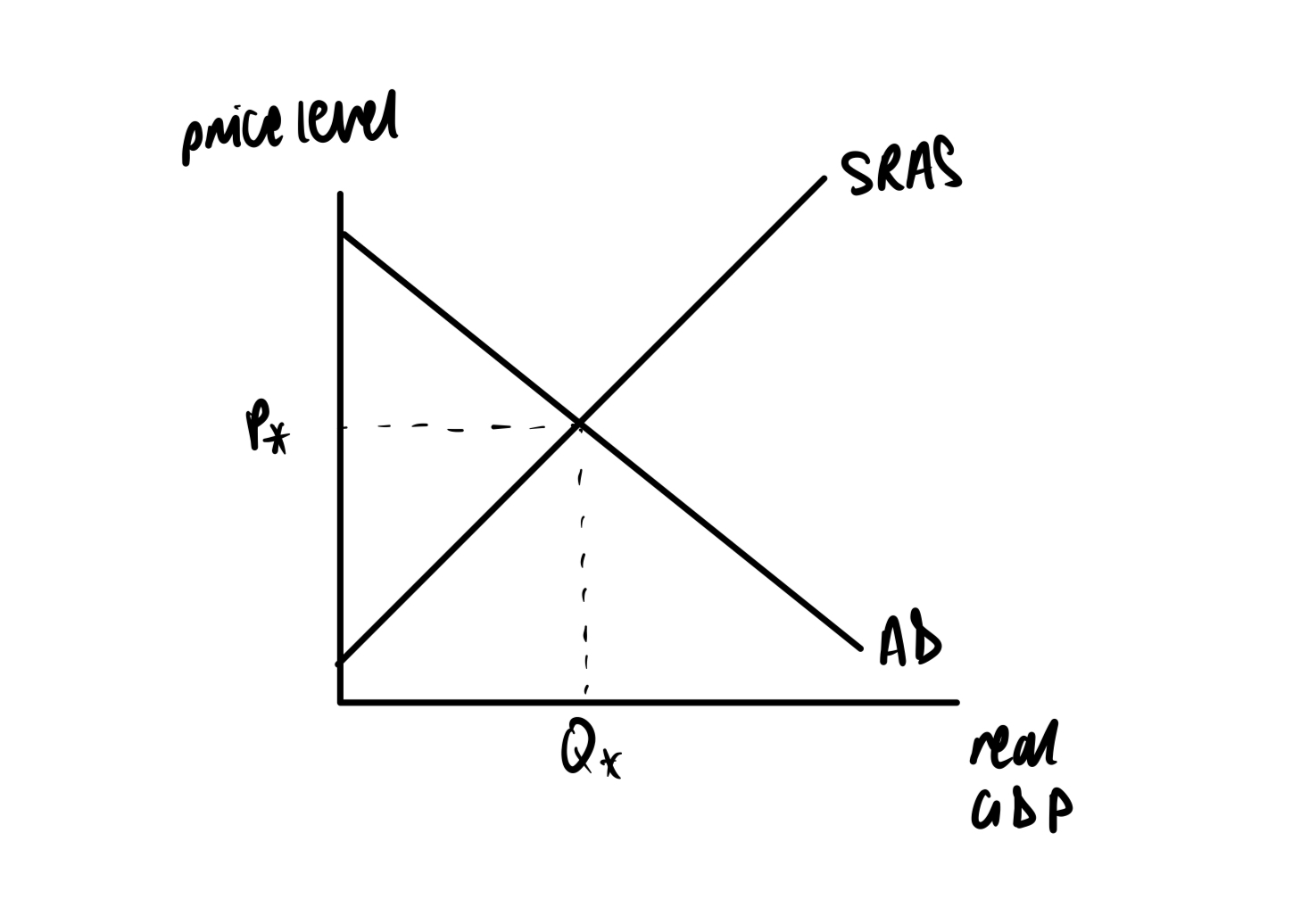
- Short-Run Equilibrium: Occurs where AD intersects SRAS. Changes in AD or SRAS shift the equilibrium:
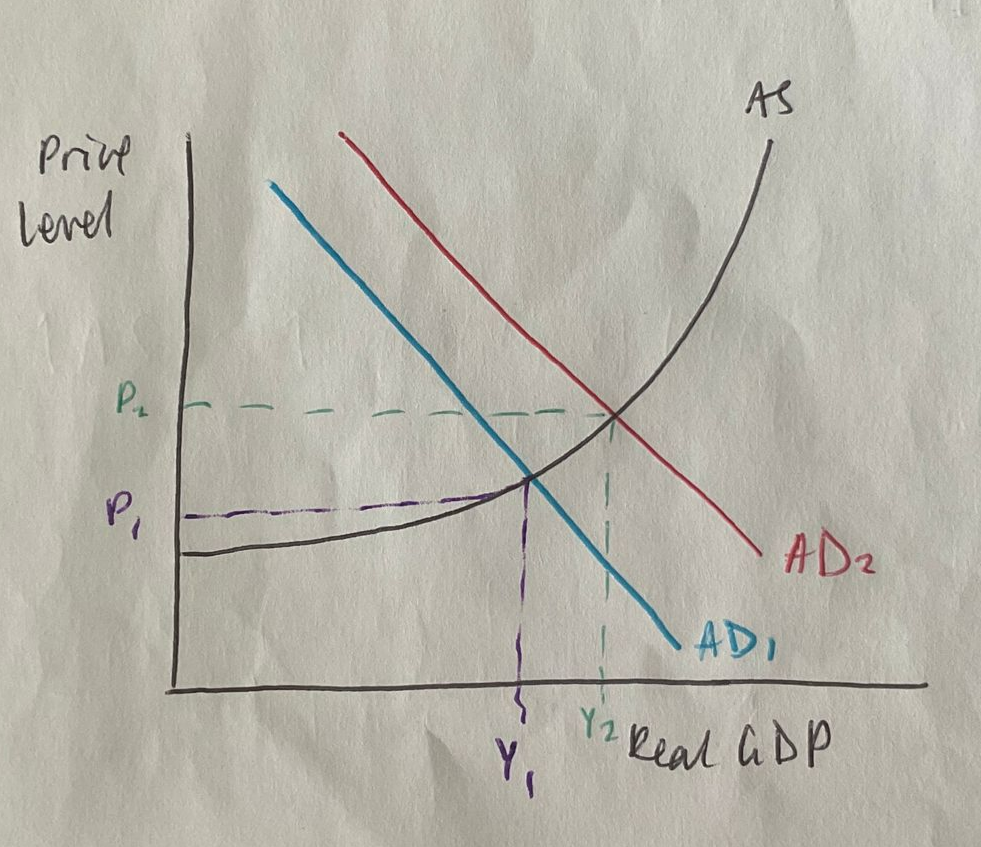
- An increase in AD (e.g., due to higher consumer confidence) shifts the AD curve right, leading to higher output and price level.
- An increase in SRAS (e.g., due to lower production costs) shifts the SRAS curve right, leading to higher output and a lower price level.
- Long-Run Equilibrium: Occurs where AD intersects LRAS. In the long run, output returns to the full employment level, potentially at different price levels:
- An increase in AD shifts the AD curve right. In the short run, this increases output and price level, but in the long run, output returns to the natural rate, and the price level remains higher.
- An improvement in productivity shifts the LRAS curve right, leading to higher output and potentially lower price levels, depending on AD changes.
Diagrams
-
AD and SRAS Diagram:
-
AD and LRAS Diagram:
Real-World Examples
Note
Great Recession (2008):
Note
COVID-19 Pandemic (2020):
Note
Oil Price Shocks: