Monetary policy (OCR A-Level Economics): Revision Notes
📚Revision Notes
3.2 Monetary policy
DEFINITIONS:
- Monetary Policy: Involves central banks altering the supply of money, exchange rates, and interest rates to influence macroeconomic performance.
- Symmetric Inflation Targeting: An inflation target where the central bank takes action when inflation rises above the target and takes action when inflation falls below the target.
- Asymmetric Inflation Targeting: An inflation target where the central bank takes action when inflation rises above the target only (e.g. European Central Bank).
- Liquidity Trap: Occurs when economic agents have a preference for holding cash or very liquid assets, meaning a cut in base interest rates will have little to no effect on aggregate demand (AD).
- Quantitative Easing: When the central bank electronically prints money and uses it to buy government bonds and corporate bonds to increase the money supply in the economy and lower interest rates.
- Money Supply: Money in circulation in the economy.
Explanation with the aid of a diagram
3.2.1 Changes in Interest Rates
Interest rates are the cost of borrowing money and the return for saving money. They play a crucial role in the economy, influencing consumer spending, business investment, inflation, and economic growth. Central banks, such as the Bank of England, adjust interest rates to manage economic stability.
Effects of Changes in Interest Rates:
Note
- Consumer Spending and Saving:
- Higher Interest Rates: Increase the cost of borrowing and the return on savings, leading to reduced consumer spending and increased saving.
- Lower Interest Rates: Decrease the cost of borrowing and the return on savings, leading to increased consumer spending and reduced saving.
- Business Investment:
- Higher Interest Rates: Increase the cost of financing for businesses, leading to reduced investment in capital projects.
- Lower Interest Rates: Decrease the cost of financing, leading to increased business investment.
- Inflation:
- Higher Interest Rates: Tend to reduce inflation by decreasing demand.
- Lower Interest Rates: Tend to increase inflation by boosting demand.
- Economic Growth:
- Higher Interest Rates: Can slow down economic growth by reducing consumption and investment.
- Lower Interest Rates: Can stimulate economic growth by encouraging consumption and investment.
Diagram:
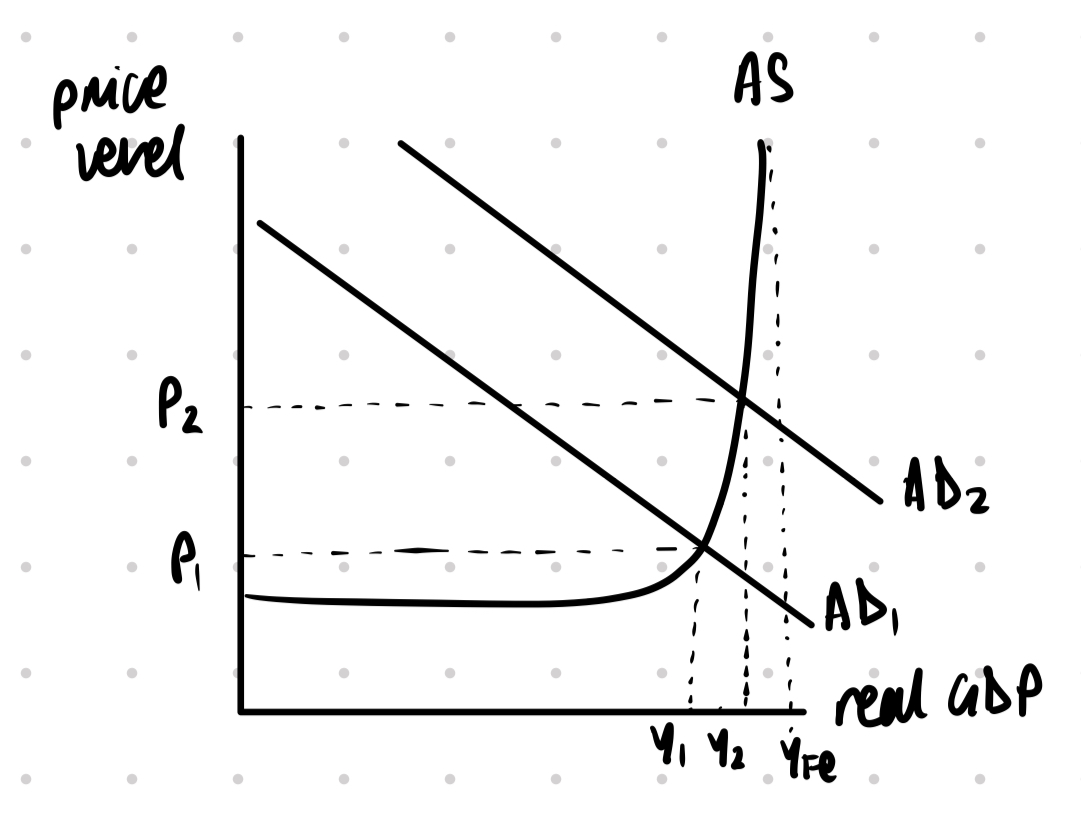
AD1 to AD2 (Shift Right): This shift represents a decrease in interest rates. Lower interest rates reduce the cost of borrowing, increasing consumer spending and business investment, thus shifting AD to the right.
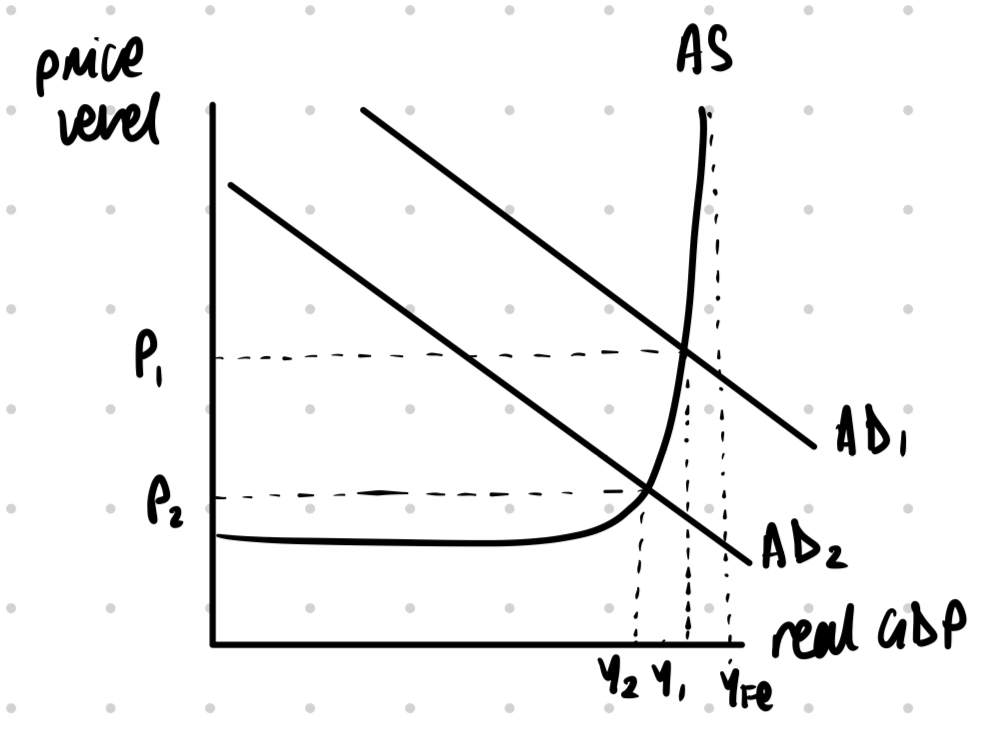
AD1 to AD2 (Shift Left): This shift represents an increase in interest rates. Higher interest rates increase the cost of borrowing, reducing consumer spending and business investment, thus shifting AD to the left.
Note
- Lower Interest Rates: Lead to increased borrowing, higher consumption and investment, a rightward shift in AD, and potential economic growth.
- Higher Interest Rates: Lead to reduced borrowing, lower consumption and investment, a leftward shift in AD, and potential slowing of economic growth.
Note
Understanding the impact of interest rate changes is crucial for policymakers to manage economic stability and growth effectively.
3.2.2 Changes in Money Supply
Explanation:
The money supply in an economy refers to the total amount of money available in the economy at a particular point in time. Changes in the money supply can have significant effects on various economic variables, such as interest rates, inflation, and economic growth. Central banks, such as the Federal Reserve in the United States or the Bank of England in the UK, control the money supply through monetary policy tools like open market operations, the discount rate, and reserve requirements.
Key Effects of Changes in Money Supply:
Note
Inflation:
Note
Interest Rates:
Note
Economic Growth:
Diagram:
To illustrate the effect of changes in the money supply, consider the Money Market diagram with the money supply and money demand curves.
Note
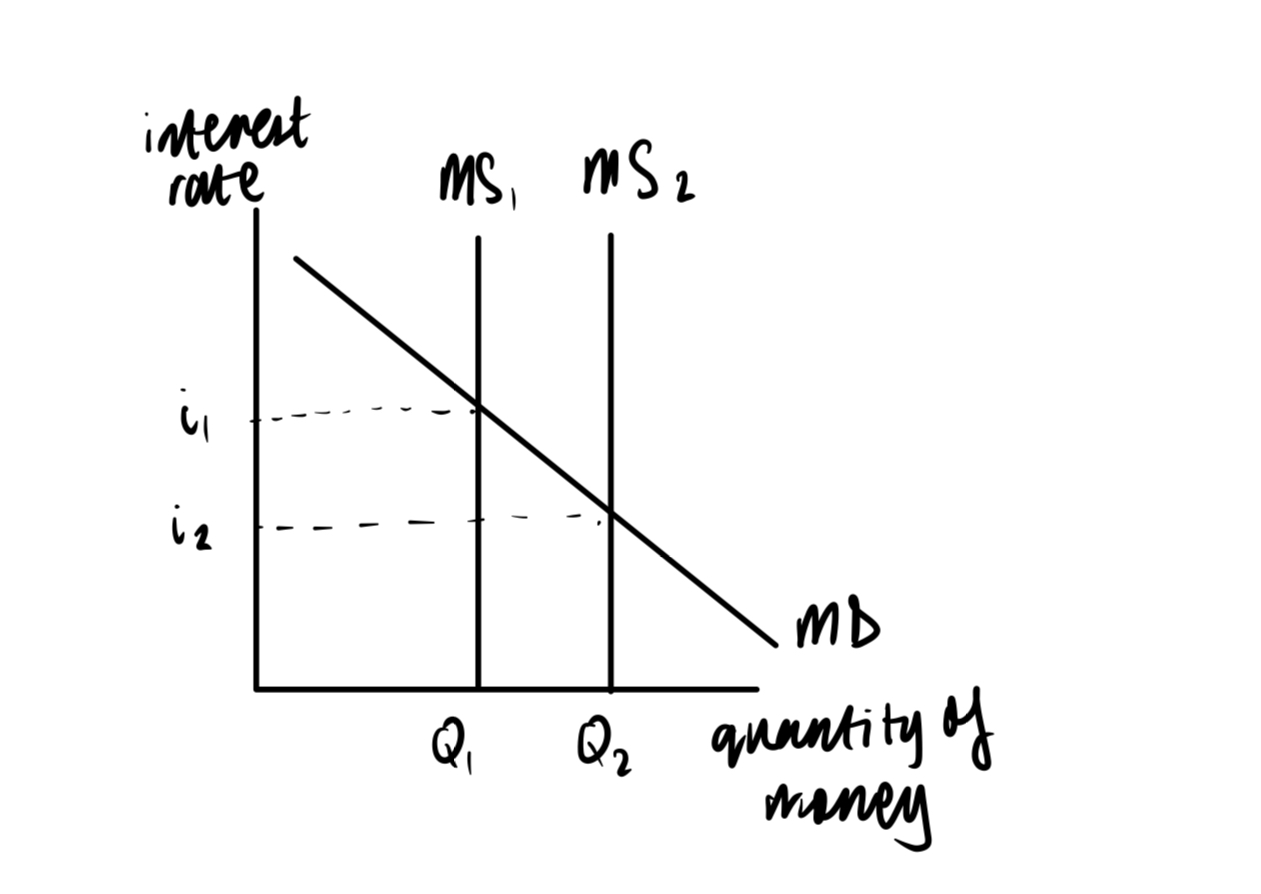
Money Supply Curve (MS): The vertical lines MS1 and MS2 represent the money supply in the economy. It is vertical because the money supply is assumed to be controlled by the central bank and is fixed at any given point. Interest Rate (i): The y-axis represents the interest rate.
Quantity of Money (Q): The x-axis represents the quantity of money in the economy.

Note
Changes in Money Supply:
- Initial Equilibrium: The economy is initially at equilibrium where MS1 intersects the money demand curve (not shown here for simplicity).
- Increase in Money Supply: When the central bank increases the money supply from MS1 to MS2, the supply of money shifts to the right.
- Effect on Interest Rates: This increase in money supply leads to a decrease in the interest rate, from i1 to i2.
- Effect on Spending and Investment: Lower interest rates encourage more borrowing and spending, stimulating economic activity.
By understanding these dynamics, economists and policymakers can predict and manage the effects of changes in the money supply on the broader economy.
3.2.3 Inflation Rate Targets
Note
Explanation: Inflation rate targets are set by central banks to achieve price stability in the economy. A common target is around 2%, which is considered low and stable enough to avoid the negative effects of both high inflation and deflation. The main objectives of setting an inflation target include: 5. Price Stability: Ensures the purchasing power of money remains stable. 6. Economic Stability: Provides a predictable environment for investment and consumption decisions. 7. Anchoring Expectations: Helps anchor inflation expectations, reducing uncertainty. 8. Credibility: Enhances the credibility of the central bank's monetary policy. Central banks use various tools, primarily interest rates, to control inflation. By raising interest rates, borrowing becomes more expensive, reducing spending and investment, which in turn can lower inflation. Conversely, lowering interest rates can stimulate spending and investment, increasing inflation.
Note
Central Bank Actions:
- If inflation is above the target: The central bank may raise interest rates to cool down the economy.
- If inflation is below the target: The central bank may lower interest rates to stimulate the economy. Setting an inflation target is a critical component of monetary policy, guiding the central bank in its efforts to maintain economic stability and foster a healthy economic environment.
3.2.4 Quantitative Easing (QE)
Quantitative Easing (QE) is a monetary policy tool used by central banks to stimulate the economy when conventional monetary policy has become ineffective. QE involves the central bank purchasing long-term securities, such as government bonds and mortgage-backed securities, to increase the money supply and lower interest rates.
Objectives of QE:
- Increase Money Supply: By buying securities, the central bank injects money directly into the economy, increasing the money supply.
- Lower Interest Rates: QE aims to lower long-term interest rates, making borrowing cheaper for businesses and consumers.
- Stimulate Economic Activity: Lower interest rates encourage spending and investment, which can boost economic growth and employment.
Mechanism of QE:
- Asset Purchases: The central bank creates money electronically and uses it to buy long-term securities from financial institutions.
- Increased Bank Reserves: The purchase of these securities increases the reserves of the banks, enabling them to lend more.
- Lower Yields on Securities: The increased demand for these securities raises their prices and lowers their yields (interest rates).
- Spill over Effects: Lower yields on government bonds lead investors to seek higher returns in other assets, such as corporate bonds and stocks, which can reduce borrowing costs for businesses and increase wealth effects.
Diagram:
Below is a simplified diagram illustrating the effects of QE:
Note
Explanation of the Diagram:
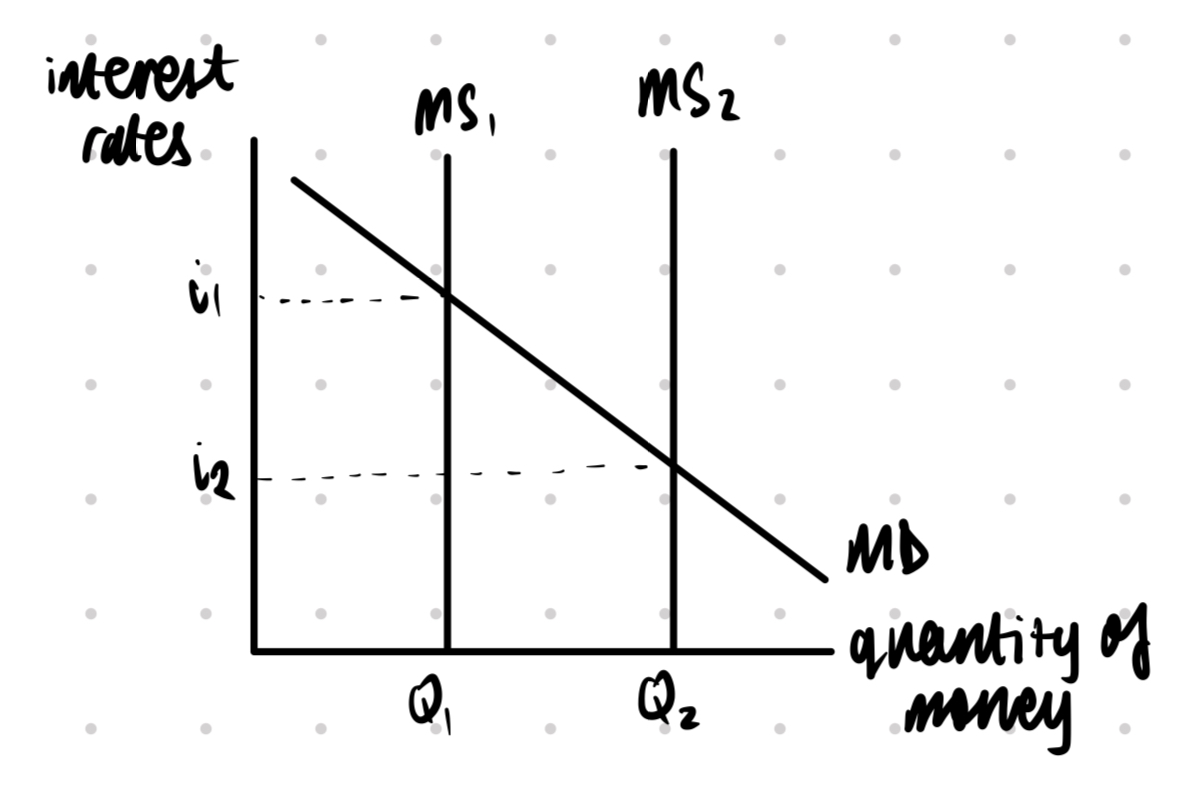
- Initial State (S1): The initial money supply curve (S1) intersects the demand curve (not shown) at interest rate i1 and quantity of money Q1 .
- Effect of QE (S2): QE shifts the money supply curve from S1 to S2, increasing the quantity of money from Q1 to Q2.
- Lower Interest Rates (i2): The increased money supply lowers the interest rate from i1 to i2
Summary:
Quantitative Easing (QE) involves central banks purchasing long-term securities to increase the money supply and lower interest rates. This policy aims to stimulate economic activity by making borrowing cheaper and encouraging spending and investment. The diagram illustrates how QE shifts the money supply curve, increasing the quantity of money and reducing interest rates.
3.2.5 Influence of Exchange Rates
Exchange rates represent the value of one currency in terms of another currency. They play a crucial role in international trade and investment, affecting the prices of goods, services, and assets between countries.
Key Concepts:
- Appreciation: When the value of a currency rises relative to another currency.
- Depreciation: When the value of a currency falls relative to another currency.
Influence on the Economy:
Note
- Exports and Imports:
- Appreciation: Makes a country's exports more expensive and imports cheaper.
- Exports: Demand for exports decreases as they become more expensive for foreign buyers.
- Imports: Demand for imports increases as they become cheaper for domestic consumers.
- Depreciation: Makes a country's exports cheaper and imports more expensive.
- Exports: Demand for exports increases as they become cheaper for foreign buyers.
- Imports: Demand for imports decreases as they become more expensive for domestic consumers.
- Inflation:
- Appreciation: Reduces inflation as cheaper imports lower the cost of goods and services.
- Depreciation: Increases inflation as more expensive imports raise the cost of goods and services.
- Economic Growth:
- Appreciation: Can slow down economic growth due to reduced export demand.
- Depreciation: Can stimulate economic growth by boosting export demand.
- Foreign Investment:
- Appreciation: May attract foreign investment as the value of returns in the domestic currency increases.
- Depreciation: May deter foreign investment as the value of returns in the domestic currency decreases.
Diagram:
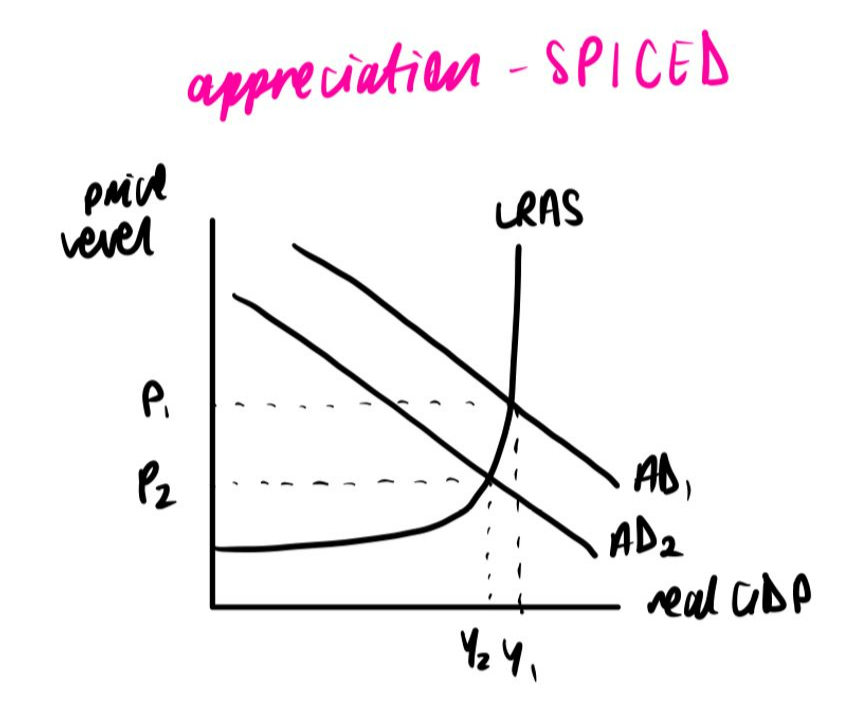
The diagram below illustrates the effect of currency appreciation and depreciation on the aggregate demand (AD) curve.
AD1 to AD2: Appreciation shifts the AD curve to the left (AD1 to AD2), leading to a lower price level and a decrease in real GDP.
Note
SPICED acronym
Strong
Pound
Imports
Cheap
Exports
Dear (expensive)
Currency Appreciation:
Currency Depreciation:
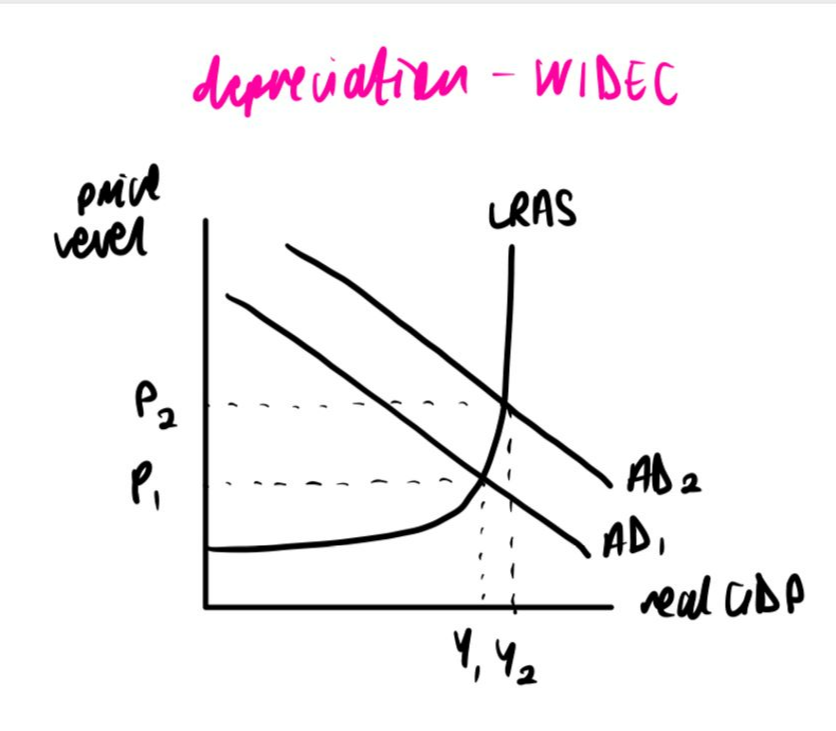
AD1 to AD2: Depreciation shifts the AD curve to the right (AD1 to AD2), leading to a higher price level and an increase in real GDP.
Note
WIDEC acronym
Weak pound
Imports
Dear (expensive)
Exports
Cheap